






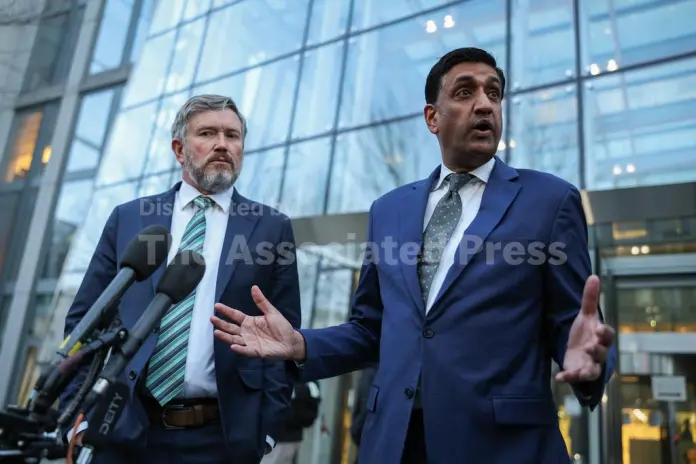
The House is expected to vote a second time to force the release of the files related to convicted sex offender Jeffrey Epstein, after Reps. Thomas Massie (R-KY) and Ro Khanna (D-CA) secured the necessary GOP signatures to force a vote.
The sequel act to the duo’s first resolution forcing the release of the Epstein files comes 10 months after President Donald Trump signed the first into law. The vote, however, won’t happen until after the November elections, when the House returns to session.
The discharge petition currently sits at 216 out of the 218 necessary signatures to trigger a vote, but the final two signatures are expected to be delivered by Democrats when the House returns.
Massie and Khanna’s first bill forcing the release of the Epstein files, the Epstein Files Transparency Act, compelled the Justice Department to release its investigation into Epstein in its entirety.
However, Massie and Khanna have accused the DOJ of withholding millions of files related to Epstein in violation of the first resolution.
The Epstein Files Transparency Act II gives state attorneys general, survivors, and members of Congress the ability to sue the U.S. attorney general to demand disclosure of the remaining documents.
Khanna told CNN that survivors “still don’t have access to millions of documents that have been covered, and there have not been prosecutions here in the United States. And a lot of these state attorneys general want to prosecute, and this bill would allow them to do so.”
The new proposed amendment to the first transparency act would also give victims entitlement to receive unredacted records relating to themselves from the DOJ. Redactions pertaining to other victims’ identifiable information would still be allowed, however.
Massie has claimed the second Epstein files bill was written with the advice and counsel of the survivors’ lawyers and the New Mexico attorney general “to ensure it will provide the tools needed to provide closure for survivors and convictions of the perpetrators.”
The legislation would also close a loophole left by the first resolution, in which Massie argues Attorney General Todd Blanche is withholding documents using “deliberative process privilege.”
“They say we owe you our final production, but we don’t have to give you our decisions and our homework,” Massie told CNN. “But the Epstein Files Transparency Act that we wrote says that you have to give us those internal memos about decisions on whether to prosecute, whether to investigate, because that’s central to this whole thing.”
He continued, “What we do in the new bill is we say, when we said you have to tell us about your decisions, that covered deliberative process privilege. But we’re saying it explicitly in this bill. You can’t assert that deliberative process privilege.”
The DOJ has released millions of documents related to the investigation into Epstein, including material that spans decades of federal investigative work and includes evidence seized from the deceased financier’s devices.
CONGRESS SET TO DEAL WITH A MASSIE-SIZED HEADACHE AFTER MIDTERM ELECTIONS
There is currently a lawsuit against the DOJ pertaining to the release of certain documents in the DOJ’s investigation, with Blanche having until Sept. 24 to provide the records or explain why the court’s orders were not “clear and unambiguous.”
The DOJ has said it did not publish the handwritten notes as they were “properly withheld because they are ‘substantially similar to’ and therefore duplicative of the typewritten reports.”
Continue reading...
[ H/T Washington Examiner ]