


Nikole Hannah-Jones, creator of the “1619 Project,” recently scored rare bipartisan plaudits. It was a marked departure from the criticism the 2019 New York Times editorial package received from eminent historians and others, over its assertion that a primary motivation for the American Revolution was the protection of slavery from British emancipation threats.
Now, Hannah-Jones is earning praise for a Sept. 20 New York Times mea culpa about her daughter’s educational path. The author admits sending her daughter to some of New York City’s worst schools in the name of antiracism did not, in fact, solve a “separate and unequal school system.”
Hannah-Jones is correct to repent for sacrificing her daughter’s education for the sake of politics and declare that the worst public schools can’t simply be saved with one privileged parent. Still, Hannah-Jones builds her essay on the back of a fundamental lie: that poor and nonwhite students are disproportionately trapped in atrocious schools because of racial segregation and a lack of resources.
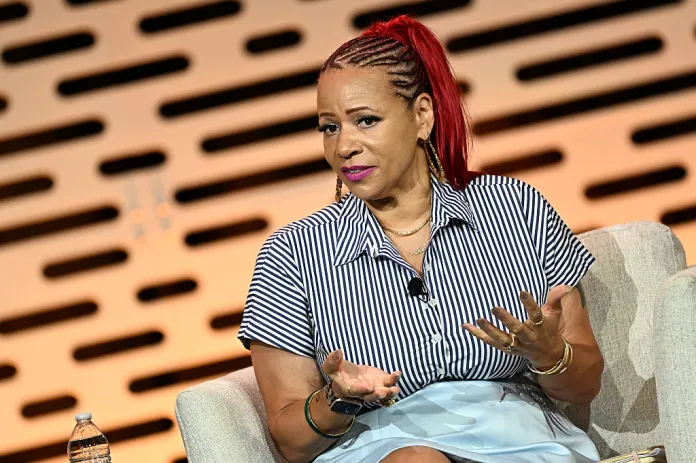
Nikole Hannah-Jones speaks onstage during “The New Power Structure: Black Politics in the Age of Resistance” panel during the 2026 National Association Of Black Journalists Convention at Atlanta Marriott Marquis on August 13, 2026 in Atlanta, Georgia. (Photo by Paras Griffin/Getty Images)
" data-large-file="https://www.washingtonexaminer.com/wp-content/uploads/2026/09/GettyImages-2291010089.jpg?w=696" src="https://www.washingtonexaminer.com/wp-content/uploads/2026/09/GettyImages-2291010089.jpg?w=696" alt="Nikole Hannah-Jones speaks onstage during "The New Power Structure: Black Politics in the Age of Resistance" panel during the 2026 National Association Of Black Journalists Convention at Atlanta Marriott Marquis on August 13, 2026 in Atlanta, Georgia. (Photo by Paras Griffin/Getty Images)" class="wp-image-4742465" style="width:871px;height:auto" srcset="https://www.washingtonexaminer.com/wp-content/uploads/2026/09/GettyImages-2291010089.jpg 1024w, https://www.washingtonexaminer.com/.../09/GettyImages-2291010089.jpg?resize=300,200 300w, https://www.washingtonexaminer.com/.../09/GettyImages-2291010089.jpg?resize=768,512 768w, https://www.washingtonexaminer.com/.../09/GettyImages-2291010089.jpg?resize=150,100 150w, https://www.washingtonexaminer.com/.../09/GettyImages-2291010089.jpg?resize=696,464 696w" sizes="(max-width: 1024px) 100vw, 1024px">
Nikole Hannah-Jones speaks onstage during “The New Power Structure: Black Politics in the Age of Resistance” panel during the 2026 National Association Of Black Journalists Convention at Atlanta Marriott Marquis on Aug. 13, 2026 in Atlanta, Georgia. (Paras Griffin/Getty Images)
“In New York, a combination of housing segregation and ‘academic’ sorting, called school choice, that begins as early as pre-K means most Black students — even middle-class ones — are forced to attend racially segregated schools with high rates of poverty. And nationally, schools in predominantly nonwhite districts receive $23 billion less in annual funding than their heavily white counterparts,” writes Hannah-Jones. Although she concedes that her involvement with her daughter’s schools and donating “checks that exceeded the annual P.T.A. budget” did not solve the problem, Hannah-Jones somehow maintains that resources are the cause.
Hannah-Jones conveniently ignores the $121 billion in federal funding that is intentionally redistributed from high earners and toward poor school districts. The Brookings Institution found that in 2020, the schools with the highest share of child poverty spent 28% more per pupil than average. And those with the highest share of nonwhite students spent 31% more per pupil than average. Hannah-Jones’s daughter’s elementary school spends nearly three times as much per pupil as the national average.
A questionable assertion about school spending
One glance at New York City’s eight specialized high schools, which admit students based solely on a rigorous entrance exam, would prove that Hannah-Jones is correct about a lack of diversity. But far from being “white privilege,” most of these schools have a majority Asian student body. And at all but two of the eight, a majority of the students are classified as economically disadvantaged.
Buried within Hannah-Jones’s lamentation are the actual factors that fuel failure in public schools: the bigotry of low expectations. Hannah-Jones details how her daughter was given straight A’s in algebra while failing to master rudimentary skills such as fractions and assignments that were never actually graded. Hannah-Jones tries to justify her daughter’s middle school banning homework by claiming that “studies show it does not have much impact on academic achievement, and that assigning it often sets up for failure students who are so academically behind that they cannot do the work on their own.”
But that latter consequence — failure — is sometimes exactly what children need to actually learn. Look no further for proof at the Mississippi Miracle.
Up until about a decade and a half ago, Mississippi ranked close to last on the benchmark National Assessment of Educational Progress. But the 2013 Literacy-Based Promotion Act forced the state to return to phonics and reject the discredited “whole language” approach to literacy, begin testing literacy from kindergarten on so parents can be notified if students are beginning to fall behind, and force students to repeat third grade if they don’t pass that year’s reading test. The teaching philosophy mattered for reading in particular, but the overall approach of repeat testing and ending the automatic promotion of unqualified students revolutionized achievement across disciplines.
Now, adjusted for demographics to account for the fact that Mississippi is very poor and nonwhite, the state boasts the highest NAEP scores in reading and math of any other state. Black fourth graders have higher reading scores in Mississippi than they do in 47 other states, despite all 47 other states being wealthier.
Mississippi’s success is all the more astounding given the country’s overall collapse in education scores. According to our international PISA test scores just released, the United States is at or near a record low for reading and math, with math performance now below the OECD average. Seeing as Mississippi spends a third as much per pupil as New York, the solution is not to throw money at the problem, but rather to restore educators’ right (and duty) to discipline, test, and fail students when necessary.
Liberal stubbornness over proven education reforms
Hannah-Jones’s refusal to acknowledge the importance of test scores is an ongoing motif in her writing. When she celebrated her daughter’s middle school graduation with the grim claim that she’s “not worth more than any other child,” Hannah-Jones said it wasn’t fair to “judge” a failing school by “test score metrics.”
More likely, she doesn’t really believe that drivel. The obstacle to Mississippi-style reforms, as illustrated by Rachel Canter earlier this month in the Wall Street Journal, is the teachers unions. Canter found that state uptake of Mississippi-style literacy policies inversely correlates with teacher union strength.
WHY NIKOLE HANNAH-JONES IS WRONG ABOUT FAILING SCHOOLS
Teachers unions may not want meritocratic reforms, but you know who does seem to crave them? Many teachers themselves. A 2025 Fordham Institute study found that teachers oppose “equitable” grading and teaching policies, such as no homework or late penalties by a double-digit margin, and the higher-education website Intelligent.com found that over a third of teachers who gave a student lower grades than they wanted were reprimanded or fired.
Education reform must disenfranchise teachers unions and empower teachers to discipline, suspend, and fail students. Any status quo that allows teachers to hold nonwhite students to lower standards is indeed racist. Just not in the way Hannah-Jones wants to admit.
Tiana Lowe Doescher (@TianaTheFirst) is an economics columnist for the Washington Examiner.
Continue reading...
[ H/T Washington Examiner ]