






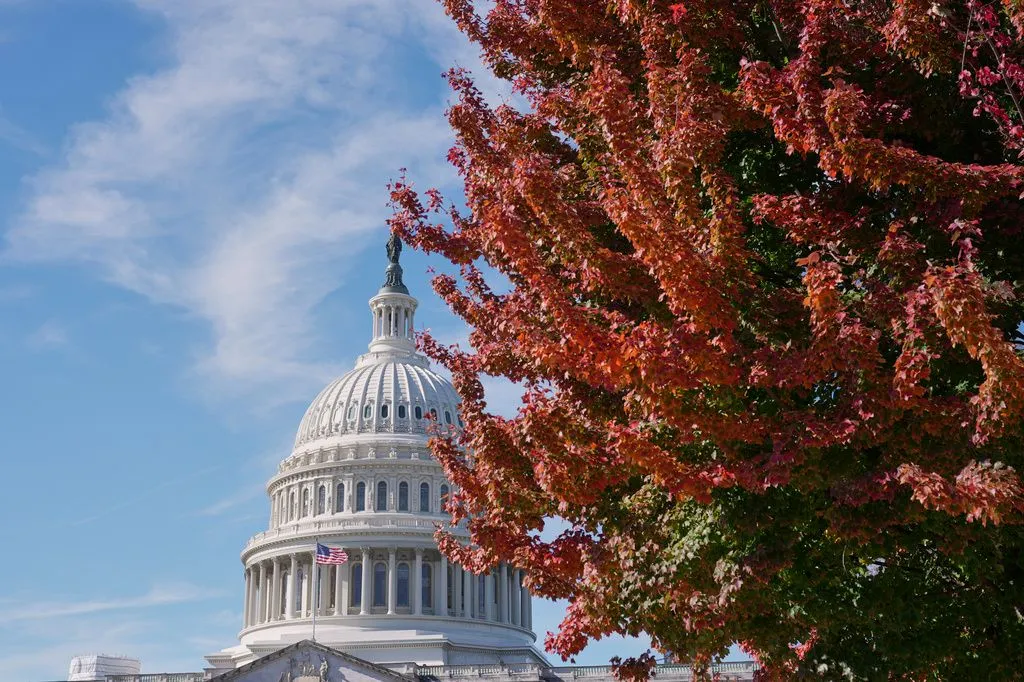
The 2026 midterm elections did more than hand Democrats control of the Senate. They reshaped the political landscape heading into 2028, leaving Republicans with a difficult path back to the majority.
Alaska’s Senate race, the final of the 2026 cycle, was called Tuesday evening, cementing a 56-44 Democratic majority in the 120th Congress’s upper chamber. The nine-seat swing is a devastating reversal for Republicans, who entered the election with a 53-47 majority.
The results suggest the Republican Party has significant political ground to recover before the next presidential election. Voters’ concerns about affordability, opposition to the Iran war, and dissatisfaction with President Donald Trump appear to have undermined GOP candidates across a range of states.
If those political conditions persist, Republicans could find themselves fighting to prevent Democrats from expanding their majority even further in 2028.
The stakes are particularly high because of the number of Republican-held seats up for reelection. Republicans will have to defend 19 seats in 2028, compared with 16 Democratic-held seats. To reclaim control, the GOP will need to make substantial gains while protecting its own vulnerable incumbents. The GOP needs to flip at least six seats to reclaim a majority.
Republicans could be eyeing Democratic-held seats in Arizona, Nevada, Georgia, and Pennsylvania, represented by Sens. Mark Kelly (D-AZ), Catherine Cortez Masto (D-NV), Raphael Warnock (D-GA), and John Fetterman (D-PA), respectively. At the same time, Republicans will have to defend potentially competitive seats held by Sens. Ron Johnson (R-WI) and Ted Budd (R-NC).
Republicans would need to make significant inroads in the Democratic-held states while preventing losses in their own territory. A repeat of the 2026 results would make that task considerably more difficult.
Before Election Day, the Cook Political Report identified six Senate races as toss-ups: Alaska, Iowa, Kansas, Maine, Ohio, and Texas. Democrats emerged victorious in all of those contests, including several states that Republicans have grown accustomed to winning comfortably.
Kansas offered perhaps the clearest illustration of the political shift. Democrat Adam Hamilton defeated Republican Sen. Roger Marshall (R-KS), giving the state its first Democratic senator since 1932. The result represented a 21-point swing toward Democrats compared with the 2024 presidential election.
North Carolina delivered another major shock to Republicans. Former Gov. Roy Cooper became the first Democrat elected to the state’s Senate delegation since 2008, defeating his Republican opponent in a 22-point swing toward Democrats. Every county in the state shifted in the Democratic direction compared with 2024.
Florida, meanwhile, provided a more complicated picture. Republican Sen. Ashley Moody (R-FL) defeated progressive Democrat Angie Nixon by fewer than 3 percentage points, despite facing an underfunded opponent. Because the contest was a special election, Moody will have to defend the seat again in 2028.
The results also offer a contrast with the 2024 election, when Republicans captured four Democratic-held seats in Pennsylvania, Ohio, Montana, and West Virginia to take control of the Senate.
Some of those victories were more predictable than others. Republicans’ takeover of West Virginia following former Sen. Joe Manchin’s retirement and their victory in Montana were widely anticipated. But Bernie Moreno’s defeat of longtime Democratic Sen. Sherrod Brown in Ohio and Sen. Dave McCormick’s narrow victory over former Sen. Bob Casey in Pennsylvania represented more significant Republican breakthroughs.
The scale of the Democratic victory also raises a longer-term question about the Senate filibuster.
Democrats hold 56 Senate seats next Congress, putting them four short of the 60 votes needed to overcome a filibuster. If the political trends seen in 2026 continue into 2028, Democrats could have an opportunity to reach that threshold, potentially giving the party significantly more power to advance its legislative agenda without Republican support.
Such an outcome is far from guaranteed. The 2028 presidential race will likely shape the political environment, while the economy, inflation, and the next administration’s approval ratings could all change the electoral calculus.
Republicans also have two years to recalibrate their messaging and attempt to regain voters’ confidence.
The GOP’s current standing offers little reassurance. RealClearPolitics polling averages between Sept. 1 and Nov. 9 put the Republican Party’s favorability at 37.2%, compared with 57.6% unfavorable.
JENSEN HUAG WILL TESTIFY BEFORE HOUSE FOREIGN AFFAIRS COMMITTEE, INTELLIGENCE COMMITTEE ON AFFAIR WITH SUSPECTED SPY
Republicans will also have to determine how to rebuild their Senate campaign operation. Sen. Bernie Moreno (R-OH) and his team have already interviewed several candidates to be the next executive director of the National Republican Senatorial Committee, according to Politico.
The 2026 results do not guarantee another blue wave in 2028. But Democrats have moved back the starting line for the GOP.
Continue reading...
[ H/T Washington Examiner ]