

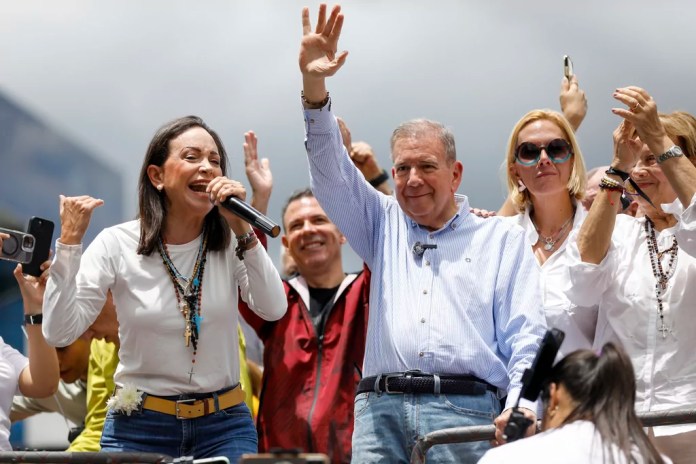
Maria Corina Machado wants a voting day. So does Diosdado Cabello. Their apparent agreement should worry anyone who thinks Venezuela’s next election will end Chavismo.
In an interview with the Financial Times published Oct. 9, Machado said there is “more than enough time” to prepare for a presidential election by July 2027. She called for transparency over oil proceeds overseen by Washington and said both countries share one goal: to “turn Venezuela into a stable democracy.” Ten months after Nicolás Maduro’s capture, the question is whether anyone will name the day.
Here is the problem. Venezuela had a vote on July 28, 2024. It did not have a credible election.
The National Electoral Council declared Maduro the winner without publishing precinct results, while opposition tally sheets showed Edmundo Gonzalez winning decisively. The Supreme Tribunal of Justice endorsed the disputed result, having already upheld Machado’s exclusion from office. Millions of Venezuelans abroad faced voting obstacles. The date was real, but the machinery was rigged.
Now look at who controls that machinery.
Cabello remains minister of Internal Relations, Justice and Peace, overseeing the police and internal security apparatus. As secretary-general of the ruling PSUV, he also influences its nationwide organization. Washington offers a $25 million reward for information leading to his arrest or conviction on narcoterrorism charges. Yet he is not hiding. He has met with U.S. officials, and his profile is Gotti-like.
He is not hiding from an election either. He is asking for one.
“If they tell us the elections are tomorrow, let’s hold elections tomorrow,” he told party members in September, adding that Chavismo does not like the silver medal. His confidence does not rest on public opinion. It rests on who controls the institutions surrounding the vote.
The real test is not whether chavismo permits an election. It is whether chavismo can lose one and surrender power.
Cabello need not falsify another tally. A government controlling the police, courts, and electoral authorities can shape the contest before voting begins. It can intimidate opponents, restrict candidates, manipulate registration, and challenge unfavorable results afterward. Counting votes is only part of the machinery.
Acting President Delcy Rodriguez plays the same hand more quietly. At the United Nations on Sept. 23, she promised elections and a transition to “full democracy,” but declined to set a date. She said Venezuelans would determine the timing. Analyst Antonio De La Cruz asked the obvious question: When will Venezuelans actually vote?
So the question for Machado is not whether July provides enough time. Enough time for whom?
Reuters cited experts estimating that a credible election could require at least 12 months to appoint reliable electoral authorities and organize balloting. July is nine months away. Millions abroad were effectively excluded in 2024, and rebuilding registration procedures across numerous countries takes time. A rushed election rewards whoever already controls the infrastructure.
There is a second danger, and it sits in Washington.
After President Donald Trump met Rodriguez in New York, Secretary of State Marco Rubio said that “for this project to be successful, it culminates in a free and fair election.” Reuters reported that Rodriguez returned home with photographs beside Trump but no concrete agreements. Critics worried that oil production and commercial arrangements had moved ahead of democratic reform.
Washington still promises elections. But a vote held on Chavista terms could satisfy that commitment politically without transferring power. The administration could declare success, Rodriguez could claim international recognition, and Cabello could retain the apparatus that enabled the previous fraud.
Machado would have demanded the very election that legitimized her opponents.
But the opposition has unfinished business. For two decades, it has struggled with factional disputes, competing leadership structures, and difficulty sustaining a unified political organization. Its coordination behind González in 2024 demonstrated what unity could accomplish, but subsequent divisions exposed its fragility. Winning an election and governing through a contested transition require different skills.
Even an honest victory would leave the opposition confronting a difficult question: Can it govern institutions still populated by Chavista loyalists? Democratic legitimacy alone cannot resolve that challenge.
None of this means Machado should stop pressing. Her Nobel Peace Prize recognized her struggle for democratic rights, and her demand for oil transparency matters. But she remains outside Venezuela, politically excluded while those who barred her control the institutions needed for a credible vote.
She should demand a sequence, not merely a deadline.
Cabello must relinquish control over internal security, with safeguards against continued influence through loyalists. The National Electoral Council must be rebuilt with independent oversight and international auditing. Opposition candidates must be allowed to compete, and the military and security institutions must accept the results and permit a transfer of power.
Washington should tie further recognition and economic concessions to measurable progress. Otherwise, it risks financing a transition whose outcome is determined by the institutions it leaves untouched.
In April 2002, I was serving as U.S. Army attaché in Caracas when Hugo Chavez was briefly removed from power and then returned to power. Those days demonstrated how quickly an apparent political victory could unravel when control of the institutions remained contested.
Chavismo has repeatedly retained institutional power even when its political legitimacy collapsed. An election staged on its terms could become its most consequential managed event yet, this time with an American seal of approval.
MACHADO POSITS VENEZUELA ELECTIONS COULD BE HELD IN LESS THAN A YEAR
Machado is asking the right question, but there is a harder one. Who will guarantee that the winner actually governs?
A voting day with Cabello still standing behind the ballot box is not necessarily the end of chavismo. It may be its renewal.
Continue reading...
[ H/T Washington Examiner ]