









US Closes Fiscal 2026 With $2 Trillion Budget Deficit, Pays Record $1.4 Trillion In Interest
With DOGE disbanded more than a year ago, and tariffs struck down by the Supreme Court, the US is no longer even pretending that there is any hope to normalize spending, or any kind of happy ending to the US debt trajectory.
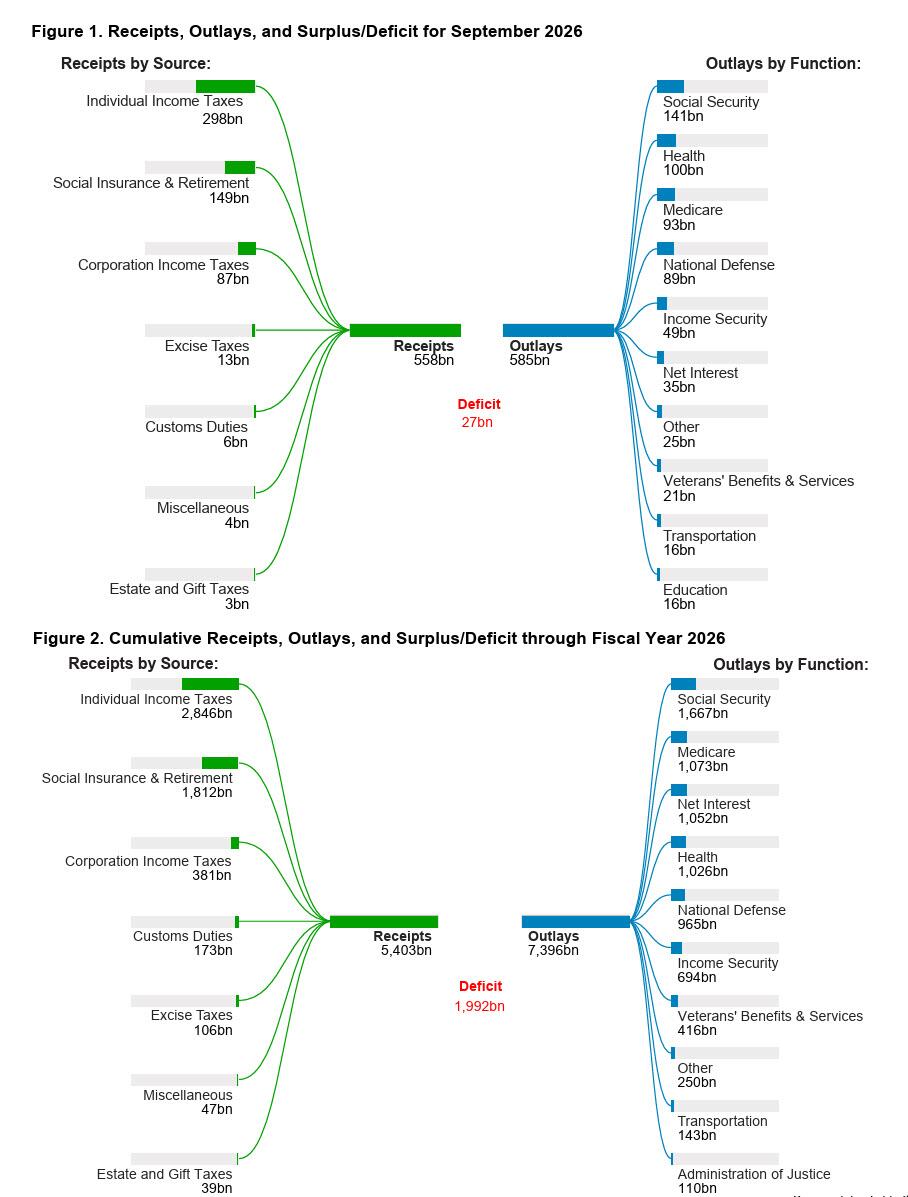
At 2pm today the US Treasury published the latest, September, monthly budget deficit data, which was also the last month of fiscal 2026, and it will again come as no surprise to anyone that things are looking ever worse.
Total US receipts for the month were $558 billion, a modest 2.6% improvement from the $544 billion a year ago, with individual income taxes accounting for $298 billion, or more than half of the total, and the bulk of the balance coming from Social Insurance and Retirement receipts of $149 billion.
On the spending side, things were ugly: total outlays were $585 billion, a 70% deterioration from the $345.7 billion spent a year ago, although like last month, much of that had to do with the calendar impact of tariffs.
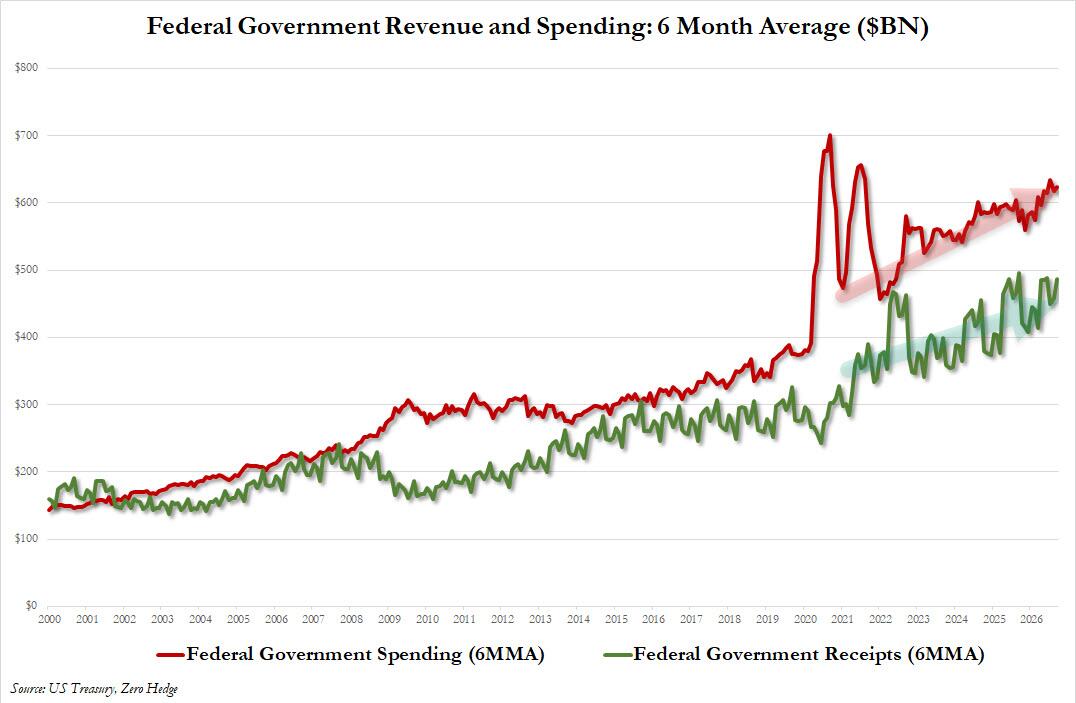
Putting receipts and spending in context, a chart of the trailing 6 months of government revenue and spending shows that the two trendlines continue to diverge with spending on pace to surpass the covid all time high, even as government revenue remains stuck in a much more narrow range.
The difference between the two, is of course, the US budget deficit, which in September was $27 billion, an improvement from August's 167 billion deficit, which however was the result of some calendar discrepancies between the two months.
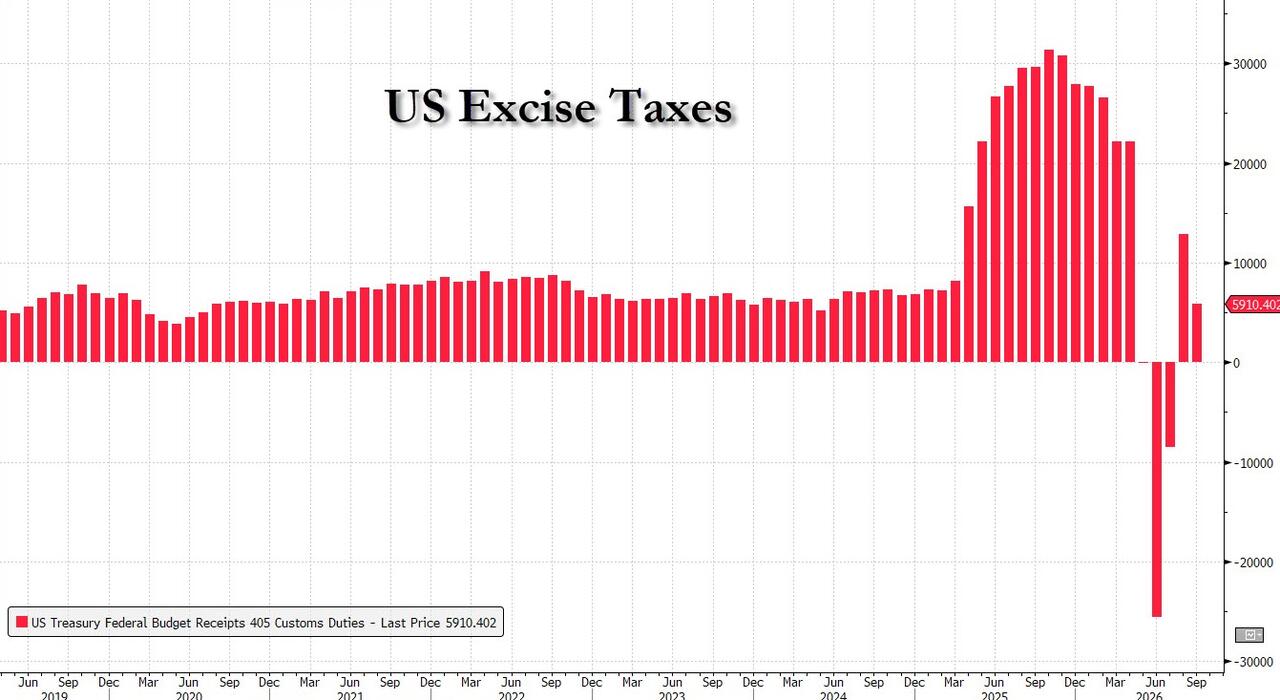
It's worth noting that after several months of EPS-boosting tariff refunds (courtesy of the Supreme Court), in September the US was once again collecting net tariff revenues, if at the normal rate from before Trump's latest trade war.
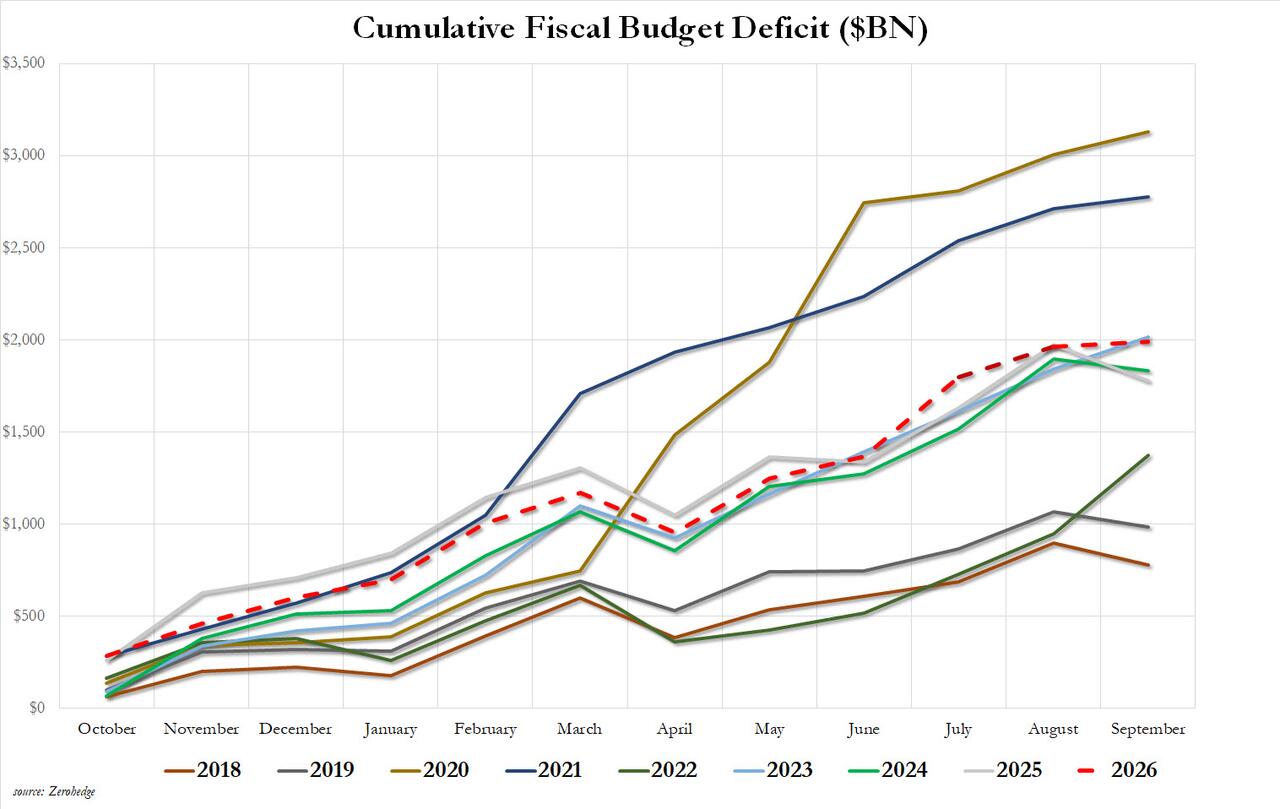
What matters more is that for the full fiscal 2026, total US deficit is closed the year at $2 trillion (technically $1.992 trillion), over $200 billion worse than last year. The silver lining is that contrary to what we said a month ago, when we predicted that "2026 will be about $200bn worse than the previous year when all is said and done, and be the 3rd worst year for the US deficit on record, with just the crisis years of 2020 and 2021 worse", 2026 was actually just fractionally better than 2023 and its $2.014 trillion deficit.
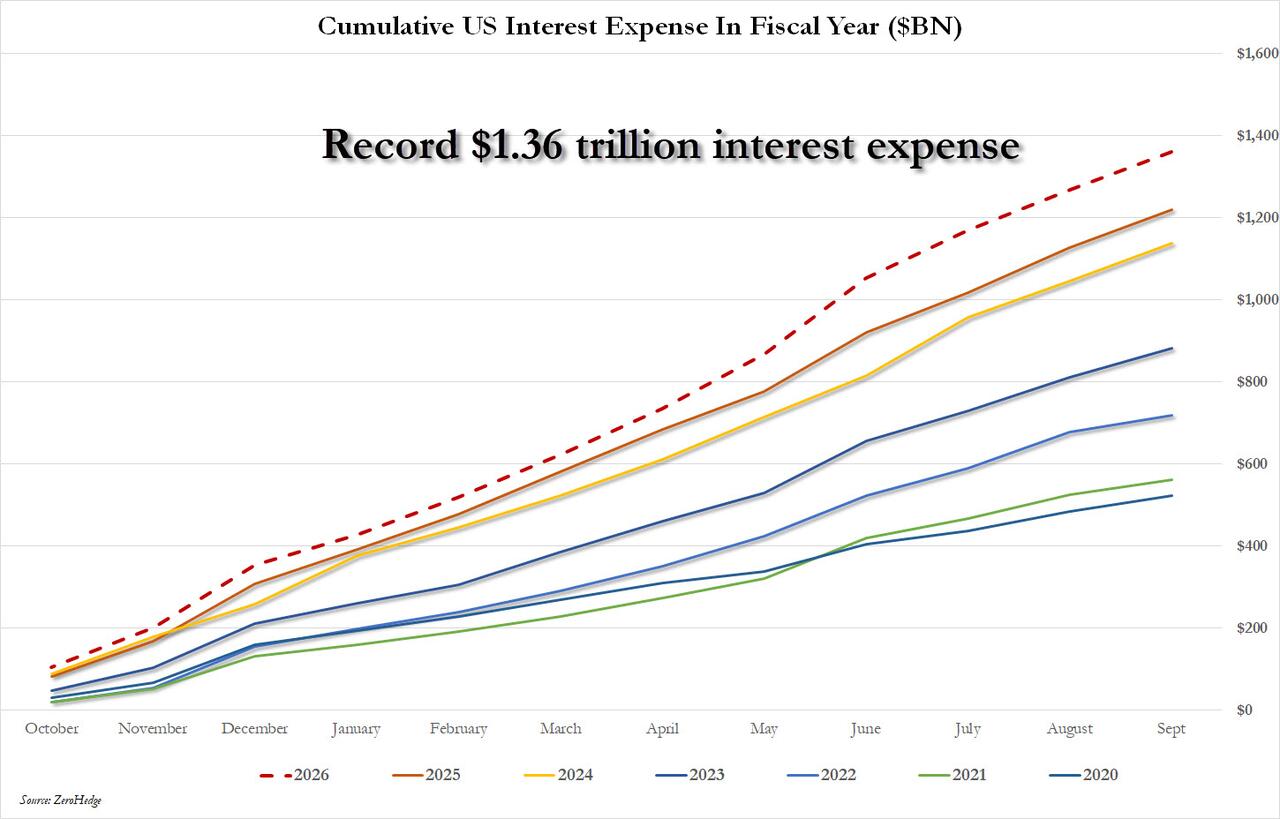
Finally, turning to the elephant in the room, namely interest expense, in September the US spent $92 billion on gross interest expense, which means for all of fiscal 2026, total US interest spending has risen to a record $1.360 trillion, up 12% from a year ago, and the highest on record (as for the net vs gross nazis, in September the US for the first time ever paid net interest of more than a trillion dollars, or $1.05TN to be precise)
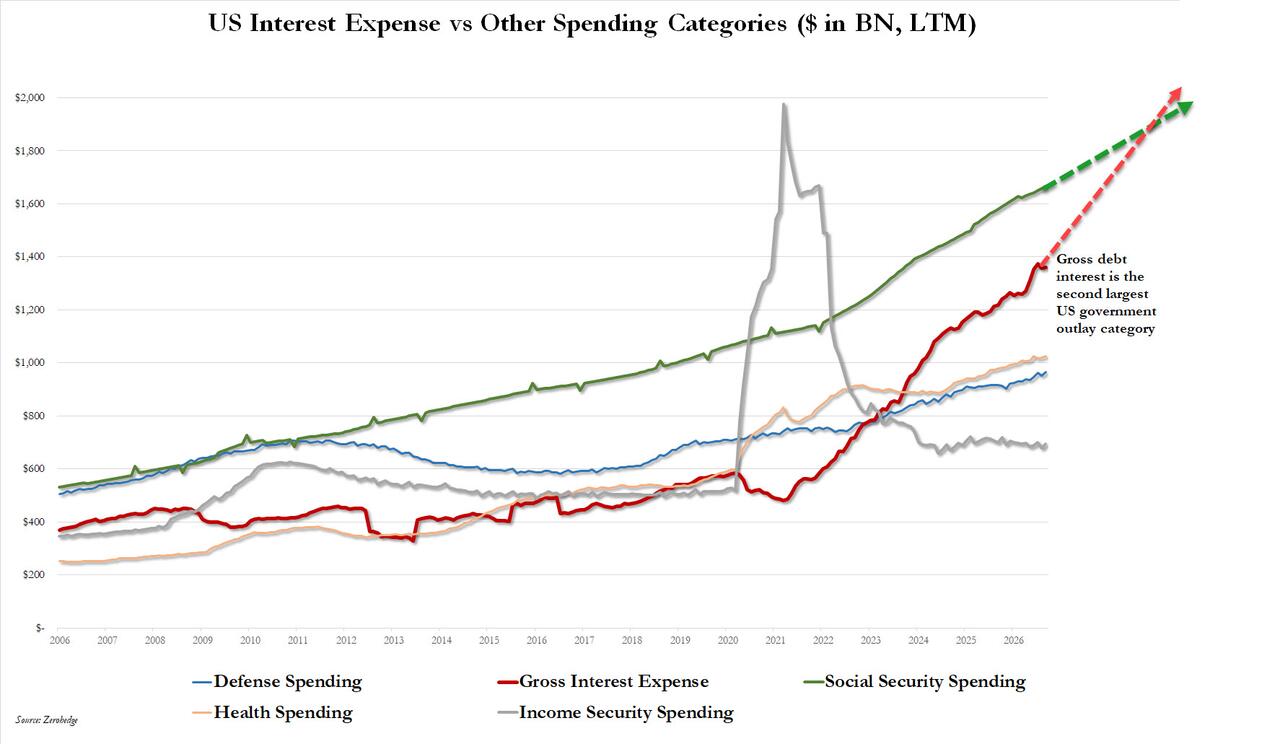
Extrapolating the current trend (and with the recent Fed rate hike our estimate may prove conservative), on an LTM basis, total US interest of $1.4 trillion is set to surpass Social Security (which was $1.67 trillion LTM but growing much slower), by the end of 2028.
And since 23% of marketable US debt is now T-Bills, which will see an immediate impact from the recent (and coming) Fed hikes, US interest expense is going to rise even more sharply, signaling that while the debt endgame for the US is guaranteed, the only question is whether Warsh will bring it on even faster.
Tyler Durden Fri, 10/16/2026 - 15:30
Continue reading...
[ H/T ZeroHedge ]
With DOGE disbanded more than a year ago, and tariffs struck down by the Supreme Court, the US is no longer even pretending that there is any hope to normalize spending, or any kind of happy ending to the US debt trajectory.
At 2pm today the US Treasury published the latest, September, monthly budget deficit data, which was also the last month of fiscal 2026, and it will again come as no surprise to anyone that things are looking ever worse.
Total US receipts for the month were $558 billion, a modest 2.6% improvement from the $544 billion a year ago, with individual income taxes accounting for $298 billion, or more than half of the total, and the bulk of the balance coming from Social Insurance and Retirement receipts of $149 billion.
On the spending side, things were ugly: total outlays were $585 billion, a 70% deterioration from the $345.7 billion spent a year ago, although like last month, much of that had to do with the calendar impact of tariffs.
Putting receipts and spending in context, a chart of the trailing 6 months of government revenue and spending shows that the two trendlines continue to diverge with spending on pace to surpass the covid all time high, even as government revenue remains stuck in a much more narrow range.
The difference between the two, is of course, the US budget deficit, which in September was $27 billion, an improvement from August's 167 billion deficit, which however was the result of some calendar discrepancies between the two months.
It's worth noting that after several months of EPS-boosting tariff refunds (courtesy of the Supreme Court), in September the US was once again collecting net tariff revenues, if at the normal rate from before Trump's latest trade war.
What matters more is that for the full fiscal 2026, total US deficit is closed the year at $2 trillion (technically $1.992 trillion), over $200 billion worse than last year. The silver lining is that contrary to what we said a month ago, when we predicted that "2026 will be about $200bn worse than the previous year when all is said and done, and be the 3rd worst year for the US deficit on record, with just the crisis years of 2020 and 2021 worse", 2026 was actually just fractionally better than 2023 and its $2.014 trillion deficit.
Finally, turning to the elephant in the room, namely interest expense, in September the US spent $92 billion on gross interest expense, which means for all of fiscal 2026, total US interest spending has risen to a record $1.360 trillion, up 12% from a year ago, and the highest on record (as for the net vs gross nazis, in September the US for the first time ever paid net interest of more than a trillion dollars, or $1.05TN to be precise)
Extrapolating the current trend (and with the recent Fed rate hike our estimate may prove conservative), on an LTM basis, total US interest of $1.4 trillion is set to surpass Social Security (which was $1.67 trillion LTM but growing much slower), by the end of 2028.
And since 23% of marketable US debt is now T-Bills, which will see an immediate impact from the recent (and coming) Fed hikes, US interest expense is going to rise even more sharply, signaling that while the debt endgame for the US is guaranteed, the only question is whether Warsh will bring it on even faster.
Tyler Durden Fri, 10/16/2026 - 15:30
Continue reading...
[ H/T ZeroHedge ]