







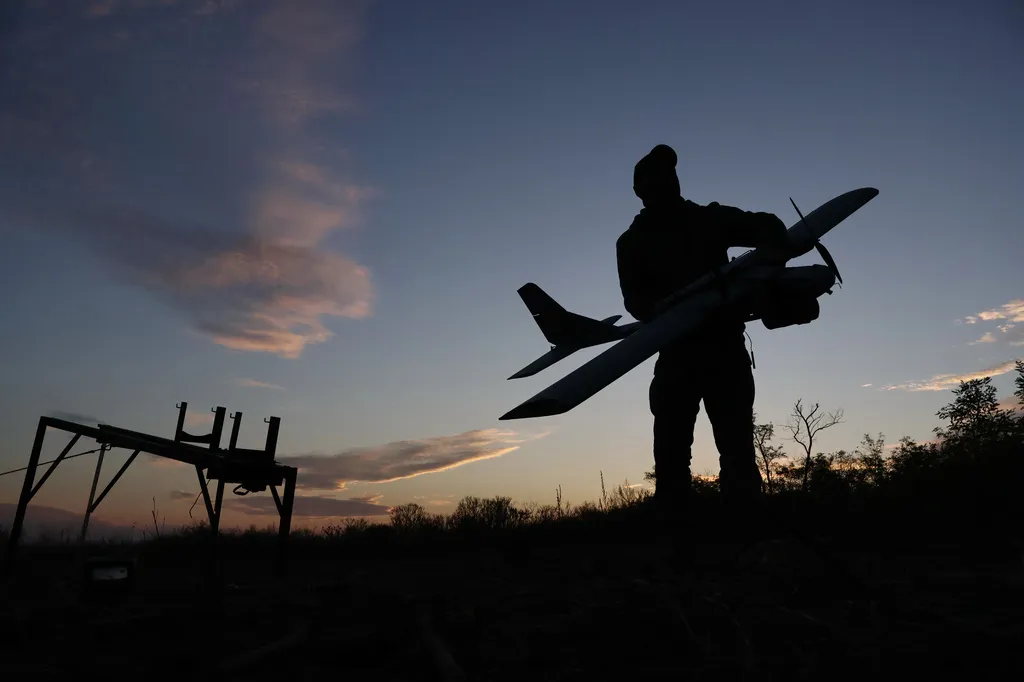
Russian forces struck a train platform at Dnipro’s main railway station in central Ukraine last week, killing at least 15 people and wounding at least 14 others. Russia targeted the train with its potent new weapon, a jet-powered drone.
For almost five years, Russia has relied on the Shahed, a cheap Iranian-designed attack drone, to pound Ukrainian cities night after night. But Ukraine learned to fight the original version, often bringing it down with small, inexpensive interceptor drones. The jet-powered model flies roughly twice as fast. Ukraine has yet to develop effective countermeasures against it. These drones have become Russia’s No. 1 choice for targeting Ukrainian civilians and infrastructure. Ukraine says that in October, Russia launched more than 4,000 of these drones against Ukraine. That compares with about 350 in June.
Still, Kyiv expects to begin to mass-produce interceptors capable of stopping these faster drones by the end of the year. Ukrainian forces intercepted about two-thirds of jet-powered drones in October, compared with nearly 90% of older, propeller-driven models. The Ukrainian manufacturers are now testing electric drones pushed to higher speeds alongside models powered by their own small jet engines. The aim is to give air defense units weapons they can use in large numbers against repeated attacks, without exhausting supplies of expensive missiles. Now ended speed restrictions on SpaceX’s Starlink-based communications further hampered those efforts, cutting satellite connections to some Ukrainian interceptors as they went after fast-moving Russian targets.
But Moscow is also expanding its use of small, relatively inexpensive cruise missiles, creating another challenge. Ukraine’s air force reported nearly 360 launches of two such missile types in October. These weapons can give Moscow a cheaper way to keep continuously attacking while conserving more expensive missiles for more important targets. Ballistic missiles pose the hardest challenge of all, since only the American Patriot air defense systems can reliably stop them, and Ukraine’s supply of Patriots is close to exhausted, with little sign of relief ahead.
As Americans woke up to vote in the midterm elections, Russia had sent nearly 300 drones and more than 70 missiles against Ukraine overnight. But this onslaught has not translated into a battlefield advance. In October, the territorial balance tilted toward Ukraine. The Institute for the Study of War, a think tank based in Washington, calculated that Russia lost more ground than it gained, as Ukrainian advances in several sectors outweighed small Russian gains elsewhere.
WHY TRUMP IS NOT GOING TO USE A NUCLEAR WEAPON AGAINST IRAN
Thus, with its ground offensive stalled, the Kremlin appears to be leaning more heavily on a campaign of attrition against Ukraine’s economy and essential services. Beyond power plants and water systems, Russian strikes have increasingly hit gas stations, supermarket chains and storage facilities. Russia’s bet is that sustained damage to this civilian strength will erode both Kyiv’s capacity and its public’s resolve to continue the war.
Russia is hoping it can get from negotiation what it cannot achieve on the battlefield or through air — Ukraine’s capitulation. As the talks mediated by the United States approach in Abu Dhabi, Moscow’s aims remain the same.
Continue reading...
[ H/T Washington Examiner ]