






The COVID-19 pandemic destroyed livelihoods, broke families apart, killed millions, and very likely resulted from an accident at a Chinese government laboratory.
For this reason alone, it should be a no-brainer that the United States needs to win the artificial intelligence race. Only American leadership in the AI revolution offers the means of identifying and neutralizing future AI threats to the U.S. and its allies. The best way to address AI-related risks is not for America to stick its metaphorical head in the sand, but rather to command AI developments. Recognizing as much, President Donald Trump deserves credit for refusing to restrain AI technologies. Following the Republican Party’s shellacking in Tuesday’s midterm elections, Trump should refocus on reinforcing a legacy of American AI dominance.
TRUMP IS LIKELY TO BECOME MORE ERRATIC FOLLOWING MIDTERM ELECTIONS DEBACLE
Yes, greater U.S. government and private sector collaboration within the AI sector will be crucial in mitigating known and as yet unknown risks. That said, this technology offers vast opportunities for the U.S. and the free world. AI will produce significant economic and societal gains such as advances in science, medicine, and technology. It will also help create many well-paying new jobs.
It’s also true that AI will negate the need for millions of existing jobs. Considering the social impact that deindustrialization has had on too many communities we must be prudent here. While free trade has greatly benefitted the vast majority of Americans, it has also caused deep pain to some communities. At the same time, China has taken advantage of free trade rules to unfairly advantage its own interests. Lessons must be learned as we contemplate policy on AI.
Nevertheless, McKinsey credibly estimates that AI can create 40 million new jobs by 2035. Many of these jobs are likely to be significantly better paid than those they replace. AI is also widely expected to produce outsize productivity and economic growth gains. Again, both the private sector and government will have to help workers engage with AI-related workforce developments. But the predictable gains far outweigh the potential losses here. It will be crucial for Trump to act as a bulwark against almost certain efforts by Democrats in the new Congress to hold back these opportunities.
Basic economics should act as Trump’s ally in this regard.
Rather than being perceived as utility cost black holes for household income, for example, we’re increasingly seeing how data centers can bring tax revenues and new jobs to communities in much need of both. As Forbes notes, “For communities with mature data center markets, tax revenues ranged from less than 1% to 31% of total local tax revenue, the Joint Legislative Audit and Review Commission report states. Virginia’s Loudon County reports that in Fiscal Year 2026, data centers generated $1.2 billion in real and personal property tax revenue, entailing 39% of the county’s overall budget.”
The U.S. federal system will assist in this buildout. If data centers are rejected in one state or locality, the free market will forge a community-AI company consensus to establish data centers in another location. And if residents see data centers generating local jobs and economic growth, while also driving down their taxes, utility cost increases will be viewed as an acceptable trade-off. We must also remember that the U.S. is not China. If data center owners fail to benefit a community, voters will send them packing. The AI buildout can thus take root in America’s finest democratic traditions, at source and at the point of delivery.
The saturation of American companies at the forefront of the AI revolution certainly puts the U.S. in an exceptional position.
This mustn’t be taken for granted. In contrast to the Trump administration’s light-touch approach to AI regulation, the European Union is adopting a regulatory-heavy stance toward AI companies. The EU will almost certainly weaken its already fragile AI industry and drive further investment toward the U.S. Indeed, in Trump and the EU, we’re seeing a live test study on which approach to AI is the best. Again, however, Trump must be the bulwark against what will be the most socialist-sympathetic Congress in history.
There is reason to believe that this strategy will pay dividends for Republicans come November 2028. Trump’s leadership on AI would offer a unifying economic template from which future Republican candidates will be able to take advantage.
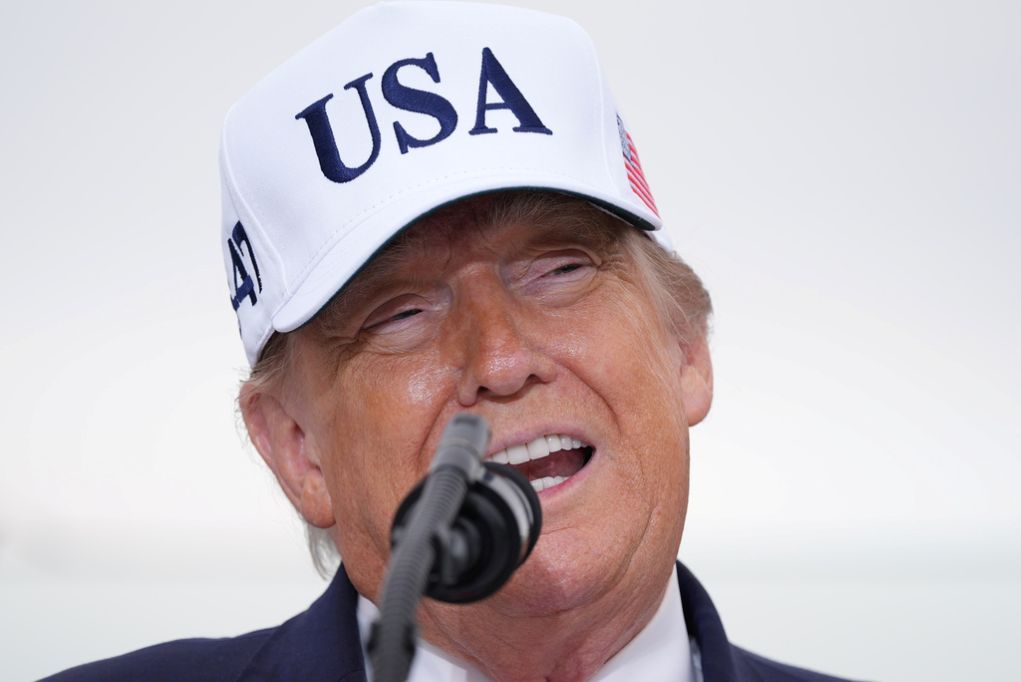
(Washington Examiner illustration; AP photo; Getty Images)
" data-large-file="https://www.washingtonexaminer.com/wp-content/uploads/2026/09/Trump_AI-e1790612616154.jpg?w=1024" src="https://www.washingtonexaminer.com/wp-content/uploads/2026/09/Trump_AI-e1790612616154.jpg?w=1024" alt="Trump in front of a background with "AI" and chat bubbles." class="wp-image-4739550" srcset="https://www.washingtonexaminer.com/wp-content/uploads/2026/09/Trump_AI-e1790612616154.jpg 1024w, https://www.washingtonexaminer.com/...09/Trump_AI-e1790612616154.jpg?resize=300,196 300w, https://www.washingtonexaminer.com/...09/Trump_AI-e1790612616154.jpg?resize=768,503 768w" sizes="auto, (max-width: 1024px) 100vw, 1024px">
(Washington Examiner illustration; AP photo; Getty Images)
After all, as the benefits of the AI revolution are increasingly felt across society, those who supported this revolution will earn new political support. This political support may be very significant. Trump has broken Republican norms with protectionist policies such as his generalized global tariffs. Still, the president’s support for AI moves a MAGA voting constituency that is otherwise more skeptical of the free market into alignment with the more traditional pro-market GOP philosophy. With Democrats increasingly beholden to the party’s far-left socialist wing, a pro-AI GOP consensus offers significant electoral opportunities. Again, the basic point is that AI is almost certain to make the vast majority of Americans wealthier and healthier.
Economic and social benefits aren’t the only reason that Trump is right to keep the AI revolution rolling. His stance is equally if not even more important when it comes to national security.
Trump rightly rebuffed President Xi Jinping’s duplicitous efforts to establish closer AI cooperation and “safeguards” during the latter’s recent visit to Washington. Only a fool would have agreed to those safeguards.
Unlike America’s democratic republic, the Chinese Communist Party exists only to advance its own supremacy. Xi and his minions have no time for introspection or human rights. They have no interest in upholding commitments made to another country if doing so will harm their own interests in the next moment. They will chase AI supremacy without speed limits because they believe that only by winning this race can they assure their 21st-century supremacy. As I noted recently, any unilateral U.S. suspension of AI research would therefore risk catastrophe in enabling China to close its AI knowledge gap. This concern is not hypothetical.
CAN EUROPE STOP RUSSIAN SUBMARINES FROM EXPLOITING BROKEN UK NAVY?
The Chinese intelligence services have redirected their vast spying apparatus to steal as much AI-related information as quickly as they can. If China is left to advance beyond or in tandem with America, the risks of an AI COVID-19 cyber-pandemic will grow exponentially. That is to say nothing of the autonomous cyber, drone, missile, and other military forces that AI will enable. Even if not deployed, the very understanding of China’s AI superiority would blackmail U.S. policymakers into coalescence with Chinese wishes. Considering what China does to its own people, that would not be a good thing.
Trump has many flaws as a leader. But on this issue, his decisive leadership is setting the U.S. — and Trump’s legacy — up for positive chapters in the history books. He should double down on it in his final two years in office.
Disclosure: I own a number of artificial intelligence-related stocks as part of a diversified portfolio.
Continue reading...
[ H/T Washington Examiner ]