





UK Pride Group "Captures" A 1,000-Year-Old Castle
Authored by Steve Watson via Modernity.news,
They called it "Capture the Castle." Not a picnic. Not a concert. Capture.
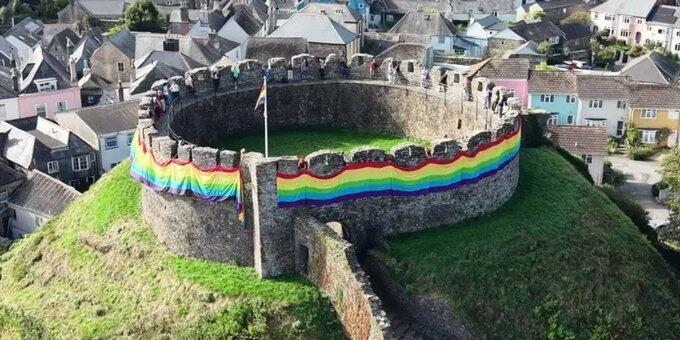
On Saturday morning a 1,000-year-old Norman fortress in Devon was wrapped in a 150-metre rainbow banner while organisers talked about occupying the ramparts and sending a message that the building now belongs to their cause. Nobody has to guess at the intent. They wrote it on the programme.
Totnes Castle sits at the highest point of the hilltop town. Founded around 1087 to lock down a crossing of the River Dart, it is one of England's best-preserved motte-and-bailey strongholds, a Grade I listed site in the care of English Heritage. On 26 September, as part of a four-day Totnes Pride festival, some 400 people gathered in the grounds while around 30 flag-bearers unfurled the giant Pride flag across the ancient masonry. The spectacle was billed as the defining image of the weekend.
Ceri Goddard of Totnes Pride told the BBC they wanted the festival to be "a bit different," and that covering "the iconic castle" would show that "queer people have always been here and we always will be." She said English Heritage had been "amazing, helping us plan," after a rehearsal to work through the logistics.
A Totnes Pride spokesman said: "Capture the Castle is the image that will define this year's festival, but what we've built around it is a genuinely ambitious arts and culture programme - over 40 events." The same statement talked of a town that "welcomes people from all walks of life." Liberal Democrat MP Caroline Voaden praised the "scale, diversity and quality of the Pride festival Totnes has produced," and said it was "sending a clear message of equality and inclusion."
That is one reading. Another is the language the organisers chose for themselves. Their own programme invited people to "storm the Castle grounds," described local flag-bearers who would "invade" the ramparts, and framed the morning as the "most visible, bold and important civic moment" of the weekend.
Some residents were appalled. Local Ian Robinson wrote: "950 years of Norman history, medieval warfare, royal decrees and Civil War - all leading up to the moment we thought: 'You know what this ancient castle really needs? A 150-metre rainbow flag'. Because apparently nine and a half centuries of heritage wasn't quite colourful enough. Still, at least the tea room survived long enough to witness the decline."
Roofer Russell Blackaller, who works on listed buildings, pointed out the double standard inside planning law itself. People in Grade II houses, he said, "require formal consent sometimes purely to erect a scaffolding." Yet a Grade I monument was draped "purely to have a celebration."
Courtney Soleil put the civic point cleanly: "No one is saying people shouldn't be free to live as they choose, but not every historic landmark needs to be turned into a statement for the cause of the moment. This is a 950-year-old Norman castle and part of Britain's shared heritage." Historic monuments, she argued, should represent that shared history rather than "continually being used to promote one particular cause."
Christian Concern chief executive Andrea Minichiello Williams told The Telegraph: "The castle may have been captured in history, but today it is the town itself that feels captured - not by an army, but by an ideology that has taken hold of its public spaces and its culture, leaving little room for anyone who dares to disagree."
Restore Britain's Rupert Lowe was no gentler: "It is not 'homophobic' to label this as wildly naff and generally vomit-inducing." He added: "Sensible gay people despise the woke theatre of it all too, and just want to get on with their lives."
Indeed, in 2016 Totnes council took down a Union Flag because it was deemed "too noisy" when it flapped in the wind. In 2015 a planned permanent rainbow crossing was blocked by Devon County Council on traffic-safety grounds, but the instinct of the activists was already clear: the civic surface of the town is a canvas, except when the paint is red, white and blue.
Flying a British or English flag from that same castle would, of course, be treated as a provocation. Across the country the pattern is no longer subtle. Britain's biggest council has gone to the High Court seeking an injunction that could put people in prison for two years for attaching Union Flags and St George's Crosses to highway furniture, while Pakistan, Palestine, Somalia, India and Jamaica flags have been hosted, lit up, or left flying.
English Heritage helped plan this latest rainbow eyesore. A sitting MP turned up to bless it. The keep that survived the Civil War is now a billboard for a faction that talks about invasion as if that were charming.
The national flags of the country that built the place are the ones that get the injunctions, the noise complaints, and the lectures about "community cohesion."
Tyler Durden Tue, 09/29/2026 - 05:00
Continue reading...
[ H/T ZeroHedge ]
Authored by Steve Watson via Modernity.news,
They called it "Capture the Castle." Not a picnic. Not a concert. Capture.
On Saturday morning a 1,000-year-old Norman fortress in Devon was wrapped in a 150-metre rainbow banner while organisers talked about occupying the ramparts and sending a message that the building now belongs to their cause. Nobody has to guess at the intent. They wrote it on the programme.
Totnes Castle sits at the highest point of the hilltop town. Founded around 1087 to lock down a crossing of the River Dart, it is one of England's best-preserved motte-and-bailey strongholds, a Grade I listed site in the care of English Heritage. On 26 September, as part of a four-day Totnes Pride festival, some 400 people gathered in the grounds while around 30 flag-bearers unfurled the giant Pride flag across the ancient masonry. The spectacle was billed as the defining image of the weekend.
Ceri Goddard of Totnes Pride told the BBC they wanted the festival to be "a bit different," and that covering "the iconic castle" would show that "queer people have always been here and we always will be." She said English Heritage had been "amazing, helping us plan," after a rehearsal to work through the logistics.
A Totnes Pride spokesman said: "Capture the Castle is the image that will define this year's festival, but what we've built around it is a genuinely ambitious arts and culture programme - over 40 events." The same statement talked of a town that "welcomes people from all walks of life." Liberal Democrat MP Caroline Voaden praised the "scale, diversity and quality of the Pride festival Totnes has produced," and said it was "sending a clear message of equality and inclusion."
That is one reading. Another is the language the organisers chose for themselves. Their own programme invited people to "storm the Castle grounds," described local flag-bearers who would "invade" the ramparts, and framed the morning as the "most visible, bold and important civic moment" of the weekend.
Some residents were appalled. Local Ian Robinson wrote: "950 years of Norman history, medieval warfare, royal decrees and Civil War - all leading up to the moment we thought: 'You know what this ancient castle really needs? A 150-metre rainbow flag'. Because apparently nine and a half centuries of heritage wasn't quite colourful enough. Still, at least the tea room survived long enough to witness the decline."
Roofer Russell Blackaller, who works on listed buildings, pointed out the double standard inside planning law itself. People in Grade II houses, he said, "require formal consent sometimes purely to erect a scaffolding." Yet a Grade I monument was draped "purely to have a celebration."
Courtney Soleil put the civic point cleanly: "No one is saying people shouldn't be free to live as they choose, but not every historic landmark needs to be turned into a statement for the cause of the moment. This is a 950-year-old Norman castle and part of Britain's shared heritage." Historic monuments, she argued, should represent that shared history rather than "continually being used to promote one particular cause."
Christian Concern chief executive Andrea Minichiello Williams told The Telegraph: "The castle may have been captured in history, but today it is the town itself that feels captured - not by an army, but by an ideology that has taken hold of its public spaces and its culture, leaving little room for anyone who dares to disagree."
Restore Britain's Rupert Lowe was no gentler: "It is not 'homophobic' to label this as wildly naff and generally vomit-inducing." He added: "Sensible gay people despise the woke theatre of it all too, and just want to get on with their lives."
Indeed, in 2016 Totnes council took down a Union Flag because it was deemed "too noisy" when it flapped in the wind. In 2015 a planned permanent rainbow crossing was blocked by Devon County Council on traffic-safety grounds, but the instinct of the activists was already clear: the civic surface of the town is a canvas, except when the paint is red, white and blue.
Flying a British or English flag from that same castle would, of course, be treated as a provocation. Across the country the pattern is no longer subtle. Britain's biggest council has gone to the High Court seeking an injunction that could put people in prison for two years for attaching Union Flags and St George's Crosses to highway furniture, while Pakistan, Palestine, Somalia, India and Jamaica flags have been hosted, lit up, or left flying.
English Heritage helped plan this latest rainbow eyesore. A sitting MP turned up to bless it. The keep that survived the Civil War is now a billboard for a faction that talks about invasion as if that were charming.
The national flags of the country that built the place are the ones that get the injunctions, the noise complaints, and the lectures about "community cohesion."
Tyler Durden Tue, 09/29/2026 - 05:00
Continue reading...
[ H/T ZeroHedge ]