

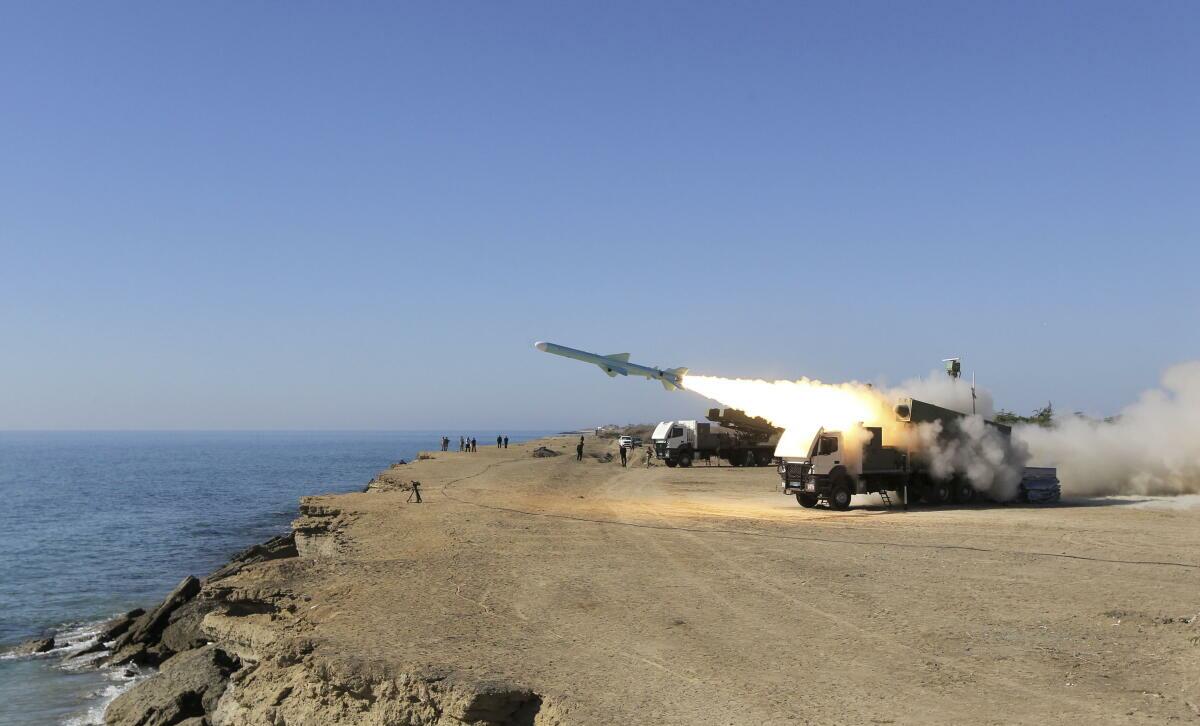





The highest-ranking officer in the Navy believes one of the best ways to reduce the cost and reliance on expensive air defense munitions is to lean into laser beams.
The military has used significant numbers of critical munitions for air defense both during the war in Iran and in conflicts that predate it — such as the Israel-Iran 12-day war last year and in Operation Rough Rider, last year’s American war against the Houthis in Yemen — which have sparked a significant effort within the department to replace them and fast.
While the department has announced several agreements with defense contractors in recent months to boost production of these munitions, and is pursuing new and cheaper variants, the head of the Navy believes the long-term answer is a variety of defensive systems that include high-energy laser systems — more formally known as high-powered directed energy — based on vessels.
“The greatest advantage of directed energy is endurance,” Adm. Daryl Caudle, the chief of Naval Operations, told the Washington Examiner. “A ship carries a finite number of missiles, and every defensive interceptor we fire is one less weapon available for the next engagement — or for offensive action.
“A laser gives us the potential to shift part of that defensive burden from a finite magazine to electrical power, dramatically improving the cost exchange against drones and other lower-cost threats while preserving our most capable kinetic weapons for the threats that require them,” he said.
Navy ships rely on the Standard Missile-3 and Standard Missile-6 missiles. These missiles, however, are finite and especially so on Navy vessels in combat when refueling and resupplying aren’t an easy option. The SM-3 and SM-6 missiles are single-use, meaning they are intended to be fired once and are then expended, like a bullet. There is a cap on the number of missiles a ship can carry, which could be emptied in a high-intensity conflict, leaving those on board vulnerable to any additional attacks if they haven’t rearmed.
Whereas ships are limited in the number of air defense missiles they can physically carry, a directed energy laser system could draw on power from the vessel itself in many cases and, as a result, fire countless times as long as the ship continues to power it. Other directed energy systems rely on batteries, which in turn could become a limiting factor if stressed to capacity.
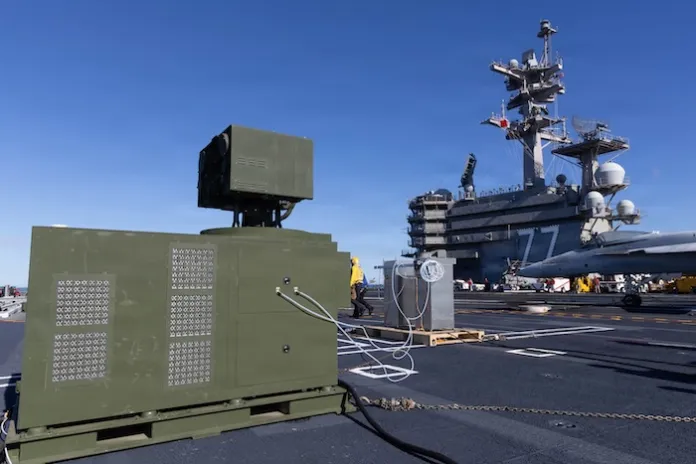
211214-M-HB658-1322 GULF OF ADEN (Dec. 14, 2021) Amphibious transport dock ship USS Portland (LPD 27) conducts a high-energy laser weapon system demonstration on a static surface training target, Dec. 14, 2021,while sailing in the Gulf of Aden. During the demonstration, the Solid State Laser – Technology Maturation Laser Weapons System Demonstrator Mark 2 MOD 0 – aboard Portland successfully engaged the training target. (Staff Sgt. Donald Holbert/Marine Corps via AP)
" data-image-caption="
211214-M-HB658-1322 GULF OF ADEN (Dec. 14, 2021) Amphibious transport dock ship USS Portland (LPD 27) conducts a high-energy laser weapon system demonstration on a static surface training target, Dec. 14, 2021,while sailing in the Gulf of Aden. During the demonstration, the Solid State Laser – Technology Maturation Laser Weapons System Demonstrator Mark 2 MOD 0 – aboard Portland successfully engaged the training target. (Staff Sgt. Donald Holbert/Marine Corps via AP)
" data-large-file="https://www.washingtonexaminer.com/wp-content/uploads/2026/09/Navy-laser.jpg?w=696" src="https://www.washingtonexaminer.com/wp-content/uploads/2026/09/Navy-laser.jpg" alt="Amphibious transport dock ship USS Portland (LPD 27) conducts a high-energy laser weapon system demonstration on a static surface training target, Dec. 14, 2021, while sailing in the Gulf of Aden. During the demonstration, the Solid State Laser – Technology Maturation Laser Weapons System Demonstrator - aboard Portland successfully engaged the training target. (Staff Sgt. Donald Holbert/Marine Corps via AP)" class="wp-image-4745458" srcset="https://www.washingtonexaminer.com/wp-content/uploads/2026/09/Navy-laser.jpg 700w, https://www.washingtonexaminer.com/wp-content/uploads/2026/09/Navy-laser.jpg?resize=300,200 300w, https://www.washingtonexaminer.com/wp-content/uploads/2026/09/Navy-laser.jpg?resize=150,100 150w, https://www.washingtonexaminer.com/wp-content/uploads/2026/09/Navy-laser.jpg?resize=696,464 696w" sizes="(max-width: 700px) 100vw, 700px">
Amphibious transport dock ship USS Portland (LPD 27) conducts a high-energy laser weapon system demonstration on a static surface training target, Dec. 14, 2021,while sailing in the Gulf of Aden. During the demonstration, the Solid State Laser – Technology Maturation Laser Weapons System Demonstrator Mark 2 MOD 0 – aboard Portland successfully engaged the training target. (Staff Sgt. Donald Holbert/Marine Corps via AP)
“If you want to truly explore the deep magazine capability of laser weapon systems, your only limitation is amount of power you can draw and amount of heat you can reject into the environment by directly integrated into a power source and to a thermal management system,” Jack Cheung, Lockheed Martin’s laser and sensor systems director, told the Washington Examiner.
Caudle and Cheung are in agreement that directed energy will not be a complete replacement or a silver bullet that makes all other types of air defense obsolete, rather it can serve as a key component of a more robust layered air defense apparatus. There are also some limitations of directed energy, such as the ability to engage one incoming threat at a time, which can be affected by atmospheric conditions, and can only engage targets it can see.
The services have long explored the use of lasers, but the war in Iran has highlighted the importance of those efforts as a result of reduced military stockpiles.
Lockheed Martin makes the 60-kilowatt High Energy Laser with Integrated Optical-dazzler and Surveillance (HELIOS System), which has been integrated into their AEGIS weapon system. The broader system is a centralized, automated, command-and-control and weapons control system. The HELIOS System was outfitted on the USS Preble in 2022. It was able to intercept four drones in a test last year, Lockheed Martin CEO Jim Taiclet said in January 2026.
“The HELIOS weapon system successfully neutralized four drone threats in a U.S. Navy-operated counter-UAS [uncrewed aerial systems] demonstration at sea, showcasing an opportunity to eliminate drone attacks using lasers, and saving U.S. and allied air defense missiles for more advanced threats,” he said at the time.
There have also been discussions about trying to increase the power of the HELIOS System, while the Navy has also experimented with other laser systems.
The Navy, Caudle said, should have two timelines in mind. The shorter timeline is focused on getting these weapons onto Navy vessels as quickly as possible, while the much longer-term plan should involve designing future vessels with these weapons’ requirements in mind.
One aspect of his plans is for the Navy to pursue containerized or palletized versions of these laser systems to alleviate the burden of transportation among other things, which also have to have specific qualities to adapt to maritime environments.
“There are really two problems we have to solve: the Fleet we have today and the Fleet we are designing for tomorrow,” Caudle said. “For tomorrow’s Fleet, electrical generation, distribution, energy storage and thermal management must become fundamental ship-design considerations. Power is increasingly a warfighting resource. My objective is not to put the identical laser from a single company on every Navy ship. I want mission-appropriate directed-energy capability available across the Fleet wherever it adds meaningful combat power.”
In March, Caudle unveiled his formal Containerized Capability Campaign to further this plan for more transportable weapons systems.
“From towed-array-systems, to drone swarms, to electronic attack systems, to high-powered lasers … I want to containerize everything,” he said at the annual McAleese Defense Programs Conference in March. “Tailored capabilities give our combatant commanders something they value above all else: options.”
The subject of air defense and the cost curves associated with it is something every U.S. military branch is trying to bend in its favor. The ultimate objective is to keep service members safe, most importantly, but also to safeguard their expensive equipment that costs taxpayers billions of dollars to manufacture in ways that don’t incur similar costs to replenish the arsenal used to defend the personnel and their weapons.
The Pentagon has announced several framework agreements with defense companies to increase the production of critical munitions used in large quantities during recent operations, which will take years to replace even as these companies try to build more faster.
UNDERSTANDING THE ARMY’S DRONE STRATEGY: NECESSARY ‘ACROSS EVERY WARFIGHTING FUNCTION
Last month, the department announced framework deals with Boeing and RTX, formerly known as Raytheon, to produce more hardware components for the SM-3. Boeing said it was a seven-year agreement to boost the output of avionics and ejector assemblies for the SM-3 Block IB and Block IIA variants.
“This gives us a clear demand signal to build and deliver SM‑3 interceptors at the levels needed to counter threats,” Bob Ciesla, vice president of Boeing Precision Engagement Systems, said at the time. “The SM‑3 is an essential part of the layered air and missile defense architecture that protects the U.S. and its allies worldwide.”
Continue reading...
[ H/T Washington Examiner ]