




This week, my wife and I are celebrating our 35th wedding anniversary. Of course, the inevitable question is, “Where would you like to go for dinner?” The ritualistic play then begins as my wife tells me she doesn’t care and asks me to choose. You can guess how the story proceeds from here. It is another example of the seeming ambiguity of choice: not necessarily knowing what we want but certainly knowing what we don’t want.
In previous essays, I’ve mentioned Jean-Paul Sartre’s Being and Nothingness, and today will be no exception. Sartre describes a man and a woman on a date. The man takes the woman’s hand. She can pull her hand away or grasp his hand firmly, with either action sending a clear signal to the man. But there is a third choice: she can do neither, leaving her hand where it is and behaving as though the situation were somehow outside her decision. That refusal to decide is itself a choice.
This brings us to the seemingly ambiguous status of Taiwan and the long-standing American policy of strategic ambiguity. The parallel is not exact, but it is useful. Washington, over several administrations — most recently under President Donald Trump — has deliberately avoided making an automatic public commitment to defend Taiwan in the event of a Chinese attack. The policy was designed, in part, to preserve uncertainty: enough uncertainty to deter Beijing from attacking while also discouraging Taiwan from taking provocative actions. The United States has therefore avoided answering the question in the simplest possible yes-or-no terms.
At one point, that ambiguity seemed to make strategic sense. But refusing to resolve a question does not eliminate its consequences. Sometimes ambiguity creates room for diplomacy. At other times, it creates room for miscalculation.
Today, the strategic environment is changing. China’s military capabilities have grown substantially, while Taiwan has continued strengthening its defenses. At the same time, economic competition between Washington and Beijing has increasingly become more closely linked with national security. The relationship is not as neatly divided between economics and military strategy.
There is another change worth considering: the attitude of some of China’s younger generation. For years, the message was fairly simple: work hard, compete, get ahead. But that bargain appears to be losing some of its appeal. The rise of “tang ping,” or “lying flat,” and later “bai lan,” roughly “let it rot,” reflects a growing willingness among some young Chinese to step away from the race rather than continue running it.
The “996” work culture — 9 a.m. to 9 p.m., six days a week — became a symbol of just how demanding that race could be. If working harder no longer seems to guarantee a better life, eventually some people will ask why they are running at all.
I don’t suggest that this means China’s young people are turning against their country, or that frustration with the economy somehow makes military conflict more likely. Most continue to pursue careers, education, and better lives. But expectations matter. And when expectations change, the calculations of governments can change with them.
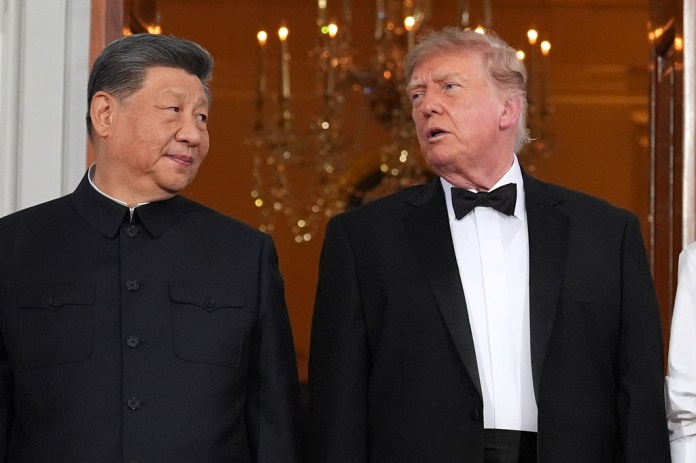
Yet competition has not eliminated cooperation. Trump and Chinese President Xi Jinping met in Busan, South Korea, on Oct. 30, 2025, reaching an agreement that addressed tariffs, agricultural purchases, and several of the very issues that have strained the relationship. Even as the two countries compete, they continue to find reasons to sit down at the same table.
The wisdom of ambiguity can prevent unnecessary conflict, but it can also become a breeding ground of miscalculation as it works only when the parties involved understand, or at least reasonably estimate, the boundaries of the scenario.
In this case, there are at least three parties holding the metaphorical hand: Washington, Beijing, and Taipei. The problem is not simply what each intends to do, but what each believes the others intend to do.
Akira Kurosawa explored something similar in the film Rashomon (1950), in which the same event is recounted from different perspectives, each producing a different understanding of what occurred. The analogy is again imperfect, but the problem of perspective is useful. Washington, Beijing, and Taipei can look at the same set of circumstances and reach different conclusions without any of them necessarily behaving irrationally. The danger arises when each act upon assumptions the others do not share.
Consider what might happen if China were to initiate an invasion and each party entered the crisis with a different assumption about Taiwan’s semiconductor facilities:
China may assume that if it invades, Taiwan will not destroy its own most valuable economic asset because doing so would hurt Taiwan enormously.
Taiwan may assume that if China invades, the U.S. will not allow China to acquire Taiwan Semiconductor Manufacturing Company’s most advanced manufacturing capability intact. (But what does allow mean?)
The U.S. may assume that Taiwan will understand that preserving the fabrication plants — or at least preventing their destruction — serves U.S. interests, and that the U.S. can prevent China from benefiting from them through technology controls, evacuation of personnel, sanctions, etc.
OPINION — TRUMP GOT TWO PANDAS, XI GOT THE PACIFIC: HOW AMERICA GOT FLEECED AT THE WHITE HOUSE
Neither my wife nor I is an irrational actor — most of the time. But even after so many years, deciding where to go for dinner can still be challenging. None of the above assumptions requires an irrational actor, yet the script can still be challenging. Each country could reasonably believe it understands the intentions of the others and still be wrong. That is where ambiguity becomes dangerous. It is one thing to leave your intentions uncertain. It is another to assume that everyone else understands what you meant by doing so.
Sartre’s woman eventually has to decide what the hand resting beneath hers means. Washington, Beijing, and Taipei may eventually face the same problem. The danger is that each may believe the others have already made the same decision.
Andrew Moore is a small business owner and author of the Primus Aeternus series.
Continue reading...
[ H/T Washington Examiner ]