







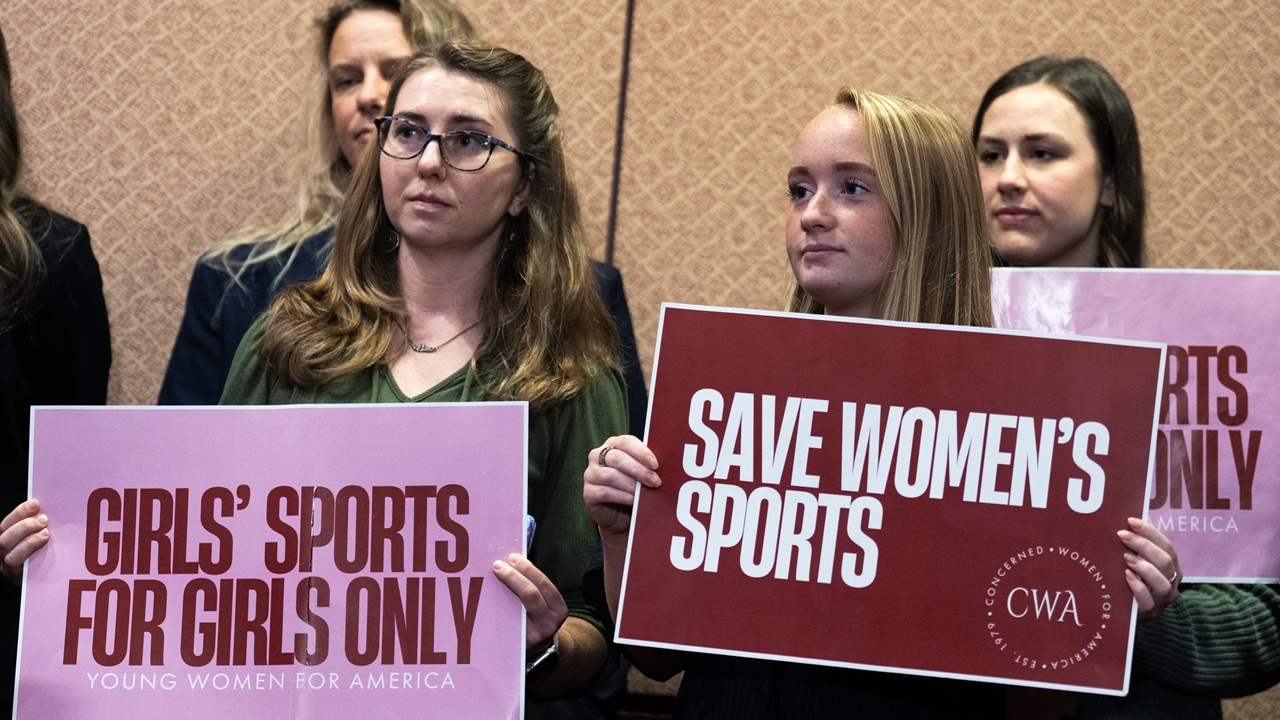
We separate boys and girls in sports for good reasons, and males don’t belong in women’s competition or in women’s locker rooms. An alleged occurrence last year makes this very clear.
On Dec. 6, 2025, 15-year-old Kallie Keeler stepped onto a mat at Emerald Ridge High School in Puyallup, Washington, for a girls’ wrestling match at the Lady Jag Kickoff. Her family says nobody informed her the opponent was a biological male. They allege the opponent shoved fingers through her uniform at the groin, and the school district’s own Title IX investigation concluded the opponent likely touched her private parts with force. Those remain allegations—no court has ruled on them, and no charges against the opponent, a minor, have been reported.
Nobody can consent to a risk that was not disclosed. Whatever Washington decides about the eligibility of males in girls’ sports, it owes parents advance notice of an opponent’s sex at the very least.
Here’s where the case stands. A federal judge denied a preliminary injunction on Aug. 23. The 9th Circuit refused emergency relief on Sept. 25. On Oct. 5, Alliance Defending Freedom asked Supreme Court Justice Elena Kagan to bar officials from forcing Keeler to wrestle males or, at minimum, to give her mother notice and let her decline those matches without penalty. The girls’ season opens in mid-November, And this is merely a request for interim protection. Nobody is asking the justices to decide guilt.
The reasons for separation are well established and rooted in physical realities. A Sports Medicine review found that muscle and strength fall only about 5% after 12 months of testosterone suppression, which the authors call a minimal reduction in the muscular advantage.
On June 30, in West Virginia v. B.P.J., a 6-3 Supreme Court upheld state laws reserving girls’ teams for biological females, reading “sex” as it was understood in the early 1970s. The majority named safety and competitive fairness as important interests and said states need not size up athletes one by one. Federal regulations already let schools field separate teams for contact sports, and they let schools provide separate locker rooms and showers by sex.
The majority left one question open: whether schools may let biological males join girls’ teams. Washington sits in that gap. Its athletic association says state law permits students to play “consistent with the gender with which they identify.”
The U.S. Department of Education, which on September 29 formally rescinded the 2024 Biden rule, takes the other view. It says Title IX protects female students’ rights to single-sex locker rooms and “competitive athletic competition restricted to biological female athletes.” Courts will keep arguing over whether Title IX requires exclusion, but a mother concerned for her daughter’s safety shouldn’t have to wait on that argument.
Locker rooms deserve the same plain talk. Girls change, shower, and recover there at their most exposed. I would never ask my sons to dress beside women, and no one should ask a teenage girl to dress beside biological males. Privacy is a legitimate interest at any age.
Notice costs nothing. Wrestling already sorts competitors by weight, and youth rugby groups kids by age, because size and strength decide who gets hurt. Nobody calls either practice an invasion of privacy.
Keeler’s mother asked the district to guarantee that her daughter wouldn’t face a male opponent, or at least to tell her in advance so she could pull her daughter out. The district refused. The application says officials treated the request as a demand for “medical information about other children.”
Aristotle held that justice means proportional equality and that quarrels begin when unequal people receive equal treatment. Girls’ sports exist because of that insight.
The failures continued well after the whistle was blown. Washington requires schools to alert law enforcement within 48 hours of alleged abuse. Police weren’t notified until January 30, 53 days after the match. Rogers High School’s principal and athletic coordinator were charged in Pierce County District Court on July 21 with failing to report. Keeler left the team in January. A girl who loved the sport lost it, and the paperwork moved at the speed of a DMV.
Washington’s superintendent says roughly 5 to 10 transgender students compete among nearly 250,000 in interscholastic activities. Fine. Then the policy costs almost nothing to change, and Keeler is one girl who needs to know who she’s facing.
The ask is narrow. Keeler’s lawyers say the family only needs to know whether their daughter will wrestle a male. The athletic association says it will revise its policy only if state law changes, which turns a mother’s simple question into a lobbying project.
But regardless of how the district decides to deal with this, sex-based girls’ divisions should be restored in statute, as Idaho and West Virginia did, and locker rooms should be sex-separated, as federal regulations already permit.
Some things are in our control and others aren’t. Parents can’t control whether their daughter will win or lose a wrestling match, but they should be able to control whether their daughter steps onto a mat informed.
Most schools warn parents about a peanut in the cafeteria. At the very least, a girl headed into a contact sport deserves to know if she is about to face a male. Call your school board and your state athletic association this week. Ask one question: will my daughter be told? If the answer is no, ask why.
We publish a variety of perspectives. Nothing written here is to be construed as representing the views of The Daily Signal.
Continue reading...
[ H/T The Daily Signal ]