


On Oct. 27, I argued in these pages that Russian President Vladimir Putin got a diesel order and President Donald Trump got the calendar. Here is the calendar.
On Oct. 8, Trump posted that he would not resume strikes on Iran before Nov. 3, Election Day. On Oct. 9, he announced that Putin had agreed to release Russian diesel to American and world markets. The Treasury issued a license the same day. One post set a date. The other set off a storm.
The storm got the coverage. Trump the seller. Trump who traded Ukraine for fuel. A week later he waived most of the new Russia sanctions, and the storm doubled. Few asked what the first post meant. Fewer noticed what happened in the window between Oct. 8 and Nov. 3.
OPINION: PUTIN BUILT AN IRON DOME FOR HIS PALACE. THE REST OF RUSSIA CAN BURN
I call the method controlled chaos and the operational pause. The chaos is loud, public, and free, because Trump’s critics supply it. The pause is quiet and deliberate. Between them sits the aikido principle: you do not block your opponent’s force; you redirect it to where it does you no harm. We have seen it before. On Sept. 22, while the world argued about Iran, Russia, and Ukraine, Trump, Denmark’s prime minister, and Greenland’s premier signed a deal allowing a larger American military presence on the island, under Danish sovereignty. Trump didn’t buy Greenland. He got what he wanted it for.
Now look inside the window. Start with Israel, which voted on Oct. 27.
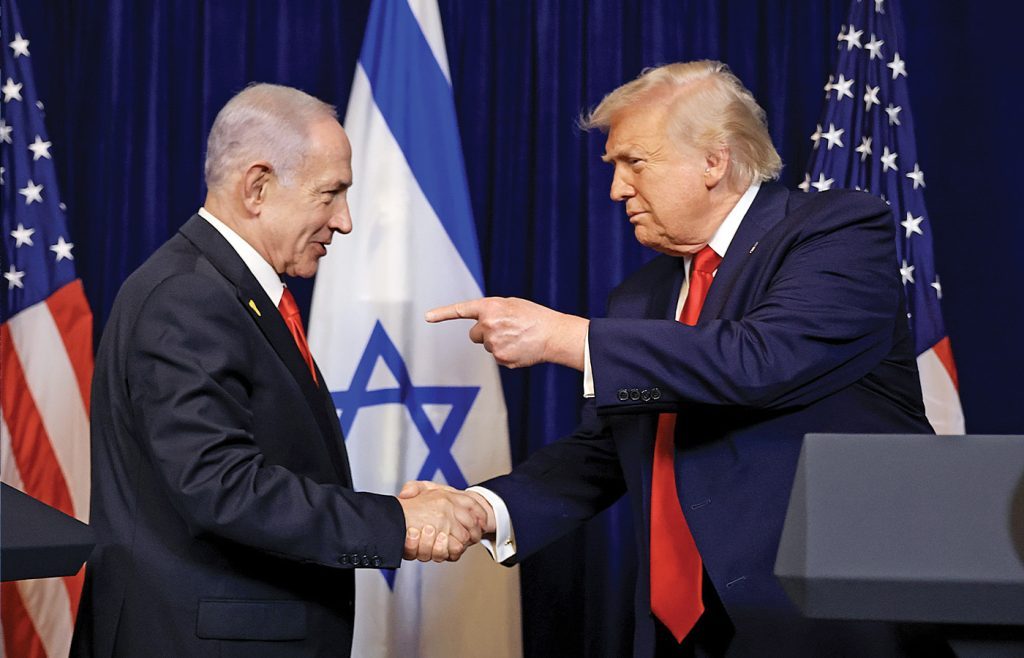
All year, the press reported a rift between Trump and Israeli Prime Minister Benjamin Netanyahu. Nine days before the vote, Trump issued his “Complete and Total Endorsement” of Netanyahu alongside a warning: with “anyone other than Bibi,” America would have to do the Iran work itself. The next day, Vice President JD Vance said he was “not getting involved in Israeli elections.” In April, Vance went to Budapest, Hungary, to campaign for Viktor Orban. Orban lost.
So the president endorsed one candidate and the vice president endorsed none. Every door stayed open.
Israeli sources told ABC News the decision is “only for Trump to decide,” and that “hunting season is open as soon as the elections end.” Note the plural. A third aircraft carrier is on its way. Together with an amphibious group, it is due to add some 10,000 sailors and Marines to the region by the end of November. Asked on Oct. 27 whether he would strike after the midterm elections, Trump said, “I can’t tell you that … but anything’s possible.” Since July, he has called off major strikes six times. That is what an operational pause looks like from the outside.
Israel has finished counting. Netanyahu’s bloc won 53 seats, down from 64; the opposition won 48, the Arab parties a record 19. Nobody has 61. Gadi Eisenkot, whose Yashar party came second, refuses to serve under Netanyahu, even in a rotation.
The fight over the count has begun. In September, Netanyahu’s Likud party got the election committee to bar both Arab lists; the Supreme Court unanimously reversed it. Now Likud says those same parties “stole” the election. The police say they see no evidence.
Coalition talks can take weeks. Until a new government is sworn in, Netanyahu remains prime minister, and his caretaker government keeps the authority to order military action. When the pause ends, the man in Jerusalem will be the one Trump endorsed. If Netanyahu holds, the partner stays. If Eisenkot takes the premiership, the partner changes. The calendar does not.
Eisenkot is no dove. The former army chief lost a son and two nephews in this war. Days before the vote, he told the New York Post that he backed Trump’s decision to strike Iran alongside Israel. Tehran, watching Israel’s count for a reprieve, should read that twice.
The same noise covered Canada, where Trump’s pressure is economic and constant. Canada spent October voting on whether to remain Canada. On Oct. 5, Quebec elected the separatist Parti Quebecois, which promises an independence referendum, just not yet. On Oct. 19, 3 in 4 Alberta voters refused even to start the process toward a referendum on leaving Canada. The separatists had met State Department staff three times, and even they conceded that “the most polarizing thing in Canada is Donald Trump.”
Five days later, British Columbia threw out Premier David Eby, who had called a snap election and urged voters to say “hell no to Trump.” The Conservatives won their first majority since 1928. The province that holds the oil voted to stay Canadian. The province that holds the coast fired the premier who ran against Trump.
In Serbia, on Oct. 25, Aleksandar Vucic, whom Putin had endorsed, conceded defeat to a student movement. Orban, another Putin favorite, had fallen in April; the man who beat him kept buying Russian oil. Orban is gone. Orban remains. Whom did Washington want in Belgrade? I do not know, and neither does anyone who claims to. I do know that Vucic stood in Moscow for Putin’s Victory Day parade in May 2025, and that U.S. sanctions on NIS, Serbia’s Russian-owned oil company, took effect that October after the Trump Treasury stopped extending waivers.
Bulgaria is next. On Nov. 1, President Iliana Iotova faces Andrey Gyurov, a pro-Western former central banker, in a runoff. Her ally, Prime Minister Rumen Radev, calls it a choice between “peace and war.”
Brazil voted on Oct. 25, too. On runoff day, Supreme Court Justice Cristiano Zanin, once Luiz Inacio Lula da Silva’s own lawyer, extended voting by two hours at the request of Lula’s coalition; Flavio Bolsonaro’s campaign had asked for more time in five states. Lula won, 51.8 to 48.2. Did two extra hours move 4.4 million votes? The electoral court counted 34,393 ballots cast after 5 p.m. The numbers answer the question.
Flavio’s own Liberal Party recognized Lula’s victory. Flavio did not. On Oct. 27, barred from leaving the country, he crossed into Argentina on an Italian passport he had been ordered to surrender, and the next day he landed in Miami. According to U.S. immigration records obtained by the newspaper O Estado de S. Paulo, he entered on his diplomatic passport, which Brazil had canceled. The State Department had already said the family would get visas, and Trump called them “fine people.”
From Miami, Bolsonaro published a letter calling himself “the true elected president of Brazil,” then edited it to read “the leader of Brazil.” Charles de Gaulle, he wrote, led Free France from London. “I will lead the opposition from here.”
The party stayed in Brasilia. The candidate flew to Miami. Brazil’s opposition now has two addresses, and only one of them is within Justice Alexandre de Moraes’s reach.
And the diesel? Still at sea. The first tanker loaded 40,000 tons on Oct. 22. Tracking data show it heading for New York, due Nov. 7, four days after the vote; the ship’s manager says the port, even the country, has not been settled. On Oct. 21 in St. Petersburg, Trump’s special envoy Steve Witkoff thanked Putin for the diesel. Afterward, the Kremlin said Putin had agreed in principle to resume three-way talks with Washington and Kyiv after Nov. 10. On Oct. 27, two days ahead of schedule, a ceasefire brokered by first lady Melania Trump took hold around Oleshky, a Russian-occupied town on the Dnipro. Three days later, with the truce holding, the evacuation began.
Now the calendar. Nov. 1: Bulgaria picks its president, and the Oleshky ceasefire runs out. Nov. 3: Americans vote. Nov. 4: Israel’s certified results go to President Isaac Herzog. Nov. 10: the new Knesset is sworn in, and the window for three-way talks on Ukraine opens. The pause expires on the second line: Election Day.
On Oct. 25, Trump told Fox News he had to choose between a deal with Iran and finishing it off. “It’s getting to be decision time,” he said. By Oct. 28, according to the Wall Street Journal, Washington had told Gulf allies to prepare for a short, intense campaign after the midterm elections. That night, War Secretary Pete Hegseth fired Lt. Gen. Brett Sylvia, the Joint Staff’s director for strategy, plans, and policy, who is accused of leaking classified information about the Iran war to the press.
Vance, the Wall Street Journal reported, had written to Iran’s top security official, Mohsen Rezaei, about a possible framework for talks. Tehran confirmed receiving the letter. Asked about it, Trump said it was about medical supplies.
OPINION: A PUTIN CRITIC FOUND THE METHOD IN TRUMP’S MADNESS. THEN HE BLAMED IT ON OIL
The diesel was loud. The pause was quiet. The critics counted tons. Trump counted days.
Draw your own conclusions. You have until Nov. 3.
Emzari Gelashvili is a San Francisco–based geopolitical analyst and columnist who monitors Russian-language media. From 1996 to 2008, he held senior positions in Georgia’s Ministry of State Security, Ministry of Defense, and Ministry of Internal Affairs, with a counterintelligence career focused on Russian and Iranian intelligence operations, and he was a member of the Georgian Parliament from 2008 to 2012. His work appears in Newsweek, the Hill, the Washington Examiner, RealClearDefense and RealClearWorld, and at emzargelashvili.substack.com.
Continue reading...
[ H/T Washington Examiner ]