CARACAS, Venezuela — Energy Secretary Chris Wright is broadening the traditionally domestic-oriented department he leads with a more global outlook.
Dubbed the “international energy secretary” by some, Wright, 61, is the figure most responsible for delivering President Donald Trump’s energy dominance agenda. That includes facilitating the buildout of nuclear power in the United States, increasing domestic oil and gas production, expanding exports of fossil fuels abroad, and reducing global reliance on Russia and other adversaries.
Wright’s public profile has risen since Jan. 3, when the Trump administration ordered a surprise U.S. military raid in Caracas. The move captured and removed Venezuelan dictator Nicolas Maduro, a longtime U.S. antagonist whose regime consolidated the nationalization of the South American nation’s oil industry, begun by a fellow socialist dictator, the late Hugo Chavez.
Simultaneously, Wright is charged with facilitating the flow of petroleum products out of the Middle East and striking a nuclear cooperation agreement with Saudi Arabia. That would be challenging enough during normal times, are exponentially complicated by Iran’s on-again-off-again closure of the Strait of Hormuz amid intermittent war between the U.S. and the Islamic Republic.
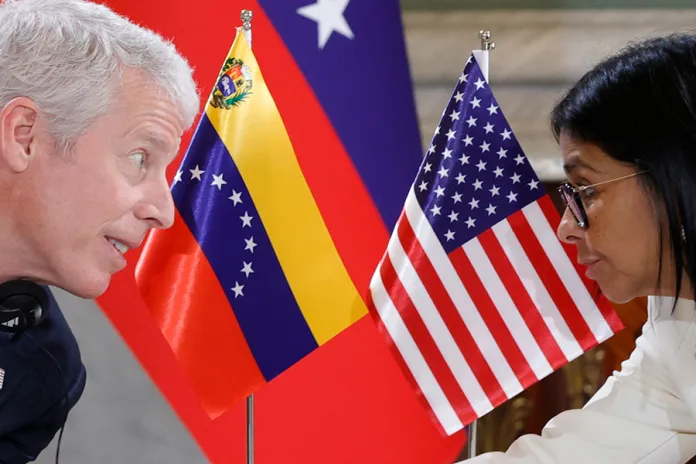
U.S. Energy Secretary Chris Wright, left, meets with Venezuelan acting President Delcy Rodriguez at Miraflores presidential palace in Caracas, Venezuela, Wednesday, Sept. 2, 2026. (AP Photo/Pedro Mattey)
" data-large-file="https://www.washingtonexaminer.com/wp-content/uploads/2026/09/AP26245635381639.jpg?w=696" src="https://www.washingtonexaminer.com/wp-content/uploads/2026/09/AP26245635381639.jpg?w=696" alt="U.S. Energy Secretary Chris Wright, left, meets with Venezuelan acting President Delcy Rodriguez at Miraflores presidential palace in Caracas, Venezuela, Wednesday, Sept. 2, 2026. (AP Photo/Pedro Mattey)" class="wp-image-4743482" style="width:873px;height:auto" srcset="https://www.washingtonexaminer.com/wp-content/uploads/2026/09/AP26245635381639.jpg 900w, https://www.washingtonexaminer.com/wp-content/uploads/2026/09/AP26245635381639.jpg?resize=300,200 300w, https://www.washingtonexaminer.com/wp-content/uploads/2026/09/AP26245635381639.jpg?resize=768,512 768w, https://www.washingtonexaminer.com/wp-content/uploads/2026/09/AP26245635381639.jpg?resize=150,100 150w, https://www.washingtonexaminer.com/wp-content/uploads/2026/09/AP26245635381639.jpg?resize=696,464 696w" sizes="(max-width: 900px) 100vw, 900px">
U.S. Energy Secretary Chris Wright, left, meets with Venezuelan acting President Delcy Rodriguez at Miraflores presidential palace in Caracas, Venezuela, Wednesday, Sept. 2, 2026. (AP Photo/Pedro Mattey)
To be sure, foreign policy has always consumed a significant amount of time for whoever leads the Energy Department. After all, they oversee the nation’s nuclear weapons program.
But Wright is more broadly involved in foreign affairs than his predecessors since the Energy Department’s creation in 1977, to the point that in President Donald Trump’s second, nonconsecutive term, Wright’s actions could reshape global energy markets.
Wright, the founder and ex-CEO of oilfield services company Liberty Energy, said in an interview that global affairs is a natural part of the job.
Energy has “become a fabric of international discussion,” Wright told the Washington Examiner while on an early September flight from Venezuela to Washington. “As a guy who has traveled to about 60 countries in my life since I was young, it’s a great interest to me as well. … This is the role that energy secretaries should be, not domestic energy policy.”
Eyes on Iran and Venezuela
Since the ousting of Maduro, Wright has led the ambitious rejuvenation of Venezuela’s oil industry.
He became the highest-ranking U.S. official to travel to the country in February, underscoring his shift toward more foreign engagement.
He has remained a key figure in negotiations with the interim government, meeting multiple times with acting President Delcy Rodriguez. He has also been heavily involved in negotiations regarding the U.S.’s own investment in the country through the 65-billion-barrel deal made with private oil and gas company North American Blue Energy Partners.
In early September, Wright also oversaw the signing of several agreements among five energy companies and Venezuela to rapidly increase oil and gas drilling. He has also pushed for using increased imports of Venezuelan oil to refill U.S. emergency reserves.
Energy Secretary Chris Wright speaks with Venezuelan acting president Delcy Rodriguez at Miraflores Palace in Caracas, Venezuela, on Sept. 2, 2026.
" data-image-caption="
Energy Secretary Chris Wright speaks with acting Venezuelan President Delcy Rodriguez on Sept. 2, 2026, at Miraflores Palace in Caracas, Venezuela. (Callie Patteson/Washington Examiner)
" data-large-file="https://www.washingtonexaminer.com/...26/09/wright-rodriguez-palace-steps.jpg?w=696" src="https://www.washingtonexaminer.com/...26/09/wright-rodriguez-palace-steps.jpg?w=696" alt="Energy Secretary Chris Wright speaks with acting Venezuelan President Delcy Rodriguez" class="wp-image-4710562" srcset="https://www.washingtonexaminer.com/wp-content/uploads/2026/09/wright-rodriguez-palace-steps.jpg 1024w, https://www.washingtonexaminer.com/...ght-rodriguez-palace-steps.jpg?resize=300,200 300w, https://www.washingtonexaminer.com/...ght-rodriguez-palace-steps.jpg?resize=768,512 768w, https://www.washingtonexaminer.com/...ght-rodriguez-palace-steps.jpg?resize=150,100 150w, https://www.washingtonexaminer.com/...ght-rodriguez-palace-steps.jpg?resize=696,464 696w" sizes="(max-width: 1024px) 100vw, 1024px">
Energy Secretary Chris Wright speaks with acting Venezuelan President Delcy Rodriguez on Sept. 2, 2026, at Miraflores Palace in Caracas, Venezuela. (Callie Patteson/Washington Examiner)
On the other side of the world, Wright has led the administration’s effort to maintain calm in global oil markets despite the disruption to transit through the Strait of Hormuz.
The war with Iran has disrupted roughly 20% of global trade in oil and oil products. Before the conflict started in late February, 20 million barrels a day were passing through the strait.
The monthslong drop-off has caused oil and gasoline prices to soar. And while traffic has slowly recovered since the summer, recent escalations in the war have kept prices high.
Wright has pushed a more optimistic view of the squeeze on the oil trade, even as the Trump administration has failed to get an agreement with Iran to open the strait. He has promoted the message that markets are finding alternatives to sending tankers through the strait and that the amount of crude leaving the Middle East is growing.
This messaging is largely aimed at reassuring markets that oil trade will continue to move toward prewar levels, despite there still being concerns about Iranian sea mines posing a risk to ships passing through the strait.
A motorboat passes a general cargo ship anchored in the Strait of Hormuz off Bandar Abbas, Iran, Sunday, Sept. 6, 2026. (AP Photo/Vahid Salemi)
" data-large-file="https://www.washingtonexaminer.com/wp-content/uploads/2026/09/AP26249358444418.jpg?w=696" src="https://www.washingtonexaminer.com/wp-content/uploads/2026/09/AP26249358444418.jpg?w=696" alt="A motorboat passes a general cargo ship anchored in the Strait of Hormuz." class="wp-image-4715319" srcset="https://www.washingtonexaminer.com/wp-content/uploads/2026/09/AP26249358444418.jpg 1024w, https://www.washingtonexaminer.com/wp-content/uploads/2026/09/AP26249358444418.jpg?resize=300,200 300w, https://www.washingtonexaminer.com/wp-content/uploads/2026/09/AP26249358444418.jpg?resize=768,512 768w, https://www.washingtonexaminer.com/wp-content/uploads/2026/09/AP26249358444418.jpg?resize=150,100 150w, https://www.washingtonexaminer.com/wp-content/uploads/2026/09/AP26249358444418.jpg?resize=696,464 696w" sizes="(max-width: 1024px) 100vw, 1024px">
A motorboat passes a general cargo ship anchored in the Strait of Hormuz on Sunday, Sept. 6, 2026, off Bandar Abbas, Iran. (AP Photo/Vahid Salemi)
Earlier this month, Wright said that on Aug. 31, roughly 17 million barrels of oil and gas products passed through the strait, the most since the war began. Wright has also repeatedly expressed optimism regarding a short timeline for repairs to key infrastructure damaged in the conflict, such as the Saudi Arabian East-West Pipeline.
With Iran and Venezuela at the forefront of Wright’s agenda, Neil Atkinson, ex-head of oil at the International Energy Agency and a former London-based employee of Venezuela’s state-owned oil firm, PDVSA, described Wright as an “international energy secretary.”
Atkinson acknowledged that domestic energy policy relatively “ticks along,” particularly as the administration increases its investments in fossil fuels and lowers its involvement in renewables.
“He’s the secretary for international energy affairs, if you like, as well as being the secretary for energy, and that is going to continue to grow, especially given we have the geopolitical turmoil that exists today,” Atkinson said.
Spread too thin?
Wright has faced some criticism for his emphasis on foreign relations, as concerns increase about the stability of the domestic energy system and the development of artificial intelligence puts more pressure on power supply and electricity bills.
“At a time when the American people are seeing unprecedented increases to their electricity bills because of Donald Trump’s war in Iran, the last thing we need is an Energy Secretary flying around the world doing the bidding of the fossil fuel industry while he does everything he can to kill the wind and solar industries at home,” Sen. Alex Padilla (D-CA) said in a statement to the Washington Examiner.
“Chris Wright’s idea of energy dominance isn’t lower bills and more savings for Americans; it’s about more profits for corporations and more private trips for himself,” Padilla continued.
It is not uncommon for energy secretaries to be directly involved in foreign affairs.
For example, Federico Pena, an energy secretary during former President Bill Clinton’s administration, launched a multinational initiative in the late 1990s to develop oil and gas resources in the Caspian Sea and build export pipelines through Turkey to the Mediterranean to reduce reliance on regional powers, including Iran and Russia.
And in more recent history, Jennifer Granholm, the energy secretary under former President Joe Biden, was often in attendance at international ministerial meetings, with her focus on building out clean energy supply chains in countries such as India.
During his most recent visit to Venezuela, Wright was in Caracas for less than 24 hours. It also came just days after Wright and his team traveled to Alaska for the Alaska Oil and Gas Association’s annual conference and days before holding separate events in Colorado and Texas.
While on the flight back to Washington from Caracas, Wright told the Washington Examiner that he “absolutely” feels pulled in many directions in his job.
“It’s why it’s a team — it’s very much a team effort,” Wright said. “Look, I’m a visible person in all of these efforts.”
Energy Secretary Chris Wright meets with Venezuelan acting President Delcy Rodriguez in Caracas, Sept. 2, 2026.
Callie Patteson/Washington Examiner
" data-image-caption="
Energy Secretary Chris Wright meets with acting Venezuelan President Delcy Rodriguez on Sept. 2, 2026, in Caracas. (Callie Patteson/Washington Examiner)Callie Patteson/Washington Examiner
" data-large-file="https://www.washingtonexaminer.com/wp-content/uploads/2026/09/Wright-Rodriguez.jpg?w=696" src="https://www.washingtonexaminer.com/wp-content/uploads/2026/09/Wright-Rodriguez.jpg?w=696" alt="Energy Secretary Chris Wright meets with acting Venezuelan President Delcy Rodriguez." class="wp-image-4710025" srcset="https://www.washingtonexaminer.com/wp-content/uploads/2026/09/Wright-Rodriguez.jpg 1024w, https://www.washingtonexaminer.com/wp-content/uploads/2026/09/Wright-Rodriguez.jpg?resize=300,206 300w, https://www.washingtonexaminer.com/wp-content/uploads/2026/09/Wright-Rodriguez.jpg?resize=768,527 768w, https://www.washingtonexaminer.com/wp-content/uploads/2026/09/Wright-Rodriguez.jpg?resize=150,103 150w, https://www.washingtonexaminer.com/wp-content/uploads/2026/09/Wright-Rodriguez.jpg?resize=218,150 218w, https://www.washingtonexaminer.com/wp-content/uploads/2026/09/Wright-Rodriguez.jpg?resize=696,477 696w" sizes="auto, (max-width: 1024px) 100vw, 1024px">
Energy Secretary Chris Wright meets with acting Venezuelan President Delcy Rodriguez on Sept. 2, 2026, in Caracas. (Callie Patteson/Washington Examiner)
He pointed to members of his team present for the interview and other administration officials from the State Department and Treasury who were also on board the aircraft.
“To make energy vibrant in the U.S., it is a cross-department, whole-of-government effort,” he said.
Atkinson also pointed out to the Washington Examiner that while Wright has been a frontman for the administration’s efforts to move oil out of the Strait of Hormuz, he is not the primary key player, as seen in Venezuela.
Instead, negotiations regarding Iran’s nuclear weapons program and reopening the strait have been led by White House special envoy Steve Witkoff; Jared Kushner, the special envoy for peace and Trump’s son-in-law; Secretary of State Marco Rubio; and Vice President JD Vance.
“The issues go way beyond just the issue of getting barrels flowing again,” Atkinson said. “It’s about, ‘is there a way of negotiating some kind of new agreement?’ You know, we had a memorandum of understanding earlier in the year. Well, is something like that being cooked up in the background we don’t know about? If it is, it’s probably not Chris Wright’s job.”
Setting the bar
Foreign engagement within the Energy Department has more often than not been done behind closed doors, though Wright’s tenure is certainly setting up future secretaries to take a more public-facing role abroad.
“I feel like he’s going above and beyond,” Travis Fisher, an energy and environmental policy expert with the Cato Institute, told the Washington Examiner. “He is raising the standard for the next person to come into that job, but I think it’s a good standard.”
Wright explained that his approach to the position stems from the belief that energy is not just one industry, but something that enables every other industry in the world. That idea has fueled much of the administration’s energy agenda, leading to the creation of the National Energy Dominance Council, an advisory board focused on increasing fossil fuel production and exports and cutting regulatory red tape for the domestic energy sector.
“Energy is different,” Wright said. “It’s just central to economies to security to foreign relations. And so you know, obviously, it’s been maybe more events than I expected, but I came in fully expecting that it would be a role that dealt with international diplomacy, that dealt with national security issues.”
The Trump administration’s intentional enmeshing of international affairs into its energy policy will undoubtedly bleed into future administrations.
By 2029, Venezuela is expected to see a gradual growth in its oil production and export volumes to the U.S., which will be an incentive for either a Republican or Democratic administration to continue encouraging investment in the country’s energy industry.
FOX NEWS POOL SUSPENSION LEAVES TRUMP WITH CABLE BLACKOUT
Looking north, a Democratic administration would very likely be focused on repairing relations with Canada, as Trump’s trade war has resulted in Ontario threatening to cut off electricity and critical mineral imports to the U.S.
“Everything will not suddenly change on Jan. 20, 2029,” Atkinson said. “You know, we have no idea what the next administration will be, but the realities on the ground on Jan. 20, 2029, are probably not different from today.”
Callie Patteson (@CalliePatteson) is an energy and environment reporter for the Washington Examiner.
Continue reading...
[ H/T Washington Examiner ]