


On one hand, the Texas economy is a thing of beauty, a thrilling example of free enterprise at work. Its GDP sits at nearly $3 trillion, just trailing California’s and larger than Italy’s. Texas is home to at least 57 Fortune 500 company headquarters, more than any other state.
Texas’s economy is booming for many reasons: no income tax, low cost of living, and fewer regulations than California have persuaded multiple high-dollar, big-name corporations, including those in Big Tech, to build some headquarters or relocate altogether to the Lone Star State.
On the other hand, this tech boom in Texas has created challenges for lawmakers and residents alike who are trying to figure out how to juggle the advantages of technology, including artificial intelligence and the data centers making it possible, and the potential downsides that range from power consumption, cybersecurity issues, and the fear of the unknown about what AI can do to our jobs, safety and our humanity.
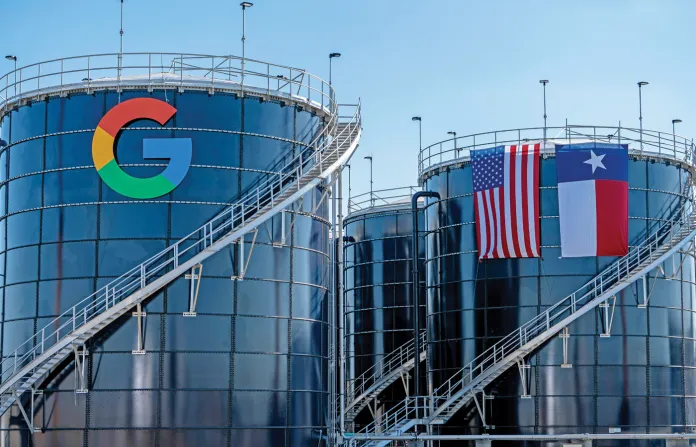
The Google logo joins the U.S. and Texas flags outside the Google Midlothian Data Center in Midlothian, Texas, Nov. 14, 2025.(Jonathan Johnson/Bloomberg/Getty)
" data-large-file="https://www.washingtonexaminer.com/wp-content/uploads/2026/09/Feat.Tech_.093026.jpg?w=696" height="658" width="1024" src="https://www.washingtonexaminer.com/wp-content/uploads/2026/09/Feat.Tech_.093026.jpg?w=696" alt="The Google logo joins the U.S. and Texas flags outside the Google Midlothian Data Center in Midlothian, Texas, Nov. 14, 2025.(Jonathan Johnson/Bloomberg/Getty)" class="wp-image-4743451" style="width:864px;height:auto" srcset="https://www.washingtonexaminer.com/wp-content/uploads/2026/09/Feat.Tech_.093026.jpg 1400w, https://www.washingtonexaminer.com/wp-content/uploads/2026/09/Feat.Tech_.093026.jpg?resize=300,193 300w, https://www.washingtonexaminer.com/wp-content/uploads/2026/09/Feat.Tech_.093026.jpg?resize=768,494 768w, https://www.washingtonexaminer.com/wp-content/uploads/2026/09/Feat.Tech_.093026.jpg?resize=1024,658 1024w, https://www.washingtonexaminer.com/wp-content/uploads/2026/09/Feat.Tech_.093026.jpg?resize=150,96 150w, https://www.washingtonexaminer.com/wp-content/uploads/2026/09/Feat.Tech_.093026.jpg?resize=696,447 696w, https://www.washingtonexaminer.com/wp-content/uploads/2026/09/Feat.Tech_.093026.jpg?resize=1068,687 1068w" sizes="auto, (max-width: 1024px) 100vw, 1024px">
The Google logo joins the U.S. and Texas flags outside the Google Midlothian Data Center in Midlothian, Texas, Nov. 14, 2025.(Jonathan Johnson/Bloomberg/Getty)
Apple, Google, Meta, Tesla, Oracle, and NVIDIA all have an established presence in Texas, most notably, the king of Big Tech himself, Elon Musk. A frontrunner in a full-court press to embrace and expand AI, one of Musk’s more recent ventures is the announcement to build Terafab, an enormous semiconductor manufacturing joint venture by Tesla, SpaceX, and Intel. It aims to produce over one terawatt of AI compute capacity per year once built.
Data centers are massive buildings that house computer servers, data storage systems, and networking equipment that process and distribute digital information. According to the Pew Research Center, there are already more than 3,000 data centers in the U.S. and another 1,500 proposed. They’re in demand now more than ever, thanks to the AI revolution, and there are a lot in Texas. Second to Virginia, Texas boasts the most operating data centers, thanks to its Big Tech-friendly attitude and abundance of rural areas.
According to KXAN, an NBC affiliate out of Austin, Texas, there are more than 300 data centers already operating in Texas. While 100 more are already under construction, 200 more are planned.
Abbott pumps the brakes
AI and the need for data centers has exploded, challenging Texas lawmakers to determine what’s best for a state that wants to remain welcoming to technology-based businesses, while still doing what’s right for Texans who range from optimistic to skeptical, to downright fearful.
In 2025, Gov. Greg Abbott (R-TX) welcomed Google to Texas and its $40 billion investment, saying he wanted Texas to become an “epicenter of AI development.” Just a year later, Abbott rolled up the welcome mat a bit, and it caused a stir.
“When Texas cools on data centers, Big Tech has a problem,” an August Bloomberg headline reads. A Reuters headline echoes a similar sentiment: “Texas Republicans turn against data centers, putting Big Tech on notice.”
Greg Abbott (R-TX) speaks in Dallas, March 27, 2026. (Gabriela Passos/AP)
" data-large-file="https://www.washingtonexaminer.com/wp-content/uploads/2026/09/Feat.Tech2_.093026.jpg?w=696" height="658" width="1024" src="https://www.washingtonexaminer.com/wp-content/uploads/2026/09/Feat.Tech2_.093026.jpg?w=696" alt="Greg Abbott (R-TX) speaks in Dallas, March 27, 2026. (Gabriela Passos/AP)" class="wp-image-4743453" style="width:828px;height:auto" srcset="https://www.washingtonexaminer.com/wp-content/uploads/2026/09/Feat.Tech2_.093026.jpg 1400w, https://www.washingtonexaminer.com/wp-content/uploads/2026/09/Feat.Tech2_.093026.jpg?resize=300,193 300w, https://www.washingtonexaminer.com/wp-content/uploads/2026/09/Feat.Tech2_.093026.jpg?resize=768,494 768w, https://www.washingtonexaminer.com/wp-content/uploads/2026/09/Feat.Tech2_.093026.jpg?resize=1024,658 1024w, https://www.washingtonexaminer.com/wp-content/uploads/2026/09/Feat.Tech2_.093026.jpg?resize=150,96 150w, https://www.washingtonexaminer.com/wp-content/uploads/2026/09/Feat.Tech2_.093026.jpg?resize=696,447 696w, https://www.washingtonexaminer.com/wp-content/uploads/2026/09/Feat.Tech2_.093026.jpg?resize=1068,687 1068w" sizes="auto, (max-width: 1024px) 100vw, 1024px">
Greg Abbott (R-TX) speaks in Dallas, March 27, 2026. (Gabriela Passos/AP)
Recently, Abbott ordered the Texas Commission on Environmental Quality to stop issuing new data center permits.
“Simply put, Texans must come first,” Abbott wrote in a Sept. 21 letter to the organization’s Executive Director, Kelly Keel. “Data centers must pay their own way, protect our grid and water and complete the ERCOT [Electric Reliability Council of Texas] and TWDB [Texas Water Development Board] audits. Until they do, TCEQ will issue no permits sought by data center projects.”
The issues surrounding planned data centers range from electricity and water use to tax breaks and the impact on local communities. Texas operates its own independent power grid separate from the rest of the country, so it must be careful.
“The Electric Reliability Council of Texas (ERCOT) is currently considering approximately 474 gigawatts of requests to connect to the Texas grid,” Abbott said in an August letter to grid operators and state regulators. “That is more than five times Texas’record peak electricity demand for ERCOT. Approximately 90 percent of the new power requests are data centers.”
Texans are wary
Abbott’s caution comes just as Texans are starting to reject, or at least demonstrate considerable cynicism, about data centers, too. Lifelong conservative Republican Dave Lowe told CBS News’s 60 Minutes that a proposed 800-acre data center campus near where he lives in Red Oak is even making him think about voting differently this year.
“This is the first time in my adult life where there’s been an issue that’s come up that I feel like is going to directly impact me,” Lowe said. “And so this time around, I’ve made the decision that I’m not going to vote red or blue; I’m going to vote for the candidate that is willing to speak up, and put up, and do something to help us with this issue.”
Protesters opposed to data center projects in downtown Austin, Sept. 2, 2026. (Jay Janner/Austin American-Statesman/Getty)
" data-large-file="https://www.washingtonexaminer.com/wp-content/uploads/2026/09/Feat.Tech3_.093026.jpg?w=696" height="658" width="1024" src="https://www.washingtonexaminer.com/wp-content/uploads/2026/09/Feat.Tech3_.093026.jpg?w=696" alt="Protesters opposed to data center projects in downtown Austin, Sept. 2, 2026. (Jay Janner/Austin American-Statesman/Getty)" class="wp-image-4743454" style="width:827px;height:auto" srcset="https://www.washingtonexaminer.com/wp-content/uploads/2026/09/Feat.Tech3_.093026.jpg 1400w, https://www.washingtonexaminer.com/wp-content/uploads/2026/09/Feat.Tech3_.093026.jpg?resize=300,193 300w, https://www.washingtonexaminer.com/wp-content/uploads/2026/09/Feat.Tech3_.093026.jpg?resize=768,494 768w, https://www.washingtonexaminer.com/wp-content/uploads/2026/09/Feat.Tech3_.093026.jpg?resize=1024,658 1024w, https://www.washingtonexaminer.com/wp-content/uploads/2026/09/Feat.Tech3_.093026.jpg?resize=150,96 150w, https://www.washingtonexaminer.com/wp-content/uploads/2026/09/Feat.Tech3_.093026.jpg?resize=696,447 696w, https://www.washingtonexaminer.com/wp-content/uploads/2026/09/Feat.Tech3_.093026.jpg?resize=1068,687 1068w" sizes="auto, (max-width: 1024px) 100vw, 1024px">
Protesters opposed to data center projects in downtown Austin, Sept. 2, 2026. (Jay Janner/Austin American-Statesman/Getty)
Lowe isn’t alone in his disdain. According to a July University of Texas/Texas Politics Project poll, 56% of Texas voters oppose the construction of AI data centers in their local communities, although Democrats and Independents are even more opposed. According to Gallup polling, more than 60% of Republicans, Independents, and Democrats all agree they don’t want a data center where they live.
Thus, Abbott has faced a unique challenge: Attract big tech investment and economic expansion while balancing AI and data centers with caution-oriented policies that offer some reasonable guardrails.
Brendan Steinhauser, a resident of Austin, is familiar with this. As the CEO of The Alliance for Secure AI Action, he is driven to educate the public about AI and to advocate for appropriate policies to safeguard it.
“We want to reap the benefits of advanced AI while mitigating the risks,” Steinhauser, a conservative, told the Washington Examiner magazine.
A Texas native with an office in Washington, D.C., Steinhauser understands Texans’ concerns.
“The zeitgeist in Texas, among Republicans, but everybody — because Democrats actually even more than Republicans — are saying we need to slow this down,” Steinhauser said. “I think that Governor Abbott is a good barometer of this, because he’s taken some pretty measured positions that are kind of data center skeptical or Big Tech skeptical, but I think are pretty in line with where the voters are.”
Abbott is up for reelection in less than two months, so it’s possible he’s correctly reading the room, especially since his race has tightened, at least according to some polls, much to the surprise of conservatives who live in Texas (as I do). A recent Marist poll shows Abbott trails his opponent, Democrat Gina Hinojosa, by 3 points, although most other polls show Abbott ahead.
Lawmakers on both sides of the aisle are starting to wake up to the public’s frustration and the way that AI has become a political flashpoint. But how to handle data centers and AI in policy terms varies.
“Republicans currently, whether they’re in the state legislature or in Congress… are more on the side of data center skeptical or a little more supportive of things like slowing down, pay your own way, transparency and accountability for the companies,” Steinhauser observed, though he noted there’s obviously a spectrum of views.
Sen. Ted Cruz (R-TX) is concerned with AI as it relates to national security, cybersecurity, and the possibility of AI hacking into our nation’s critical infrastructure.
“The United States is a primary target for cyber threats precisely because we lead the world in technological innovation,” Cruz said in a statement in a 2025 Senate Commerce Subcommittee on Telecommunications and Media hearing. “Our challenge, therefore, is to secure communications infrastructure effectively without creating excessive and useless regulation that stifles the very innovation that gives us our competitive edge.”
Cruz’s attempt to balance the pros and cons of AI without too much regulation, but with some safeguards, seems more common among conservative Texans. Many Democrats are calling for far more regulation.
After analyzing data on AI, Steinhauser makes a keen observation: Texans aren’t just pushing back against the physical ramifications of data centers. “The data center revolt is not just buildings and energy and water and all that stuff,” Steinhauser said. “It’s actually about the radical transformation of society that they kind of fear.”
He’s referring, of course, to the growing presence of AI in everyday life.
WAR ON DATA CENTERS A FRONT IN VITAL FIGHT FOR AI
According to TD’s second annual U.S. AI Insights Report, 78% of Americans use AI-enabled tools in their daily lives. But Pew Research reports that globally, more people expect AI to cause job losses than job growth. AI is one of those rare topics that seems to unite Americans across political parties. Nearly half of Texans (49%) expect AI to have a negative impact on the economy, according to the July University of Texas/Texas Politics Project poll. So this is the challenge Texas lawmakers, business owners, and residents are grappling with: How do they welcome Big Tech so that Texas’s economy keeps on humming to the tune of nearly $3 trillion, while trying to assuage the fears Texans have about data centers and AI, too?
“I do think AI is unique. It’s not like the steam engine, or the cotton gin, or the wheel. Those things were tools that we used. AI is what it says it is, it’s an artificial intelligence,” Steinhauser said. “As President Trump is calling it, a super intelligence, a superior intelligence. So, as we go down that route, it becomes very dangerous. You’re creating what the head scientist at OpenAI recently called ‘an alien mind in your midst.’ That’s scary. That’s dangerous. So, how do we preserve liberty in the free market with that sort of alien mind? Without any guardrails? I don’t think we can.”
Nicole Russell is an opinion columnist for USA Today. She lives in Texas with her four children.
Continue reading...
[ H/T Washington Examiner ]