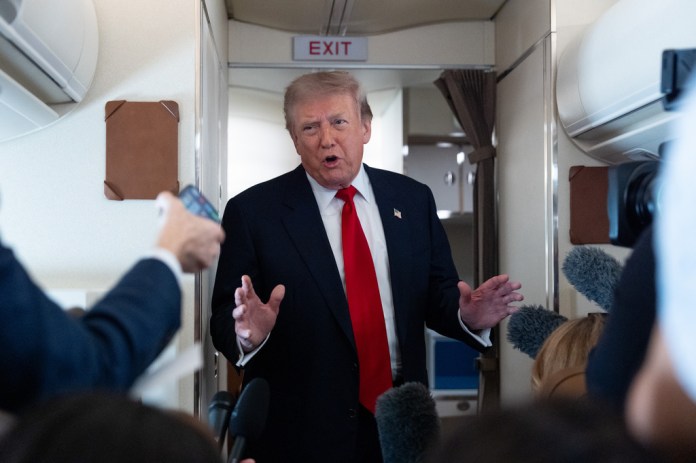




Recently, Walmart announced rollbacks on ground beef, ribs, soda, and thousands of other summer staples, part of a number of retailers following suit. President Donald Trump welcomed the news and noted that his administration had asked retailers to deliver for consumers. The media reaction was instant and predictable. CNN and others rushed to inform the country that the sale was already planned, and therefore, no credit to the president, while missing the entire point.
A retailer can schedule a sale whenever it likes. What it cannot do is cut prices it cannot afford. For four years under the Biden administration, sales came and went while grocery prices marched higher. The question worth asking is not who announced what first. It is why, after the worst food inflation in a generation, companies suddenly have room to lower prices at all. The answer is a policy environment that prioritizes American farmers and families.
Farm input costs largely determine the cost of food: fuel, labor, fertilizer, seed, and interest rates. During the Biden administration, price inflation exceeding 21% drove increases in farm production expenses. Those input costs, borne by farmers, increased roughly 40% and, in turn, got passed to consumers at the checkout line.
No sale, seasonal or otherwise, survives those spikes.
Policymakers and media commentators who ignored rising production costs since 2021 while demanding “lower food prices” are asking farmers to subsidize consumers out of their own pockets. The real solution is sensible policy changes like the ones made in the last year and a half that protect both farmers’ and consumers’ bottom lines.
Research from the America First Policy Institute has shown that there are a variety of win-win policies for farmers and consumers affecting prices, and that even small percentage declines in price at the grocery store can significantly ease pressure for working families. Many of these policies have been pursued by the Trump administration.
On his first day in office, Trump signed a memorandum directing all federal agencies to identify and implement price relief measures for consumers. This order included ending “crushing regulatory burden
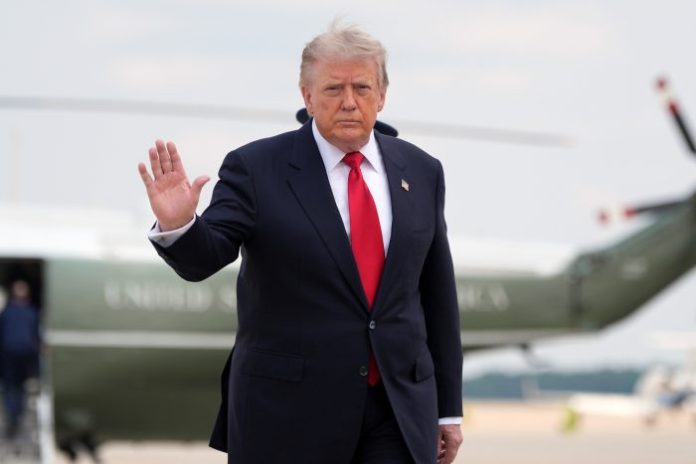
President Donald Trump waves as he walks from Marine One to board Air Force One, Monday, July 27, 2026, at Joint Base Andrews, Md. (AP Photo/Alex Brandon)
" data-image-caption="
President Donald Trump waves as he walks from Marine One to board Air Force One, Monday, July 27, 2026, at Joint Base Andrews, Md. (AP Photo/Alex Brandon)
" data-large-file="https://www.washingtonexaminer.com/.../07/AP26208579830464-e1785168755721.jpg?w=696" src="https://www.washingtonexaminer.com/.../07/AP26208579830464-e1785168755721.jpg?w=696" alt="President Donald Trump waves as he walks from Marine One to board Air Force One, Monday, July 27, 2026, at Joint Base Andrews, Md. (AP Photo/Alex Brandon)" class="wp-image-4664463" srcset="https://www.washingtonexaminer.com/wp-content/uploads/2026/07/AP26208579830464-e1785168755721.jpg 700w, https://www.washingtonexaminer.com/...08579830464-e1785168755721.jpg?resize=300,200 300w, https://www.washingtonexaminer.com/...08579830464-e1785168755721.jpg?resize=150,100 150w, https://www.washingtonexaminer.com/...08579830464-e1785168755721.jpg?resize=696,464 696w" sizes="(max-width: 700px) 100vw, 700px">
President Donald Trump waves as he walks from Marine One to board Air Force One, Monday, July 27, 2026, at Joint Base Andrews, Md. (AP Photo/Alex Brandon)
Examples of these in agriculture are frivolous climate lawsuits and environmental regulations that inflate costs for farmers and ranchers to produce the food that Americans eat. Farmers and ranchers were America’s first conservationists. They care for and know their land best. When third-party environmental groups were able to impose burdensome and unnecessary regulations on America’s producers, grocery costs rose. Thankfully, because of expanded energy production and deregulation, including commonsense refrigerant rules, more than $180 billion in family savings has been generated. This was realized through cuts to fuel, cooling, storage, and other energy costs borne in the food economy.
The Department of Justice and the Federal Trade Commission have also created a new “Food Supply Chain Security Task Force” aimed at identifying and stopping price fixing and attacking volatile farmer input costs. This, coupled with the DOJ’s investigation into collusion among major meatpackers, will strengthen competitive supply chains and ensure farmers don’t have to raise their prices.
Farmers have also been granted more than $30 billion in assistance since January 2025 to assist producers in continuing to plant while the cost squeeze is alleviated. The Working Families Tax Cuts also made an unprecedented combination of investments in the crop safety net, conservation, and trade promotion, and made tax relief permanent. The Small Business Administration also announced in March the “Grocery Guarantee,” a loan program backed by the federal government to help producers expand their food production with aims to lower grocery prices for American families.
America First reforms and investments are already working. Egg prices are down more than 90% from their early 2025 peaks. Avocados are down about 19%. Butter, cheese, berries, and chicken are also significantly down. Companies do not cut prices out of charity.
ADAM SMITH AND THE SCOTTISH FANS WHO REMINDED AMERICA WHY IT WORKS
They cut prices when their costs fall and when competition returns to their industries. Walmart’s rollback is not a coincidence of the calendar. This is the result of policy working its way from the farm gate to the checkout line.
Yes, big grocery stores planned summer sales. But smart policy reforms, including relief for Americans at the stores and in the fields, have made lower prices possible.
Kip Tom served as ambassador to the United Nations Food and Agriculture Agencies in Rome from 2019 to 2021 and now serves as vice chairman for Rural Policy at the America First Policy Institute.
Continue reading...
[ H/T Washington Examiner ]