





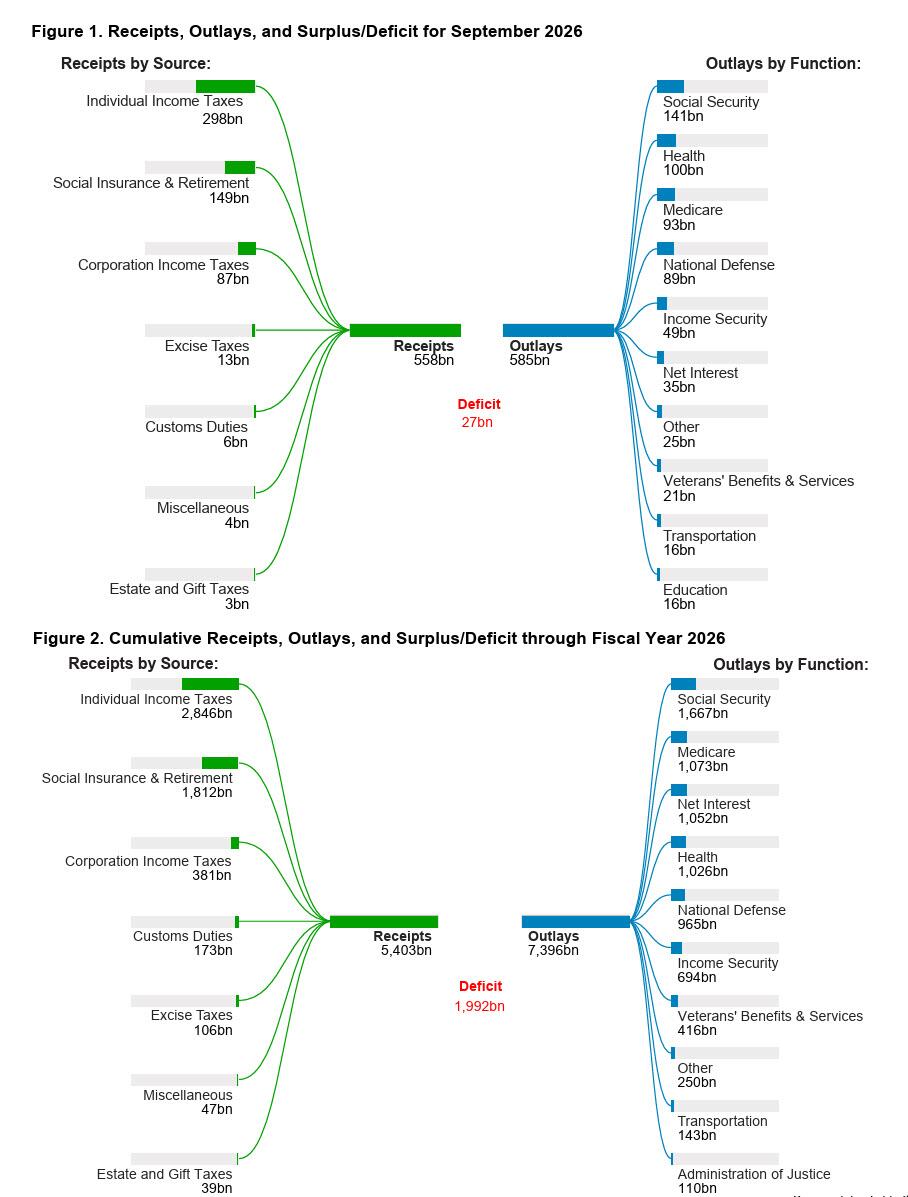

The federal budget deficit rose to nearly $2 trillion in fiscal 2026, the Treasury Department announced on Friday.
The shortfall is large for a nation not at war or in a recession, and shows that the government faces a long-term mismatch between spending and revenues.
Revenues have risen, but spending has risen even faster and has not slowed down under the administration of President Donald Trump and a Congress controlled by Republicans.
WHAT TO EXPECT FOR INFLATION, JOBS, STOCKS, AND HOUSING IN THE YEAR AHEAD
The government said that it took in $4.5 trillion in tax revenue but spent $7.4 trillion.
Over the long term, rising spending on healthcare and retirement programs has driven much of the difference between spending and taxes. In fiscal 2026, $1.67 trillion was on Social Security.
But in recent years, costs for paying interest on the debt have also soared, thanks to rising yields on Treasury securities. Last month, the yield on the benchmark 10-year Treasury crossed 5%, which is the highest yield on that security since the summer of 2007, near the start of the financial crisis and the Great Recession.
The U.S. spent $1.1 trillion on interest payments on the debt this past year. For context, that is more than total national defense spending, which was $965 billion in fiscal 2026. The national debt recently hit $40 trillion.
Former Democratic Georgia Rep. Carolyn Bourdeaux, the executive director of the deficit reduction group the Concord Coalition, said that, absent action from lawmakers, the federal government is “careening toward an ominous fiscal crisis.”
HERE IS HOW MUCH PRICES FOR GROCERIES, GAS, UTILITIES, AND SHELTER ARE UP UNDER TRUMP
“Week after week, we continue to receive dire warnings about the nation’s skyrocketing debt and unsustainable annual deficits, yet Washington continues to ignore these warnings,” she said. “We all need to recognize that this is not just a threat to our future; it is affecting us now with rising interest rates that make borrowing more expensive for families, businesses and the federal government.”
Another major problem facing Congress in the years ahead is the looming exhaustion of the Social Security retirement trust in 2032. Senior citizens would face a cut in their benefits of about a fifth at that time unless Congress acts, according to the program’s trustees.
Continue reading...
[ H/T Washington Examiner ]