






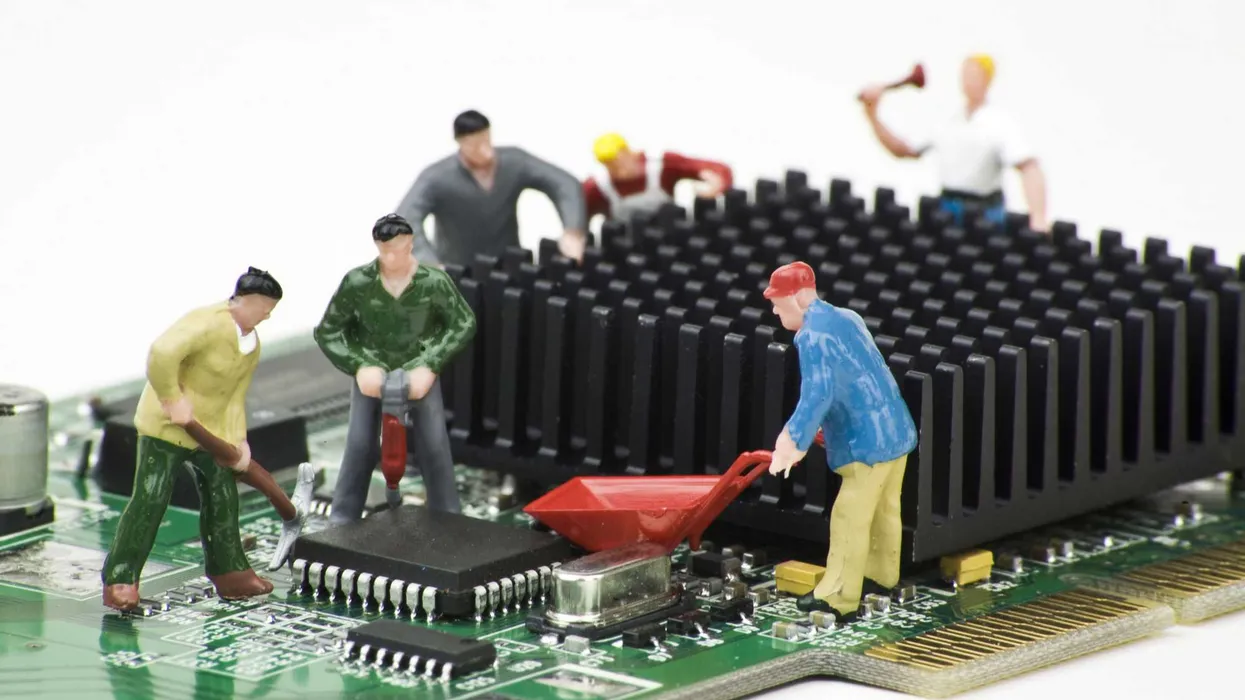
If you have recently bought a new vehicle, replaced a laptop, or purchased a new phone, you have likely noticed that almost everything costs more to buy and to repair. Most people chalk this up to general inflation or bad luck. Behind the scenes, however, a hidden culprit is driving up prices and slowing modern conveniences: the tiny microchip.
That’s why Applied Materials’ recent announcement of the EPIC Center, a massive research facility designed to shorten chip development timelines by at least 30%, is so important. On paper, it sounds like just another corporate ribbon-cutting. In reality, it might be the only thing standing between American economic dominance and total technological obsolescence and between extortion of American citizens and reasonably priced products.
Faster microchips help keep food prices stable and grocery shelves full.
Most people treat microchips like clean socks. They notice them only when they run out or when they suddenly cost far more than they did last week. Yet almost every single aspect of your daily routine depends on these microscopic pieces of silicon. Your morning coffee maker uses them. The anti-lock brakes in your car use them. The hospital machine that monitors your heart rate depends on them entirely. If those chips stop improving, or if the supply line powering them breaks, the entire system grinds to a sudden halt.
Consider what happened just a few years ago, when new-car lots sat empty across the country and used-car prices soared to absurd heights. That massive disruption didn’t happen because automakers ran out of steel, rubber, or glass, but because Asian factories couldn’t ship those tiny microchips. When chip designs stall or supply chains hit bottlenecks, companies aren’t the only ones to suffer. They pass extra costs straight on to consumers, adding to the price of everyday goods.
Creating a new generation of microchips used to be a relatively straightforward task. A few decade-defining breakthroughs could be sketched in a lab by a handful of brilliant, chain-smoking engineers. Today, advancing from a lab discovery to a mass-produced processor takes many years and requires enormous investment. Because chip design has become so slow and costly, technology upgrades have grown pricier; hardware improvements have begun to plateau.
The new $5 billion EPIC Center aims to break this bottleneck by bringing chipmakers, university researchers, and hardware engineers under one roof, letting them solve problems in parallel instead of waiting years to pass ideas back and forth. It’s a common-sense, America-first approach.
If the venture is successful, it means cheaper, more reliable consumer goods.
RELATED: Trump finally shut down this tech giant's America-last hiring policy

To begin with, faster chip development translates directly into stronger supply lines and lower manufacturing costs. When tech moves seamlessly from research labs to factory floors, the cost of building everything from smart washing machines to high-definition TVs drops. That keeps everyday household goods from jumping dramatically in price every year.
Second, it means devices with real battery life that lasts for years rather than months. Everyone knows the blood-boiling frustration of a phone battery dying by midafternoon or a laptop running slower than a DMV queue after 18 months of light use. Making electronics run faster without burning through power requires fundamental breakthroughs in microchip energy efficiency. Accelerating those hardware breakthroughs means your personal devices will run cooler and last longer on a single charge, potentially saving you thousands of dollars in upgrade costs.
Third, it accelerates lifesaving health care and medical treatment. Modern AI is often portrayed as nothing more than a tool for lazy college students or Silicon Valley tech bros. This is utter nonsense. It is also a form of super-powered pattern recognition. In modern hospitals, AI systems powered by specialized chips can analyze thousands of medical scans, blood samples, and diagnostic records in seconds, catching dangerous illnesses like cancer long before human eyes could spot them. Faster, more accessible microchips make this diagnostic equipment far cheaper and easier for local hospitals to deploy. This results in shorter wait times, earlier disease detection, and, perhaps most importantly, more accurate treatment for you and your family.
Finally, faster microchips help keep food prices stable and grocery shelves full. The elaborate shipping networks that deliver fresh produce from farms to your neighborhood supermarket rely on routing software. When shipping routes or trucking schedules run inefficiently, food spoils in transit. Deliveries arrive late, and grocery prices spike. Smarter chips power logistics networks that can predict weather delays and reroute delivery fleets in real time.
It is easy to completely tune out news about corporate mega-facilities or abstract headlines about the global technology race between the United States and China. Ultimately, though, microchips are the invisible, indispensable force powering every aspect of modern life. When chip development accelerates, the everyday technology you rely on becomes cheaper, safer, and far more dependable. And that $5 billion investment in California is a practical step toward making the average American’s daily life run more smoothly and the nation more secure.
Continue reading...
[H/T Blaze Media]