



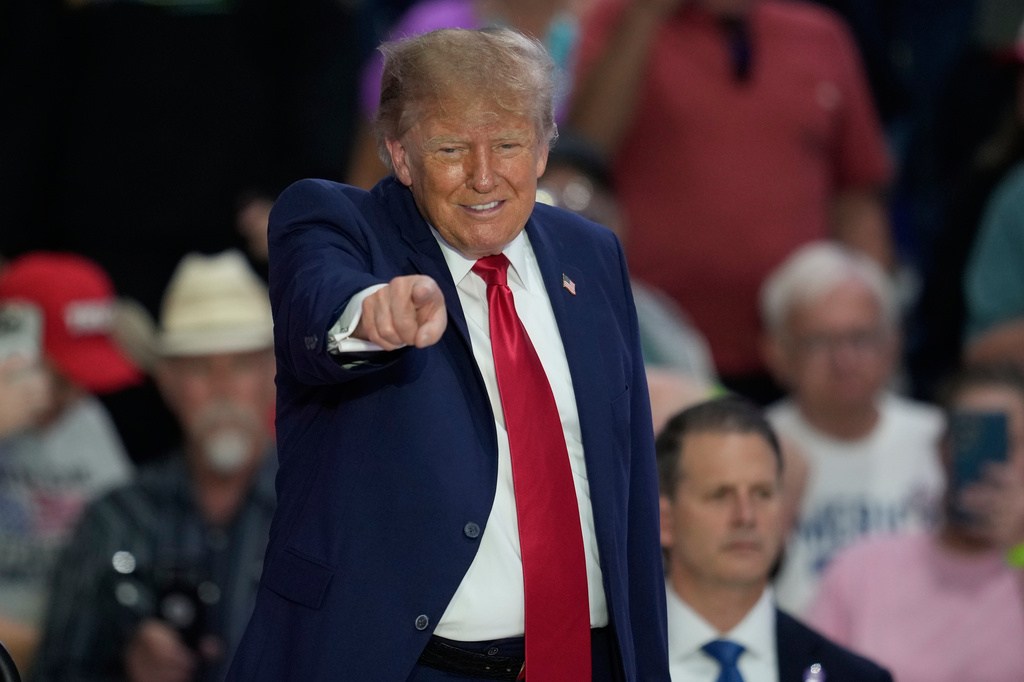
According to recent intelligence from the U.S. intelligence community, the Islamic Republic of Iran plans to harm and physically eliminate President Donald Trump. Reports of intelligence received by the United States on the Islamic Republic’s escalating efforts to assassinate Trump are not merely alarming news about presidential security. They expose one of the most dangerous dimensions of Washington’s current confrontation with Tehran’s occupying, terrorist regime.
The U.S. has transferred additional military equipment, ammunition, and interceptor systems to Israel and other regional countries, and further strikes against Tehran’s Shiite mullah regime have been raised as a possibility to liberate 90 million people held captive under the Shiite mullahs’ religious tyranny in Iran. Alongside its military threats, Tehran continues to contemplate one of authoritarianism’s oldest instruments: physically eliminating a political enemy. U.S. court records document a history of assassination threats against Trump by operatives linked to the Islamic Revolutionary Guard Corps. Anyone who reads the history of Shiite terrorism knows that the only good mullah is a dead mullah!
The White House speaks of considering a limited three-to-four-day military operation — whose capacity to fundamentally alter the existing political and security balance remains unclear, because the White House still lacks genuine resolve to replace this criminal cartel’s regime, while deluded optimists wish to pose as peacemakers and pursue diplomacy with the savage mullahs and the terrorist Revolutionary Guard! Meanwhile, Israeli military officials report readiness for a broader war, while commanders of the occupying, repressive Tehran regime’s terrorist organizations issue delusional, deranged threats daily, declaring that any signs of attack will prompt them to act without waiting, setting everything ablaze to drag everyone into a vortex of destruction. Strategically, this situation is dangerous because three factors converge: the erosion of conventional deterrence under the Islamic Caliphate regime — commonly known as the Islamic Republic — the growing likelihood of preemptive war, and the possible shift of part of the conflict into terrorist and asymmetric operations.
The bitter truth of political history is that when authoritarian, ideological governments can no longer prevail on the battlefield, they seek to change history by eliminating pivotal figures. In such systems, political assassination is not merely revenge. It is an attempt to supplant the will of nations and governments with that of savage killers. From this perspective, the threat to Trump’s life must be examined not merely as a matter of presidential protection, but as a threat to national sovereignty, independent U.S. political decision-making, and American national security. This very failure to understand Islamist terrorism gave rise to the Sept. 11, 2001 terrorist attacks.
Since its establishment in 1979 — under the fraudulent name of a republic — the regime of thugs and terrorist mobs has used political violence, radicalism, and Islamist terrorism not merely to consolidate the despised Shiite clerical establishment’s power within Iran, but gradually as foreign-policy instruments as well. In other words, this regime relied on terrorism to acquire power and wealth and retain power for half a century. Naturally, it can only be removed through war. The hostage-taking of American diplomats, support for Islamist Terrorist proxies under the sinister, fraudulent labels of “resistance” and “jihad,” overseas operations, and pursuit of dissidents abroad all reflect a poisoned mindset recognizing no fundamental distinction between an ideological regime’s interests and expediencies and the rules governing international relations. In this dark, criminal worldview, a political enemy is not simply a negotiating or bargaining rival, but an entity to be contained, intimidated, and eliminated. This is precisely where the modern democratic state’s logic clashes with that of terrorist Islamic rule.
Case files at Washington’s counterterrorism centers have transformed this danger from theory into a national security reality. Repeatedly, operatives linked to the Revolutionary Guard or the Ministry of Intelligence have plotted Trump’s murder and even hired killers. Some, of course, have been arrested and charged, but the regime’s terrorist sleeper cells and Islamic Republic–linked networks remain active on American soil. Despite their legal and operational differences, these cases reveal a common pattern: using intermediaries and criminal networks to perpetrate political violence within the U.S. The terrorists have spread like AIDS.
More troubling still, such operations do not necessarily require an army, missiles, or sophisticated military equipment. With limited funding, clandestine contacts, and locally recruited criminals, a government’s intelligence apparatus can create a threat whose political consequences far exceed its operatives’ capabilities. This defines asymmetric warfare: turning military weakness into a security threat through fear, surprise, and disruption of an adversary’s calculations. Thus, destroying part of the Islamic Republic’s missile capabilities or military facilities does not necessarily eliminate its capacity for covert operations.
The identification, identity monitoring, intelligence-gathering, and punishment of Iranian dissidents abroad must alert U.S. counterterrorism agencies. Specific assassination operations and the confirmed activation of sleeper cells are unambiguous. Combined with the known record of transnational repression, these indicators underscore the need for counterintelligence vigilance and preventive investigations.
The threat to Trump matters not merely for its security implications, but also for his historical role. The world needs Trump because his presidency has coincided with one of the modern era’s most decisive security tests. Trump gradually weakened the Islamic Republic’s operational network, then humiliatingly eliminated the supreme leader of the world’s terrorists — Ali Khamenei — and members of his criminal sect, such as Qassem Soleimani. An even greater historical opportunity now awaits him: to translate America’s military superiority into a security order in which the Islamic Republic can no longer use state-sponsored terrorism, nuclear threats, and proxy wars as instruments of survival. But because terrorism, hostility, and crisis are integral to this fraudulent regime’s identity and DNA, the only solution is regime change and the destruction of its occupying, repressive leadership.
History teaches that political courage without strategic wisdom can lead to short-lived victories and long-term defeats. Here, the distinction between a victorious commander and a historically consequential statesman becomes clear. Destroying military targets may bring a commander victory, but a statesman succeeds only by transforming an operation’s outcome into a lasting order. If Washington reenters the cycle of futile, farcical negotiations, concessions, and restoration of the Islamic Republic’s capabilities, the historic opportunity will be squandered.
Meanwhile, American policy’s fundamental contradictions are troubling. Trump speaks of extensive strikes against the Islamic Republic’s military and nuclear capabilities while remaining open to continued negotiations. What, truly, can dialogue with terrorists accomplish? From a terrorist’s perspective, negotiations confer legitimacy and inherently signal weakness. Diplomacy without a clearly defined ultimate objective, enforceable guarantees, or an assessment of the other side’s nature now buys Tehran’s regime time to recover and continue its parasitic existence. No lasting regional security agreement is possible with a system whose affiliated operatives stand accused of plotting to murder senior officials of the very country negotiating with it. The illusion of diplomacy must be abandoned, and state-sponsored terrorism and threats against American officials and citizens must be taken seriously as matters transcending imaginary negotiations and political bargaining. No nuclear-limitation agreement can address a transnational security network’s threat. Genuine security requires more than reducing uranium stockpiles or destroying military equipment. The time has come to end a violent, uncivilized, hostage-taking, corrupt regime.
The issue transcends Trump himself. An attempt by a foreign, occupying, terrorist government to murder the U.S. president assaults the fundamental principles of American law. Tehran’s ultimate objective is to change a nation’s decisions through violence and assassination. Even Trump’s fiercest opponents must understand that protecting his life neither defends the Republican Party nor endorses his personal policies. It defends America’s independence and national interests.
JD VANCE FOUND A NEW PEN PAL: AN IRGC TERRORIST WITH AMERICAN BLOOD ON HIS HANDS
Here, Israel’s security, America’s security, and the Iranian people’s freedom are intertwined. The Islamic Republic — with its Islamist-left lobbies, the so-called reformists — has sought to transform domestic crises into regional conflicts by tying its political survival to external hostility. The Iranian people, victims of this murderous government’s repressive machinery, deserve a future free of state-sponsored terrorism and the danger of war. Regime change in Tehran, alongside support for the Iranian nation’s demand, could begin a greater transformation in Middle Eastern history. Under these circumstances, U.S. intelligence agencies must accurately assess threats, uncover networks, and prevent operations. Protecting Trump is essential. Tehran’s savage mullahs must not imagine that threatening the American president’s life can break Washington’s political resolve or spare them accountability.
I hope Trump lives long enough and has sufficient time to witness a great transformation that could reshape global security for generations: an end to the Islamic Republic’s ability to wield terrorism as an instrument of power. If he can defeat the Islamist terrorist regime, that historic achievement will transcend a single presidential term and matter to humanity’s future. Trump now faces such a momentous historical judgment and decision. The world needs security, stability, peace, and an end to terrorism. And the world still needs Trump, because he can help end this regime in Iran. If he emerges from this historic test with honor, his most important legacy will await future generations. And history will one day place his name alongside leaders who changed the world’s course.
Erfan Fard is a counterterrorism analyst and Middle East studies researcher based in Washington, with a particular focus on Iran, Islamic terrorism, and ethnic conflicts in the region.
Continue reading...
[ H/T Washington Examiner ]