



Submitted by Mary Christine
Guest Post by The Big Short
For the first time since 1945, the leaders of the three biggest Western powers stood in the same room and said the same thing out loud. The world order is over.
Not shifting. Not evolving. Over.
Germany’s chancellor said the structure that held the planet together for 80 years no longer exists. France’s president said Europe has to prepare for war. The US Secretary of State said the old world is gone.
If three heads of state had said this ten years ago, markets would have crashed by Monday. In 2026, it barely moved the S&P 500. That tells you everything you need to know about how asleep most investors are.
Because the person who has been warning about this exact moment for a decade just published 60 pages explaining what happens next. His name is Ray Dalio. He runs one of the biggest hedge funds in history. He built his career studying how empires rise and fall over 500-year windows.
And his framework is now describing the present tense, not the future.
The Six Stages of a Dying World
Dalio divides every world order into six stages. The first five are the quiet ones. Peace, prosperity, debt, overreach, cracks. We lived through all five between 1945 and roughly 2015.
Stage six is where it gets ugly. Stage six is where “there are no rules, might is right, and great powers clash.”
Read that sentence twice. It is not metaphorical. It is the technical definition of what happens when a system of international agreements breaks down and no new system has replaced it yet. The old referee walks off the field. The new referee has not been named. For a window of years, the strongest player simply does what it wants.
The last time the world was in stage six was 1930 to 1945. You know what came out of it. Fifty million people dead. Two cities vaporized. Entire economies restructured. Currencies collapsed. Wealth transferred violently from the countries that lost to the country that won.
And here is the part most people miss. The war itself was only the final chapter. The economic war ran for a full decade before the first bomb dropped. Tariffs in 1930. Trade restrictions in 1931. Asset freezes in 1935. Oil embargoes in 1941. By the time Pearl Harbor happened, the shooting war was almost a formality. The real war had been running for eleven years.
Look at what is happening right now. Tariffs between the US and China. Chip export bans. Russian assets frozen in Western banks. Capital market restrictions. Sanctions stacked on sanctions. Supply chain weaponization.
If Dalio’s framework is right, we are not entering the pre-war period. We are already five years into it.
The Five Wars That Happen Before the Shooting Starts
Dalio names them explicitly. Trade war. Technology war. Capital war. Geopolitical war. Military war.
The first four are already underway. Each one builds pressure on the next.
Trade war is the easiest to see. Tariffs are back at levels not seen since the Smoot-Hawley Act of 1930. The country that passed that act, by the way, triggered the economic spiral that led directly to World War II. Every historian agrees on this. Every policymaker who studies the period knows it. And yet here we are again.
Technology war is the one most people underestimate. The US has cut China off from the most advanced chips in the world. China has cut the US off from rare earth metals that the entire semiconductor industry depends on. Each side is trying to strangle the other’s ability to build the next generation of military and economic infrastructure. This is not trade friction. This is pre-war positioning.
Capital war is where your money lives. The US froze $300 billion of Russian central bank assets in 2022. That single act told every other country on earth that holding dollars is now a political decision, not a neutral one. The reaction has been immediate and quiet. Central banks have been dumping Treasuries and buying gold at the fastest pace in modern history. Gold is up over 60% in the last 18 months. Nobody on CNBC is explaining why. The reason is on page 42 of Dalio’s chapter.
Geopolitical war is the open map of alliances being redrawn. Saudi Arabia pricing oil in yuan. BRICS expanding to include Iran and the UAE. Europe building a defense industry independent of American weapons. Japan rearming for the first time since 1947. Every one of these moves is a country hedging against a world where the US is no longer the guaranteed protector.
Military war is the fifth one. Dalio says the biggest risk of military war is when “both parties have military powers that are roughly comparable and irreconcilable existential differences.”
The United States and China. Over Taiwan. That is his specific example. He wrote it before Covid. The chip supply chain hasn’t moved an inch away from Taiwan since. If anything, both sides have doubled down on how much they are willing to risk over an island of 23 million people.
What History Says Happens to Money Next
Here is the part of Dalio’s chapter that should keep every investor awake at night.
He studied every major war of the last 500 years. He tracked what happened to currencies, bonds, stocks, and gold through each one. The pattern is almost perfectly consistent.
Before the war, currencies feel strong. Stocks keep rallying. Bonds pay what they promise. Everyone believes the system will hold. This is the quiet period. It can last ten years. It feels permanent while you are inside it.
Then the economic war begins. Tariffs. Sanctions. Asset freezes. Markets become more volatile but still trend up because the underlying system is still intact. People who sell early look foolish.
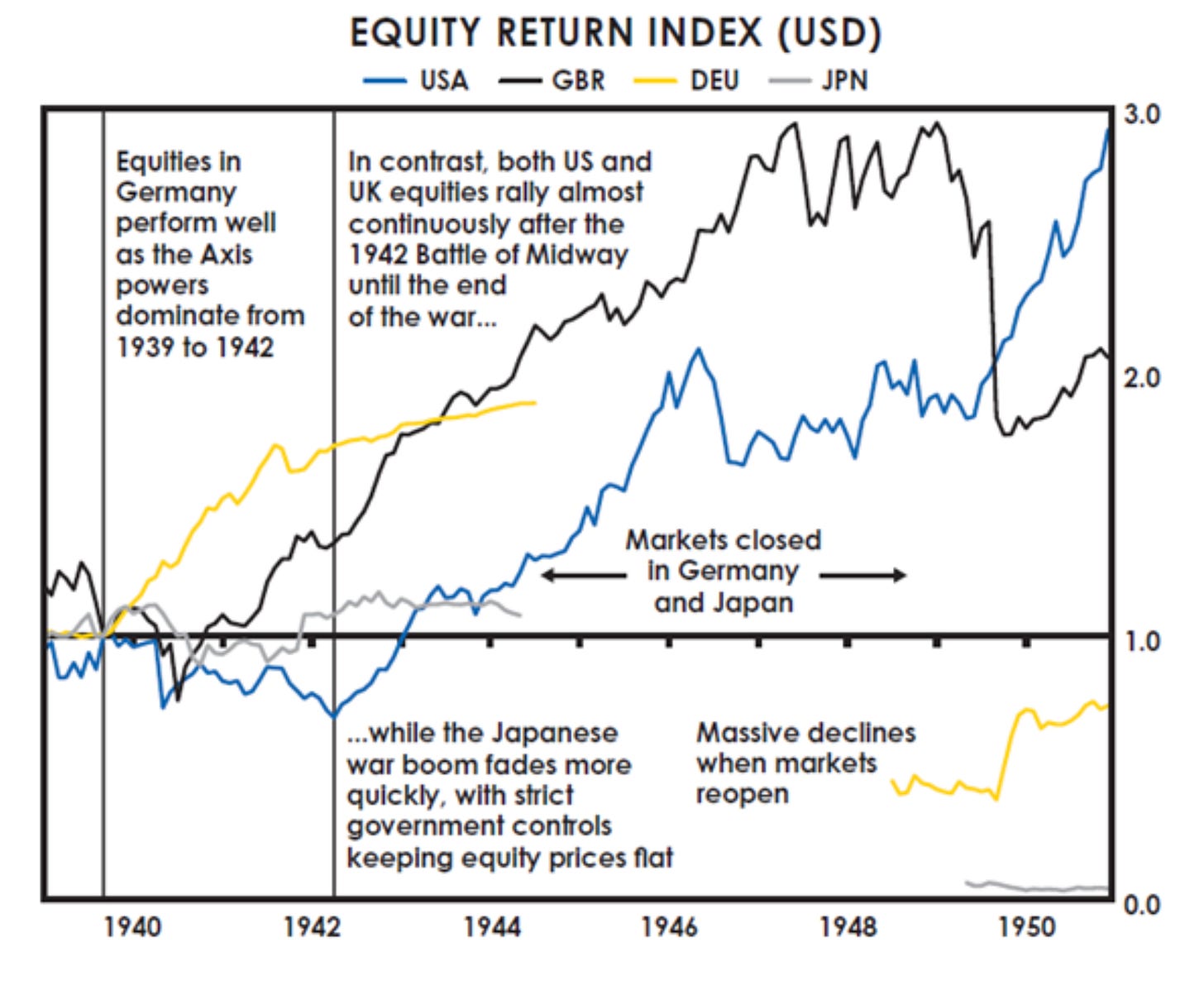
Then the real war begins. Stock markets in losing countries get wiped out. Germany’s and Japan’s stock exchanges were closed for five years at the end of World War II. When they reopened, previous shareholders had lost almost everything. Currencies in losing countries become worthless. The Reichsmark went to zero. The yen collapsed. Bonds in losing countries defaulted or got inflated into nothing.
The one asset that worked in every single war Dalio studied, going back to the 1600s, was gold.
Not because gold is magical. Because gold is the only form of money that is not someone else’s liability. A dollar is a US government IOU. A euro is an ECB IOU. A bond is a corporate or government IOU. A stock is a claim on future profits that only exists if the issuing company and country survive.
Gold is just gold. When countries stop trusting each other’s paper, they fall back on the one thing that has worked for 5,000 years.
Central banks already know this. That’s why they are buying it. The retail investor is the last one to figure it out.
The Specific Mistake Most Investors Will Make
Dalio has one line in the chapter that reads like a prophecy.
“Before there is a shooting war there is usually an economic war. As is also typical, before all-out wars are declared there is about a decade of economic, technological, geopolitical, and capital wars, during which the conflicting powers intimidate each other, testing the limits of each other’s power.”
A decade.
The economic war started around 2018. The chip export controls started around 2020. The Russian asset freeze happened in 2022. Each move raised the stakes. Each move was answered by the other side.
If the pattern Dalio documented across 500 years holds, we are somewhere between year five and year seven of a ten-year countdown.
Most investors are positioned as if the countdown isn’t happening. 60% US stocks. 40% US bonds. All of it denominated in dollars. All of it dependent on the world order that was just officially pronounced dead by three heads of state.
That portfolio made sense when the US was the undisputed global hegemon and the dollar was the undisputed global reserve currency. Both of those facts are now being actively contested by half the world’s population.
The investors who studied Dalio’s framework a decade ago already moved. They bought gold at $1,200. They bought bitcoin at $8,000. They bought real assets, commodities, and productive businesses in countries that aren’t exposed to the US-China fault line. They diversified currency exposure out of dollars and into a basket of hard assets.
Everyone else is still debating whether the next Fed meeting will cut rates by 25 or 50 basis points, as if that is the thing that matters.
The Only Framework That Explains What You’re Watching
If you have been reading the news for the past three years and nothing has made sense, this is why.
The old mental model stopped working around 2020 and nobody updated it. The world you grew up in was a specific historical arrangement, not the default state of humanity. That arrangement had rules. Those rules are now being torn up in real time.
The new world does not have rules yet. For some period of years, probably a decade, the strongest countries will do whatever they can get away with. The weaker countries will scramble to find protection. Alliances will shift faster than at any time since the 1930s. Capital will flow in strange directions. Prices of assets you have never paid attention to will move in ways that look crazy until you understand the framework underneath.
Dalio has been publishing this framework for ten years. He updated it this month because the pattern he predicted is now the pattern that is playing out. He is not guessing. He is reading the same chart he has been reading for a decade and telling you what it says.
The question is not whether the world is changing. The question is whether you will change your positioning before or after the next phase of the cycle hits.
The investors who moved early in 1935 kept their wealth through the 1940s. The investors who waited lost everything.
That is the lesson from the only historical case we have of this exact transition.
Dalio spent 500 pages making sure you cannot say nobody warned you.
Tweet
Continue reading...
[ H/T The Burning Platform ]
Guest Post by The Big Short
For the first time since 1945, the leaders of the three biggest Western powers stood in the same room and said the same thing out loud. The world order is over.
Not shifting. Not evolving. Over.
Germany’s chancellor said the structure that held the planet together for 80 years no longer exists. France’s president said Europe has to prepare for war. The US Secretary of State said the old world is gone.
If three heads of state had said this ten years ago, markets would have crashed by Monday. In 2026, it barely moved the S&P 500. That tells you everything you need to know about how asleep most investors are.
Because the person who has been warning about this exact moment for a decade just published 60 pages explaining what happens next. His name is Ray Dalio. He runs one of the biggest hedge funds in history. He built his career studying how empires rise and fall over 500-year windows.
And his framework is now describing the present tense, not the future.
The Six Stages of a Dying World
Dalio divides every world order into six stages. The first five are the quiet ones. Peace, prosperity, debt, overreach, cracks. We lived through all five between 1945 and roughly 2015.
Stage six is where it gets ugly. Stage six is where “there are no rules, might is right, and great powers clash.”
Read that sentence twice. It is not metaphorical. It is the technical definition of what happens when a system of international agreements breaks down and no new system has replaced it yet. The old referee walks off the field. The new referee has not been named. For a window of years, the strongest player simply does what it wants.
The last time the world was in stage six was 1930 to 1945. You know what came out of it. Fifty million people dead. Two cities vaporized. Entire economies restructured. Currencies collapsed. Wealth transferred violently from the countries that lost to the country that won.
And here is the part most people miss. The war itself was only the final chapter. The economic war ran for a full decade before the first bomb dropped. Tariffs in 1930. Trade restrictions in 1931. Asset freezes in 1935. Oil embargoes in 1941. By the time Pearl Harbor happened, the shooting war was almost a formality. The real war had been running for eleven years.
Look at what is happening right now. Tariffs between the US and China. Chip export bans. Russian assets frozen in Western banks. Capital market restrictions. Sanctions stacked on sanctions. Supply chain weaponization.
If Dalio’s framework is right, we are not entering the pre-war period. We are already five years into it.
The Five Wars That Happen Before the Shooting Starts
Dalio names them explicitly. Trade war. Technology war. Capital war. Geopolitical war. Military war.
The first four are already underway. Each one builds pressure on the next.
Trade war is the easiest to see. Tariffs are back at levels not seen since the Smoot-Hawley Act of 1930. The country that passed that act, by the way, triggered the economic spiral that led directly to World War II. Every historian agrees on this. Every policymaker who studies the period knows it. And yet here we are again.
Technology war is the one most people underestimate. The US has cut China off from the most advanced chips in the world. China has cut the US off from rare earth metals that the entire semiconductor industry depends on. Each side is trying to strangle the other’s ability to build the next generation of military and economic infrastructure. This is not trade friction. This is pre-war positioning.
Capital war is where your money lives. The US froze $300 billion of Russian central bank assets in 2022. That single act told every other country on earth that holding dollars is now a political decision, not a neutral one. The reaction has been immediate and quiet. Central banks have been dumping Treasuries and buying gold at the fastest pace in modern history. Gold is up over 60% in the last 18 months. Nobody on CNBC is explaining why. The reason is on page 42 of Dalio’s chapter.
Geopolitical war is the open map of alliances being redrawn. Saudi Arabia pricing oil in yuan. BRICS expanding to include Iran and the UAE. Europe building a defense industry independent of American weapons. Japan rearming for the first time since 1947. Every one of these moves is a country hedging against a world where the US is no longer the guaranteed protector.
Military war is the fifth one. Dalio says the biggest risk of military war is when “both parties have military powers that are roughly comparable and irreconcilable existential differences.”
The United States and China. Over Taiwan. That is his specific example. He wrote it before Covid. The chip supply chain hasn’t moved an inch away from Taiwan since. If anything, both sides have doubled down on how much they are willing to risk over an island of 23 million people.
What History Says Happens to Money Next
Here is the part of Dalio’s chapter that should keep every investor awake at night.
He studied every major war of the last 500 years. He tracked what happened to currencies, bonds, stocks, and gold through each one. The pattern is almost perfectly consistent.
Before the war, currencies feel strong. Stocks keep rallying. Bonds pay what they promise. Everyone believes the system will hold. This is the quiet period. It can last ten years. It feels permanent while you are inside it.
Then the economic war begins. Tariffs. Sanctions. Asset freezes. Markets become more volatile but still trend up because the underlying system is still intact. People who sell early look foolish.
Then the real war begins. Stock markets in losing countries get wiped out. Germany’s and Japan’s stock exchanges were closed for five years at the end of World War II. When they reopened, previous shareholders had lost almost everything. Currencies in losing countries become worthless. The Reichsmark went to zero. The yen collapsed. Bonds in losing countries defaulted or got inflated into nothing.
The one asset that worked in every single war Dalio studied, going back to the 1600s, was gold.
Not because gold is magical. Because gold is the only form of money that is not someone else’s liability. A dollar is a US government IOU. A euro is an ECB IOU. A bond is a corporate or government IOU. A stock is a claim on future profits that only exists if the issuing company and country survive.
Gold is just gold. When countries stop trusting each other’s paper, they fall back on the one thing that has worked for 5,000 years.
Central banks already know this. That’s why they are buying it. The retail investor is the last one to figure it out.
The Specific Mistake Most Investors Will Make
Dalio has one line in the chapter that reads like a prophecy.
“Before there is a shooting war there is usually an economic war. As is also typical, before all-out wars are declared there is about a decade of economic, technological, geopolitical, and capital wars, during which the conflicting powers intimidate each other, testing the limits of each other’s power.”
A decade.
The economic war started around 2018. The chip export controls started around 2020. The Russian asset freeze happened in 2022. Each move raised the stakes. Each move was answered by the other side.
If the pattern Dalio documented across 500 years holds, we are somewhere between year five and year seven of a ten-year countdown.
Most investors are positioned as if the countdown isn’t happening. 60% US stocks. 40% US bonds. All of it denominated in dollars. All of it dependent on the world order that was just officially pronounced dead by three heads of state.
That portfolio made sense when the US was the undisputed global hegemon and the dollar was the undisputed global reserve currency. Both of those facts are now being actively contested by half the world’s population.
The investors who studied Dalio’s framework a decade ago already moved. They bought gold at $1,200. They bought bitcoin at $8,000. They bought real assets, commodities, and productive businesses in countries that aren’t exposed to the US-China fault line. They diversified currency exposure out of dollars and into a basket of hard assets.
Everyone else is still debating whether the next Fed meeting will cut rates by 25 or 50 basis points, as if that is the thing that matters.
The Only Framework That Explains What You’re Watching
If you have been reading the news for the past three years and nothing has made sense, this is why.
The old mental model stopped working around 2020 and nobody updated it. The world you grew up in was a specific historical arrangement, not the default state of humanity. That arrangement had rules. Those rules are now being torn up in real time.
The new world does not have rules yet. For some period of years, probably a decade, the strongest countries will do whatever they can get away with. The weaker countries will scramble to find protection. Alliances will shift faster than at any time since the 1930s. Capital will flow in strange directions. Prices of assets you have never paid attention to will move in ways that look crazy until you understand the framework underneath.
Dalio has been publishing this framework for ten years. He updated it this month because the pattern he predicted is now the pattern that is playing out. He is not guessing. He is reading the same chart he has been reading for a decade and telling you what it says.
The question is not whether the world is changing. The question is whether you will change your positioning before or after the next phase of the cycle hits.
The investors who moved early in 1935 kept their wealth through the 1940s. The investors who waited lost everything.
That is the lesson from the only historical case we have of this exact transition.
Dalio spent 500 pages making sure you cannot say nobody warned you.
Tweet
Continue reading...
[ H/T The Burning Platform ]