




Guest Post by QTR
If I had to boil down my entire view of the market right now into 15 points, these would be them. Some are things I’ve been writing about for months, others are more immediate observations, but taken together, they represent how I see the big picture unfolding and what I’m watching in the days, weeks, and months ahead.
As always, this is not financial advice. I could be dead-ass wrong, and I certainly have been in the past. But I wanted to put my entire outlook into words as clearly and concisely as possible, especially heading into what could be another volatile week.
Take what you like, leave the rest, and do your own homework. This is simply how the ole’ Q-Man sees the world on a Sunday morning if I had to do my damndest to describe the current market landscape.
In absolutely no way do I think the market has put in a durable bottom here, and I would be extremely cautious about trying to catch falling knives.
Valuations are nowhere near what I would consider deep value, and the bigger concern is that earnings estimates could start coming down, making stocks even more expensive on a forward basis despite declining share prices.
·
Oct 20
Read full story
The Nasdaq is still roughly 20% above its March 2026 lows and about 50% above its April 2025 lows. That’s not exactly the kind of devastation that historically marks a generational buying opportunity. In other words, we’re a long way from anything resembling genuine panic, in my opinion.
Despite my bearish outlook, I recognize that there are several potential catalysts that could produce sharp rallies, even in a deteriorating market.
Progress, or even the perception of progress, toward resolving the Iran conflict could give markets a reason to celebrate, particularly if the Trump administration makes a concerted effort to reassure investors before midterms.
A surprise improvement in trade negotiations, softer inflation data, or a sudden change in the bond market could also provide temporary relief. And of course, the administration has every political incentive to keep financial markets from unraveling.
None of these possibilities would necessarily change my longer-term thesis, but they could certainly produce violent countertrend rallies.
I think the news that OpenAI is reportedly cutting its fundraising valuation expectations after Friday’s close could be one of the biggest drivers of sentiment when trading resumes Monday.
For months, the AI trade has depended on increasingly extraordinary valuations being accepted as perfectly reasonable, regardless of profitability, cash burn, or the enormous financing requirements involved.

Read full story
If investors are finally starting to question what the industry’s flagship private companies are worth, it raises uncomfortable questions about the valuations of their publicly traded counterparts.
That said, there’s still plenty of time for new headlines to emerge before Monday’s opening bell, so I wouldn’t assume this will be the only story driving markets.
My expectation for Monday is heightened volatility, with the VIX likely to remain firm as investors digest an increasingly complicated backdrop.
That doesn’t mean I’m predicting a specific direction for the session, and I wouldn’t be surprised by a violent rally any more than I would be surprised by another selloff.
But the balance of risks, in my opinion, remains heavily skewed toward further downside because valuations are still elevated, liquidity is becoming more selective, and the fundamental problems underlying the AI trade haven’t been resolved.
Markets can bounce on headlines, but eventually the numbers have to make sense. Right now, I don’t think they do.
If Democrats perform well in Tuesday’s elections, I expect markets to interpret the results as another potential negative, particularly for sectors that have benefited from expectations of a relatively permissive regulatory environment.

·
Oct 31
Read full story
Some of that possibility is almost certainly being priced in already, but the actual results could still force investors to reassess political risk heading into 2027.
A stronger Democratic position could increase expectations for investigations, regulatory scrutiny, and legislative gridlock, depending on the balance of power.
Whether those expectations ultimately materialize is another question entirely. For now, I think the uncertainty alone could weigh on sentiment.
The AI bubble remains the single biggest structural risk I see in the equity market, and the warning signs are becoming increasingly difficult to ignore.
Financing that once seemed unlimited is becoming harder to justify, investors are beginning to scrutinize extraordinary capital expenditure commitments, and accounting practices that helped flatter reported earnings are finally receiving more attention.

·
Oct 22
Read full story
As I’ve written recently, enormous paper gains, aggressive adjustments, and circular financing relationships have helped create the appearance of prosperity across an industry that still needs to demonstrate sustainable returns on its investment.

·
Aug 25
Read full story
The problem isn’t that artificial intelligence has no future; it’s that the market may have priced in decades of success before anyone has demonstrated the economics necessary to support it. When that realization begins to spread, I think the consequences could be enormous.
Outside of technology, I see several other areas of the financial system that look particularly vulnerable to a sudden repricing, starting with cryptocurrency.
In my view, crypto represents an extraordinary amount of speculative value…potentially approaching $2 trillion of what I would characterize as pure air…supported largely by liquidity, confidence, and the expectation that somebody else will eventually pay more.

·
Oct 30
Read full story
After that, I’d be watching commercial real estate, private credit, and subprime auto lending, all of which face their own combinations of questionable collateral values, refinancing pressure, and deteriorating borrower quality.

·
Oct 29
Read full story
Unlike crypto, those latter three markets have significant connections to the banking system, especially smaller and regional institutions. For that reason, I’d also be extremely cautious about the regional banking ETF KRE, which could become a pressure point if credit stress accelerates.
A strong Democratic showing Tuesday could create additional problems for precisely the sectors I already consider most vulnerable.
Judging by the frequency and tone of Elizabeth Warren’s public criticism of cryptocurrency, banks, and private credit, I wouldn’t be surprised to see renewed efforts to investigate these industries and increase regulatory scrutiny.

·
Aug 10
Read full story
Subpoenas, hearings, and demands for greater transparency could expose problems that investors have been content to overlook while asset prices were rising. Of course, election victories don’t automatically translate into new laws or sweeping regulatory powers, but they can change the political narrative almost overnight.
And in fragile markets, sometimes the prospect of scrutiny is enough to make investors start asking questions they should have been asking all along.
The upcoming earnings reports from Apple, AMD, Cisco, and Nvidia could play an outsized role in determining whether this selloff accelerates or temporarily stabilizes.
After disappointing results from several major technology names last week, investors appear increasingly unwilling to give companies the benefit of the doubt simply because they’re associated with AI.
Nvidia, in particular, strikes me as the most important potential catalyst because expectations have become so extraordinary after roughly 15 consecutive quarters of beating estimates.

·
Oct 29
Read full story
An outright miss could be catastrophic for sentiment, but even a result that merely meets expectations could be poorly received if investors have become accustomed to enormous upside surprises. When perfection is already priced in, being merely excellent can become a problem.
I expect the housing market to deteriorate further as the calendar turns toward 2027, particularly if financial markets continue moving lower and household balance sheets come under additional pressure.
Financial stress often works its way through consumers in stages: first they sell liquid investments, then they tap savings or retirement accounts, then they lean harder on credit, fall behind on auto payments, and eventually struggle to carry their homes. That’s not a universal sequence, but it’s a useful way to think about how financial pressure can migrate through an economy.
·
Oct 21
Read full story
Add elevated housing costs, stretched consumers, and the possibility of rising unemployment, and I think we could see a meaningful increase in distressed sales and mortgage delinquencies.
Making matters worse, we’ve cultivated an unprecedented culture of speculation and gambling in financial markets, meaning a major crash could hit a generation of participants who have never experienced a prolonged period of genuine financial pain.
I have absolutely no idea what the Federal Reserve plans to do next, but I don’t see an attractive long-term outcome from any of its obvious choices.
It can cut rates and risk reigniting inflation, maintain restrictive policy and risk accelerating a credit contraction, or increasingly rely on more favorable inflation measures and messaging to justify whatever it wants to do.

·
Oct 23
Read full story
In my view, all three paths ultimately lead toward conditions that could be supportive of gold, either through renewed monetary accommodation, damaged confidence in policymakers, or an economic crisis that eventually forces an inflationary response.
That doesn’t mean gold moves higher in a straight line; as I’ve repeatedly argued, I think it could initially crash alongside other assets during a liquidity event before recovering and ultimately making new highs. My long-term conviction in gold and gold miners remains intact.
One of my strongest expectations for the next phase of this market is a rotation away from speculative technology and toward boring, durable, cash-generating businesses.
I’m talking about companies with recognizable brands, defensible market positions, manageable debt, consistent earnings, and products people continue buying regardless of what happens to the Nasdaq.

·
Oct 14
Read full story
These stocks won’t necessarily be immune to a broad selloff, but I think many could emerge as relative winners once investors rediscover the value of predictable cash flow and reasonable valuations.
I’ve already started naming some of the businesses I’m interested in, and I’ll be expanding that list in my upcoming piece on 27 stocks I’m watching for 2027. Barring a major change in market conditions before year-end, that’s where I expect much of my attention to be focused.
If the market continues to decline, there are three areas I’m particularly interested in accumulating at more attractive prices: uranium, gold miners, and one niche corner of technology that I believe could become critically important over the coming decade.
URA has been beaten up alongside the broader AI and electricity-demand trade, but my long-term uranium thesis remains intact because I believe nuclear power will play an increasingly important role in meeting global energy needs. GDX remains my favorite investment idea for the reasons I’ve outlined repeatedly: I expect gold miners to eventually benefit enormously from higher gold prices, particularly after an initial liquidity-driven selloff.
The third idea is a technology subsector that I think investors are still dramatically underappreciating, and one I’ve recently started discussing with subscribers.

·
Oct 30
Read full story
Last year, my under-the-radar speculative idea was psychedelic stocks. Most of them have beaten the market this year easily (estimates: PSIL is +20% DFTX is +171% and CMPS is +67% YTD).
Heading into 2027, I think this particular technology trade could become one of the most interesting multiyear opportunities on my radar.
I think now is an excellent time to be cautious because we are potentially sitting near the top of one of the largest speculative bubbles in stock market history, and the market is still nowhere close to what I would call genuine capitulation.
Depending on the valuation indicator, aggregate equity valuations have recently been near or above some of the most extreme levels ever recorded, and a modest pullback doesn’t suddenly transform historically expensive stocks into bargains.
As prices fall, a million people will offer a million reasons every day why it’s time to buy, but personally, I prefer waiting for moments of genuine discomfort…CNBC anchors practically running off the desk, Bill Ackman crying on national television, or investors openly questioning whether the financial system is going to survive.
From the Independent back in 2015:
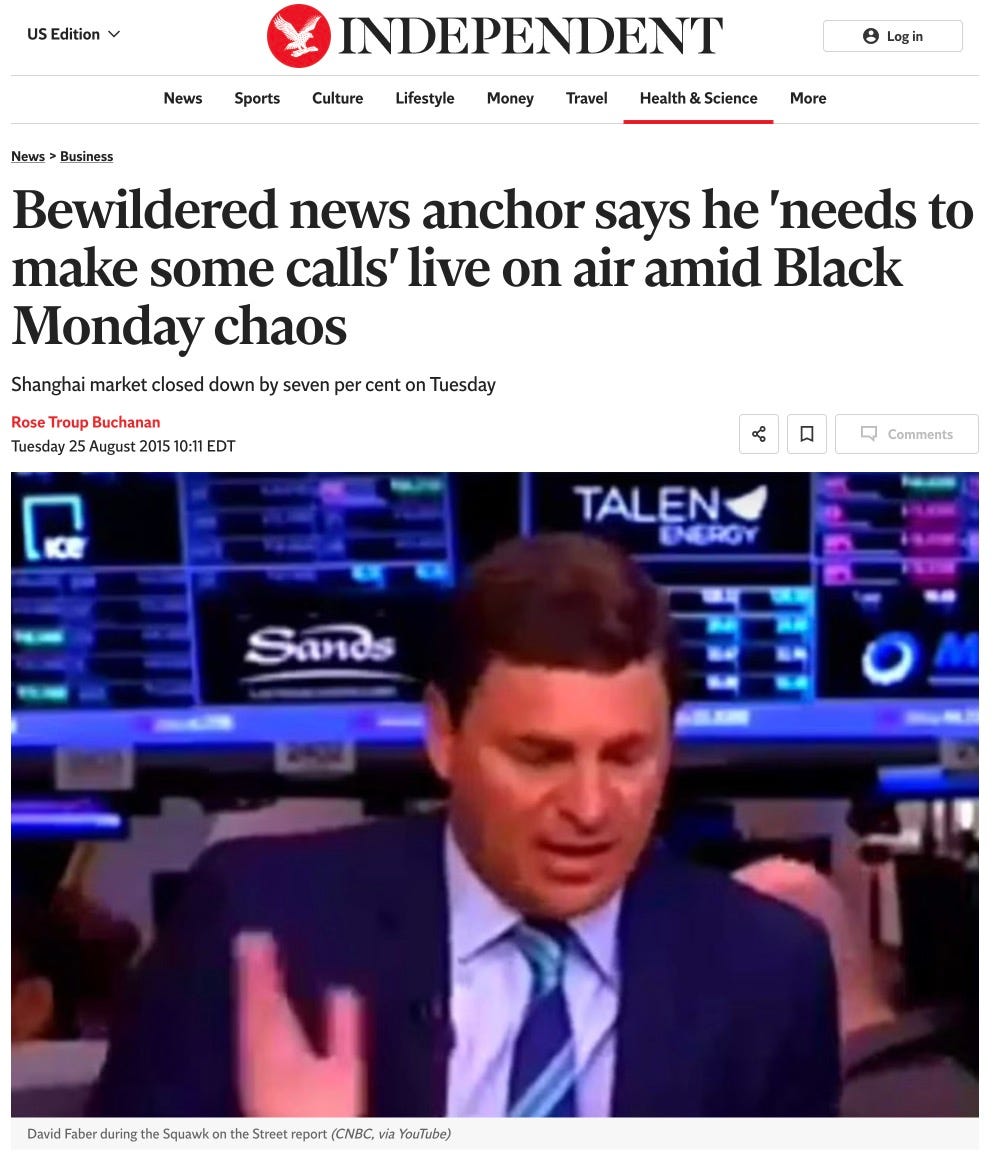
Those are the kinds of environments where I start thinking seriously about panic-driven opportunities, not when the Nasdaq is still sitting miles above its lows from a year and a half ago. Panic sounds like this:
And remember, several tripwires in the AI trade have already been triggered; we may only be beginning to discover what they’re connected to.
One of the most important things to remember about financial crises is that the initial decline in asset prices is often just the beginning of a much larger chain reaction.
As markets move lower, margin calls begin, collateral requirements tighten, debt covenants get breached, and institutions discover that assets they assumed were liquid suddenly aren’t. Every party has a counterparty, and when one institution gets into trouble, the consequences can spread through relationships that nobody was particularly worried about when prices were going up.
These problems can take weeks or months to become public because everyone involved has an incentive to negotiate, refinance, restructure, or otherwise exhaust every possible option before admitting something is wrong. That’s why financial crises can appear to unfold slowly at first, right up until the moment the entire thing accelerates and **** hits the fan.
I don’t know whether Monday will be green or red. I don’t know whether the election will surprise people, whether Nvidia will deliver another miracle, or whether the Fed will find some new way to convince investors that everything is under control.
What I do know is that the market is still extraordinarily expensive, the financial system is carrying enormous amounts of leverage, and several of the narratives that have supported asset prices are beginning to crack simultaneously.
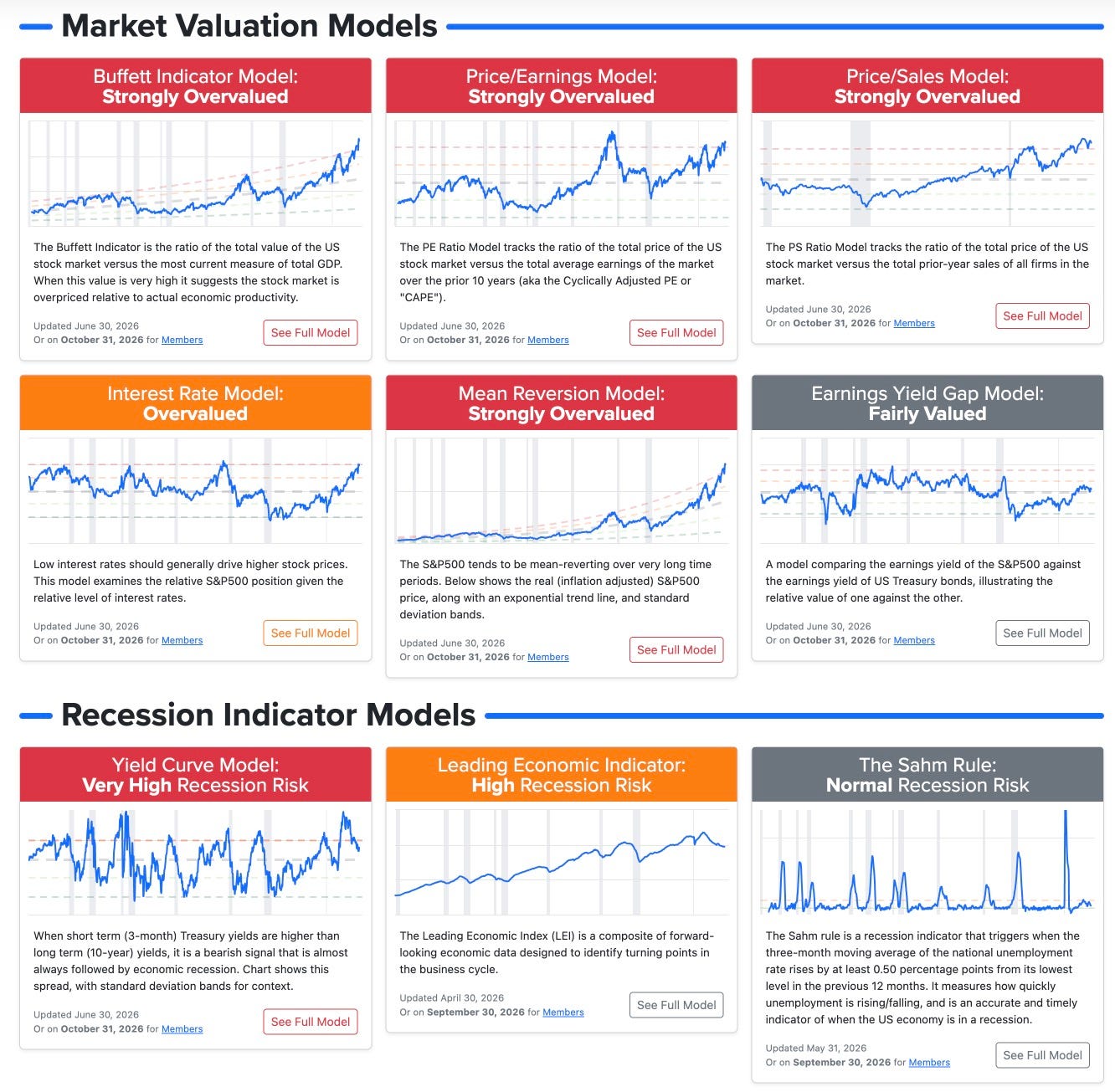
That combination doesn’t guarantee a crash tomorrow, next week, or even next month. But it does suggest to me that the potential downside is significantly larger than many investors are prepared to contemplate.
I’ve spent months writing about these risks, and I see very little reason to abandon that framework simply because stocks are down slightly the last few weeks.
Tweet
Continue reading...
[ H/T The Burning Platform ]
If I had to boil down my entire view of the market right now into 15 points, these would be them. Some are things I’ve been writing about for months, others are more immediate observations, but taken together, they represent how I see the big picture unfolding and what I’m watching in the days, weeks, and months ahead.
As always, this is not financial advice. I could be dead-ass wrong, and I certainly have been in the past. But I wanted to put my entire outlook into words as clearly and concisely as possible, especially heading into what could be another volatile week.
Take what you like, leave the rest, and do your own homework. This is simply how the ole’ Q-Man sees the world on a Sunday morning if I had to do my damndest to describe the current market landscape.
1. I Do Not Think The Market Has Bottomed
In absolutely no way do I think the market has put in a durable bottom here, and I would be extremely cautious about trying to catch falling knives.
Valuations are nowhere near what I would consider deep value, and the bigger concern is that earnings estimates could start coming down, making stocks even more expensive on a forward basis despite declining share prices.
Sometimes, Knives Just Keep Falling
Quoth the Raven·
Oct 20
Read full story
The Nasdaq is still roughly 20% above its March 2026 lows and about 50% above its April 2025 lows. That’s not exactly the kind of devastation that historically marks a generational buying opportunity. In other words, we’re a long way from anything resembling genuine panic, in my opinion.
2. There Are Still Potential Positive Surprises
Despite my bearish outlook, I recognize that there are several potential catalysts that could produce sharp rallies, even in a deteriorating market.
Progress, or even the perception of progress, toward resolving the Iran conflict could give markets a reason to celebrate, particularly if the Trump administration makes a concerted effort to reassure investors before midterms.
A surprise improvement in trade negotiations, softer inflation data, or a sudden change in the bond market could also provide temporary relief. And of course, the administration has every political incentive to keep financial markets from unraveling.
None of these possibilities would necessarily change my longer-term thesis, but they could certainly produce violent countertrend rallies.
3. OpenAI Could Set The Tone Monday
I think the news that OpenAI is reportedly cutting its fundraising valuation expectations after Friday’s close could be one of the biggest drivers of sentiment when trading resumes Monday.
For months, the AI trade has depended on increasingly extraordinary valuations being accepted as perfectly reasonable, regardless of profitability, cash burn, or the enormous financing requirements involved.
OpenAI Cuts Funding Round: Bad News At The Worst Time
Oct 31Read full story
If investors are finally starting to question what the industry’s flagship private companies are worth, it raises uncomfortable questions about the valuations of their publicly traded counterparts.
That said, there’s still plenty of time for new headlines to emerge before Monday’s opening bell, so I wouldn’t assume this will be the only story driving markets.
4. I’m Expecting Volatility, Not Necessarily A Straight Line Down
My expectation for Monday is heightened volatility, with the VIX likely to remain firm as investors digest an increasingly complicated backdrop.
That doesn’t mean I’m predicting a specific direction for the session, and I wouldn’t be surprised by a violent rally any more than I would be surprised by another selloff.
But the balance of risks, in my opinion, remains heavily skewed toward further downside because valuations are still elevated, liquidity is becoming more selective, and the fundamental problems underlying the AI trade haven’t been resolved.
Markets can bounce on headlines, but eventually the numbers have to make sense. Right now, I don’t think they do.
5. Tuesday’s Election Could Be Another Negative Catalyst
If Democrats perform well in Tuesday’s elections, I expect markets to interpret the results as another potential negative, particularly for sectors that have benefited from expectations of a relatively permissive regulatory environment.
Could Democrats Crash This Market?
Quoth the Raven·
Oct 31
Read full story
Some of that possibility is almost certainly being priced in already, but the actual results could still force investors to reassess political risk heading into 2027.
A stronger Democratic position could increase expectations for investigations, regulatory scrutiny, and legislative gridlock, depending on the balance of power.
Whether those expectations ultimately materialize is another question entirely. For now, I think the uncertainty alone could weigh on sentiment.
6. The AI Bubble Is Starting To Show Its Cracks
The AI bubble remains the single biggest structural risk I see in the equity market, and the warning signs are becoming increasingly difficult to ignore.
Financing that once seemed unlimited is becoming harder to justify, investors are beginning to scrutinize extraordinary capital expenditure commitments, and accounting practices that helped flatter reported earnings are finally receiving more attention.
“The Economics Are Abysmal”: Harris Kupperman Warns The Crash Is Here
Quoth the Raven·
Oct 22
Read full story
As I’ve written recently, enormous paper gains, aggressive adjustments, and circular financing relationships have helped create the appearance of prosperity across an industry that still needs to demonstrate sustainable returns on its investment.
8 Sharp Bear Cases You Must Read Today
Quoth the Raven·
Aug 25
Read full story
The problem isn’t that artificial intelligence has no future; it’s that the market may have priced in decades of success before anyone has demonstrated the economics necessary to support it. When that realization begins to spread, I think the consequences could be enormous.
7. There Are Air Pockets Everywhere
Outside of technology, I see several other areas of the financial system that look particularly vulnerable to a sudden repricing, starting with cryptocurrency.
In my view, crypto represents an extraordinary amount of speculative value…potentially approaching $2 trillion of what I would characterize as pure air…supported largely by liquidity, confidence, and the expectation that somebody else will eventually pay more.
Tech Isn’t The Only Problem…
Quoth the Raven·
Oct 30
Read full story
After that, I’d be watching commercial real estate, private credit, and subprime auto lending, all of which face their own combinations of questionable collateral values, refinancing pressure, and deteriorating borrower quality.
The Commercial Real Estate Crisis Is Far From Over
Quoth the Raven·
Oct 29
Read full story
Unlike crypto, those latter three markets have significant connections to the banking system, especially smaller and regional institutions. For that reason, I’d also be extremely cautious about the regional banking ETF KRE, which could become a pressure point if credit stress accelerates.
8. Democratic Victories Could Put Crypto And Credit Under The Microscope
A strong Democratic showing Tuesday could create additional problems for precisely the sectors I already consider most vulnerable.
Judging by the frequency and tone of Elizabeth Warren’s public criticism of cryptocurrency, banks, and private credit, I wouldn’t be surprised to see renewed efforts to investigate these industries and increase regulatory scrutiny.
6 Market Shocks I Predict If Democrats Win Midterms
Quoth the Raven·
Aug 10
Read full story
Subpoenas, hearings, and demands for greater transparency could expose problems that investors have been content to overlook while asset prices were rising. Of course, election victories don’t automatically translate into new laws or sweeping regulatory powers, but they can change the political narrative almost overnight.
And in fragile markets, sometimes the prospect of scrutiny is enough to make investors start asking questions they should have been asking all along.
9. The Next Three Weeks Of Earnings Are Critical
The upcoming earnings reports from Apple, AMD, Cisco, and Nvidia could play an outsized role in determining whether this selloff accelerates or temporarily stabilizes.
After disappointing results from several major technology names last week, investors appear increasingly unwilling to give companies the benefit of the doubt simply because they’re associated with AI.
Nvidia, in particular, strikes me as the most important potential catalyst because expectations have become so extraordinary after roughly 15 consecutive quarters of beating estimates.
The World Will End If Nvidia Misses Earnings
Quoth the Raven·
Oct 29
Read full story
An outright miss could be catastrophic for sentiment, but even a result that merely meets expectations could be poorly received if investors have become accustomed to enormous upside surprises. When perfection is already priced in, being merely excellent can become a problem.
10. I Think Housing Gets Uglier In 2027
I expect the housing market to deteriorate further as the calendar turns toward 2027, particularly if financial markets continue moving lower and household balance sheets come under additional pressure.
Financial stress often works its way through consumers in stages: first they sell liquid investments, then they tap savings or retirement accounts, then they lean harder on credit, fall behind on auto payments, and eventually struggle to carry their homes. That’s not a universal sequence, but it’s a useful way to think about how financial pressure can migrate through an economy.
Housing Is Collapsing, Wall Street Hasn’t Noticed
Quoth the Raven·
Oct 21
Read full story
Add elevated housing costs, stretched consumers, and the possibility of rising unemployment, and I think we could see a meaningful increase in distressed sales and mortgage delinquencies.
Making matters worse, we’ve cultivated an unprecedented culture of speculation and gambling in financial markets, meaning a major crash could hit a generation of participants who have never experienced a prolonged period of genuine financial pain.
11. The Fed Is Trapped, And I Still Like Gold
I have absolutely no idea what the Federal Reserve plans to do next, but I don’t see an attractive long-term outcome from any of its obvious choices.
It can cut rates and risk reigniting inflation, maintain restrictive policy and risk accelerating a credit contraction, or increasingly rely on more favorable inflation measures and messaging to justify whatever it wants to do.
Gold Could Crash…Before It Doubles
Quoth the Raven·
Oct 23
Read full story
In my view, all three paths ultimately lead toward conditions that could be supportive of gold, either through renewed monetary accommodation, damaged confidence in policymakers, or an economic crisis that eventually forces an inflationary response.
That doesn’t mean gold moves higher in a straight line; as I’ve repeatedly argued, I think it could initially crash alongside other assets during a liquidity event before recovering and ultimately making new highs. My long-term conviction in gold and gold miners remains intact.
12. I Expect A Rotation Toward Blue Chips And Defensives
One of my strongest expectations for the next phase of this market is a rotation away from speculative technology and toward boring, durable, cash-generating businesses.
I’m talking about companies with recognizable brands, defensible market positions, manageable debt, consistent earnings, and products people continue buying regardless of what happens to the Nasdaq.
Going “Old School” With “Boring” Blue Chip Stocks
Quoth the Raven·
Oct 14
Read full story
These stocks won’t necessarily be immune to a broad selloff, but I think many could emerge as relative winners once investors rediscover the value of predictable cash flow and reasonable valuations.
I’ve already started naming some of the businesses I’m interested in, and I’ll be expanding that list in my upcoming piece on 27 stocks I’m watching for 2027. Barring a major change in market conditions before year-end, that’s where I expect much of my attention to be focused.
13. My Bear Market Watchlist Also Includes Uranium, Gold Miners, And One Overlooked Tech Trade
If the market continues to decline, there are three areas I’m particularly interested in accumulating at more attractive prices: uranium, gold miners, and one niche corner of technology that I believe could become critically important over the coming decade.
URA has been beaten up alongside the broader AI and electricity-demand trade, but my long-term uranium thesis remains intact because I believe nuclear power will play an increasingly important role in meeting global energy needs. GDX remains my favorite investment idea for the reasons I’ve outlined repeatedly: I expect gold miners to eventually benefit enormously from higher gold prices, particularly after an initial liquidity-driven selloff.
The third idea is a technology subsector that I think investors are still dramatically underappreciating, and one I’ve recently started discussing with subscribers.
The Tech Trade Nobody Notices Yet…But Will
Quoth the Raven·
Oct 30
Read full story
Last year, my under-the-radar speculative idea was psychedelic stocks. Most of them have beaten the market this year easily (estimates: PSIL is +20% DFTX is +171% and CMPS is +67% YTD).
Heading into 2027, I think this particular technology trade could become one of the most interesting multiyear opportunities on my radar.
14. This Is Not What Panic Looks Like
I think now is an excellent time to be cautious because we are potentially sitting near the top of one of the largest speculative bubbles in stock market history, and the market is still nowhere close to what I would call genuine capitulation.
Depending on the valuation indicator, aggregate equity valuations have recently been near or above some of the most extreme levels ever recorded, and a modest pullback doesn’t suddenly transform historically expensive stocks into bargains.
As prices fall, a million people will offer a million reasons every day why it’s time to buy, but personally, I prefer waiting for moments of genuine discomfort…CNBC anchors practically running off the desk, Bill Ackman crying on national television, or investors openly questioning whether the financial system is going to survive.
From the Independent back in 2015:
Those are the kinds of environments where I start thinking seriously about panic-driven opportunities, not when the Nasdaq is still sitting miles above its lows from a year and a half ago. Panic sounds like this:
And remember, several tripwires in the AI trade have already been triggered; we may only be beginning to discover what they’re connected to.
15. The Real Problems Often Don’t Surface Until Later
One of the most important things to remember about financial crises is that the initial decline in asset prices is often just the beginning of a much larger chain reaction.
As markets move lower, margin calls begin, collateral requirements tighten, debt covenants get breached, and institutions discover that assets they assumed were liquid suddenly aren’t. Every party has a counterparty, and when one institution gets into trouble, the consequences can spread through relationships that nobody was particularly worried about when prices were going up.
These problems can take weeks or months to become public because everyone involved has an incentive to negotiate, refinance, restructure, or otherwise exhaust every possible option before admitting something is wrong. That’s why financial crises can appear to unfold slowly at first, right up until the moment the entire thing accelerates and **** hits the fan.
Final Thoughts
I don’t know whether Monday will be green or red. I don’t know whether the election will surprise people, whether Nvidia will deliver another miracle, or whether the Fed will find some new way to convince investors that everything is under control.
What I do know is that the market is still extraordinarily expensive, the financial system is carrying enormous amounts of leverage, and several of the narratives that have supported asset prices are beginning to crack simultaneously.
That combination doesn’t guarantee a crash tomorrow, next week, or even next month. But it does suggest to me that the potential downside is significantly larger than many investors are prepared to contemplate.
I’ve spent months writing about these risks, and I see very little reason to abandon that framework simply because stocks are down slightly the last few weeks.
Tweet
Continue reading...
[ H/T The Burning Platform ]