






On a quiet Thursday morning in suburban Detroit, 140 preschoolers were settling into their classrooms at Temple Israel’s early childhood center when a Ford F-150 pulled into the parking lot. For more than two hours, the truck sat there, idling.
Then, at 12:15 p.m. on March 12, the driver — Ayman Mohamad Ghazali, a 41-year-old Lebanese-born U.S. citizen from Dearborn Heights, Michigan — pressed the accelerator and rammed his vehicle through the synagogue’s front doors. In the truck bed were commercial-grade fireworks and jugs of flammable liquid, purchased two days earlier for $2,250. The children were 5 years old and younger. They were, as Gov. Gretchen Whitmer (D-MI) said, “babies who are Jewish.”
The attack on Temple Israel, the largest Reform synagogue in the United States, ended with only the attacker dead, a testament to security preparations that had been accumulating for years. But the near-catastrophe it represents, and the web of radicalism, geopolitical grievance, and organized terrorism that appears to have animated it, demands a reckoning about where American Jews now stand, and whether the civilized world stands with them.
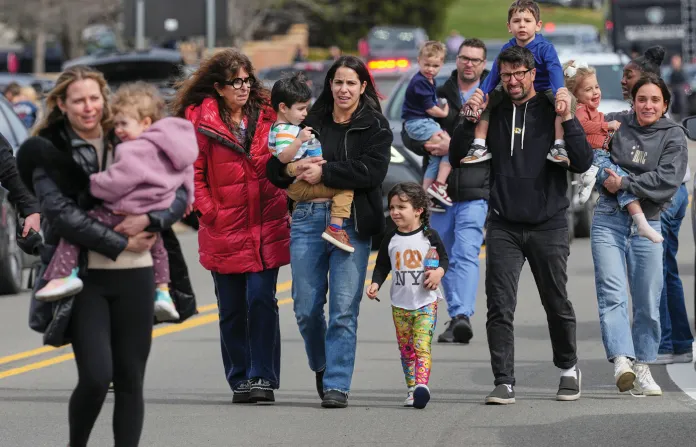
Law enforcement escorts families with children away from the Temple Israel synagogue on March 13 in West Bloomfield Township, Michigan, after Ayman Mohamad Ghazali rammed his truck filled with fireworks and jugs of flammable liquid through the front doors. (Photos by Paul Sancya/AP)
" data-large-file="https://www.washingtonexaminer.com/wp-content/uploads/2026/10/Fea.FortSynagogue.100726.jpg?w=696" height="658" width="1024" src="https://www.washingtonexaminer.com/wp-content/uploads/2026/10/Fea.FortSynagogue.100726.jpg?w=696" alt="Law enforcement escorts families with children away from the Temple Israel synagogue on March 13 in West Bloomfield Township, Michigan, after Ayman Mohamad Ghazali rammed his truck filled with fireworks and jugs of flammable liquid through the front doors. (Photos by Paul Sancya/AP)" class="wp-image-4753041" style="width:865px;height:auto" srcset="https://www.washingtonexaminer.com/wp-content/uploads/2026/10/Fea.FortSynagogue.100726.jpg 1400w, https://www.washingtonexaminer.com/...0/Fea.FortSynagogue.100726.jpg?resize=300,193 300w, https://www.washingtonexaminer.com/...0/Fea.FortSynagogue.100726.jpg?resize=768,494 768w, https://www.washingtonexaminer.com/.../Fea.FortSynagogue.100726.jpg?resize=1024,658 1024w, https://www.washingtonexaminer.com/...10/Fea.FortSynagogue.100726.jpg?resize=150,96 150w, https://www.washingtonexaminer.com/...0/Fea.FortSynagogue.100726.jpg?resize=696,447 696w, https://www.washingtonexaminer.com/.../Fea.FortSynagogue.100726.jpg?resize=1068,687 1068w" sizes="(max-width: 1024px) 100vw, 1024px">
Law enforcement escorts families with children away from the Temple Israel synagogue on March 13 in West Bloomfield Township, Michigan, after Ayman Mohamad Ghazali rammed his truck filled with fireworks and jugs of flammable liquid through the front doors. (Photos by Paul Sancya/AP)
The attack unfolded with methodical violence. Ghazali sat in the parking lot for more than two hours before ramming the building, striking the temple’s security director and knocking him unconscious, then firing through the windshield. Armed security officers returned fire. The truck’s engine caught fire. and Ghazali, trapped in the jammed vehicle, died of a self-inflicted gunshot wound. Miraculously, not a single child or staff member was killed or seriously injured. Six hundred five law enforcement professionals from 42 agencies responded.
The FBI designated the attack “a targeted act of violence against the Jewish community.” Federal officials told CNN that Ghazali appeared in government databases as having connections to “known or suspected terrorists” associated with Hezbollah in Lebanon (though he was not listed as a member himself). He had no prior criminal record and had never been the subject of an FBI investigation.
The immediate trigger, according to sources who spoke to CBS News, was personal: an Israeli airstrike approximately 10 days before the attack killed Ghazali’s two brothers (both of whom were reportedly members of a Hezbollah rocket unit) in southern Lebanon. He stopped working, isolated himself, and shortly before the attack called his ex-wife to tell her to take care of their children. Attorney General Dana Nessel (D-MI) drew the connection directly: “I think we can absolutely draw a nexus between the war in Iran and the events of today.”
A fortress built from necessity
The reason 140 children left that building unharmed is not luck. It is the product of years of grim, methodical preparation that has become the defining condition of Jewish communal life in America.
Temple Israel had hired a former police lieutenant, Danny Phillips, as its full-time security director the previous June. Bollards had been installed at entrances. The doors were bulletproof. Just weeks before the attack, FBI agents led active shooter preparedness training for clergy and staff.
“We’ve been talking for two weeks about the potential, sadly, for this happening,” Oakland County Sheriff Michael Bouchard said at a press conference that day.
Dutch police officers stand guard near a Jewish school in Amsterdam on March 16 following its reopening two days after an attack on the institution. (ANP/AFP via Getty Images)
" data-large-file="https://www.washingtonexaminer.com/wp-content/uploads/2026/10/Fea.FortSynagogue2.100726.jpg?w=696" height="658" width="1024" src="https://www.washingtonexaminer.com/wp-content/uploads/2026/10/Fea.FortSynagogue2.100726.jpg?w=696" alt="Dutch police officers stand guard near a Jewish school in Amsterdam on March 16 following its reopening two days after an attack on the institution. (ANP/AFP via Getty Images)" class="wp-image-4753042" style="width:796px;height:auto" srcset="https://www.washingtonexaminer.com/wp-content/uploads/2026/10/Fea.FortSynagogue2.100726.jpg 1400w, https://www.washingtonexaminer.com/.../Fea.FortSynagogue2.100726.jpg?resize=300,193 300w, https://www.washingtonexaminer.com/.../Fea.FortSynagogue2.100726.jpg?resize=768,494 768w, https://www.washingtonexaminer.com/...Fea.FortSynagogue2.100726.jpg?resize=1024,658 1024w, https://www.washingtonexaminer.com/...0/Fea.FortSynagogue2.100726.jpg?resize=150,96 150w, https://www.washingtonexaminer.com/.../Fea.FortSynagogue2.100726.jpg?resize=696,447 696w, https://www.washingtonexaminer.com/...Fea.FortSynagogue2.100726.jpg?resize=1068,687 1068w" sizes="(max-width: 1024px) 100vw, 1024px">
Dutch police officers stand guard near a Jewish school in Amsterdam on March 16 following its reopening two days after an attack on the institution. (ANP/AFP via Getty Images)
Sen. Elissa Slotkin (D-MI), who grew up attending Temple Israel, put the stakes starkly: “If they had not all done their jobs almost perfectly, we would be talking about an immense tragedy here today, with children gone.”
Michael Masters, CEO of the Secure Community Network, credited the preparation for the limited casualties, and disclosed a further data point: In the six days after the attack, his organization tracked more than 8,000 calls for violence against the Jewish community in the United States. The Jewish Federations of North America, according to its chairman, Gary Torgow, now spends more than $750 million annually on security for Jewish communities. That figure, $750 million just to allow Jews to enter their synagogues and schools without dying, may be the single most damning statistic in the story of contemporary American Jewish life.
The Temple Israel attack did not emerge from a vacuum. It is a specific expression of a growing tempest of terror that is showing few signs of letting up. The FBI documented 1,938 antisemitic hate crimes in 2024, the highest figure since the bureau began collecting such data in 1991. Jews, only about 2% of the American population, accounted for 69% of all religion-based hate crimes.
The Anti-Defamation League tracked 9,354 antisemitic incidents in 2024, the highest total in its history — physical assaults rose 21% in a single year. The American Jewish Committee’s 2025 State of Antisemitism report found 91% of American Jews feel less safe, and 55% have changed their daily behavior out of fear. Between July 2024 and January 2026, the ADL tracked 12 terrorist plots or attacks targeting Jews in the United States, compared to seven in the previous four and a half years.
Michigan state Sen. Jeremy Moss, a Jewish Democrat, articulated the reality plainly: “We stand on guard all the time for somebody to penetrate a house of worship or a school or another Jewish institution with an act of terror. We’re a community that’s kind of used to learning and praying in a fortress. It’s no way to live, but it’s the reality.”
The coordinated campaign in Europe
The attack in Michigan did not occur in isolation. The following morning — March 13, in the early hours before dawn — an explosive device detonated at a synagogue in Rotterdam, Netherlands. Dutch police arrested four teenagers nearby, subsequently charging them with “causing an explosion, arson and attempted arson, all with a terrorist intent.”
The Rotterdam attack came three days after an explosion at a synagogue in Liege, Belgium. Both attacks were claimed by a group calling itself the Islamic Movement of the Companions of the Right (Harakat Ashab al Yamin al Islamiyyah), whose videos circulated on channels watchdogs associate with Iranian-backed networks.
The night after Rotterdam, a second device detonated against the outer wall of an Orthodox Jewish school in Amsterdam. Amsterdam Mayor Femke Halsema said the city’s Jewish residents felt “fear and anger” and were being increasingly targeted.
British Prime Minister Keir Starmer, left, meets first responders from Shomrim North West London during a visit to Golders Green, on April 30, following an attack in which two Jewish men were stabbed in broad daylight. (Stefan Rousseau/Pool via AP)
" data-large-file="https://www.washingtonexaminer.com/wp-content/uploads/2026/10/Fea.FortSynagogue3.100726.jpg?w=696" height="658" width="1024" src="https://www.washingtonexaminer.com/wp-content/uploads/2026/10/Fea.FortSynagogue3.100726.jpg?w=696" alt="British Prime Minister Keir Starmer, left, meets first responders from Shomrim North West London during a visit to Golders Green, on April 30, following an attack in which two Jewish men were stabbed in broad daylight. (Stefan Rousseau/Pool via AP)" class="wp-image-4753043" style="width:804px;height:auto" srcset="https://www.washingtonexaminer.com/wp-content/uploads/2026/10/Fea.FortSynagogue3.100726.jpg 1400w, https://www.washingtonexaminer.com/.../Fea.FortSynagogue3.100726.jpg?resize=300,193 300w, https://www.washingtonexaminer.com/.../Fea.FortSynagogue3.100726.jpg?resize=768,494 768w, https://www.washingtonexaminer.com/...Fea.FortSynagogue3.100726.jpg?resize=1024,658 1024w, https://www.washingtonexaminer.com/...0/Fea.FortSynagogue3.100726.jpg?resize=150,96 150w, https://www.washingtonexaminer.com/.../Fea.FortSynagogue3.100726.jpg?resize=696,447 696w, https://www.washingtonexaminer.com/...Fea.FortSynagogue3.100726.jpg?resize=1068,687 1068w" sizes="auto, (max-width: 1024px) 100vw, 1024px">
British Prime Minister Keir Starmer, left, meets first responders from Shomrim North West London during a visit to Golders Green, on April 30, following an attack in which two Jewish men were stabbed in broad daylight. (Stefan Rousseau/Pool via AP)
Then, early on March 23, the same group appears to have struck in Golders Green, the heart of London’s largest Jewish community. Four ambulances belonging to Hatzola Northwest, a volunteer Jewish emergency medical service, were set ablaze outside a synagogue. Oxygen cylinders exploded, shattering apartment windows. Four of Hatzola’s six ambulances were destroyed.
British Prime Minister Keir Starmer called it “a deeply shocking antisemitic arson attack,” meeting Jewish community leaders at Downing Street and declaring that it was “not just an attack on the Jewish community, but it’s an attack on all of us.” Metropolitan Police chief Mark Rowley said investigators were pursuing “an online claim of responsibility by an Islamist group who have claimed other attacks across Europe and have potential Iranian state links.” The Community Security Trust recorded 3,700 antisemitic incidents in Britain in 2025 — more than double the 2022 figure.
The campaign has intensified alarmingly in the weeks since. On April 15, arsonists attempted to attack the Finchley Reform Synagogue in London by placing bottles of accelerants next to the building and throwing a brick through its window. On April 18, another synagogue in northwest London was targeted in a similar attack.
Then, on April 29, two Jewish men were stabbed in broad daylight on a busy street in Golders Green. A 45-year-old Somalian man was arrested on suspicion of attempted murder after being tasered by officers who feared he was carrying an explosive device. The victims, aged 34 and 76, were treated by Hatzola volunteers and taken to the hospital in stable condition.
London’s head of counterterrorism policing declared the attack a terrorist incident, while Harakat Ashab al Yamin al Islamiyyah claimed responsibility. It was the second declared terrorist attack on Britain’s Jewish community in seven months. Britain’s Chief Rabbi Ephraim Mirvis, who had said after the April 18 attack that “the sustained campaign of violence and intimidation against the Jewish community is gathering momentum,” was tragically proven right within days.
A wave crosses the Atlantic
The current wave of attacks shares a profile distinct from the far-right domestic terrorism that drove the worst previous chapters of American antisemitic violence, such as the 2018 Tree of Life massacre in Pittsburgh and the 2019 Poway shooting.
Those attacks were carried out by white nationalist ideologues. What is happening now is largely rooted in Islamist radicalism, animated by Middle Eastern conflicts, and connected to what appear to be Iran-linked networks operating across borders. Ghazali appears to have been a man consumed by personal grief who redirected it into ideological violence against Jews he held collectively responsible for his brothers’ deaths. That pattern, private wound weaponized by ideology into mass murder, is among the most dangerous in the modern terrorist typology precisely because it is difficult to predict, often invisible to law enforcement, and potentially replicable by thousands of individuals with similar grievances.
The weeks following the Temple Israel attack demonstrated just how replicable that template has become, and how broadly the threat extends.
On April 22, Congregation Beth Israel in Houston, the oldest Jewish house of worship in Texas, home to 1,500 families, was forced to close along with its affiliated Shlenker School after the Houston Police Department received credible threat information from an FBI Joint Terrorism Task Force. Within 24 hours, two arrests had been made in two states: An 18-year-old from North Carolina and a 16-year-old in Houston were charged in connection with an alleged plot to drive a vehicle through the congregation and “kill as many Jews as possible,” in the words of a district court judge.
That same week, antisemitic vandals struck twice in the Midwest and South: A 51-year-old homeless man was charged with a hate crime after spray-painting swastikas and antisemitic slurs on Congregation Beth Shalom in Oak Park, Michigan, on April 19; and on April 24, Congregation Beth Israel in Austin, Texas (a 150-year-old Reform synagogue still recovering from a 2021 arson attack) was defaced with a swastika and the words “Death to Israel.”
“The words that were written on the wall were not just graffiti, they were hate,” the synagogue’s senior rabbi told local media. Recent developments have continued to highlight the scope of the threat.
Earlier this year, Dan Sohail pled guilty in Brooklyn federal court to charges related to his January car-ramming attack on the Chabad-Lubavitch world headquarters in Brooklyn, where he intentionally rammed his vehicle into the building multiple times to damage the Jewish landmark. Federal authorities also charged Mohammad Baqer Saad Dawood al Saadi, a commander of the Iran-backed Kataib Hezbollah militia, with plotting attacks on Jewish sites in the United States, including a synagogue in New York City. In addition, the shooters in the May 18 attack on the Islamic Center in San Diego were revealed to have made antisemitic statements and included virulent anti-Jewish rhetoric in their manifesto. These are not isolated incidents. They are data points in a broader trend.
To understand the weight of what is happening, it is necessary to place it in a historical context — and that context is not reassuring. Jews have lived in the United States in relative safety for over two centuries. The post-Holocaust order, with its human rights frameworks and its explicit commitments to “Never Again,” was supposed to have made a repeat of that calamity impossible in the democratic West.
What is happening in 2026 is not a Holocaust. But it is a profound rupture with the postwar order. Jews across Western democracies are now modifying their behavior — hiding identifying markers of their Jewishness, avoiding synagogues, reconsidering whether to display mezuzot on their doors — at levels not seen since the period those frameworks were designed to foreclose. According to the AJC’s 2025 report, 55% of American Jews have changed their daily behavior out of fear of antisemitism, and 91% report feeling less safe. The ADL has found that over half of American Jews now regard antisemitism as a routine part of Jewish life, not an aberration from it. The ADL’s 2025 Antisemitism Landscape Survey found that the share of Americans categorized as active “allies” of the Jewish community fell from 15% in 2023 to just 9%, while the share categorized as “haters” rose from 6% to 10%. About 27% of Americans now say they believe Jews “cause problems in the world,” up from 19% two years ago. The public is not merely failing to stand against antisemitism; a growing share is actively endorsing it.
The European dimension may be even more alarming. The chairman of the Rotterdam synagogue, speaking to Dutch broadcaster NOS in the days after the attack, offered a distinction worth sitting with. The explosion “did not do a lot of damage to the building,” he said, “but it’s primarily the emotional impact.” That gap — between the physical damage that was contained and the psychic damage that is not — is the real measure of where things stand. Jews across Western democracies are being told, repeatedly and violently, that no space they occupy is entirely safe: not our schools, not our ambulances, not our Yom Kippur gatherings, not even our morning commutes.
In London, within 24 hours of the Hatzola arson, over half a million pounds had been raised to replace the destroyed ambulances. At Temple Israel, a Shabbat service was held on Friday evening. The congregation’s CEO, Steven Ingber, captured both our resolve and our disappointment: “We’re angry, we’re sad. I wish I could say we were surprised, but this is the kind of stuff that’s happening in our world right now.”
In each city, Jewish leaders chose public defiance over retreat. At Congregation Beth Israel in Houston, Rabbi David Lyon expressed gratitude to law enforcement while affirming his community’s resolve to remain open. At Congregation Beth Israel in Austin, executive director Jake Cohen vowed that his congregation would refuse “to let fear define us.” Yet resilience, however inspiring, is not a policy. The $750 million American Jewish federations spend annually on security is money not spent on schools, hospitals, or the ordinary civic infrastructure Jewish communities have historically contributed so generously to American life.
Growing up, I loved reading about castles and medieval fortresses. Sometimes I’d even try to build them out of cardboard boxes and sofa cushions. (Perhaps you did too.) But I never dreamed of going to a synagogue fortress. The fortress synagogue is a monument to necessity. It is also an indictment of the societies that made it necessary. What is required is a moral and political reckoning with the conditions that have allowed antisemitic violence to reach this level: the failure to enforce hate crime laws with the seriousness they demand; the persistence of antisemitic rhetoric — from the white nationalist far right and the “globalize the jihad” far left — in mainstream discourse; and the willingness of some governments to treat antisemitism as a lesser priority than other prejudices.
WHY ISRAEL IS LOSING ITS FRIENDS
The attackers in Rotterdam were teenagers who drove an hour to bomb a synagogue before dawn and were stopped near a second synagogue they may have been planning to hit next. The group that claims its allegiance also claims ambulances in London and schools in Amsterdam. The people who allegedly plotted to ram a vehicle through a Houston synagogue were a teenager and an 18-year-old. The man who spray-painted swastikas on a Michigan synagogue was apprehended blocks away. The man who stabbed two Jews on a London street was tackled by a neighborhood watch patrol. It bears repeating that these are not isolated incidents. They are the consequences of a millennia-old campaign of anti-Jewish hatred that had lain relatively dormant in the postwar years and is now once again as active and as destructive as ever. It is a campaign that must be defeated, not merely survived.
The children of Temple Israel went home safe that day. Their parents will keep sending children back to a school where the doors are bulletproof, the entrances reinforced with bollards, and the parking lot now a place of menace in family memory. The congregants of Beth Israel in Houston and Austin will return to synagogues that now bear the fresh marks of hatred. The Jews of Golders Green will walk streets that have become, in the span of weeks, a theater of terror. That is the condition of Jewish life in America and across the democratic West in 2026. It should alarm every citizen, of every faith, who believes that a civilization is measured by how it protects its most vulnerable.
Daniel Ross Goodman (@DanRossGoodman) is a Washington Examiner contributing writer and teaches theology and religious studies at St. John’s University. His next book, Dante’s Guide to Life: How The Divine Comedy Can Change Our Fortunes, Our World, and Ourselves, will be published this fall by Angelico Press.
Continue reading...
[ H/T Washington Examiner ]