






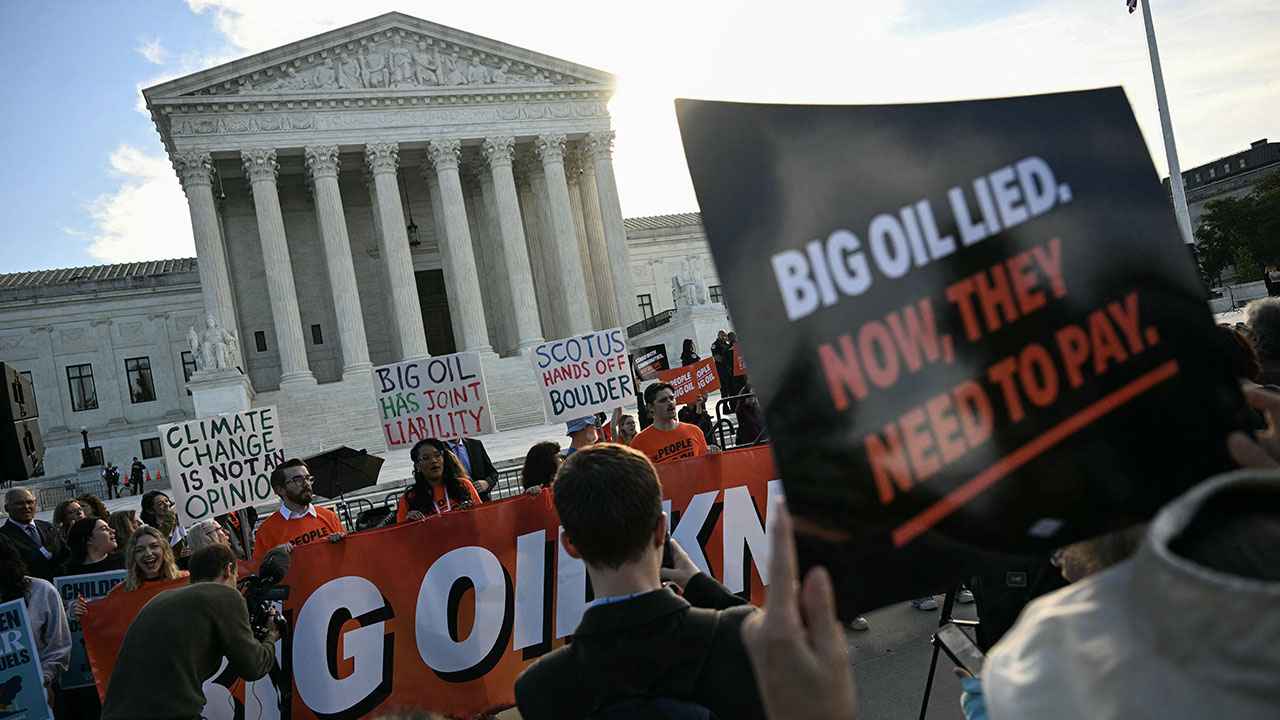
The Supreme Court will hear arguments in one of the most consequential cases of the term that some legal commentators have put on par with cases such as Citizens United v. FEC or Dobbs v. Jackson Women’s Health Organization.
In Suncor Energy v. County Commissioners of Boulder, the Justices will decide whether Boulder County, Colorado, can utilize state nuisance law to hold fossil fuel companies liable for all harms allegedly caused by global climate change, effectively setting energy policy for the entire country. This question has far-reaching effects on our economy and our federalist system of government.
Much of the focus has been on the balance of power between states and the federal government. For example, in the petitioner’s Supreme Court brief, they have argued that the regulation of interstate greenhouse-gas emissions is an issue reserved exclusively for the federal government because any attempt by a state to “redress inherently trans-boundary issues such as global climate change” would intrude on the federal government’s authority to resolve interstate disputes.
But less attention has been paid to a key dimension of federalism that is at stake. The Constitution explicitly recognizes not only a vertical division of authority between the federal government and the states, but also a horizontal structure governing the relationships among the states themselves. The Constitution is full of guardrails that keep individual states from disrupting the national order.
The Privileges and Immunities Clause bars states from discriminating against citizens of other states. The Commerce Clause creates a “national common market,” and courts have interpreted it to forbid states from favoring local businesses over out-of-state competitors or unduly burdening trade across state lines. The Full Faith and Credit Clause requires each state to respect the public acts, records, and court judgments of every other state. Even the Republican Guarantee Clause prohibits states from dictating the public policy of other states.
But key to understanding horizontal federalism is the Tenth Amendment, which the Supreme Court has recognized protects states from intrusions into their inherent sovereignty. So far, the Court has applied that protection only against the federal government. But the Amendment’s text protects states against intrusions from other states.
The Amendment reserves to “the States respectively” every power the Constitution did not delegate to the national government or prohibit to the states. To comprehend what powers states retained, it’s important to consider what it meant to be a sovereign nation at the time of the founding.
As independent sovereigns, the states were governed by the law of nations, which guaranteed every sovereign the right to “self-government and territorial sovereignty” and mandated “perfect equality of nations.”
That meant that no nation could “rightfully impose a rule on another,” or, as Joseph Story put it, “all the laws made by a sovereign have no force or authority except within the limits of his domains.”
Moreover, that understanding of each state’s sovereignty did not change following ratification because states kept “a residuary and inviolable sovereignty,” surrendering only what the Constitution expressly took away. James Madison, for instance, at the Virginia Convention, expressed the understanding that Virginia could not project its laws beyond its borders absent some constitutional authorization to the contrary.
Yet that is precisely what Boulder is attempting to do. Its state-law tort claims seek to hold energy producers liable for global harm arising from conduct that occurred wholly outside Colorado. This infringes on its sister states’ sovereign authority to regulate conduct within their own borders and violates the Tenth Amendment. Under Colorado law, abatement is the primary remedy for public nuisance claims, meaning Boulder could seek an order directing defendants to curtail their out-of-state operations.
Suncor gives the Justices an opportunity to revive and clarify this aspect of our Constitution. The Court has repeatedly stated that “No State can legislate except with reference to its own jurisdiction”; that state authority is “bounded by the States’ respective borders”; and that no state may “impose its own policy choice on neighboring States.”
What the Court has never done is tie those statements to a single constitutional home. Recognizing that the Tenth Amendment protects state sovereignty from intrusions by other states would bring order to the body of doctrine. It would also provide a framework for the wave of copycat climate suits now pending in Delaware, California, Illinois, Oregon, and elsewhere, as well as for litigation related to “climate superfund” statutes that Vermont and New York have enacted.
This approach also has practical advantages — it rests on the Constitution’s text and aligns with the Supreme Court’s prior precedent. The horizontal federalism arguments in Suncor have mostly been framed as appeals to “the structure of the Constitution,” offered in support of a preemption theory on the vertical division of power.
THE POLLS ARE LYING: WHY THE REPUBLICANS ARE ABOUT TO SWEEP THE MIDTERM ELECTIONS
Those arguments are correct, but they rely on purposes and objectives embodied within the Constitution. Members of the Court have long been skeptical of “freewheeling, extratextual” reasoning about purposes and objectives, insisting that rights be “lodged firmly in the text or tradition of a specific constitutional provision.” The Tenth Amendment provides that anchor. Moreover, the Court has established that private actors, such as the Suncor Petitioners, may invoke the Tenth Amendment as an affirmative defense to challenge laws that upset our federalist structure, meaning the approach is firmly rooted in current precedent.
The Founders created a union of equal sovereigns, not a system in which the most aggressive state sets the rules for everyone else. When deciding this case, the Justices should keep in mind that the Tenth Amendment prevents states from intruding on one another, not only the federal government from intruding on the states.
Continue reading...
[ H/T Washington Examiner ]