


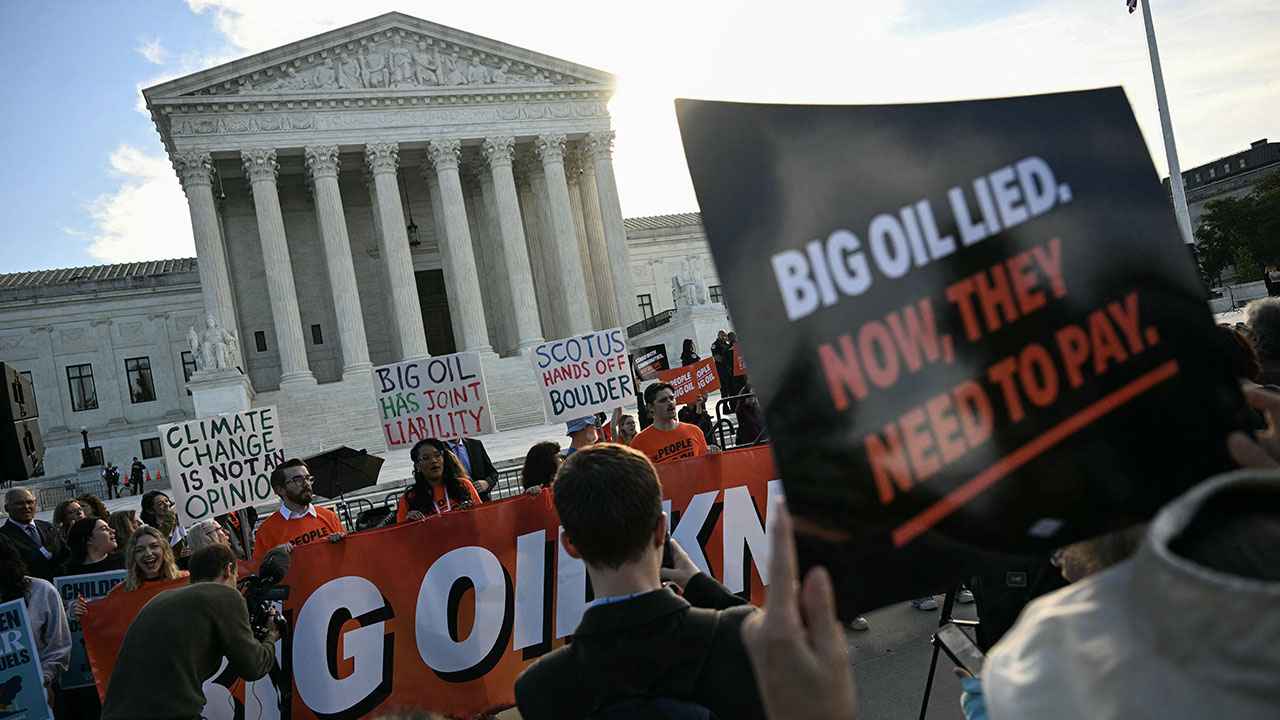
Supreme Court justices appeared skeptical Monday of Boulder County’s claims that the energy company Suncor caused the county concrete harm by contributing to global climate change in a case that could open the floodgates of climate lawfare across the country.
“If Boulder’s claims are allowed to go forward, some 90,000 municipalities across the country will have the ability to make national and international energy policy by asking juries to impose catastrophic damages on selected fossil fuel producers,” warned Kannon Shanmugam, a partner at the law firm Davis Polk and the attorney representing Suncor. “Put simply, that is not the constitutional scheme that the Founders adopted.”
Justice Brett Kavanaugh, an appointee of President Donald Trump, noted that “a wall of precedent” upholds the idea that interstate pollution is a federal matter, rather than an issue regulated by state law regarding concrete harms. The other Republican-appointed justices appeared similarly skeptical of Boulder’s arguments, while Democrat-appointed justices seemed more willing to countenance them.
Yet Kevin Russell, a partner at Russell & Woofter and the attorney representing Boulder, told the Supreme Court that “since the Founding, states have had the power to provide tort remedies for injuries occurring within their borders, even when the conduct causing those injuries occurred elsewhere.” He claimed, “It has never been thought that only federal law can provide a remedy simply because the tortious conduct and the injury occurred in different states, because the harm was widespread, the damages were large, or the defendants were part of an important industry.”
Shanmugam, however, argued that the lawsuit represented an attempt to impose legislation by other means.
“This case and others like it reflect an all-too-regrettable trend of trying to resolve major political issues in court rather than leaving them to the political branches where they belong,” he argued.
Kannon Shanmugam, the attorney for Suncor, briefly explains why Boulder's lawsuit aiming to force an energy company to pay for alleged harms related to climate change is so dangerous. There's no limit: anyone can sue anyone else for vague climate harmspic.twitter.com/k7kqJeEKsE
— Tyler O'Neil (@Tyler2ONeil) October 5, 2026
David Bookbinder, who previously served as part of Boulder’s legal team on this case, appeared to give weight to Shanmugam’s argument last year.
“Tort liability is an indirect carbon tax,” Bookbinder said on a Federalist Society panel in October 2025. “You sue an oil company, an oil company is liable. The oil company then passes that liability on to the people who are buying its products.”
“I’d prefer an actual carbon tax, but if we can’t get one of those… this is a rather, somewhat convoluted way, to achieve the goals of a carbon tax,” he added.
'INDIRECT CARBON TAX'
Here's David Bookbinder, who represented Boulder in its lawsuit against Suncor (which the Supreme Court should consider and strike down).
He admits climate lawsuits for damages under state law are an "indirect carbon tax," trying to circumvent Congress.pic.twitter.com/QSeq1CXbky
— Tyler O'Neil (@Tyler2ONeil) February 6, 2026
Chief Justice John Roberts, an appointee of President George W. Bush, told Russell, “Presumably, if you prevail, the next day a municipality in every single state would file a lawsuit, copy your pleadings, and then there will be at least 50 different cities… causes of action filed.”
“Is there anything anomalous in your mind to apply state law here to worldwide conduct?” Justice Neil Gorsuch, another Trump appointee, asked Russell.
Justice Amy Coney Barrett, another Trump appointee, asked Russell to distinguish between his lawsuit and Colorado passing “a law purporting to cap emissions in the other 49 states.”
He responded by saying that this case would merely require companies “to internalize a portion of the cost of their activities by paying for some of the damage that those activities inflict.”
Justice Clarence Thomas, an appointee of President George W.H. Bush, asked Russell whether his theory will prevent plaintiffs from suing large oil retailers. The lawyer admitted, “nothing in our theory prevents that.”
'WALL OF PRECEDENT'
Supreme Court Justice Brett Kavanaugh notes a "wall of precedent" saying that "state tort law" does not apply to climate change harms. pic.twitter.com/Ub3teOpjWp
— Tyler O'Neil (@Tyler2ONeil) October 5, 2026
While Justice Samuel Alito, another George H.W. Bush appointee, recused himself from the case, the remaining Republican-appointed justices reflected concerns that echoed Suncor’s arguments.
In fact, Justice Kavanaugh faulted Shanmugam for apparently “resisting” the clear precedents that support Suncor’s case.
The Democrat-appointed justices tied the case to lawsuits against tobacco companies.
“This suit appears to be based on the old 1990s tobacco suits that were brought by states and local governments,” Justice Elena Kagan, an appointee of President Barack Obama, said. She referred to the current case as “chapter 3” of the same book, but Shanmugam claimed that this case came from “a different book.” Kavanaugh agreed with Shanmugam in drawing a clear distinction between this case and the tobacco cases.
Shanmugam noted that municipalities have already brought more than 60 cases using state tort law against energy companies, and he warned that a ruling in Boulder’s favor would release a torrent of climate lawfare.
The Supreme Court is expected to decide the case between now and June 2027.
Continue reading...
[ H/T The Daily Signal ]