




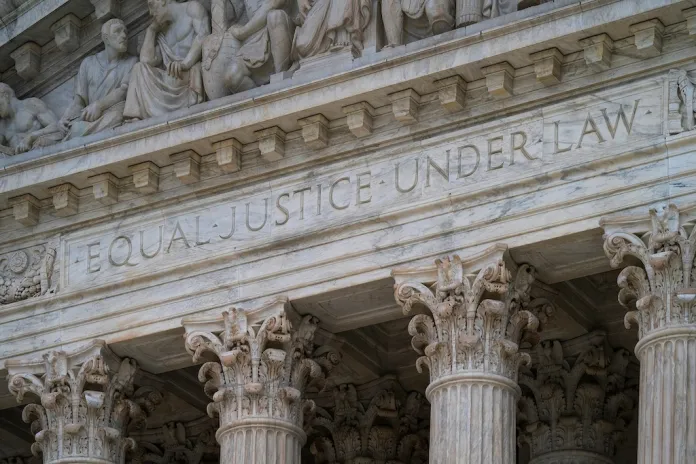
The Fifth Amendment promises “just compensation” when the government takes your land. On June 29, the Supreme Court agreed to decide whether a private pipeline company gets to write its own definition of “just.”
The case is Hoffmann v. WBI Energy Transmission, and it started with 12 miles of pipe through McKenzie County, North Dakota. In 2018, WBI Energy invoked its federal certificate under the Natural Gas Act and moved to condemn easements across land belonging to Leonard and Denae Hoffmann, Randall Stevenson, and Rocky Prestangen. The company’s opening offer ran to roughly half of fair market value. The ranchers didn’t object to the pipeline. They objected to the price, and the Constitution happens to back them up on that point.
They sued, spent three years establishing what the land was actually worth, and settled confidentially on the value in 2021. A federal judge then ordered WBI to cover the landowners’ legal fees and costs, a bill of roughly $380,000 they’d run up proving a number the company should have offered honestly the first time. The 8th Circuit Court of Appeals reversed that fee award. Its reasoning: The federal Natural Gas Act itself doesn’t authorize fee-shifting, so North Dakota’s law entitling condemned landowners to recover their costs doesn’t apply once a private company is exercising federal condemnation power.
That puts the 8th Circuit at odds with most of its sister circuits, which have held for more than 40 years that pipeline companies wielding federal eminent domain still have to follow the compensation rules of the state where the land sits. North Dakota and 11 other states filed briefs backing the landowners. The Justice Department backed the pipeline company. That alignment tells you what this case actually is: a fight over whether federal energy policy pulls state property law along with it or leaves it alone.
The Supreme Court has been here before, at least on the delegation question. In PennEast Pipeline Co. v. New Jersey, the justices confirmed that Congress can hand a private company the federal power to condemn land, and even to sue a nonconsenting state to get it. What PennEast didn’t settle is what happens after the condemnation, when it’s time to write the check. Hoffmann is where that question lands, and the answer will decide whether “just compensation” carries a state-law floor or becomes whatever a federally certificated company decides to argue in court, with the landowner footing the bill for the argument either way.
Watch what happened in Colorado while this was working its way to Washington. In May, the Colorado Supreme Court upheld a government-owned water enterprise’s authority to condemn a private easement for a regional pipeline project, reading the enterprise’s authorizing statute broadly rather than narrowly in the landowner’s favor, the traditional default in eminent domain cases. Different question, same drift. Whether the condemning party is a quasi-public water district or a gas company certificated by the Federal Energy Regulatory Commission, courts keep giving the benefit of the doubt to the entity holding the power and leaving the property owner to prove, at his own expense, what fair actually means.
THE GOVERNMENT KILLED YOUR BUSINESS AND MADE YOUR BANKER HOLD THE KNIFE
I’ve spent 30 years valuing assets for institutional clients and testifying as an expert witness in disputes over exactly these kinds of questions: what something is worth, and who has to prove it. Those fights get resolved with appraisals, discounted cash flow models, and expert testimony that both sides pay for out of pocket long before a court ever rules. Valuation fights are never free. Someone always absorbs the cost of finding the right number. The issue in Hoffmann is simply who that someone is. If a private company can invoke federal condemnation power, lowball the offer, and then stick the landowner with the bill for correcting it, the fee-shifting rules a state legislature wrote to protect its citizens become dead letters the moment a federal certificate shows up. That’s not a technical question about attorneys’ fees. It’s a question about whether the Fifth Amendment’s guarantee means anything in practice or just sits there as a nice sentiment that costs six figures to enforce.
Arguments are expected this fall, with a ruling likely by early summer 2027. The ranchers in McKenzie County didn’t set out to litigate federalism. They set out to get paid a fair price for their own dirt. It turns out the Constitution had already taken their side. Now we’ll find out whether the Supreme Court agrees, or whether “just compensation” is about to get a federal asterisk.
Jay Rogers is a financial professional with more than 30 years of experience in private equity, private credit, hedge funds, and wealth management. He has a bachelor’s degree in criminal justice from Northeastern University and has completed postgraduate studies at the University of California, Los Angeles; the University of Pennsylvania; and Harvard University. He writes about issues in finance, constitutional law, national security, human nature, and public policy.
Continue reading...
[ H/T Washington Examiner ]