





Summary
- The Northwest Passage is losing the Arctic competition to Russia.
- New American icebreakers could make the passage expand Arctic shipping.
- Crucially, more icebreakers would improve the passage’s economic viability.
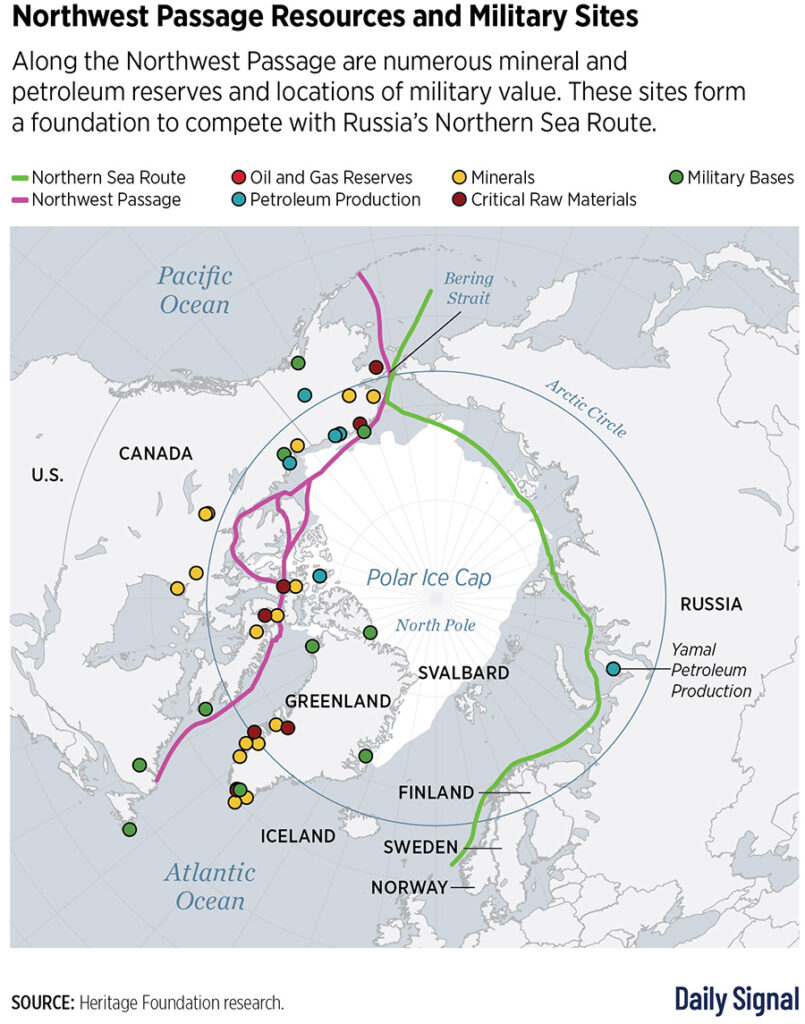
For the last two decades, the Arctic ice cap has had more seasonal variance in ice thickness and scope, making shipping routes and bountiful resources more accessible. Two routes stand out: the Northwest Passage (NWP), crossing northern Alaskan and Canadian coasts, and the Northern Sea Route (NSR), transiting Russia’s northern coast.
These promise shorter global shipping transits that are safe from Middle Eastern conflicts and pirate-prone Southeast Asian and African waters. But it is natural resources that could make the NWP worth developing. After all, Russia attracted significant Chinese investment, thanks to massive petroleum reserves at Yamal, to make Russia’s NSR viable.
The Competition
In a sign of past significant Arctic investments, Russia today has more than 40 icebreakers. In the last decade, Moscow has also constructed six major Arctic seaports, with plans to develop the Utrenny terminal off the coast of Ob Bay and ports in Chaika and Severny inside the Taymyr Peninsula.
China’s more than $734 million investment through the Silk Road Fund and an additional $12 billion of Chinese financing were key to developing Russia’s Yamal LNG facility and specialty ice-hardened ships. This spurred demand for Arctic shipping, which in turn caused a need for the specialty ships required to accomplish it, icebreakers, ice-hardened LNG carriers, and supply vessels.
Though still lacking critical infrastructure, the NSR supports significant maritime traffic. Meanwhile, the NWP is primarily used by private yachts and cruise ships during the July to September ice-free season. The NWP experienced 465 vessels navigating its waters between 1903 and December 2025. While Russia’s NSR saw over 3,000 vessels between 2013 and 2025. From a business perspective, the NWP is losing the Arctic competition. Closing the gap will require icebreakers.
To that end, the United States is collaborating with Canada and Finland, through the Icebreaker Collaboration Effort (ICE) Pact, to produce icebreakers. Through use of these ships, the NWP could become economically viable.
The Daily Signal.
New American Icebreakers
To secure American Arctic waters, the Coast Guard has assessed that it requires five Polar Security Cutters (PSC) and five Arctic Security Cutters (ASC). A medium ASC can break through 4 feet, six inches of ice transiting at 3 knots or 8 feet by backing and ramming. ASCs do not support year-round Arctic operations. PSCs, however, operate year-round in the Arctic, breaking up to 20 feet of ice. This capability doesn’t come cheap.
The ICE Pact initiative and associated Finland model would see the first two icebreakers of two classes built in Finland while a shipyard in the U.S. starts construction of subsequent icebreakers. The first U.S.-built icebreaker is scheduled to be delivered in 2028.
At present, the U.S. has contracted 11 icebreakers that will increase the U.S. fleet. However, the current operating icebreakers are past their operational service lives and have had many updates to stay operational and recover from frequent breakdowns.
The most recent incident occurred in September, resulting in a canceled Arctic deployment of Coast Guard icebreaker Healy—one of three active U.S. icebreakers, which had previously suffered a fire in 2024 that canceled another planned Arctic deployment. The new ships are intended to conduct icebreaking and channel clearing work, which will enable Arctic shipping traffic and support American Arctic economic development.
That said, Arctic operations and economic activity do not come cheap. For example, icebreakers are specialty vessels, with construction costs 20% higher than open-water counterparts. Ice-class container ships have a 40% higher fuel consumption, and tankers require reinforced hulls, greater propulsion power, and specialized Arctic operating systems, raising both capital and operating fees about 9%.
Northwest Passage Navigation
Sailing the NWP is about 3,750 nautical miles shorter than going via the Panama Canal. However, shallow water is a constraint on the NWP. The Davis Strait limits ships to drafts of less than 14 meters, excluding large container ships and very large crude carriers oil tankers.
Less of an issue economically is the long-standing freedom of navigation legal status dispute. Canada asserts that the waters of the NWP are within Canadian territorial waters as an Archipelago, therefore shipping through it subject to its authority. The U.S. sees this as an international waterway and therefore U.S. naval vessels and other official vessels exempt from requiring Canadian permission to transit. This dispute is relevant but only impacts the relatively infrequent innocent passage of official U.S. ships through the NWP.
Economic Opportunities
In recent years, the NWP has welcomed 5,000 tourists annually. In 2025, 11 cruises completed transits with over 450 cruise options offered. Tourism has been an early driver of NWP development.
In the early 2000s, 27,399 people traveled to the region, and in 2025, 102,930 tourists visited. Alaskan tourism would further benefit from an open NWP, having already seen its 1 million visitors in 2004 grow to over 3 million by 2024. Overall, Arctic tourism has grown in the last 15 years by almost 500%. Canada is investing $2 million in tourism infrastructure and service projects this year, with Alaskan and Canadian governments expecting Arctic tourism to jump as receding ice makes travel easier.
But tourism alone will not tap the full potential. Like the NSR, development of mineral and petroleum reserves along the route will be instrumental in attracting investments to develop the NWP. A 2009 U.S. geological survey concluded that 30% of the world’s undiscovered gas and 13% of its undiscovered oil are in the region. The USGS estimated over 31.4 billion barrels of petroleum reserves are in the East Greenland Rift basin.
Canada is investing $50 million to build a deepwater Arctic port in Grays Bay, and, anticipating future critical mineral shipping, the Canadian government has granted Glacies Technologies $5 million to reduce technical costs in Arctic mines.
A recent report by the Center for Minerals and Materials shows significant amounts of critical raw materials along the NWP. Extracting these resources profitably requires safe shipping for companies investing in exporting those resources.
Icebreakers would expand the operational time of cruises and shipping in the NWP, driving growth in multiple sectors.
NSR Cost Comparisons
The transit distance from Europe to Asia via the NSR is one-third that of the Suez Canal route. With Russian icebreaker escorts, vessels have been able to safely transit its 3,000–3,500 nautical miles.
Given Middle Eastern conflicts and piracy threats, the NSR offers a shorter, safer route. This largely benefits Russia, which charges between $200,000-$800,000 per escort, compared with the $400,000 to $600,000 in escort fees to be guided through the Suez Canal. The Panama Canal charges $300,000 to $900,000.
For Canada and the U.S. to develop a competitive NWP, it must be cost competitive. However, the U.S. could just focus on its portion of the route and accessing resources in Alaska’s northern waters.
Until the conflict with Iran broke out in February 2026, Japan was acquiring more than 90% of its oil from the Middle East. In pursuit of more secure sources of energy, Japan has explored importing oil from Alaska. Tokyo and Washington are in the final stages of negotiations to increase production of Alaskan crude oil, which would meet more than 10% of Japan’s annual consumption. Already, Japan’s crude oil imports from the U.S. have increased by 24%. It takes 45-50 days to get a tanker from the Persian Gulf to Japan, compared with an average of 10 days from Alaska.
Arctic Economic and Security Potential Requires Icebreakers
To be economically competitive, the NWP must draw in shippers, access rich Arctic petroleum reserves, and mine rich mineral deposits.
To achieve this goal, the first step would be to develop the American portion of the NWP. Conducting a comprehensive assessment of the economic viability of Alaska’s northern waters and the NWP will be key. This would then inform an Arctic fleet plan that would include the participation of allies and inform the work of the ICE Pact initiative with Canada.
Continue reading...
[ H/T The Daily Signal ]