





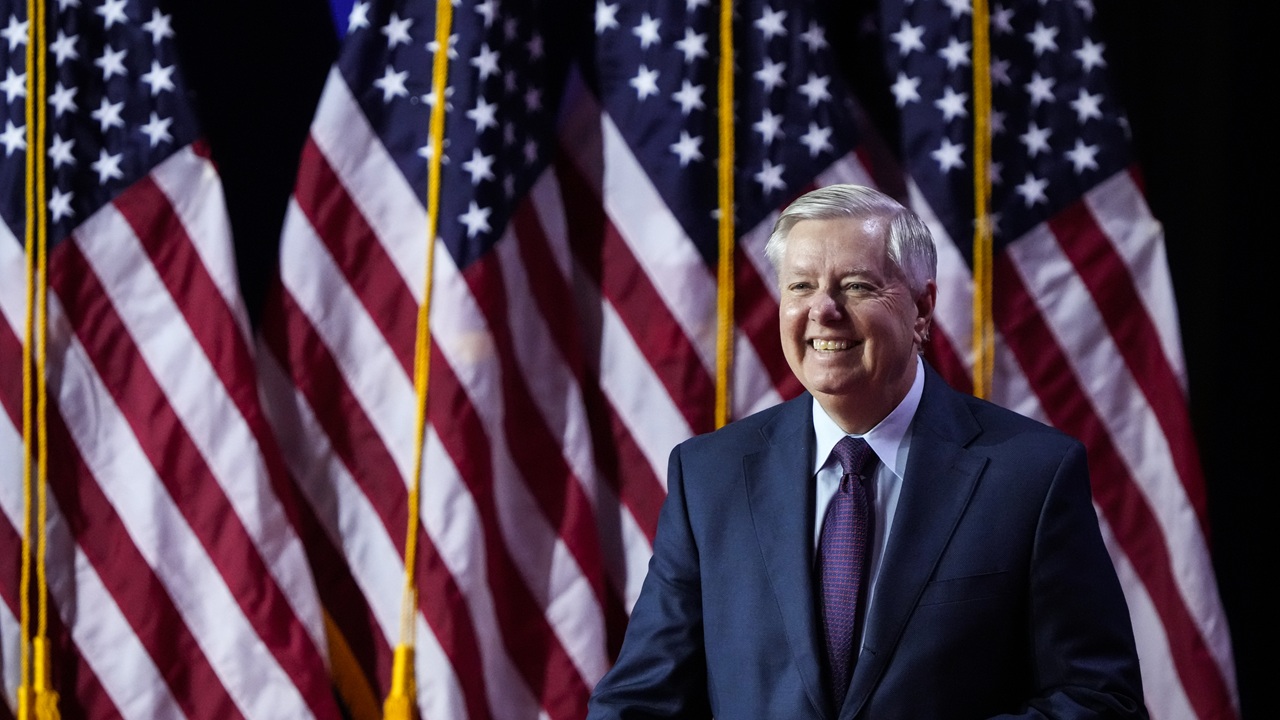
I have flown to Washington, D.C., more times than I can count over the last 1,000 days, almost always for the same reason: to press for the return of the American hostages held in Gaza, including my son. This week I flew there for a different reason: to stand among the people saying goodbye to the late Sen. Lindsey Graham, R-S.C.
I am not a head of state or a former colleague from the Senate floor. I am the father of Itay, an American who was nineteen when Hamas murdered him on Oct. 7, 2023, and held his remains in Gaza for more than two years. In the worst stretch of my life, Graham was one of the very few people in Washington willing to tell me the truth about my son’s case, even on the days I did not want to hear it. That is not a small thing to offer a stranger, and I will never forget it.
Many tributes call Graham one of Israel’s great friends, and he was. But it was never a sentimental friendship. Graham’s conviction, stated to me directly more than once, was that Israel’s security would ultimately be secured not by firepower alone but by weaving Israel into the economic life of its region, by bringing Saudi Arabia to the table, widening the Abraham Accords, and boxing in Iran. That was the map he was still drawing when he died. Most of it is still just lines on paper.
The uncomfortable question is what happens to that map now. Graham was not merely a reliable vote; he was the person who kept making the calls after everyone else had moved on to the next news cycle. There are serious people left in the Senate who care: James Risch, R-Idaho; Joni Ernst, R-Iowa; Ted Budd, R-N.C.; and James Lankford, R-Okla., among them.
As it happens, Washington does not have to wait for a congressional champion to appear. President Donald Trump has been the driving force on the Accords, and his historic dealmaking has produced another example of creating mutual interest in a more stable region.
President Trump recently announced a U.S.-Saudi civil nuclear deal, under which American firms would help build out Saudi Arabia’s nuclear power program with the goal of moving toward normalization with Israel. That agreement heads to Congress for review in the coming weeks. It is exactly the kind of mutual-interest dealmaking the world needs: something concrete on both sides of the ledger, not a favor extended in one direction.
It is worth being specific about what the Accords can enable for the U.S. and the troubled Middle East. In August 2025, Israeli gas producers announced a $35 billion deal to supply Egypt through 2040, the largest export agreement in Israel’s history. Emirati and Israeli defense firms are now negotiating joint production of surveillance drones, and trade between Israel and its Middle Eastern partners is up more than 100% since 2021.
Researchers at RAND estimate that a fully expanded Accords, anchored by Saudi Arabia, could generate more than $1 trillion in economic activity and 4 million jobs—likely including American ones—within a decade. Much of the economic activity would likely run through the proposed India-Middle East-Europe corridor as an answer to China’s Belt and Road ambitions for the region.
None of that is sentiment. It is the scaffolding Graham believed would eventually make war more expensive than peace for everyone involved.
Members of Congress who consider themselves friends of Israel, it is time to ask Prime Minister Benjamin Netanyahu—along with the leaders of Saudi Arabia and the Middle East who were friends of Graham’s—to commit to normalization and expansion of the Abraham Accords. Soon there will be an actual vote coming—not a eulogy to deliver, but an agreement to review. That is a better use of this moment than another round of tributes.
I make one last request that has nothing to do with trade figures. Forty-six Americans were murdered by Hamas on Oct. 7, 2023, one of the deadliest single days for American civilians at the hands of terrorists since Sept. 11, 2001. My son was the youngest of them. A country shows what it values by what it chooses to remember, and mine has not yet chosen to remember this.
I am asking our government to establish a National Day of Remembrance for the Americans killed by terrorism on Oct. 7, 2023. Then we will all remember them and give a face and name to what happens when we do not have peace.
Lindsey Graham never let their names go quiet, and through Trump’s vision of the Accords, Americans have been presented with a vision of how to bring peace to the Middle East. It is falling to the rest of us now.
We publish a variety of perspectives. Nothing written here is to be construed as representing the views of the Daily Signal.
Continue reading...
[ H/T The Daily Signal ]