





The Last Safe Haven Reports: Everything You Need To Know Ahead Of Apple Earnings
For most of October, Apple was the only megacap tech stock that didn't need an AI story.
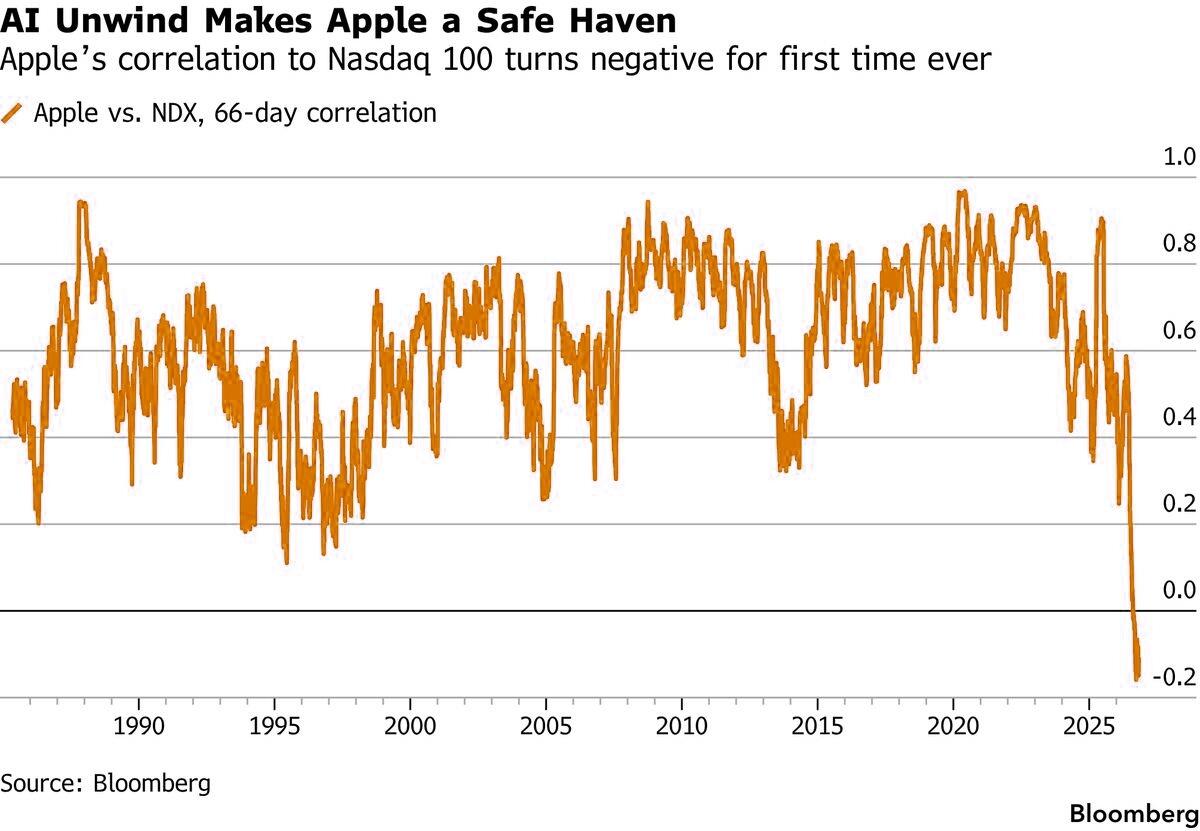
While semis were puking and the Nasdaq 100 slid into its third correction of the year, Apple quietly reclaimed the title of world's most valuable company on Friday, and its correlation to the Nasdaq 100 turned negative for the first time ever. As our friends at The Market Ear put it on Oct 19, "Apple is doing something it has never done before." Here is what that looks like, courtesy of Bloomberg:
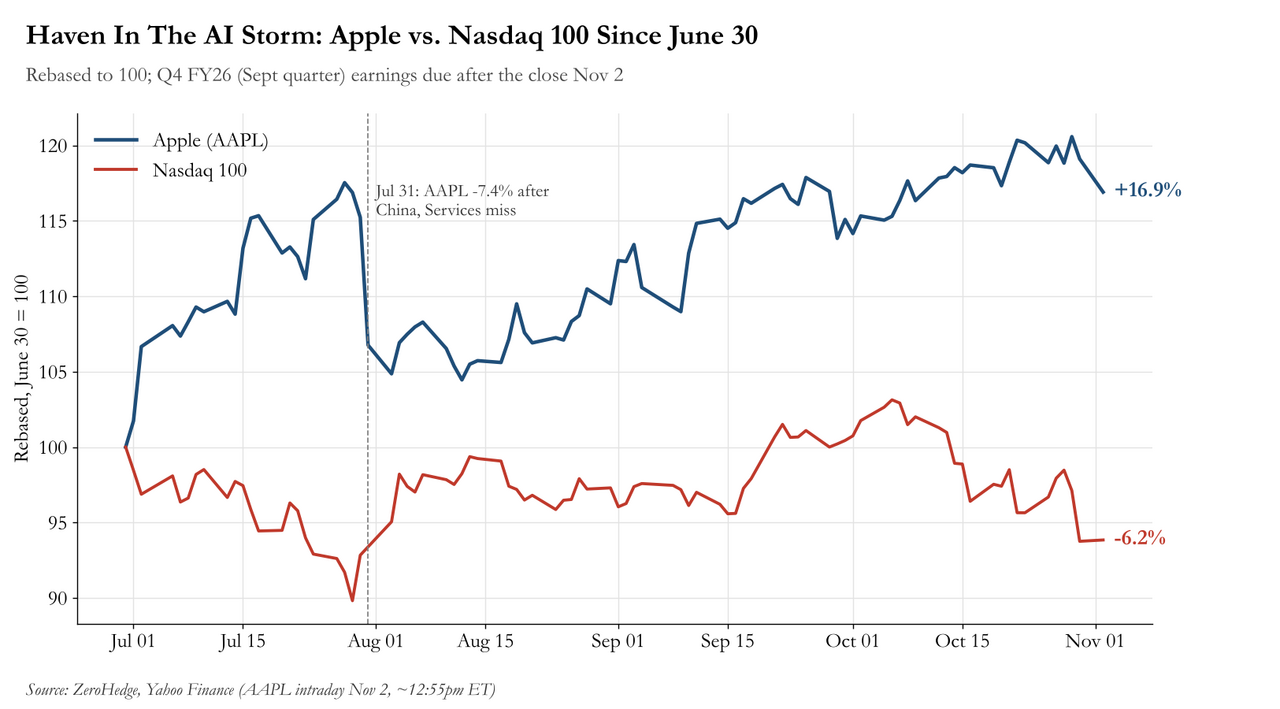
The result: Apple is up 17% since the end of June, while the Nasdaq 100 is down 6%, and that includes a 7.4% puke after the China and Services miss on July 30:
Tonight, after the close, the haven has to report. It will also be John Ternus' first earnings call as CEO (Tim Cook took his final call in July), and Goldman's Giulio Esposito calls it "the ultimate test for consumer hardware elasticity and self-funded AI deployment." In other words, can Apple keep raising prices faster than people stop buying, at a time when memory chips cost multiples of what they did a year ago?
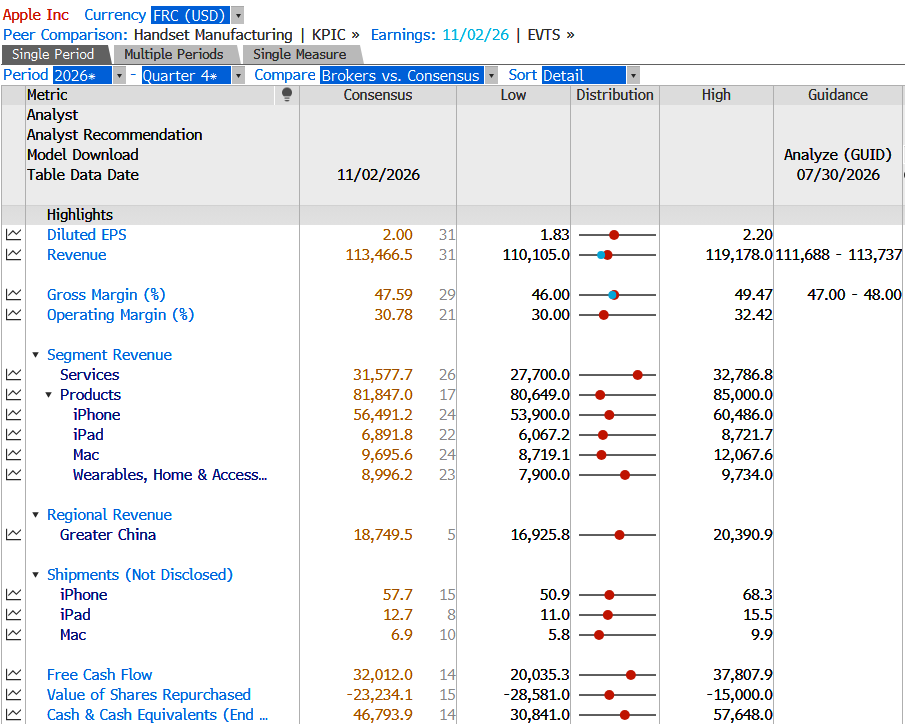
Start with the bar. The Street is looking for fiscal Q4 (September quarter) revenue of $113.5 billion, right at the top of Apple's $111.7-113.7 billion guidance range, with EPS of $2.00 and a gross margin of 47.6% (guidance 47-48%). iPhone is expected at $56.5 billion and Services at $31.6 billion, per Bloomberg:
Nobody on the sell-side is reaching for the top end. UBS Sales & Trading gives Apple a sentiment score of just 6.5 out of 10 (it had Amazon at 9 last week), and analyst David Vogt (Neutral, $296 PT) "made limited estimate changes ahead of Apple earnings." His numbers sit a hair below consensus:
Translation: fewer phones, at higher prices, adding up to roughly the same dollars. Hold that thought.
Goldman's Michael Ng (Buy, $390 PT) is a touch more constructive but lands in the same place. In his F4Q26 preview, "iPhone 18 family + Duo to drive growth in F2027" (available to pro subs), he writes:
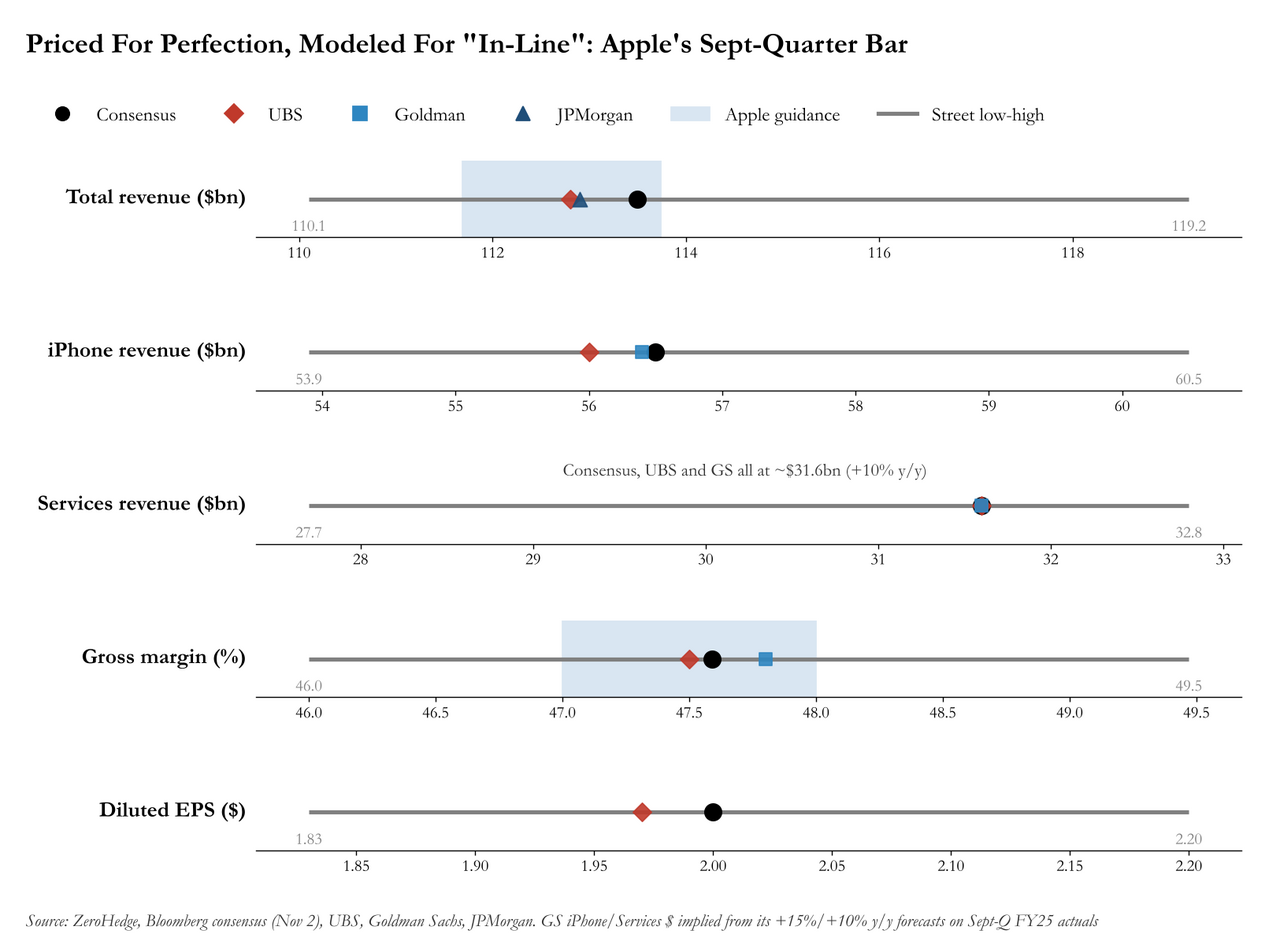
Ng's growth rates work out to roughly $56.4 billion of iPhone and $31.6 billion of Services, i.e. right on consensus. JPMorgan's Samik Chatterjee has revenue at $112.9 billion (+10% y/y), "modestly above the guidance midpoint." Put it all together and the sell-side has converged on one word: in-line:
Vogt sees EPS of $1.97 vs. $1.99 consensus, and flags where any upside would come from: "A few cents of upside is possible from lower operating expenses, although an opex-driven beat is unlikely to be rewarded by investors." Which is a polite way of saying that cutting costs to make the quarter is what companies do when the product isn't making it for them.
As usual, the quarter matters less than the December-quarter guidance. Goldman's TMT desk (Peter Callahan) lists the "4Q revenue guide" as one of three things investors care about tonight, noting that GIR "expects Apple to guide to total revenue growth of LSD%-MSD% yoy." JPMorgan's Chatterjee is on the same page ("look for low to mid-single digit growth with iPhones ASPs offsetting lower volumes"), and his December-quarter model is where it gets interesting:
Read that again: iPhone units down 18% in Apple's biggest quarter of the year, with price doing all the work. Part of that is self-inflicted timing: this year Apple launched only its premium models in the fall (the 18 Pro, Pro Max and the ~$2,000 foldable Duo) and pushed the base iPhone 18 to spring 2027. Part of it, though, looks like plain sticker shock.
Recall that back in June, Apple jacked up Mac and iPad prices by 15-25% overnight because of the memory crunch, and the iPhone 18 Pro and Pro Max then launched at $1,199 and $1,299, both $100 above their predecessors. The early read has not been great:
And then there's the Duo. Pre-orders sold out instantly (reportedly), resellers demanded steep premiums, and then, within days of delivery, screens started cracking down the middle:
Apple acknowledged "display problems" and offered replacements, and "Crackgate" was born. UBS Evidence Lab still had average Duo wait times at 89 days as of last week, but Vogt is watching for signs of buyers deferring to a second-generation foldable or trading down to the Pro models. Goldman's Rich Privorotsky says tonight matters for "what it says about iPhone demand and early Duo orders." Expect that question on the call, probably more than once.
Goldman, for its part, thinks FY27 is fine: Ng counts on "the full-year contribution from price increases on the iPhone 18 Pro/Pro Max, a replacement cycle improvement catalyzed by the iPhone Duo, the Spring 2027 launches of the base iPhone 18, iPhone 18e and iPhone Air 2," plus the new touchscreen MacBook Pro unveiled at last week's "Pro and Tell" event. JPM's Chatterjee has FY27 revenue of $518.3 billion (+9%), "just below consensus," on iPhone units of only ~247 million (+3%). Sure, so long as consumers keep paying up.
Gross margin is the second thing on Callahan's list ("cost inflation, pricing & services mix"), and here the headline number flatters. Both banks have it inside guidance, but both get help from a one-off: UBS's 47.5% "includ[es] a roughly 100bp tariff-refund benefit," as does Goldman's 47.8%. Strip that out and, per UBS, "gross margin is expected to decline due largely to higher DRAM costs."
That's no surprise to anyone who has looked at a memory price lately. Back in June, Vogt estimated that memory had gone from about $50-60 (a mid-single-digit share) of a $1,000 iPhone's bill of materials to "~20%" depending on long-term agreements, which is why he expected Apple to push through roughly $100 price increases just to keep product margins in the 37-38% range. Since then, things have gotten worse: South Korean DRAM exports hit another record $34 billion in October, up 595% y/y (per Goldman's Korea tech team), and TrendForce sees mobile DRAM contract prices up another 0-5% q/q in Q4. Somebody pays for that, and so far it has been the consumer. The question for tonight is how long that lasts, and what happens to the margin guide once the tariff refund is gone.
Services was supposed to be the part of Apple that didn't care about DRAM. In July it missed by almost $1 billion, growing just 12%, which prompted this:
Three months later, the Street has caught up. Everyone is now at about +10% y/y ($31.6 billion), and UBS notes that "App Store growth slowed to low single digits." Callahan's first question for tonight is whether Apple can "hold DDs y/y growth on this line," and Ng names "the sustainability of DD% Services growth given slower App Store trends and continued regulatory pressure on App Store monetization" as one of the two key debates. Probably the most important one, given it's the highest-margin line Apple has.
Here is the problem with being the safe haven: everyone hides in the same place. Callahan points out that Apple "goes into earnings on Monday night at an all-time high multiple - both on an absolute basis (36x fwd P/E...) and on a relative basis (17x premium to the S&P 500)" (chart source GS, Bloomberg):
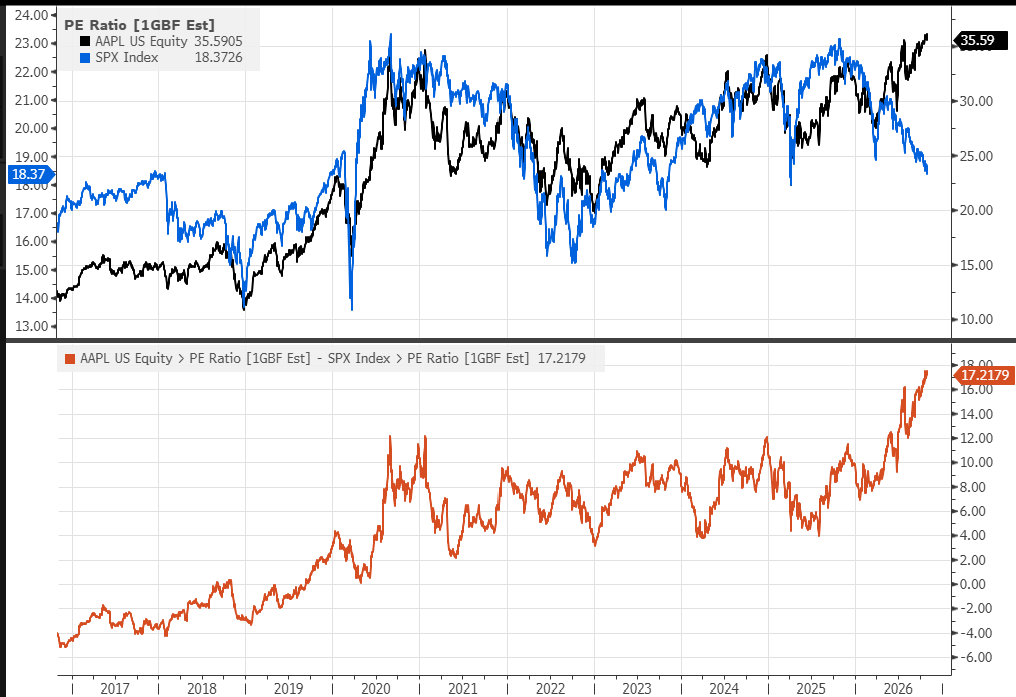
That is a forward P/E nearly double the S&P's 18.4x for a company whose unit volumes are expected to shrink next quarter. Our contributor Quoth the Raven asked last week whether Apple has peaked, and did the math on a trailing basis: "If Apple's earnings remained unchanged and its valuation contracted from 40x to 30 times, the stock would fall 25%... at 20x earnings, investors would be looking at a 50% haircut without the company losing a single dollar of annual profitability." Larry McDonald's Bear Traps Report went further on Friday, telling clients it is "long AAPD, high conviction" (that would be the inverse Apple ETF).
The bulls aren't hiding, though. Last Monday and Tuesday, Nomura's Charlie McElligott flagged "MASSIVE Upside Vol BUYERS" in megacap tech into earnings, with Apple leading the pack:
We know how the Alphabet leg of that trade went.
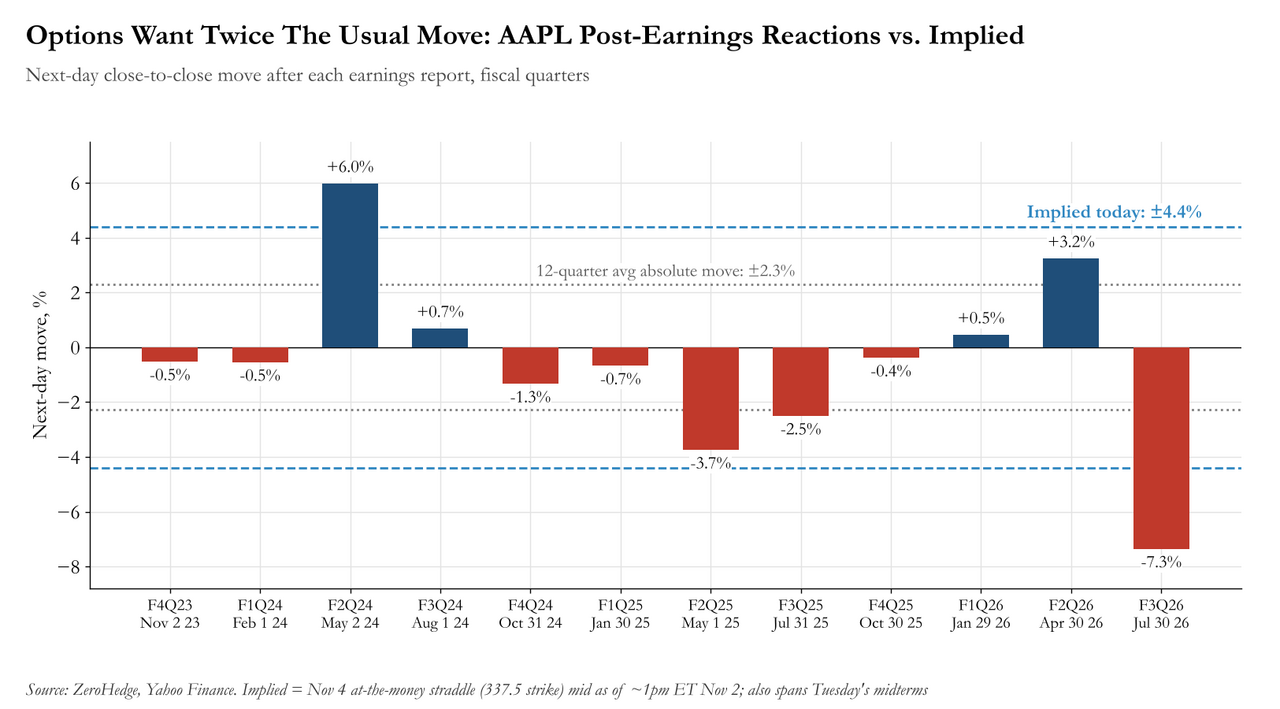
Options are pricing a big move for tonight. On our math, the Wednesday at-the-money straddle implies about 4.4%, roughly double Apple's 2.3% average absolute move over the past 12 reports. In fairness, that expiry also covers Tuesday's midterms, but Goldman's Brian Garrett notes that at the index level "excess variance for the midterms remains nonexistent" (the Wednesday SPX straddle "captures aapl earnings and midterms and yet costs 30bps less than Friday's single session move"). So most of that premium is probably Apple. And the last time it reported, the stock fell 7.3%:
So here's the setup. Apple walks in at an all-time high multiple, with a moderate sentiment score (6.5/10 at UBS), a sell-side that expects "in-line," a gross margin propped up by a tariff refund, Services growth slowing toward 10%, and a December quarter in which JPMorgan sees iPhone units falling 18% while price does the heavy lifting. It also walks in as the stock people bought because it isn't an AI trade, the same week Deutsche Bank's strategists flipped back to positive on US tech after an 11% drawdown. If the AI names bounce, the haven money has somewhere else to go.
Can Ternus pull it off? Maybe, if the Duo backlog is real and the guide lands at the high end of "LSD-MSD." But we suspect the market is about to find out what we flagged in July: a 36x multiple is a lot to pay for fewer phones at higher prices, and an opex beat won't cover for that. UBS put it best: a few cents of upside from lower costs "is unlikely to be rewarded by investors."
Then again, nothing says "safe haven" like a stock whose earnings growth increasingly depends on how much more people will pay for a phone that cracks.
Much more in the full Goldman F4Q26 preview "iPhone 18 family + Duo to drive growth in F2027" available to pro subs.
Tyler Durden Mon, 11/02/2026 - 14:49
Continue reading...
[ H/T ZeroHedge ]
For most of October, Apple was the only megacap tech stock that didn't need an AI story.
While semis were puking and the Nasdaq 100 slid into its third correction of the year, Apple quietly reclaimed the title of world's most valuable company on Friday, and its correlation to the Nasdaq 100 turned negative for the first time ever. As our friends at The Market Ear put it on Oct 19, "Apple is doing something it has never done before." Here is what that looks like, courtesy of Bloomberg:
The result: Apple is up 17% since the end of June, while the Nasdaq 100 is down 6%, and that includes a 7.4% puke after the China and Services miss on July 30:
Tonight, after the close, the haven has to report. It will also be John Ternus' first earnings call as CEO (Tim Cook took his final call in July), and Goldman's Giulio Esposito calls it "the ultimate test for consumer hardware elasticity and self-funded AI deployment." In other words, can Apple keep raising prices faster than people stop buying, at a time when memory chips cost multiples of what they did a year ago?
"In-Line" Is The New Beat
Start with the bar. The Street is looking for fiscal Q4 (September quarter) revenue of $113.5 billion, right at the top of Apple's $111.7-113.7 billion guidance range, with EPS of $2.00 and a gross margin of 47.6% (guidance 47-48%). iPhone is expected at $56.5 billion and Services at $31.6 billion, per Bloomberg:
Nobody on the sell-side is reaching for the top end. UBS Sales & Trading gives Apple a sentiment score of just 6.5 out of 10 (it had Amazon at 9 last week), and analyst David Vogt (Neutral, $296 PT) "made limited estimate changes ahead of Apple earnings." His numbers sit a hair below consensus:
Translation: fewer phones, at higher prices, adding up to roughly the same dollars. Hold that thought.
Goldman's Michael Ng (Buy, $390 PT) is a touch more constructive but lands in the same place. In his F4Q26 preview, "iPhone 18 family + Duo to drive growth in F2027" (available to pro subs), he writes:
Ng's growth rates work out to roughly $56.4 billion of iPhone and $31.6 billion of Services, i.e. right on consensus. JPMorgan's Samik Chatterjee has revenue at $112.9 billion (+10% y/y), "modestly above the guidance midpoint." Put it all together and the sell-side has converged on one word: in-line:
Vogt sees EPS of $1.97 vs. $1.99 consensus, and flags where any upside would come from: "A few cents of upside is possible from lower operating expenses, although an opex-driven beat is unlikely to be rewarded by investors." Which is a polite way of saying that cutting costs to make the quarter is what companies do when the product isn't making it for them.
The Guide Is The Print: Price Up, Units Down... A Lot
As usual, the quarter matters less than the December-quarter guidance. Goldman's TMT desk (Peter Callahan) lists the "4Q revenue guide" as one of three things investors care about tonight, noting that GIR "expects Apple to guide to total revenue growth of LSD%-MSD% yoy." JPMorgan's Chatterjee is on the same page ("look for low to mid-single digit growth with iPhones ASPs offsetting lower volumes"), and his December-quarter model is where it gets interesting:
Read that again: iPhone units down 18% in Apple's biggest quarter of the year, with price doing all the work. Part of that is self-inflicted timing: this year Apple launched only its premium models in the fall (the 18 Pro, Pro Max and the ~$2,000 foldable Duo) and pushed the base iPhone 18 to spring 2027. Part of it, though, looks like plain sticker shock.
Recall that back in June, Apple jacked up Mac and iPad prices by 15-25% overnight because of the memory crunch, and the iPhone 18 Pro and Pro Max then launched at $1,199 and $1,299, both $100 above their predecessors. The early read has not been great:
- Bernstein found that US Pro and Pro Max demand was down low single digits y/y (China was up 12% in launch week).
- Nikkei reported that Apple cut October component orders for the two Pro models by 15-20%, with one supplier calling the handsets "just too expensive."
- Loop Capital downgraded the stock to Hold on Oct 20, citing iPhone shipment reductions.
And then there's the Duo. Pre-orders sold out instantly (reportedly), resellers demanded steep premiums, and then, within days of delivery, screens started cracking down the middle:
Apple acknowledged "display problems" and offered replacements, and "Crackgate" was born. UBS Evidence Lab still had average Duo wait times at 89 days as of last week, but Vogt is watching for signs of buyers deferring to a second-generation foldable or trading down to the Pro models. Goldman's Rich Privorotsky says tonight matters for "what it says about iPhone demand and early Duo orders." Expect that question on the call, probably more than once.
Goldman, for its part, thinks FY27 is fine: Ng counts on "the full-year contribution from price increases on the iPhone 18 Pro/Pro Max, a replacement cycle improvement catalyzed by the iPhone Duo, the Spring 2027 launches of the base iPhone 18, iPhone 18e and iPhone Air 2," plus the new touchscreen MacBook Pro unveiled at last week's "Pro and Tell" event. JPM's Chatterjee has FY27 revenue of $518.3 billion (+9%), "just below consensus," on iPhone units of only ~247 million (+3%). Sure, so long as consumers keep paying up.
Tariff Refunds In, DRAM Out
Gross margin is the second thing on Callahan's list ("cost inflation, pricing & services mix"), and here the headline number flatters. Both banks have it inside guidance, but both get help from a one-off: UBS's 47.5% "includ[es] a roughly 100bp tariff-refund benefit," as does Goldman's 47.8%. Strip that out and, per UBS, "gross margin is expected to decline due largely to higher DRAM costs."
That's no surprise to anyone who has looked at a memory price lately. Back in June, Vogt estimated that memory had gone from about $50-60 (a mid-single-digit share) of a $1,000 iPhone's bill of materials to "~20%" depending on long-term agreements, which is why he expected Apple to push through roughly $100 price increases just to keep product margins in the 37-38% range. Since then, things have gotten worse: South Korean DRAM exports hit another record $34 billion in October, up 595% y/y (per Goldman's Korea tech team), and TrendForce sees mobile DRAM contract prices up another 0-5% q/q in Q4. Somebody pays for that, and so far it has been the consumer. The question for tonight is how long that lasts, and what happens to the margin guide once the tariff refund is gone.
Services: The Golden Calf Slows Down
Services was supposed to be the part of Apple that didn't care about DRAM. In July it missed by almost $1 billion, growing just 12%, which prompted this:
Three months later, the Street has caught up. Everyone is now at about +10% y/y ($31.6 billion), and UBS notes that "App Store growth slowed to low single digits." Callahan's first question for tonight is whether Apple can "hold DDs y/y growth on this line," and Ng names "the sustainability of DD% Services growth given slower App Store trends and continued regulatory pressure on App Store monetization" as one of the two key debates. Probably the most important one, given it's the highest-margin line Apple has.
A Haven... At A Record Multiple
Here is the problem with being the safe haven: everyone hides in the same place. Callahan points out that Apple "goes into earnings on Monday night at an all-time high multiple - both on an absolute basis (36x fwd P/E...) and on a relative basis (17x premium to the S&P 500)" (chart source GS, Bloomberg):
That is a forward P/E nearly double the S&P's 18.4x for a company whose unit volumes are expected to shrink next quarter. Our contributor Quoth the Raven asked last week whether Apple has peaked, and did the math on a trailing basis: "If Apple's earnings remained unchanged and its valuation contracted from 40x to 30 times, the stock would fall 25%... at 20x earnings, investors would be looking at a 50% haircut without the company losing a single dollar of annual profitability." Larry McDonald's Bear Traps Report went further on Friday, telling clients it is "long AAPD, high conviction" (that would be the inverse Apple ETF).
The bulls aren't hiding, though. Last Monday and Tuesday, Nomura's Charlie McElligott flagged "MASSIVE Upside Vol BUYERS" in megacap tech into earnings, with Apple leading the pack:
We know how the Alphabet leg of that trade went.
Options are pricing a big move for tonight. On our math, the Wednesday at-the-money straddle implies about 4.4%, roughly double Apple's 2.3% average absolute move over the past 12 reports. In fairness, that expiry also covers Tuesday's midterms, but Goldman's Brian Garrett notes that at the index level "excess variance for the midterms remains nonexistent" (the Wednesday SPX straddle "captures aapl earnings and midterms and yet costs 30bps less than Friday's single session move"). So most of that premium is probably Apple. And the last time it reported, the stock fell 7.3%:
Elasticity Has A Limit
So here's the setup. Apple walks in at an all-time high multiple, with a moderate sentiment score (6.5/10 at UBS), a sell-side that expects "in-line," a gross margin propped up by a tariff refund, Services growth slowing toward 10%, and a December quarter in which JPMorgan sees iPhone units falling 18% while price does the heavy lifting. It also walks in as the stock people bought because it isn't an AI trade, the same week Deutsche Bank's strategists flipped back to positive on US tech after an 11% drawdown. If the AI names bounce, the haven money has somewhere else to go.
Can Ternus pull it off? Maybe, if the Duo backlog is real and the guide lands at the high end of "LSD-MSD." But we suspect the market is about to find out what we flagged in July: a 36x multiple is a lot to pay for fewer phones at higher prices, and an opex beat won't cover for that. UBS put it best: a few cents of upside from lower costs "is unlikely to be rewarded by investors."
Then again, nothing says "safe haven" like a stock whose earnings growth increasingly depends on how much more people will pay for a phone that cracks.
Much more in the full Goldman F4Q26 preview "iPhone 18 family + Duo to drive growth in F2027" available to pro subs.
Tyler Durden Mon, 11/02/2026 - 14:49
Continue reading...
[ H/T ZeroHedge ]