






Guest Post by Peter Reagan

Your News to Know rounds up the most important stories about precious metals and the overall economy. This week, we’ll cover:
We don’t have to look hard for forecasts of a gold price rise $5,000 in 2027.
Bank of America still sees gold averaging about $4,813 in 2027, while saying $5,000 remains within reach if the current drivers hold.
French bank Natixis is more cautious near term, seeing gold under pressure through the rest of 2026 before a recovery into 2027. Its upside scenario hits $5,250 if the Fed stays on hold and investor and central-bank demand recover.
Metals Focus also expects a strong year for gold, reportedly forecasting an average of $5,330 next year. If gold averages that level, the peak is likely higher.
But despite all this – and despite gold climbing back toward $4,200 as of this writing – I want to talk about the warnings instead.
Reuters reported spot gold near $4,168 on October 12 as traders focused on inflation data, oil and the dollar. Now, BofA and Natixis both allow for the possibility of gold falling toward the mid-$3,000s before the next move higher. Analyst Chris Vermeulen of Technical Traders analyst went even lower in his warnings with a possible pullback toward the low $3,000 range before gold resumes its long-term climb.
Even though Vermeulen is an extreme bear here – in the sense that it is hard to find downside targets that low – let’s use that as a baseline.
My question to you, as either an existing or prospective gold owner, is simple:
Is $3,100/ounce gold a low price?
And if you’d answer “yes,” why?
Objectively, $2,200 or even $2,000 gold is already historically high. That $2,000 threshold was only breached in 2020. For years and years before the pandemic, gold was around $1,650 and the gold bulls set their targets at $1,900.
The price of gold has far outpaced official inflation readings since 2020. That’s why I’ve been pounding the table over inflation gauges that simply aren’t doing what people think they are.
My point here isn’t just to rail at you. Two things:
First, if gold were to hit $2,200 or $2,000 – which many now argue “can’t happen anymore” – that isn’t anything long-term gold owners should lament. Gold at $2,000 would be a very, very high “low.”
And the thing about lows? Afterward, we go up. Let me remind you: None of the forces that drove gold through its earlier highs have gone away. They are multiplying. So the long-term cause for short-term price panic just doesn’t exist. Then again, I’ve been watching the gold market for a whole lot longer than, say, someone who first saw the need to buy gold bullion back in February 2020. If your first purchase dates from then, well, you’ve only taken the trip in one direction. I can understand a little concern.
Second, dips in price are a blessing to long-term owners with conviction. I’ve always said the timing obsession misses the point for physical gold owners. Most Birch Gold Group customers are not thinking on a three-week timeline. They are thinking in terms of 10, 20 or 30 years. (Occasionally, we do receive inquiries from buyers interested in “flipping” gold coins. We prefer not to work with speculators.)
Anyway, the more you zoom out, the better gold’s performance looks over long time periods. On average, since 1971, gold’s price has 9% a year, handily beating other, more popular asset classes over periods ranging from a year to two decades.
But that’s a strictly-numbers perspective. Let’s face it: Most of us aren’t perfectly rational, cold-blooded investors. Emotions are real and they matter. All too often, we let those emotions sit in the driver’s seat.
A lot of people, customers and non-customers alike, get anxious when they see a price decline. They hesitate. Maybe they save $100 per ounce when they finally pull the trigger… Or maybe they pay $100 more. Either way, in the meantime, they’re missing out on the diversification benefits of gold.
More importantly, they’re missing out on peace of mind. I know many, many people gladly willing to trade extra dollars for months and years of real peace of mind. (Most people already do, but they call it insurance.)
Personally, I’ll take peace of mind over a few hundred dollars to an ounce any day of the week. Especially when you consider that a few hundred dollars is becoming increasingly negligible in everyday cost of living expenses.
There’s another important point in this seemingly pointless talk of price dips.
Gold’s recent moves higher were sudden. They surprised even seasoned gold investors. In other words, gold got very pricey very quickly. And that limits options for some investors. Frankly, I believe it spooked a lot of people away. When your safe haven surges like a meme, all of a sudden it doesn’t seem so safe anymore.
So Vermeulen’s lower target would be good from one standpoint: It would be an amazing gift for people who still want to own physical gold. Not coincidentally, Vermeulen sees dips as opportunities rather than reasons to abandon the long-term case.
But here’s the problem: We might be in a dip right now.
Gold near $4,200 already looks like a drop from recent highs. Yet we have major banks forecasting above $5,000, J.P. Morgan has floated $6,300 as “possible” in 2027, and technical analysts like Vermeulen still see much higher longer-term targets.
So, suppose gold does another quick repricing to the upside soon. Those who hesitate will have have missed out on the dip of today. Gold will be out of range for more and more people.
Unfortunately, this has been the story of gold since our ancestors first dug it out of the ground.
Silver is around $60, which still sounds strange to say out loud. J.P. Morgan sees silver averaging $70 in 2026 and $63 in 2027, while a recent LBMA conference delegate survey put silver near $95 over the next 12 months.
…that is quite a spread.
Who to believe?
Would you believe me if I said I didn’t even realize today’s silver price is $60? (I expect it sounds mighty weird, given my devotion to precious metals and sound money.)
But existing readers will know exactly what that is about. The gold-to-silver ratio – how many ounces of silver are needed to buy an ounce of gold – is what I’m watching. Along with fundamentals like supply, availability and industrial demand.
Based on the gold/silver ratio, years of deficits and physical availability, I’d put silver’s fair value closer to $90-$100 on the conservative side.
I believe it could easily be higher.
So why should I, or any silver investor, care that they’re telling us silver is $60 except on the day we’re increasing our silver exposure further?
Now, remember: I forecast much higher silver, and when the move came, I said it could fall back down if paper-market pressure and investor sentiment turned against it. I was saying it before, during and after that target, and that is sadly the scenario we’re watching right now.
It’s disappointing to see silver weakness framed as proof that the metal was merely pushed up by tiny liquidity shortages, which has been the go-to damage control story for as long as I can remember.
Now we’re being told we could see a “supply excess” in 2027 because of rising inventories and declining industrial demand.
…what? How will we hit a “supply excess” when the Silver Institute and Metals Focus expect a sixth straight annual deficit, with the 2026 shortfall expected to be 46.3 million ounces?
Don’t forget, most silver is a byproduct of mining for base metals like lead and zinc. Irrelevant, except this makes it hard for miners to simply “dial up” silver production when prices rise. Don’t ask me how this is supposed to work!
This chart raises more questions than it answers:
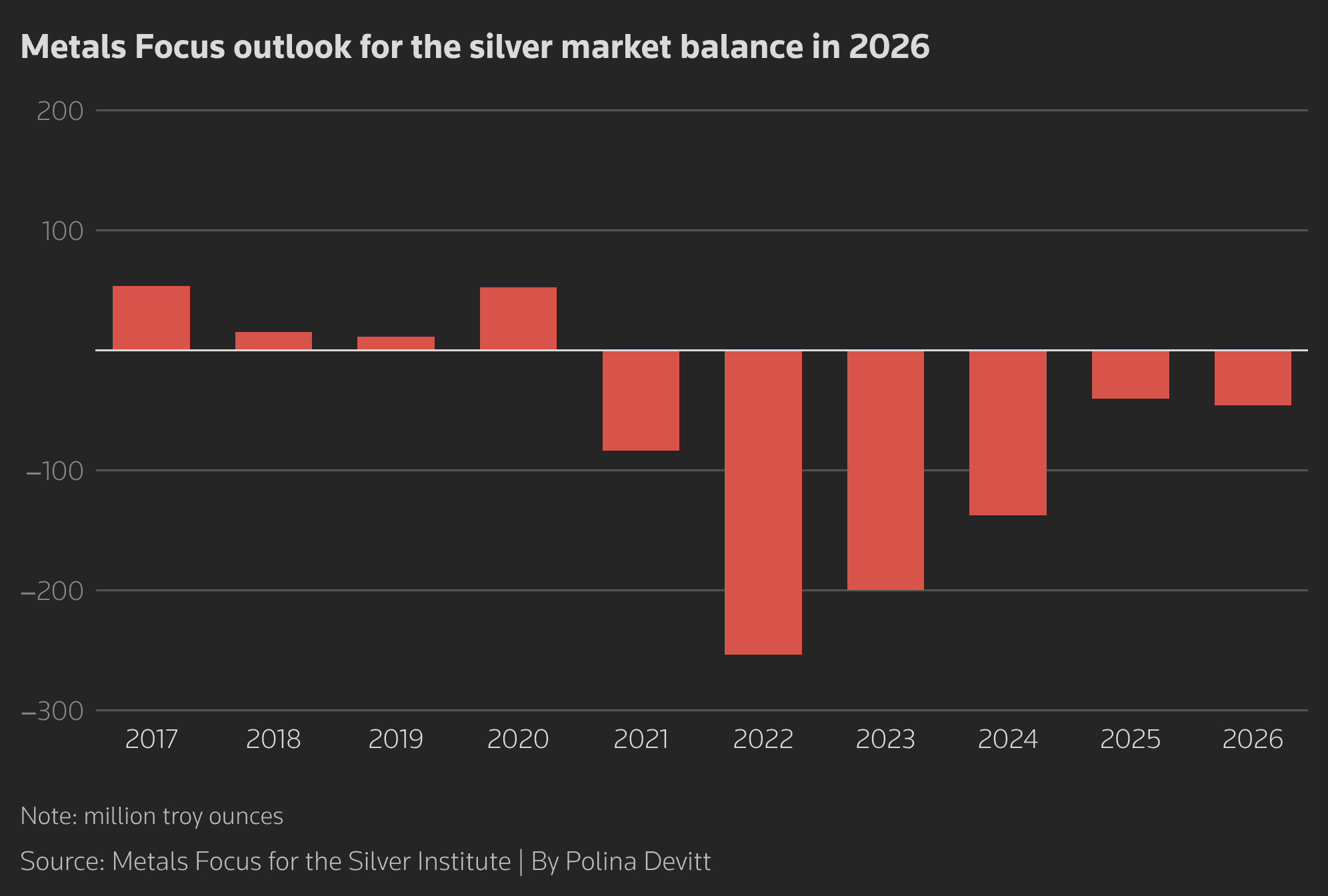
Chart via Reuters
Now, a lot of the coverage focuses on supposedly abundant commercial vault inventories of silver bullion. But availability on paper is not the same thing as simple, immediate access to the right metal in the right form. Vault shortages aren’t the only reason silver’s price went up. I think the much bigger force was organic repricing based on investor demand, silver’s price relative to gold and overall availability.
True, we’re told manufacturers are slashing silver consumption because of improved production methods. But manufacturers do not try to thrift silver because everything is fine! They do it because silver is expensive, supply is tight and margins matter. (Or when the economy is stagnating and manufacturing demand is down.)
The Silver Institute has been blunt about this. The market remains “structurally tight” even as manufacturers try to reduce silver use where they can. The word “structurally” in this context means fundamentally. Meaning, It’s not going to change.
As interesting as industrial use of silver is, it’s the investment side I really care about.
I spoke about dips in gold not being that relevant. Silver, though? Well, it’s in a kind of permanent dip, and investors know it.
Any investor worth their salt was paying attention to $34 silver with $2,000-$3,000 gold, and they are doing just the same now with $60 silver around $4,200 gold. That’s a 74:1 ratio, historically out of line with the post-1971 median of 60.
As I said, so long as silver price stays this low, I’ll only pay attention to the price on the day I’m upping my exposure even more.
It’s not a happy day when the IMF tells governments to act now on sovereign debt, energy prices, high interest rates and inflation.
According to IMF Managing Director Kristalina Georgieva, the global economy is being pulled between an energy supply shock and an AI-driven demand boom. Meanwhile, rising sovereign debt continues to pose risks to growth and of inflation.
Georgieva’s message was blunt enough without embellishment: High energy prices, record public debt and rising borrowing costs are squeezing governments all at the same time.
There is no “easy money” left.
Inflation eats cash. High rates punish borrowers… And governments keep borrowing anyway.
While this is happening, public debt is at record levels and debt-service costs are rising globally.
But Georgieva missed a very important part: Governments and central banks around the world are doing plenty to address these issues – for themselves.
Poland’s reported gold reserves have climbed to about 648 tonnes, putting it in tenth place among the world’s largest official gold holders and near its stated 700-metric ton target.
Countries around the world continue to add gold officially, and many reserve managers expect the trend to continue. According to the World Gold Council’s 2026 Central Bank Gold Reserves Survey, 45% of reserve managers expect their institutions’ gold holdings to increase over the next 12 months. And 89% expect global central-bank gold reserves to continue rising.
On top of that, central banks are rethinking where their gold is located.
Germany completed a major repatriation program years ago, and more recent European debates over gold custody show the same instinct: Countries want to know where their gold is and whether they can access it in a crisis.
So from a central bank’s point of view, they are being very dutiful about their finances!
When it comes down to incentives, central banks are far more focused on keeping the financial system and their adjacent governments afloat than on preserving the purchasing power of your savings.
Listen closely enough, and you’ll hear them tell you that your own wealth is your responsibility, not theirs.
So for countries with large gold reserves, the last few years have not been all bad. They have watched the price of gold surge. They have strengthened reserve positions. They have questioned custody arrangements. They have treated gold as strategic.
To citizens, it looks very different.
Their economies are under strain. Their grocery bills are higher. Their energy bills are higher. Their wages do not stretch the way they used to. Their retirement savings are forced to live inside the same currency-and-debt-based financial systems that central banks are quietly diversifying away from.
That is the part that should stay with you!
When the dust settles, governments and central banks will still be looking at their reserve assets. Households will be left looking at grocery bills, energy bills and (hopefully) savings balances.
It’s not a nice thing, but I have to remind people: There is little you can do except take action to diversify your own savings in the same spirit central banks are.
Central banks buy gold for resilience.
They hold it because they know paper promises fail.
They store it, move it, audit it, repatriate it and argue over where it should sit.
Then ordinary citizens are told to sit tight, trust policy and hope inflation behaves.
No thank you!
The U.S. sits in a strange worst-of-both-worlds position. We report the largest official gold reserves on earth, yet our monetary authorities show little urgency about the metal while the dollar’s purchasing power keeps eroding.
The Federal Reserve’s unusual public-private structure does not make that any more reassuring.
Gold is not a guarantee. Silver is not a magic wand. Precious metals do not stop governments from mismanaging money.
But they do something increasingly rare: They give savers a tangible financial asset outside the promises of the very same institutions warning everyone else to brace for impact.
The dollar buys less today than it did a year ago, a decade ago, a generation ago. That slide is the predictable result of endless printing and borrowing. Dr. Ron Paul believes the FED has the answer. But they’re keeping it to themselves. Fortunately, a new financial chart has publicly exposed their secret moves. See it for yourself: https://freekit.birchgold.com/lf/ro...D_v02a_article&placement=article&cid=rp_media
To learn more about how physical gold could help protect your retirement portfolio, click here to get your FREE info kit on Gold IRAs from Birch Gold Group. And now introducing a Crypto IRA to capitalize on the fastest growing market in the world.
Tweet
Continue reading...
[ H/T The Burning Platform ]
Your News to Know rounds up the most important stories about precious metals and the overall economy. This week, we’ll cover:
- Bank of America, Natixis and Metals Focus see gold pushing higher next year…
- …but I want to talk about $3,100 instead
- Reminder: Silver is still nonsensically undervalued
- IMF issues urgent warning on government debt, inflation and interest rates…
- …while central banks keep buying gold, leaving citizens to fend for themselves
Will there finally be gold dips to buy into? (Are we in one now?)
We don’t have to look hard for forecasts of a gold price rise $5,000 in 2027.
Bank of America still sees gold averaging about $4,813 in 2027, while saying $5,000 remains within reach if the current drivers hold.
French bank Natixis is more cautious near term, seeing gold under pressure through the rest of 2026 before a recovery into 2027. Its upside scenario hits $5,250 if the Fed stays on hold and investor and central-bank demand recover.
Metals Focus also expects a strong year for gold, reportedly forecasting an average of $5,330 next year. If gold averages that level, the peak is likely higher.
But despite all this – and despite gold climbing back toward $4,200 as of this writing – I want to talk about the warnings instead.
Reuters reported spot gold near $4,168 on October 12 as traders focused on inflation data, oil and the dollar. Now, BofA and Natixis both allow for the possibility of gold falling toward the mid-$3,000s before the next move higher. Analyst Chris Vermeulen of Technical Traders analyst went even lower in his warnings with a possible pullback toward the low $3,000 range before gold resumes its long-term climb.
Even though Vermeulen is an extreme bear here – in the sense that it is hard to find downside targets that low – let’s use that as a baseline.
My question to you, as either an existing or prospective gold owner, is simple:
Is $3,100/ounce gold a low price?
And if you’d answer “yes,” why?
Objectively, $2,200 or even $2,000 gold is already historically high. That $2,000 threshold was only breached in 2020. For years and years before the pandemic, gold was around $1,650 and the gold bulls set their targets at $1,900.
The price of gold has far outpaced official inflation readings since 2020. That’s why I’ve been pounding the table over inflation gauges that simply aren’t doing what people think they are.
My point here isn’t just to rail at you. Two things:
First, if gold were to hit $2,200 or $2,000 – which many now argue “can’t happen anymore” – that isn’t anything long-term gold owners should lament. Gold at $2,000 would be a very, very high “low.”
And the thing about lows? Afterward, we go up. Let me remind you: None of the forces that drove gold through its earlier highs have gone away. They are multiplying. So the long-term cause for short-term price panic just doesn’t exist. Then again, I’ve been watching the gold market for a whole lot longer than, say, someone who first saw the need to buy gold bullion back in February 2020. If your first purchase dates from then, well, you’ve only taken the trip in one direction. I can understand a little concern.
Second, dips in price are a blessing to long-term owners with conviction. I’ve always said the timing obsession misses the point for physical gold owners. Most Birch Gold Group customers are not thinking on a three-week timeline. They are thinking in terms of 10, 20 or 30 years. (Occasionally, we do receive inquiries from buyers interested in “flipping” gold coins. We prefer not to work with speculators.)
Anyway, the more you zoom out, the better gold’s performance looks over long time periods. On average, since 1971, gold’s price has 9% a year, handily beating other, more popular asset classes over periods ranging from a year to two decades.
But that’s a strictly-numbers perspective. Let’s face it: Most of us aren’t perfectly rational, cold-blooded investors. Emotions are real and they matter. All too often, we let those emotions sit in the driver’s seat.
A lot of people, customers and non-customers alike, get anxious when they see a price decline. They hesitate. Maybe they save $100 per ounce when they finally pull the trigger… Or maybe they pay $100 more. Either way, in the meantime, they’re missing out on the diversification benefits of gold.
More importantly, they’re missing out on peace of mind. I know many, many people gladly willing to trade extra dollars for months and years of real peace of mind. (Most people already do, but they call it insurance.)
Personally, I’ll take peace of mind over a few hundred dollars to an ounce any day of the week. Especially when you consider that a few hundred dollars is becoming increasingly negligible in everyday cost of living expenses.
There’s another important point in this seemingly pointless talk of price dips.
Gold’s recent moves higher were sudden. They surprised even seasoned gold investors. In other words, gold got very pricey very quickly. And that limits options for some investors. Frankly, I believe it spooked a lot of people away. When your safe haven surges like a meme, all of a sudden it doesn’t seem so safe anymore.
So Vermeulen’s lower target would be good from one standpoint: It would be an amazing gift for people who still want to own physical gold. Not coincidentally, Vermeulen sees dips as opportunities rather than reasons to abandon the long-term case.
But here’s the problem: We might be in a dip right now.
Gold near $4,200 already looks like a drop from recent highs. Yet we have major banks forecasting above $5,000, J.P. Morgan has floated $6,300 as “possible” in 2027, and technical analysts like Vermeulen still see much higher longer-term targets.
So, suppose gold does another quick repricing to the upside soon. Those who hesitate will have have missed out on the dip of today. Gold will be out of range for more and more people.
Unfortunately, this has been the story of gold since our ancestors first dug it out of the ground.
In case you forgot, silver is still barely $60
Silver is around $60, which still sounds strange to say out loud. J.P. Morgan sees silver averaging $70 in 2026 and $63 in 2027, while a recent LBMA conference delegate survey put silver near $95 over the next 12 months.
…that is quite a spread.
Who to believe?
Would you believe me if I said I didn’t even realize today’s silver price is $60? (I expect it sounds mighty weird, given my devotion to precious metals and sound money.)
But existing readers will know exactly what that is about. The gold-to-silver ratio – how many ounces of silver are needed to buy an ounce of gold – is what I’m watching. Along with fundamentals like supply, availability and industrial demand.
Based on the gold/silver ratio, years of deficits and physical availability, I’d put silver’s fair value closer to $90-$100 on the conservative side.
I believe it could easily be higher.
So why should I, or any silver investor, care that they’re telling us silver is $60 except on the day we’re increasing our silver exposure further?
Now, remember: I forecast much higher silver, and when the move came, I said it could fall back down if paper-market pressure and investor sentiment turned against it. I was saying it before, during and after that target, and that is sadly the scenario we’re watching right now.
It’s disappointing to see silver weakness framed as proof that the metal was merely pushed up by tiny liquidity shortages, which has been the go-to damage control story for as long as I can remember.
Now we’re being told we could see a “supply excess” in 2027 because of rising inventories and declining industrial demand.
…what? How will we hit a “supply excess” when the Silver Institute and Metals Focus expect a sixth straight annual deficit, with the 2026 shortfall expected to be 46.3 million ounces?
Don’t forget, most silver is a byproduct of mining for base metals like lead and zinc. Irrelevant, except this makes it hard for miners to simply “dial up” silver production when prices rise. Don’t ask me how this is supposed to work!
This chart raises more questions than it answers:
Chart via Reuters
Now, a lot of the coverage focuses on supposedly abundant commercial vault inventories of silver bullion. But availability on paper is not the same thing as simple, immediate access to the right metal in the right form. Vault shortages aren’t the only reason silver’s price went up. I think the much bigger force was organic repricing based on investor demand, silver’s price relative to gold and overall availability.
True, we’re told manufacturers are slashing silver consumption because of improved production methods. But manufacturers do not try to thrift silver because everything is fine! They do it because silver is expensive, supply is tight and margins matter. (Or when the economy is stagnating and manufacturing demand is down.)
The Silver Institute has been blunt about this. The market remains “structurally tight” even as manufacturers try to reduce silver use where they can. The word “structurally” in this context means fundamentally. Meaning, It’s not going to change.
As interesting as industrial use of silver is, it’s the investment side I really care about.
I spoke about dips in gold not being that relevant. Silver, though? Well, it’s in a kind of permanent dip, and investors know it.
Any investor worth their salt was paying attention to $34 silver with $2,000-$3,000 gold, and they are doing just the same now with $60 silver around $4,200 gold. That’s a 74:1 ratio, historically out of line with the post-1971 median of 60.
As I said, so long as silver price stays this low, I’ll only pay attention to the price on the day I’m upping my exposure even more.
IMF issues a warning and central banks take action (but with themselves in mind)
It’s not a happy day when the IMF tells governments to act now on sovereign debt, energy prices, high interest rates and inflation.
According to IMF Managing Director Kristalina Georgieva, the global economy is being pulled between an energy supply shock and an AI-driven demand boom. Meanwhile, rising sovereign debt continues to pose risks to growth and of inflation.
Georgieva’s message was blunt enough without embellishment: High energy prices, record public debt and rising borrowing costs are squeezing governments all at the same time.
There is no “easy money” left.
Inflation eats cash. High rates punish borrowers… And governments keep borrowing anyway.
While this is happening, public debt is at record levels and debt-service costs are rising globally.
But Georgieva missed a very important part: Governments and central banks around the world are doing plenty to address these issues – for themselves.
Poland’s reported gold reserves have climbed to about 648 tonnes, putting it in tenth place among the world’s largest official gold holders and near its stated 700-metric ton target.
Countries around the world continue to add gold officially, and many reserve managers expect the trend to continue. According to the World Gold Council’s 2026 Central Bank Gold Reserves Survey, 45% of reserve managers expect their institutions’ gold holdings to increase over the next 12 months. And 89% expect global central-bank gold reserves to continue rising.
On top of that, central banks are rethinking where their gold is located.
Germany completed a major repatriation program years ago, and more recent European debates over gold custody show the same instinct: Countries want to know where their gold is and whether they can access it in a crisis.
So from a central bank’s point of view, they are being very dutiful about their finances!
When it comes down to incentives, central banks are far more focused on keeping the financial system and their adjacent governments afloat than on preserving the purchasing power of your savings.
Listen closely enough, and you’ll hear them tell you that your own wealth is your responsibility, not theirs.
So for countries with large gold reserves, the last few years have not been all bad. They have watched the price of gold surge. They have strengthened reserve positions. They have questioned custody arrangements. They have treated gold as strategic.
To citizens, it looks very different.
Their economies are under strain. Their grocery bills are higher. Their energy bills are higher. Their wages do not stretch the way they used to. Their retirement savings are forced to live inside the same currency-and-debt-based financial systems that central banks are quietly diversifying away from.
That is the part that should stay with you!
When the dust settles, governments and central banks will still be looking at their reserve assets. Households will be left looking at grocery bills, energy bills and (hopefully) savings balances.
It’s not a nice thing, but I have to remind people: There is little you can do except take action to diversify your own savings in the same spirit central banks are.
Central banks buy gold for resilience.
They hold it because they know paper promises fail.
They store it, move it, audit it, repatriate it and argue over where it should sit.
Then ordinary citizens are told to sit tight, trust policy and hope inflation behaves.
No thank you!
The U.S. sits in a strange worst-of-both-worlds position. We report the largest official gold reserves on earth, yet our monetary authorities show little urgency about the metal while the dollar’s purchasing power keeps eroding.
The Federal Reserve’s unusual public-private structure does not make that any more reassuring.
Gold is not a guarantee. Silver is not a magic wand. Precious metals do not stop governments from mismanaging money.
But they do something increasingly rare: They give savers a tangible financial asset outside the promises of the very same institutions warning everyone else to brace for impact.
The dollar buys less today than it did a year ago, a decade ago, a generation ago. That slide is the predictable result of endless printing and borrowing. Dr. Ron Paul believes the FED has the answer. But they’re keeping it to themselves. Fortunately, a new financial chart has publicly exposed their secret moves. See it for yourself: https://freekit.birchgold.com/lf/ro...D_v02a_article&placement=article&cid=rp_media
To learn more about how physical gold could help protect your retirement portfolio, click here to get your FREE info kit on Gold IRAs from Birch Gold Group. And now introducing a Crypto IRA to capitalize on the fastest growing market in the world.
Tweet
Continue reading...
[ H/T The Burning Platform ]