




As Justice Samuel Alito has said, there are “some people who have nothing better to do than count Supreme Court laughs.”
True enough: Last September, I did just that, tallying the number of “laughs” between the 2017-18 and the 2024-25 terms to crown “the funniest justice.” The winner: Justice Neil Gorsuch, with 225 laughs. He was followed by Chief Justice John Roberts at 189 and Justice Elena Kagan with 153.
As we enter the new term in less than two weeks, I thought it would be a good time to take a break from our rather serious news cycle by identifying the champion this term and exploring what types of humor the court engaged in throughout it.
This term’s funniest justice
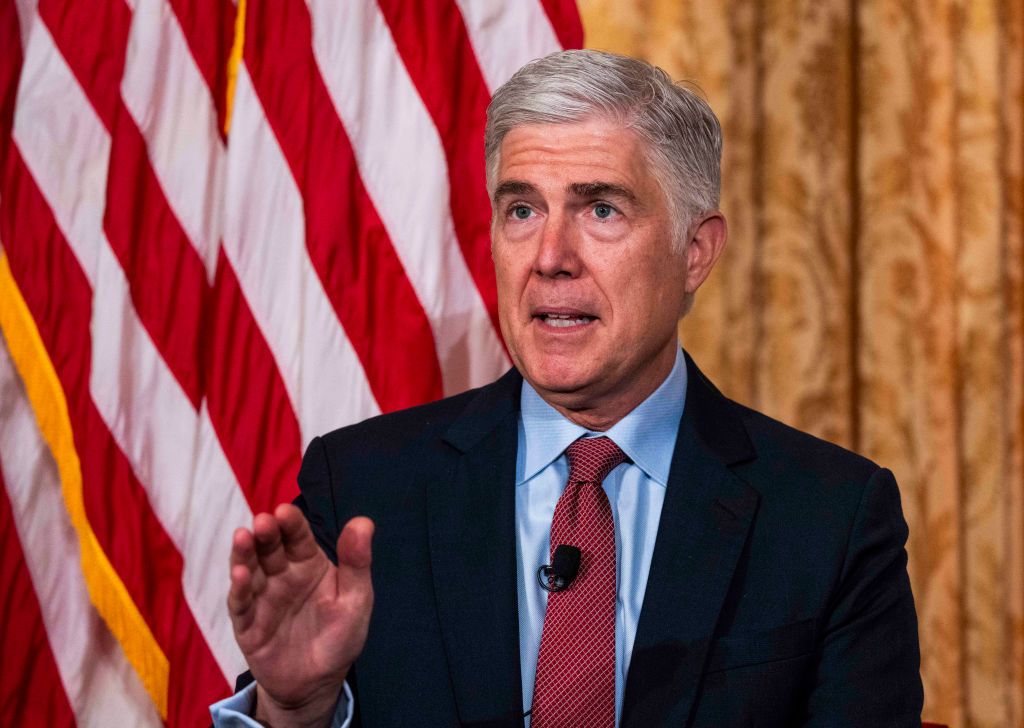
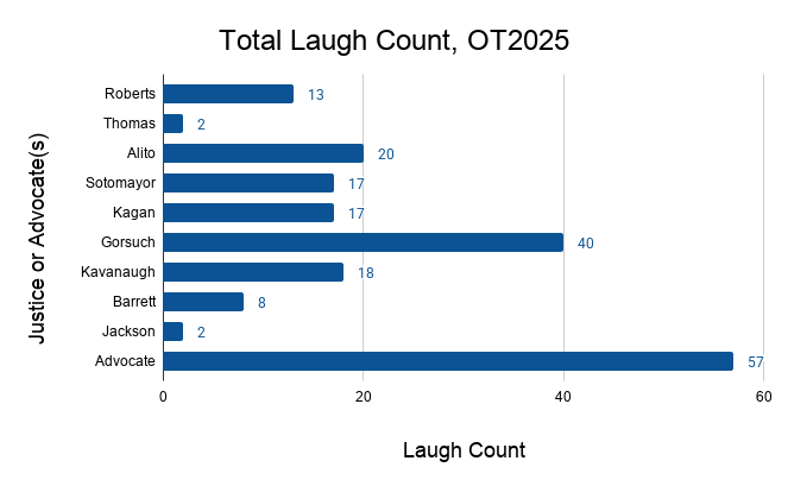
Meet the new funniest justice – same as the old funniest justice. That’s right: Gorsuch was far and away the term’s funniest justice, with 40 laughs. Alito came in second (20), followed by Justice Brett Kavanaugh (18), with Kagan and Justice Sonia Sotomayor tying for fourth at 17 laughs each. Roberts came in fifth place with 13 laughs – somewhat surprising given his second-place finish in last year’s multi-term tally.
But what, exactly, generated all those laughs on the nation’s highest judicial body?
The categories
Similar to last year, I found that court humor basically sorted into five categories:
- Undermining an argument;
- Making fun of fellow justices;
- A self-deprecating joke about him/herself or the court;
- Hypotheticals and their responses; and
- Misspeaks or accidental interruptions.
(Note that I did not categorize or track laughs generated by individual lawyers – although I can tell you that the incomparable Lisa Blatt likely topped the list on that front.)
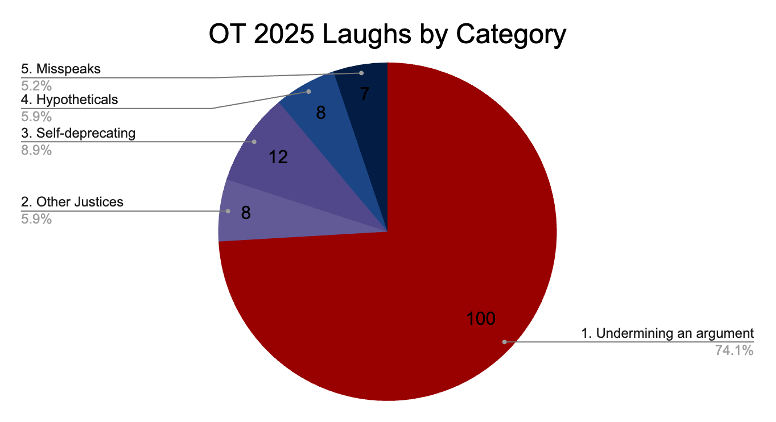
As the chart below shows, the most common type of humor by a wide margin came in the first category – using humor to undermine the argument of an advocate:
Of course, all of this is admittedly a little subjective – and the “(Laughter.)” notations in oral argument transcripts (which allowed me to do this at least pseudo-scientifically) don’t always perfectly translate to one of the five categories.
For instance, sometimes the humor came from an advocate’s deadpan response (set up by a justice’s questioning), as was the case in Abouammo v. United States, in which the court was considering whether a defendant could only be tried in the district where his or her crime was committed:
Other times, the advocates “purposely” supplied the humor, as in the April 20 oral argument in T. M. v. University of Maryland Medical System Corp., which looked at the rather convoluted question of whether the Rooker-Feldman doctrine bars federal district court review of non-final state court judgments and in which Blatt “suggested” that it was too close to the summer recess to overrule such precedent:
And then there were more profound lines – as in Trump v. Barbara, the birthright citizenship case, in which Roberts responded to U.S. Solicitor General D. John Sauer’s emphasis on the problem of so-called “birth tourism” – the practice of women coming to the United States specifically to give birth so that their children have U.S. citizenship – by suggesting that the phenomenon was not a problem when the 14th Amendment was ratified in the 19th century:
But on to the categories themselves.
Category 1: Undermining an argument
As noted above, the most common type of humor involved the justices focusing on the flaws in advocates’ arguments. This tactic was especially favored by Gorsuch (87.5% of his laughs) and Kavanaugh (83.3%).
In Chiles v. Salazar, a case in which the court was considering whether Colorado’s law banning conversion therapy violated the First Amendment (not a particularly funny subject), Sotomayor got a laugh in this category by offering a pithy reply to the advocate’s argument based on a prior case:
In another case, FS Credit Opportunities Corp. v. Saba Capital Master Fund, Ltd., which asked whether a section of the Investment Company Act allowed private parties to sue investment companies, frequent Supreme Court advocate Paul Clement went back and forth with Gorsuch on whether litigants should be able to bring a lawsuit when the statute on which they rely does not specifically allow them to do so:
Category 2: Making fun of the (other) justices
Bench-on-bench banter made up just 4% of the total laughs this year (8 laughs total) and was dominated by Sotomayor (5 of those 8). In Keathley v. Buddy Ayers Construction, Inc., a case about rules punishing omissions by bankrupt debtors (again, a not particularly humorous subject), Sotomayor began her questioning with the following:
Category 3: A self-deprecating joke
The justices will occasionally make fun of themselves (or at least the court) rather than the advocates. Roberts had the greatest share of such jokes (23% of his laughs) but tied with Gorsuch in terms of the highest raw number of self-deprecating jokes (3). For instance, in Louisiana v. Callais:
And in Flowers Foods, Inc. v. Brock, an arbitration case involving a rather complicated fact pattern:
Category 4: Hypotheticals and their responses
Next, we have hypotheticals and responses to them, in which members of the court apply absurd extensions of advocates’ arguments in an effort to expose flaws in those arguments. This was done most often by Alito (the master of the hypothetical). But the chief took a turn at it in Case v. Montana, which looked at when police may enter a home without a warrant during an emergency. After an advocate answered a question from Sotomayor about the boundaries of what counts as “reasonable suspicion” for the officer to do so, the chief responded with a rather specific (and fairly disturbing) scenario:
Category 5: Misspeak/Interruptions
And then, finally, there are laughs that result from unintentional speaking or timing errors. Roberts led in this category, likely as a result of his role as the chief justice, which puts him in charge of when others in the courtroom may speak. But he wasn’t alone here; for instance, in an exchange in Louisiana v. Callais which contrasted significantly with the seriousness of this Voting Rights Act case:
***
So what can we take away from this? More than a few questions arise from this study, some profound (What does a justice’s humor ultimately tell us about his or her jurisprudence? Is an increasingly fractured court also increasingly humorless?), some undoubtedly more trivial (Why exactly is Mr. Yang an Android guy?).
For now, though, we’ll hold further judgment on what it all means until after the next term.
Continue reading...
[ H/T SCOTUSblog ]