





Guest Post by John Walter
On the first morning of August 2026, a man in his fifties stood at a gun counter in a Denver suburb with a certificate in his hand and discovered that the rifle he had been promising himself since the spring had just become an application. Colorado had woken up that Saturday under a new permit-to-purchase system, and to walk out with the semi-automatic he wanted he first needed a state card, which meant a safety course, a set of fingerprints, a fee, a background investigation and a wait measured in weeks rather than minutes. The clerk had been expecting the queue and had printed a one-page summary of the steps, and the man read it twice before asking, with the particular flatness of somebody recalculating a budget, whether the price on the tag included any of that. It did not. Across the state that month, background checks ran at record pace as buyers rushed the deadline, and afterwards the pace fell off a cliff, because a right that requires a card is a right people schedule around their other errands.
Something similar had already happened six hundred miles west and two years earlier, when California began requiring a firearm eligibility check for ammunition, and the line at the sporting goods counter started running through a state database before a box of twenty-two long rifle could change hands. Colorado voters had meanwhile approved a 6.5 percent excise on guns and cartridges, California had gone to eleven percent, Illinois had begun demanding a licence for either, and New York had been charging a fee to run a background check on a box of shells since 2023. Read those four facts in sequence and a pattern assembles itself that has almost nothing to do with rifles. The state stopped regulating the object and started regulating the supply line.
The rifles kept coming for the courts. In June 2026 the Supreme Court granted certiorari in two challenges to so-called assault weapon bans, having refused every such petition for years, and the grant itself carried a message: four justices had been writing separate opinions about those denials for two terms, and one of them, Brett Kavanaugh, used the occasion to state in writing that the question deserved a hearing. Argument falls this autumn, a decision lands near June 2027, and the lead case, Snope v. Brown, comes out of Maryland with a Delaware companion trailing it. Should the bans fall, a dozen states have to rewrite their statutes at once while the fight migrates to Congress, where an Assault Weapons Ban of 2025 already sits filed and waiting for a reason. Should they stand, the most popular rifle in the country remains lawful only by the grace of a state capital and the template is set for everything after it. Either way, 2027 is the hinge, and nobody shopping in November 2026 gets a second pass at today’s prices… (As gun confiscation threats grow, ignorance could become your greatest weakness. Click here to access 1,500+ essential survival, firearms, and preparedness guides before it’s too late.)
Five months before that grant, on the sixteenth of November, the Court had quietly declined to hear a challenge to Maryland’s “sensitive places” law, which bars carrying in state parks, on transit, at amusement parks and more or less anywhere alcohol changes hands. The map of where a permit means anything contracted on a Monday afternoon, and beyond the hobby the country shrugged. That same autumn, the one bill capable of erasing the patchwork entirely — national concealed carry reciprocity, H.R. 38, a driver’s-licence model bolted onto a constitutional right — lay on the House Union Calendar where it had sat since clearing committee in March 2025, with its Senate companion gathering dust and twenty-nine states having already gone permitless on their own. A man holding a valid licence from one of those states remains a criminal the instant he crosses an invisible line in a rental car with his children asleep in the back, and the Congress that could fix it in an afternoon has spent eighteen months finding other things to do.
On the first of January 2026, though, a door opened in the opposite direction and hardly anybody mentioned it. The reconciliation law Congress passed in July 2025 had abolished the two-hundred-dollar tax stamp on suppressors and short-barreled rifles, lifting both out of the National Firearms Act’s registration machinery and into ordinary Title I status, so that a can costing a thousand dollars and a ten-month wait in 2024 now costs eight hundred and a week. That is a genuine, quiet, enormous shift, and it collides with everything else on this page, because a suppressed carbine is the difference between hearing your own house after a shot in a hallway and hearing nothing but ringing for two days. A market flooded by first-time buyers follows, along with a supply of cans about to become a political question.
What emerges from that heap of news is a country pulling in two directions at once with equal force, loosening at the statehouse and tightening at the agency, and the contradiction is not a stalemate. It is a squeeze. Given enough time it resolves one way, since the tightening runs through courts and bureaucracies, which are permanent, while the loosening runs through legislatures, which are seasonal and easily distracted. The people doing the tightening are, by and large, sincere, competent and endlessly patient, and somewhere along the way they learned the single lesson that decides these fights: a national ban is hard, and forty state bans are easy.
So here is the position, stripped of decoration. What sits ahead of you is roughly one buying cycle before the market, the law and the calendar turn against you in the same season, and the honest name for that condition is a window, because windows close. Britain’s shut in 1988 and again in 1997. Australia’s shut over a single weekend in 1996, and they bought the guns back with tax money and melted them into fence posts. Canada’s shut by order-in-council on a Friday in May 2020, with a pen, while the country sat locked down and nobody could organize a rally. New Zealand managed the whole business in weeks. The American version will arrive as eleven smaller events rather than one, staggered by jurisdiction, each small enough to survive a news cycle, each sold as a compromise, each carrying a grandfather clause with an expiry date. Cheap imported ammunition, paperless private sales across most of the country, standard-capacity magazines at thirty dollars, stripped lower receivers for the price of a decent dinner — that inventory of small advantages is what a window actually consists of, and it is being priced out from under you month by month.
Before the list, the ledger, since the ledger is where this argument gets won and lost dishonestly from both ends.
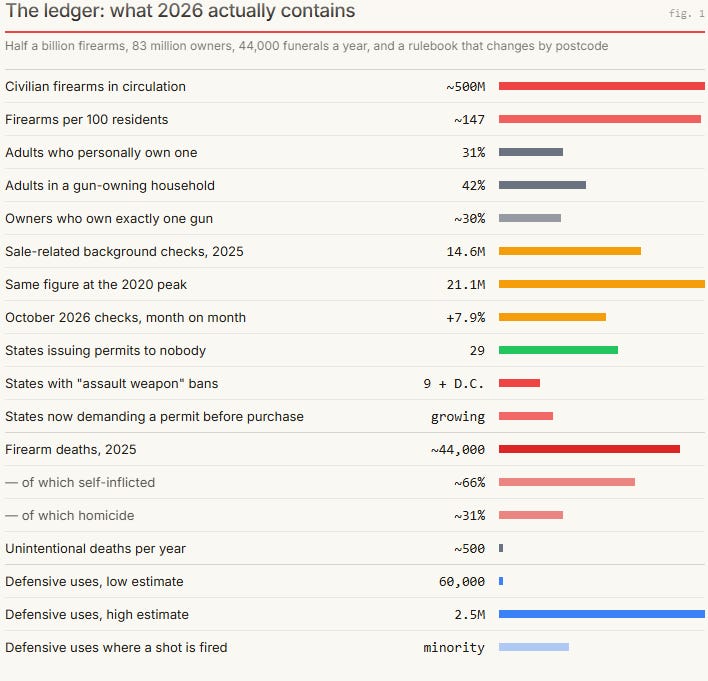

Set the two columns side by side and something awkward falls out of them. Half a billion firearms sit in private hands, roughly a hundred and forty-seven for every hundred residents, and fewer than a third of adults personally own even one of them, which means the stock pools in a minority of households while the burden of the rules settles on everybody and explains why licensing schemes keep polling well among people who will never use one. Three in ten owners hold exactly one gun, typically a pistol in a nightstand drawer, typically unfired for years at a stretch. Those households are the softest target in the country, kitted out with a single magazine, a handful of loose cartridges and no training currency, and when the paperwork lands they will be the first to decide it isn’t worth the errand. Every tightening in the next twenty years will draw its political strength from that gap between how many guns exist and how few people actually touch them.
The death column comes next, where the honest argument has to live whether or not that suits anybody.
Forty-four thousand a year amounts to a small city, and two-thirds of it is suicide, a proportion that surprises people whose sense of gun violence comes from the evening news, where coverage is dominated by the one-third that is homicide and, inside that third, by the sliver that is a public mass shooting. It matters for what comes next because it shows you the raw material the legislation will be built from. Storage mandates, insurance requirements, training certificates, waiting periods, the gun in the house that nobody knows how to run. Each framing converts a right into an obligation with a fee attached, each polls at sixty-five percent or better, and not one of them sounds like much in isolation. Bundle four of them and you have a licence.
On the opposite side of the sheet, defensive use ranges from about sixty thousand incidents a year at the lowest credible measure to something north of two million at the highest, and in most of those encounters the gun gets shown rather than fired. The spread is enormous and has been litigated for thirty years by people with doctorates, and it never resolves because it measures something the bureaucracy keeps no file on: the mugging that ended with a shout and a raised shirttail, the driveway at two in the morning, the dog walk, the man who chose against the dark shortcut. Those go unwritten, and in a country about to want to know everything, the commonest defensive event in America stays undocumented by design. Whether that is an accident of record-keeping or something more convenient is a question worth carrying into the next section.
One figure sits missing from that table, and it decides the next twenty-five years. How many guns exist matters far less than how many of the people holding them will still be holding them when the form shows up, and the early returns on that are poor. New York’s SAFE Act demanded registration of certain rifles by April 2014, estimates of affected guns ran into the millions, and what actually got registered came in near a few percent, a number studied quietly and then shelved because it embarrassed the premise. Connecticut’s parallel law produced compliance in the mid-teens. No knock came at anyone’s door, rifles went into attics and stopped existing on paper, and the state declared victory, since the state never wanted the rifles in the first place. It wanted the paper, and it got enough of it to say so out loud.
Take the politics off and the machinery fits onto an index card.
Any government that wants the guns gone carries three problems and they arrive in sequence. Knowledge comes first, because it cannot take what it cannot find. Compliance comes second, because it cannot find what people refuse to declare. Capacity comes third, since no agency is sending vans to eighty-three million doorsteps, which leaves exactly one viable route: make possession expensive, awkward and faintly embarrassing until collection turns cheap. Every disarmament programme in the developed world ran that order, and the order matters more than the politics. Britain registered shotguns in 1968, banned self-loading rifles after Hungerford in 1988, banned handguns outright after Dunblane in 1997, each step easier than the last because a registry already existed and the public had already absorbed the idea that guns were things you declared. Australia’s 1996 programme worked off state records and a compulsory buyback carrying a real price. Canada had a long-gun registry it nearly killed over cost, then discovered in May 2020 that an order-in-council needs no registry whatsoever: publish a list of model names and enough people comply out of habit and fatigue. New Zealand’s 2019 buyback recovered a fraction of the estimated stock, the fraction got called a success, and the law moved on regardless.
That last detail belongs in your pocket, because it tells you what the enforcement threshold actually is. Compliance only has to be high enough that the remainder goes invisible, unsold, unregistered and eventually un-shootable, and the quickest road to un-shootable runs through the cartridge rather than the firearm. Ammunition is finite, consumable and bought in public, and a rifle without it is a wall ornament with a story attached. New York began running background checks on cartridge buyers in 2023, with a fee, a form and a state record of who bought what. California added an eleven percent excise on guns and ammunition in 2024 and requires an eligibility check at the till. Colorado voters approved a 6.5 percent excise the same year, Illinois wants a licence before you buy either, and somewhere in the middle of all that the card networks agreed to give gun shops their own merchant category code so that a bank statement can say firearms instead of general merchandise. The argument over what the processors do with that data has barely begun and will run for a decade.
Storage is where the licensing architecture truly bites, since it reaches inside the house and ordinary people notice it first. A rule that a gun stay locked unless it rides your person sounds trivial until you have priced a safe, rented a smaller flat and had a landlord’s insurer ask about it, at which point the abstractions acquire a monthly figure. Add an insurance requirement and you have invented a recurring premium attached to a right. Add a training certificate with an expiry and you have invented a renewal cycle. None of the three is unreasonable on its own, which is precisely the difficulty, and stacked together they describe a privilege that has to be maintained rather than a fact that simply holds.
Push the clock forward, because the sequence has a shape and pretending otherwise is dishonest.
Litigation and the presidential cycle consume 2027 and 2028. Courts decide whether the categories are constitutional while the cycle decides whether anybody has votes to act on the answer, and the two timelines refuse to synchronize, which is the entire reason the next four years will feel like whiplash. Somewhere between 2029 and 2032 a federal framework gets attempted, though arithmetic rules out a total ban against five hundred million guns, so what arrives instead is a licensing architecture: an owner’s card, a course, a registry wearing a background-check database as a disguise, a magazine ceiling at ten or twelve, an age floor at twenty-one, and a storage mandate enforced through the insurance market rather than the courts. By the middle of the 2030s the registry is real, the first grandfather clauses expire, and the initial confiscation wave lands. Attrition, not door-knocking. A banned rifle may be kept only if registered, registration lapses when you move, transfer requires a dealer, the dealer wants a hundred and fifty dollars and an appointment six weeks out, the rifle is worth less than the paperwork, and the rifle goes into the pile. Same destination as a knock at the door, reached with a calendar and a fee schedule.
Possession gets digitized between 2035 and 2040. The credential migrates into a phone, ammunition ties to it at the till, and a smart-gun mandate arrives the way catalytic converters did, sold on child safety and stolen-gun recovery, working well enough that mechanical guns read as primitive and slightly dangerous and get taxed the way leaded fuel did. Then the long fade from 2040 to 2050, in which the legal question stops being what may you own and becomes under what conditions may you own anything at all, answered by then without much argument: a certified member in good standing of a recognized militia body, current on training, current on fees, with a locked box and a receipt for every box of shells. Invention plays little part in that forecast. It is the European settlement arriving on a forty-year delay, and the officers doing the counting in 2026 are already being trained for the clerical half of it.
The practical question, therefore, is not which rifle shoots best. It is what you acquire over the next eighteen months that will still be worth owning, feeding and explaining in 2040.
What follows is sequenced rather than ranked. Work down it in order, or as near to that as money permits, because every entry covers a gap the ones above it cannot and the sequence front-loads whatever will be restricted soonest and hardest. Opening with a duty pistol sounds like the dull answer until you notice that magazines are the likeliest item in the whole apparatus to be capped, serialized or frozen out of transfer, and that a pistol is the thing most likely to be in your hand at three in the morning. Closing with a lever-action carbine makes sense for a related reason, since it is the only gun on the page that will still be legal, still be fed and still be running after the last of the paperwork has gone through the shredder.
Two rules govern the spending.
Consolidate calibers. Nine millimeter, twelve gauge, twenty-two long rifle and three-oh-eight cover every role here, which means four supply chains instead of ten, four price points to track, four crates to stack and one less variable during a shortage. Magazine commonality follows the same logic, since the carbine at three eats what the pistol at one eats, and that is deliberate rather than convenient.
Buy the boring version of everything. Race triggers, boutique finishes and cartridges invented last year all cost money and buy trouble, while boring means parts on a shelf, gunsmiths who know the pattern, holsters molded for it and a manual you can read by flashlight with cold hands.
One thing the list cannot do on your behalf: a gun you have never trained with is a talisman. Budget for ammunition the way you budget for fuel, and put the first thousand rounds through each of the opening three entries before the fourth one gets bought.
Start with the gun you would bet a night on this week rather than the one you would brag about, and start used, because a duty pistol with somebody else’s holster wear on the slide costs half of new and shoots identically.
A compact striker-fired nine holding fifteen rounds is the modern default for reasons nobody enjoys stating aloud. It is the cheapest reliable answer to the widest spread of problems, and it rides a holster, a nightstand, a glovebox or a fanny pack on a run without complaint. Ammunition is the most produced centerfire handgun cartridge on earth, so it stays on the shelf when other shelves thin out, because nine millimeter is what every police department, every federal agency and every NATO logistics officer buys by the pallet. Parts sit in bins behind every counter, holsters hang on pegs, and a gunsmith within an hour’s drive knows the pattern well enough to rebuild it blindfolded with a coffee in the other hand.
Models are close to interchangeable and arguing about them is a hobby rather than a decision. Glock 19 or 45, Smith & Wesson’s M&P 2.0 Compact, Heckler & Koch’s VP9, Walther’s PDP, CZ’s P-10C, Springfield’s Echelon. Handle four, buy whichever points where your eye lands, then stop reading reviews written by men who own thirty of them.
Better than new is a police trade-in, and the reason is bureaucratic rather than mechanical. Departments rotate duty pistols on a procurement schedule unrelated to wear, so the distributor market fills with lightly used guns carrying holster polish and some retired sergeant’s badge number scratched under the grip tape. You get a proven pattern, frequently with night sights already fitted, for three hundred and fifty to five hundred dollars. The finish will be scuffed and the barrel will be fine. Buying a trade-in also amounts to a small act of salvage, which counts for something in a country about to take a keen interest in provenance.
Buy magazines as though the cap is coming, because it is. Ten standard-capacity magazines at twenty-five to thirty-five dollars apiece is the best three hundred dollars in this article. Should the ceiling drop to ten rounds, the fifteen-round tubes are already yours and so are the guns that take them, and grandfather clauses almost always shelter what sits in the safe while banning new sales. Ten-rounders can wait, and you will want a few for travel into restricted states, bought second and bought cheap.
A second identical pistol is not extravagance. One rides the belt, the other lives in the safe as a spare and as a trainer for whoever else in the household needs to learn, and between them they cover the two failures that actually end fights, the gun and the hands.
Six hundred rounds a month through the first year, minimum, and trigger presses from the holster at seven yards until the draw stops being a decision and becomes something you can do mid-sentence.
Here is the case for the gun most instructors tell you to skip, and it rests on a structural fact rather than a preference.
Every semi-automatic on this list depends on a detachable box magazine, and magazines are the softest target in the whole regulatory apparatus, being cheap to ban, easy to count, hard to argue about in court, and crippling to a gun without technically prohibiting it. A revolver carries no magazine at all. What it has instead is a cylinder machined into the frame, and no legislature in the English-speaking world has managed to ban a cylinder, which makes the snub the only firearm here whose feeding device is beyond the reach of a statute.
Smith & Wesson’s 642 or 442, Ruger’s LCR, a Charter Arms Undercover when money is tight. Alloy frame, concealed hammer, five rounds of thirty-eight Special, four to five hundred dollars new and less used, with the LCR’s polymer frame shaving ounces that start to tell around hour twelve of a long day. Dropped in a coat pocket it disappears without printing, and it will fire from inside that pocket if it must, keep working through weeks of lint and neglect, and sit comfortably in the hand of somebody who has never run a slide in her life. The trade comes in five rounds, recoil harsher than the paper ballistics suggest, and a double-action trigger that punishes anyone who skips practice. Twenty-five yards is a long shot with one, so treat it as the gun for the last ten feet or the gun for the person in the house who will not wear a belt holster.
Load standard-pressure wadcutters or a modern short-barrel hollow point rather than the hottest magnum the clerk waves at you, since a hundred and thirty-five grain thirty-eight Special at eight hundred feet per second has been ending arguments since before your grandfather was born. Buy two speedloaders and actually learn them, because the reload is the entire weakness and therefore the entire skill.
Already own a nine and short of cash? Push this entry back a place or two. Living somewhere cold, or buying for a partner who won’t carry anything larger? Move it up, and buy the LCR, since the lighter gun gets carried and the carried gun gets used.
The most underrated firearm in America is a rifle-shaped thing chambered for pistol ammunition, and its virtue is that it makes a mediocre handgun shot into a competent one inside two range sessions.
Nine millimeter through a shoulder stock, a longer sight radius and a third point of contact transforms what the shooter can actually do under pressure, while recoil nearly disappears and blast stays modest enough to keep the neighbours friendly. Inside a house it hits harder than the pistol, velocity climbing until the projectile fragments rather than pencils through, and the ammunition and magazines from number one travel in the same bag without a second inventory to maintain. Kel-Tec’s Sub-2000 folds to sixteen inches and disappears into a laptop sleeve, Ruger’s PC Carbine is heavier and softer and takes Glock magazines with a thirty-dollar insert, Smith & Wesson’s FPC folds and ships in a case resembling a tennis bag, and Beretta’s Cx4 is the most refined of them and the most expensive. Any of the four does the job at five to nine hundred dollars, and the folding models earn their premium purely because a gun you actually bring beats two you leave in the truck.
Statutory exposure runs high here, semi-automatic with a detachable magazine sitting squarely in the sights of every assault weapons law, which is exactly why the entry belongs early rather than late. Post-ban versions will survive with ten-round sticks and a pinned stock; your pre-ban gun, folding mechanism and thirty-round magazines intact, will be the one people ask about in ten years and the one worth handing down.
Don’t scope it. A red dot at most, plus a sling. The whole point is light, quick and packable, and a two-pound optic on a five-pound gun kills the only advantage it has.
Politically, the shotgun is the most durable firearm in existence, and the reason has nothing to do with ballistics.
Birdshot survives every ban ever written, twelve gauge being loaded in every country that has birds, and a pump action keeps its workings simple enough to sit outside any feature-based statute: a tube, a slide and a locking lug, with only the frame carrying a number. It is also the only gun here whose shells can be assembled at a kitchen table, where a bag of shot, a pound of powder, a sleeve of primers, a box of hulls and a five-hundred-dollar press turn a shortage into an inconvenience. That capability outvalues the gun and outlives every regulation aimed at the cartridge.
Mossberg’s 590A1 or 500, Remington’s 870 Express, either one bought used and inspected by somebody who knows what a worn locking lug looks like. Twenty-inch cylinder bore, bead or ghost ring, five or six in the tube, four to six hundred dollars, and the sound of a slide racking has settled more confrontations than most calibers ever have.
Buck for the house, nine-pellet double-aught, or a reduced-recoil loading if somebody smaller than you will shoot it. Slugs for reach, since a rifled slug takes deer inside eighty yards and makes this the one gun on the list that feeds a family as readily as it defends one. A fore-end light is not optional, because a shape in a dark hallway cannot be identified without one, and muzzle blast in a stairwell will handle whatever remains.
Practice the reload off a side saddle and practice the select-slug drill. Pattern your chosen load at seven, fifteen and twenty-five yards so you know the actual spread instead of the forum’s version of it.
Training is a supply problem long before it becomes a discipline problem, and the twenty-two answers it at the till.
Ruger’s 10/22, Marlin’s 60, a Henry lever twenty-two, any of them puts a thousand rounds a month inside the price of a dinner out. Nobody gets dangerous on a centerfire budget. Recoil vanishes, so fundamentals build instead of being flinched through, and the skills climb upward because trigger press, breathing and sight picture are identical on a twenty-two and on anything larger you will ever own.
It doubles as a working gun, and that half of the job deserves saying plainly. Twenty-two long rifle takes squirrel, rabbit, raccoon and possum inside fifty yards and does it quietly enough not to empty the woods. Suppressed, it is quieter than a hand clap, and a suppressed twenty-two is the best small-game tool a civilian can put in a pack. Threaded barrels come factory-standard on the 10/22 Takedown and the Ruger American Rimfire, so the capability costs a muzzle device rather than a gunsmith.
Two thousand rounds before the scope. Then a red dot or a fixed four-power, a sling, and a brick of subsonic hollow points kept for the can.
The statute books leave it mostly alone, though detachable-magazine versions do appear in feature-based laws, which argues for keeping a tube-fed Marlin or Henry alongside. A tube-fed twenty-two is also the gun you hand a twelve-year-old without a magazine to lose.
Everything true of the rifle holds here, with one addition that earns the entry its own place: a twenty-two pistol lets you rehearse the draw, the presentation and the first shot a thousand times a month on a five-dollar budget.
Ruger’s MK IV, Taurus’s TX22, Browning’s Buck Mark, three to four hundred dollars, threaded from the factory in most configurations, dependable enough with decent ammunition to run real drills rather than plinking. The MK IV’s push-button takedown fixed the only miserable feature of the pattern, since the old ones went back together with a mallet and a prayer, and the TX22 runs on anything and holds sixteen.
Spend it on everything that eats centerfire barrels and centerfire money: presentations from concealment, one-handed work, transitions, movement while shooting, the first fifty draws of every session before the carry gun comes out of the holster. A suppressed twenty-two pistol is also the most fun available for four hundred dollars, and fun is what keeps the habit alive through the years when nothing is happening anywhere and the safe starts feeling like furniture.
Now the centerpiece, and the rifle most likely to be named in a statute.
Modularity defines the AR-15 above every other quality it has. One lower receiver swallows uppers in five calibers, four barrel lengths and every sighting system invented since the Picatinny rail, while the bolt, trigger group, springs and pins are commodity parts turned out by a dozen makers at every price point. That same modularity explains both its popularity and its reputation, since a legislator leafing through a parts catalogue sees a hundred configurations and concludes there must be a hundred loopholes, hence the feature lists, the pistol grips and flash hiders and collapsible stocks, and the cosmetic distinctions that decide legality across nine states and the District of Columbia.
Sixteen-inch mid-length, free-float handguard, decent trigger, sling and light. Six hundred to twelve hundred dollars for something competent, since a four-hundred-fifty-dollar bargain rifle will function and will also teach you the inside of a gunsmith’s shop at the worst possible moment. Red dot on a lower-third mount, back-up irons, a case of ammunition, and then a class rather than a second opinion from a friend.
Buy a second one, or at the very least a second lower, and understand precisely what you are buying. The serialized part of an AR is the lower receiver, while everything else ships to your door in most states without paper at all. A stripped lower runs sixty to a hundred and twenty dollars and five minutes at a counter, and it is the piece a future ban will name by number. Two or three in the safe, built out over years as money allows, is the cheapest insurance there is against a fixed-capacity future, and it costs less than a decent red dot.
Ban-proofing matters if you live behind the lines. Featureless builds with no pistol grip, no flash hider and a pinned stock pass in California. A fixed-magazine conversion with a ten-round cap passes in New York and New Jersey. The brace-equipped “other” firearm held a strange and useful niche before the braces went to court and will hold one again. Read your statute before you buy, then pick the configuration that keeps you out of a courtroom rather than the one that photographs best.
With the tax stamp gone, hang a suppressor off the muzzle. Eight hundred dollars and a week’s wait in 2026 is a different proposition from a thousand dollars and ten months in 2024, and a can turns the AR from something that hurts indoors into something you can fire down a hallway without a second thought. Buy it with the rifle rather than later, because later has a way of becoming 2028.
An AR is a machine with a maintenance schedule, and the schedule takes no interest in what year it is.
Consumables, in depth: two spare bolt carrier groups, three firing pins, extractor and ejector kits, a spring and detent set, a gas tube, a buffer, a spare charging handle, a lower parts kit still sealed in its bag. Two hundred dollars of small steel keeps a rifle alive for a decade, and it is the sort of purchase nobody makes until the rifle is already down. Add punches, a vise block and a torque wrench, plus the willingness to strip the gun to the pins and rebuild it until that becomes ordinary rather than nerve-racking.
Upper receivers are the loophole a future ban is likeliest to close and least able to police, given that uppers carry no serial number and sell by mail. A three-hundred-blackout upper, a twenty-two conversion kit or a nine-inch shorty on a pistol lower stretches one receiver across three roles. Three hundred blackout is a nine-millimeter-sized package that hits like a rifle and suppresses beautifully, which makes it the house gun for anyone with a can and a corridor. Worth knowing, too, that the eighty-percent receiver question has shifted: the Supreme Court held in 2025 that the ATF may treat frame-and-jig kits as firearms, closing a door that had stood open for a decade and making finished, serialized lowers the safer bet for anyone who isn’t already a machinist.
Ammunition, in tiers. Five hundred rounds per caliber as a working stock, two thousand as a reserve, and the discipline to rotate the oldest to the front of the shelf. Case lots when it is cheap, single boxes only in emergencies, dry boxes with desiccant, dates on the lid, off the floor and out of the sun.
Should your state begin requiring a permit for ammunition, and more will, the depth you laid in before the rule is the depth you keep, because grandfathering shelters possession far more reliably than it shelters purchase.
Sooner or later every ban wave in the developed world goes after semi-automatics, and every one of them leaves the bolt gun alone, because a bolt gun is what farmers and hunters own and no politician wants that quarrel on his desk.
It also reaches past four hundred yards, the distance where a carbine stops being useful and a rifle begins, and three-oh-eight beats the fashionable six-five Creedmoor on the only measure that counts here: a NATO-adjacent military cartridge, stocked on every shelf in every farm town, killing elk since 1952, headspaced by every gunsmith in the country.
Ruger’s American, Savage’s 110, Tikka’s T3x, Howa’s 1500, five to eight hundred dollars, and the Tikka earns the premium. Detachable box magazines rather than a hinged floorplate, so that a ten-round cap never reaches you at all.
Glass at the price of the rifle, then learn to use it. A second-focal-plane three-to-nine is ample, a fixed six is better for the money, and the rings get lapped and torqued to spec before anything else happens. Zero at a hundred yards off a bag before shooting at distance, then take a class in ranging and wind, because a rifle you cannot range with is a loud twenty-two with expensive glass.
Should the semi-automatics go, the bolt gun is also the last rifle you will be permitted to hunt with, which is the practical form of the argument and the reason this entry sits at nine rather than fifteen.
Keep the survivor for last and buy it for the very reason it survives.
Chambered in thirty-five-seven Magnum, a lever action sits outside nearly every regulation on the books: tube magazine, manual action, workings simple enough to strip on a tailgate, and a silhouette that photographs like a Western and reads to a legislator as traditional. Ten in the tube, the same cartridge as the revolver you may already own, deer taken cleanly inside a hundred yards, and Marlin’s 1894, Henry’s Big Boy or Rossi’s 92 at three to eight hundred dollars, with the Rossi a better rifle than its price suggests.
Carrying it is also the pleasantest experience on this list, which counts for more than any of the technical argument. Nine pounds of walnut and steel across a shoulder on a cold morning differs entirely from a black carbine with a light bolted on, and that difference is what keeps people in the woods past the age when they have anything left to prove to anybody.
Regulation barely touches it, and ammunition is the constraint instead: thirty-five-seven is a revolver cartridge first and a rifle cartridge second, so it stays available without being cheap and it does not stack on pallets. A thousand rounds, a set of dies, a bullet mold and a hundred pounds of lead, and the gun becomes self-sufficient in a way nothing else here can match.
Ten entries, four cartridges, one magazine family, a bill landing somewhere between four and eight thousand dollars if you shop used, spread over eighteen months and skipping whatever you already own. That is a used car, and it buys the difference between being a person with a pistol in a drawer and being a household able to defend itself, feed itself, train itself and repair itself without a supply chain.
Monday, start with the pistol and the magazines. The shotgun and the twenty-two rifle follow, because ammunition depth buys more capability than another gun ever will, and the AR and its spare lower come third while the trade-in pistols are still on the distributor shelves. The snub and the carbine fill the concealment gap, and the bolt gun and the lever gun close things out as the two firearms nobody is coming for.
Ten entries make a schedule rather than a shopping list, and the schedule exists because of a date. Around June 2027 the Supreme Court will say whether a state may ban a rifle by name, and whichever way it goes, the buying cycle ending with that decision is the last cheap one. Get in front of it.
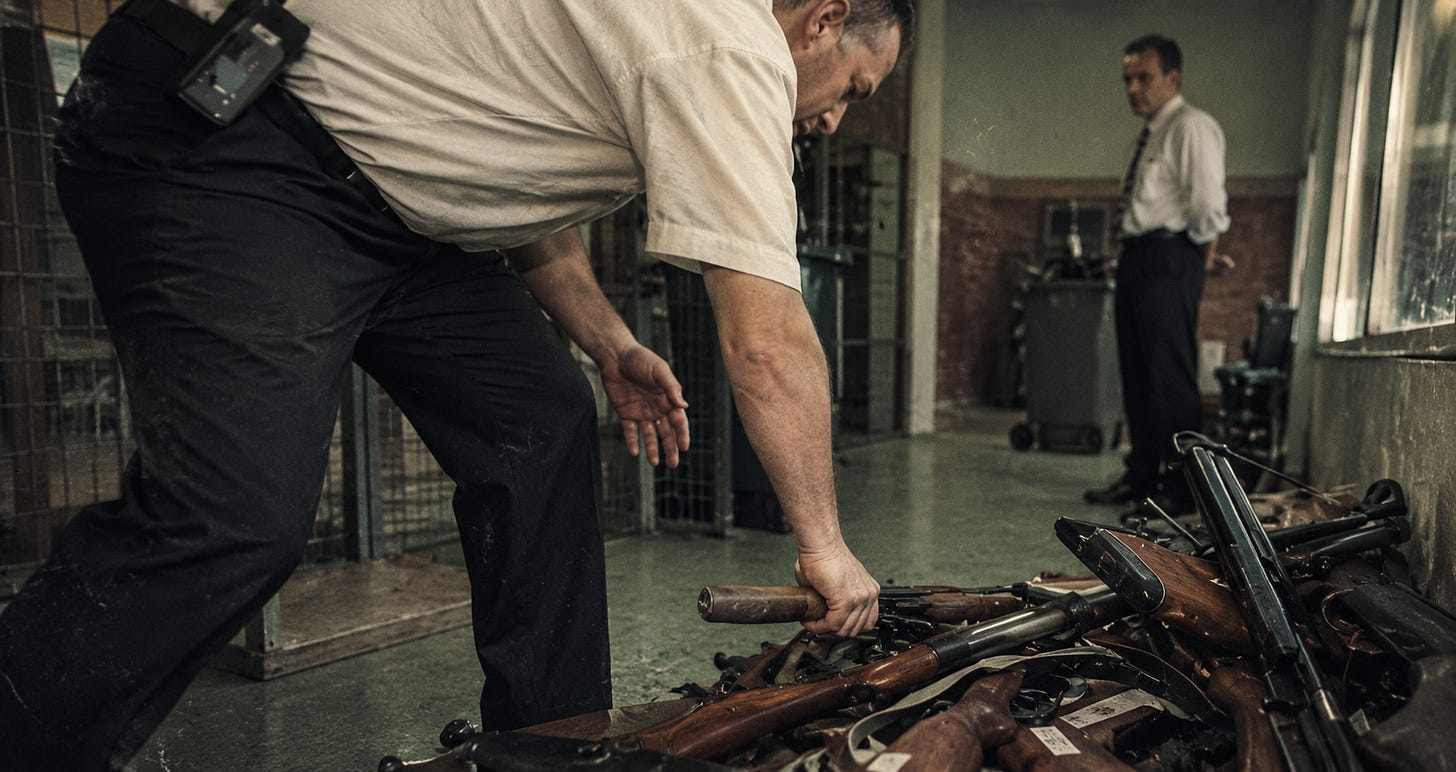
Then keep the receipts, photograph the serial numbers, write the purchase dates on the back of the photographs, and leave the whole file somewhere a stranger could find it. In a country quietly converting a right into a record, being well documented is the last form of armour, and the only kind that keeps working once the rifles are already in the pile on the green floor with the hooks empty above them and somebody kneeling in the middle of it all, sorting.
Tweet
Continue reading...
[ H/T The Burning Platform ]
On the first morning of August 2026, a man in his fifties stood at a gun counter in a Denver suburb with a certificate in his hand and discovered that the rifle he had been promising himself since the spring had just become an application. Colorado had woken up that Saturday under a new permit-to-purchase system, and to walk out with the semi-automatic he wanted he first needed a state card, which meant a safety course, a set of fingerprints, a fee, a background investigation and a wait measured in weeks rather than minutes. The clerk had been expecting the queue and had printed a one-page summary of the steps, and the man read it twice before asking, with the particular flatness of somebody recalculating a budget, whether the price on the tag included any of that. It did not. Across the state that month, background checks ran at record pace as buyers rushed the deadline, and afterwards the pace fell off a cliff, because a right that requires a card is a right people schedule around their other errands.
Something similar had already happened six hundred miles west and two years earlier, when California began requiring a firearm eligibility check for ammunition, and the line at the sporting goods counter started running through a state database before a box of twenty-two long rifle could change hands. Colorado voters had meanwhile approved a 6.5 percent excise on guns and cartridges, California had gone to eleven percent, Illinois had begun demanding a licence for either, and New York had been charging a fee to run a background check on a box of shells since 2023. Read those four facts in sequence and a pattern assembles itself that has almost nothing to do with rifles. The state stopped regulating the object and started regulating the supply line.
The rifles kept coming for the courts. In June 2026 the Supreme Court granted certiorari in two challenges to so-called assault weapon bans, having refused every such petition for years, and the grant itself carried a message: four justices had been writing separate opinions about those denials for two terms, and one of them, Brett Kavanaugh, used the occasion to state in writing that the question deserved a hearing. Argument falls this autumn, a decision lands near June 2027, and the lead case, Snope v. Brown, comes out of Maryland with a Delaware companion trailing it. Should the bans fall, a dozen states have to rewrite their statutes at once while the fight migrates to Congress, where an Assault Weapons Ban of 2025 already sits filed and waiting for a reason. Should they stand, the most popular rifle in the country remains lawful only by the grace of a state capital and the template is set for everything after it. Either way, 2027 is the hinge, and nobody shopping in November 2026 gets a second pass at today’s prices… (As gun confiscation threats grow, ignorance could become your greatest weakness. Click here to access 1,500+ essential survival, firearms, and preparedness guides before it’s too late.)
Five months before that grant, on the sixteenth of November, the Court had quietly declined to hear a challenge to Maryland’s “sensitive places” law, which bars carrying in state parks, on transit, at amusement parks and more or less anywhere alcohol changes hands. The map of where a permit means anything contracted on a Monday afternoon, and beyond the hobby the country shrugged. That same autumn, the one bill capable of erasing the patchwork entirely — national concealed carry reciprocity, H.R. 38, a driver’s-licence model bolted onto a constitutional right — lay on the House Union Calendar where it had sat since clearing committee in March 2025, with its Senate companion gathering dust and twenty-nine states having already gone permitless on their own. A man holding a valid licence from one of those states remains a criminal the instant he crosses an invisible line in a rental car with his children asleep in the back, and the Congress that could fix it in an afternoon has spent eighteen months finding other things to do.
On the first of January 2026, though, a door opened in the opposite direction and hardly anybody mentioned it. The reconciliation law Congress passed in July 2025 had abolished the two-hundred-dollar tax stamp on suppressors and short-barreled rifles, lifting both out of the National Firearms Act’s registration machinery and into ordinary Title I status, so that a can costing a thousand dollars and a ten-month wait in 2024 now costs eight hundred and a week. That is a genuine, quiet, enormous shift, and it collides with everything else on this page, because a suppressed carbine is the difference between hearing your own house after a shot in a hallway and hearing nothing but ringing for two days. A market flooded by first-time buyers follows, along with a supply of cans about to become a political question.
What emerges from that heap of news is a country pulling in two directions at once with equal force, loosening at the statehouse and tightening at the agency, and the contradiction is not a stalemate. It is a squeeze. Given enough time it resolves one way, since the tightening runs through courts and bureaucracies, which are permanent, while the loosening runs through legislatures, which are seasonal and easily distracted. The people doing the tightening are, by and large, sincere, competent and endlessly patient, and somewhere along the way they learned the single lesson that decides these fights: a national ban is hard, and forty state bans are easy.
So here is the position, stripped of decoration. What sits ahead of you is roughly one buying cycle before the market, the law and the calendar turn against you in the same season, and the honest name for that condition is a window, because windows close. Britain’s shut in 1988 and again in 1997. Australia’s shut over a single weekend in 1996, and they bought the guns back with tax money and melted them into fence posts. Canada’s shut by order-in-council on a Friday in May 2020, with a pen, while the country sat locked down and nobody could organize a rally. New Zealand managed the whole business in weeks. The American version will arrive as eleven smaller events rather than one, staggered by jurisdiction, each small enough to survive a news cycle, each sold as a compromise, each carrying a grandfather clause with an expiry date. Cheap imported ammunition, paperless private sales across most of the country, standard-capacity magazines at thirty dollars, stripped lower receivers for the price of a decent dinner — that inventory of small advantages is what a window actually consists of, and it is being priced out from under you month by month.
Before the list, the ledger, since the ledger is where this argument gets won and lost dishonestly from both ends.
Set the two columns side by side and something awkward falls out of them. Half a billion firearms sit in private hands, roughly a hundred and forty-seven for every hundred residents, and fewer than a third of adults personally own even one of them, which means the stock pools in a minority of households while the burden of the rules settles on everybody and explains why licensing schemes keep polling well among people who will never use one. Three in ten owners hold exactly one gun, typically a pistol in a nightstand drawer, typically unfired for years at a stretch. Those households are the softest target in the country, kitted out with a single magazine, a handful of loose cartridges and no training currency, and when the paperwork lands they will be the first to decide it isn’t worth the errand. Every tightening in the next twenty years will draw its political strength from that gap between how many guns exist and how few people actually touch them.
The death column comes next, where the honest argument has to live whether or not that suits anybody.
Forty-four thousand a year amounts to a small city, and two-thirds of it is suicide, a proportion that surprises people whose sense of gun violence comes from the evening news, where coverage is dominated by the one-third that is homicide and, inside that third, by the sliver that is a public mass shooting. It matters for what comes next because it shows you the raw material the legislation will be built from. Storage mandates, insurance requirements, training certificates, waiting periods, the gun in the house that nobody knows how to run. Each framing converts a right into an obligation with a fee attached, each polls at sixty-five percent or better, and not one of them sounds like much in isolation. Bundle four of them and you have a licence.
On the opposite side of the sheet, defensive use ranges from about sixty thousand incidents a year at the lowest credible measure to something north of two million at the highest, and in most of those encounters the gun gets shown rather than fired. The spread is enormous and has been litigated for thirty years by people with doctorates, and it never resolves because it measures something the bureaucracy keeps no file on: the mugging that ended with a shout and a raised shirttail, the driveway at two in the morning, the dog walk, the man who chose against the dark shortcut. Those go unwritten, and in a country about to want to know everything, the commonest defensive event in America stays undocumented by design. Whether that is an accident of record-keeping or something more convenient is a question worth carrying into the next section.
One figure sits missing from that table, and it decides the next twenty-five years. How many guns exist matters far less than how many of the people holding them will still be holding them when the form shows up, and the early returns on that are poor. New York’s SAFE Act demanded registration of certain rifles by April 2014, estimates of affected guns ran into the millions, and what actually got registered came in near a few percent, a number studied quietly and then shelved because it embarrassed the premise. Connecticut’s parallel law produced compliance in the mid-teens. No knock came at anyone’s door, rifles went into attics and stopped existing on paper, and the state declared victory, since the state never wanted the rifles in the first place. It wanted the paper, and it got enough of it to say so out loud.
How a right gets converted into a file, and why the ammunition counter ends up mattering more than the gun counter
Take the politics off and the machinery fits onto an index card.
Any government that wants the guns gone carries three problems and they arrive in sequence. Knowledge comes first, because it cannot take what it cannot find. Compliance comes second, because it cannot find what people refuse to declare. Capacity comes third, since no agency is sending vans to eighty-three million doorsteps, which leaves exactly one viable route: make possession expensive, awkward and faintly embarrassing until collection turns cheap. Every disarmament programme in the developed world ran that order, and the order matters more than the politics. Britain registered shotguns in 1968, banned self-loading rifles after Hungerford in 1988, banned handguns outright after Dunblane in 1997, each step easier than the last because a registry already existed and the public had already absorbed the idea that guns were things you declared. Australia’s 1996 programme worked off state records and a compulsory buyback carrying a real price. Canada had a long-gun registry it nearly killed over cost, then discovered in May 2020 that an order-in-council needs no registry whatsoever: publish a list of model names and enough people comply out of habit and fatigue. New Zealand’s 2019 buyback recovered a fraction of the estimated stock, the fraction got called a success, and the law moved on regardless.
That last detail belongs in your pocket, because it tells you what the enforcement threshold actually is. Compliance only has to be high enough that the remainder goes invisible, unsold, unregistered and eventually un-shootable, and the quickest road to un-shootable runs through the cartridge rather than the firearm. Ammunition is finite, consumable and bought in public, and a rifle without it is a wall ornament with a story attached. New York began running background checks on cartridge buyers in 2023, with a fee, a form and a state record of who bought what. California added an eleven percent excise on guns and ammunition in 2024 and requires an eligibility check at the till. Colorado voters approved a 6.5 percent excise the same year, Illinois wants a licence before you buy either, and somewhere in the middle of all that the card networks agreed to give gun shops their own merchant category code so that a bank statement can say firearms instead of general merchandise. The argument over what the processors do with that data has barely begun and will run for a decade.
Storage is where the licensing architecture truly bites, since it reaches inside the house and ordinary people notice it first. A rule that a gun stay locked unless it rides your person sounds trivial until you have priced a safe, rented a smaller flat and had a landlord’s insurer ask about it, at which point the abstractions acquire a monthly figure. Add an insurance requirement and you have invented a recurring premium attached to a right. Add a training certificate with an expiry and you have invented a renewal cycle. None of the three is unreasonable on its own, which is precisely the difficulty, and stacked together they describe a privilege that has to be maintained rather than a fact that simply holds.
Push the clock forward, because the sequence has a shape and pretending otherwise is dishonest.
Litigation and the presidential cycle consume 2027 and 2028. Courts decide whether the categories are constitutional while the cycle decides whether anybody has votes to act on the answer, and the two timelines refuse to synchronize, which is the entire reason the next four years will feel like whiplash. Somewhere between 2029 and 2032 a federal framework gets attempted, though arithmetic rules out a total ban against five hundred million guns, so what arrives instead is a licensing architecture: an owner’s card, a course, a registry wearing a background-check database as a disguise, a magazine ceiling at ten or twelve, an age floor at twenty-one, and a storage mandate enforced through the insurance market rather than the courts. By the middle of the 2030s the registry is real, the first grandfather clauses expire, and the initial confiscation wave lands. Attrition, not door-knocking. A banned rifle may be kept only if registered, registration lapses when you move, transfer requires a dealer, the dealer wants a hundred and fifty dollars and an appointment six weeks out, the rifle is worth less than the paperwork, and the rifle goes into the pile. Same destination as a knock at the door, reached with a calendar and a fee schedule.
Possession gets digitized between 2035 and 2040. The credential migrates into a phone, ammunition ties to it at the till, and a smart-gun mandate arrives the way catalytic converters did, sold on child safety and stolen-gun recovery, working well enough that mechanical guns read as primitive and slightly dangerous and get taxed the way leaded fuel did. Then the long fade from 2040 to 2050, in which the legal question stops being what may you own and becomes under what conditions may you own anything at all, answered by then without much argument: a certified member in good standing of a recognized militia body, current on training, current on fees, with a locked box and a receipt for every box of shells. Invention plays little part in that forecast. It is the European settlement arriving on a forty-year delay, and the officers doing the counting in 2026 are already being trained for the clerical half of it.
The practical question, therefore, is not which rifle shoots best. It is what you acquire over the next eighteen months that will still be worth owning, feeding and explaining in 2040.
Reading the order properly: sequence, caliber consolidation, and the discipline of buying boring things
What follows is sequenced rather than ranked. Work down it in order, or as near to that as money permits, because every entry covers a gap the ones above it cannot and the sequence front-loads whatever will be restricted soonest and hardest. Opening with a duty pistol sounds like the dull answer until you notice that magazines are the likeliest item in the whole apparatus to be capped, serialized or frozen out of transfer, and that a pistol is the thing most likely to be in your hand at three in the morning. Closing with a lever-action carbine makes sense for a related reason, since it is the only gun on the page that will still be legal, still be fed and still be running after the last of the paperwork has gone through the shredder.
Two rules govern the spending.
Consolidate calibers. Nine millimeter, twelve gauge, twenty-two long rifle and three-oh-eight cover every role here, which means four supply chains instead of ten, four price points to track, four crates to stack and one less variable during a shortage. Magazine commonality follows the same logic, since the carbine at three eats what the pistol at one eats, and that is deliberate rather than convenient.
Buy the boring version of everything. Race triggers, boutique finishes and cartridges invented last year all cost money and buy trouble, while boring means parts on a shelf, gunsmiths who know the pattern, holsters molded for it and a manual you can read by flashlight with cold hands.
One thing the list cannot do on your behalf: a gun you have never trained with is a talisman. Budget for ammunition the way you budget for fuel, and put the first thousand rounds through each of the opening three entries before the fourth one gets bought.
1. Begin where the risk actually lives, with a compact double-stack nine taken cheap and used off a police distributor’s trade-in bin
Start with the gun you would bet a night on this week rather than the one you would brag about, and start used, because a duty pistol with somebody else’s holster wear on the slide costs half of new and shoots identically.
A compact striker-fired nine holding fifteen rounds is the modern default for reasons nobody enjoys stating aloud. It is the cheapest reliable answer to the widest spread of problems, and it rides a holster, a nightstand, a glovebox or a fanny pack on a run without complaint. Ammunition is the most produced centerfire handgun cartridge on earth, so it stays on the shelf when other shelves thin out, because nine millimeter is what every police department, every federal agency and every NATO logistics officer buys by the pallet. Parts sit in bins behind every counter, holsters hang on pegs, and a gunsmith within an hour’s drive knows the pattern well enough to rebuild it blindfolded with a coffee in the other hand.
Models are close to interchangeable and arguing about them is a hobby rather than a decision. Glock 19 or 45, Smith & Wesson’s M&P 2.0 Compact, Heckler & Koch’s VP9, Walther’s PDP, CZ’s P-10C, Springfield’s Echelon. Handle four, buy whichever points where your eye lands, then stop reading reviews written by men who own thirty of them.
Better than new is a police trade-in, and the reason is bureaucratic rather than mechanical. Departments rotate duty pistols on a procurement schedule unrelated to wear, so the distributor market fills with lightly used guns carrying holster polish and some retired sergeant’s badge number scratched under the grip tape. You get a proven pattern, frequently with night sights already fitted, for three hundred and fifty to five hundred dollars. The finish will be scuffed and the barrel will be fine. Buying a trade-in also amounts to a small act of salvage, which counts for something in a country about to take a keen interest in provenance.
Buy magazines as though the cap is coming, because it is. Ten standard-capacity magazines at twenty-five to thirty-five dollars apiece is the best three hundred dollars in this article. Should the ceiling drop to ten rounds, the fifteen-round tubes are already yours and so are the guns that take them, and grandfather clauses almost always shelter what sits in the safe while banning new sales. Ten-rounders can wait, and you will want a few for travel into restricted states, bought second and bought cheap.
A second identical pistol is not extravagance. One rides the belt, the other lives in the safe as a spare and as a trainer for whoever else in the household needs to learn, and between them they cover the two failures that actually end fights, the gun and the hands.
Six hundred rounds a month through the first year, minimum, and trigger presses from the holster at seven yards until the draw stops being a decision and becomes something you can do mid-sentence.
2. A five-shot snub revolver, chosen precisely because a cylinder is the one component no legislature has figured out how to ban
Here is the case for the gun most instructors tell you to skip, and it rests on a structural fact rather than a preference.
Every semi-automatic on this list depends on a detachable box magazine, and magazines are the softest target in the whole regulatory apparatus, being cheap to ban, easy to count, hard to argue about in court, and crippling to a gun without technically prohibiting it. A revolver carries no magazine at all. What it has instead is a cylinder machined into the frame, and no legislature in the English-speaking world has managed to ban a cylinder, which makes the snub the only firearm here whose feeding device is beyond the reach of a statute.
Smith & Wesson’s 642 or 442, Ruger’s LCR, a Charter Arms Undercover when money is tight. Alloy frame, concealed hammer, five rounds of thirty-eight Special, four to five hundred dollars new and less used, with the LCR’s polymer frame shaving ounces that start to tell around hour twelve of a long day. Dropped in a coat pocket it disappears without printing, and it will fire from inside that pocket if it must, keep working through weeks of lint and neglect, and sit comfortably in the hand of somebody who has never run a slide in her life. The trade comes in five rounds, recoil harsher than the paper ballistics suggest, and a double-action trigger that punishes anyone who skips practice. Twenty-five yards is a long shot with one, so treat it as the gun for the last ten feet or the gun for the person in the house who will not wear a belt holster.
Load standard-pressure wadcutters or a modern short-barrel hollow point rather than the hottest magnum the clerk waves at you, since a hundred and thirty-five grain thirty-eight Special at eight hundred feet per second has been ending arguments since before your grandfather was born. Buy two speedloaders and actually learn them, because the reload is the entire weakness and therefore the entire skill.
Already own a nine and short of cash? Push this entry back a place or two. Living somewhere cold, or buying for a partner who won’t carry anything larger? Move it up, and buy the LCR, since the lighter gun gets carried and the carried gun gets used.
3. A folding pistol-caliber carbine that eats the same magazines as the pistol on your belt and stows in a laptop sleeve
The most underrated firearm in America is a rifle-shaped thing chambered for pistol ammunition, and its virtue is that it makes a mediocre handgun shot into a competent one inside two range sessions.
Nine millimeter through a shoulder stock, a longer sight radius and a third point of contact transforms what the shooter can actually do under pressure, while recoil nearly disappears and blast stays modest enough to keep the neighbours friendly. Inside a house it hits harder than the pistol, velocity climbing until the projectile fragments rather than pencils through, and the ammunition and magazines from number one travel in the same bag without a second inventory to maintain. Kel-Tec’s Sub-2000 folds to sixteen inches and disappears into a laptop sleeve, Ruger’s PC Carbine is heavier and softer and takes Glock magazines with a thirty-dollar insert, Smith & Wesson’s FPC folds and ships in a case resembling a tennis bag, and Beretta’s Cx4 is the most refined of them and the most expensive. Any of the four does the job at five to nine hundred dollars, and the folding models earn their premium purely because a gun you actually bring beats two you leave in the truck.
Statutory exposure runs high here, semi-automatic with a detachable magazine sitting squarely in the sights of every assault weapons law, which is exactly why the entry belongs early rather than late. Post-ban versions will survive with ten-round sticks and a pinned stock; your pre-ban gun, folding mechanism and thirty-round magazines intact, will be the one people ask about in ten years and the one worth handing down.
Don’t scope it. A red dot at most, plus a sling. The whole point is light, quick and packable, and a two-pound optic on a five-pound gun kills the only advantage it has.
4. A short-barreled twelve-gauge pump, the single firearm whose shells can be assembled at a kitchen table during a shortage
Politically, the shotgun is the most durable firearm in existence, and the reason has nothing to do with ballistics.
Birdshot survives every ban ever written, twelve gauge being loaded in every country that has birds, and a pump action keeps its workings simple enough to sit outside any feature-based statute: a tube, a slide and a locking lug, with only the frame carrying a number. It is also the only gun here whose shells can be assembled at a kitchen table, where a bag of shot, a pound of powder, a sleeve of primers, a box of hulls and a five-hundred-dollar press turn a shortage into an inconvenience. That capability outvalues the gun and outlives every regulation aimed at the cartridge.
Mossberg’s 590A1 or 500, Remington’s 870 Express, either one bought used and inspected by somebody who knows what a worn locking lug looks like. Twenty-inch cylinder bore, bead or ghost ring, five or six in the tube, four to six hundred dollars, and the sound of a slide racking has settled more confrontations than most calibers ever have.
Buck for the house, nine-pellet double-aught, or a reduced-recoil loading if somebody smaller than you will shoot it. Slugs for reach, since a rifled slug takes deer inside eighty yards and makes this the one gun on the list that feeds a family as readily as it defends one. A fore-end light is not optional, because a shape in a dark hallway cannot be identified without one, and muzzle blast in a stairwell will handle whatever remains.
Practice the reload off a side saddle and practice the select-slug drill. Pattern your chosen load at seven, fifteen and twenty-five yards so you know the actual spread instead of the forum’s version of it.
5. A twenty-two rifle, bought for the brutal arithmetic that puts five hundred rounds on the tailgate for thirty dollars
Training is a supply problem long before it becomes a discipline problem, and the twenty-two answers it at the till.
Ruger’s 10/22, Marlin’s 60, a Henry lever twenty-two, any of them puts a thousand rounds a month inside the price of a dinner out. Nobody gets dangerous on a centerfire budget. Recoil vanishes, so fundamentals build instead of being flinched through, and the skills climb upward because trigger press, breathing and sight picture are identical on a twenty-two and on anything larger you will ever own.
It doubles as a working gun, and that half of the job deserves saying plainly. Twenty-two long rifle takes squirrel, rabbit, raccoon and possum inside fifty yards and does it quietly enough not to empty the woods. Suppressed, it is quieter than a hand clap, and a suppressed twenty-two is the best small-game tool a civilian can put in a pack. Threaded barrels come factory-standard on the 10/22 Takedown and the Ruger American Rimfire, so the capability costs a muzzle device rather than a gunsmith.
Two thousand rounds before the scope. Then a red dot or a fixed four-power, a sling, and a brick of subsonic hollow points kept for the can.
The statute books leave it mostly alone, though detachable-magazine versions do appear in feature-based laws, which argues for keeping a tube-fed Marlin or Henry alongside. A tube-fed twenty-two is also the gun you hand a twelve-year-old without a magazine to lose.
6. A twenty-two pistol, because a concealed draw decays faster than any other skill and cheap repetitions are the only cure
Everything true of the rifle holds here, with one addition that earns the entry its own place: a twenty-two pistol lets you rehearse the draw, the presentation and the first shot a thousand times a month on a five-dollar budget.
Ruger’s MK IV, Taurus’s TX22, Browning’s Buck Mark, three to four hundred dollars, threaded from the factory in most configurations, dependable enough with decent ammunition to run real drills rather than plinking. The MK IV’s push-button takedown fixed the only miserable feature of the pattern, since the old ones went back together with a mallet and a prayer, and the TX22 runs on anything and holds sixteen.
Spend it on everything that eats centerfire barrels and centerfire money: presentations from concealment, one-handed work, transitions, movement while shooting, the first fifty draws of every session before the carry gun comes out of the holster. A suppressed twenty-two pistol is also the most fun available for four hundred dollars, and fun is what keeps the habit alive through the years when nothing is happening anywhere and the safe starts feeling like furniture.
7. A sixteen-inch AR-15, then a second one, bought before the paperwork learns the platform’s name and the statute learns its features
Now the centerpiece, and the rifle most likely to be named in a statute.
Modularity defines the AR-15 above every other quality it has. One lower receiver swallows uppers in five calibers, four barrel lengths and every sighting system invented since the Picatinny rail, while the bolt, trigger group, springs and pins are commodity parts turned out by a dozen makers at every price point. That same modularity explains both its popularity and its reputation, since a legislator leafing through a parts catalogue sees a hundred configurations and concludes there must be a hundred loopholes, hence the feature lists, the pistol grips and flash hiders and collapsible stocks, and the cosmetic distinctions that decide legality across nine states and the District of Columbia.
Sixteen-inch mid-length, free-float handguard, decent trigger, sling and light. Six hundred to twelve hundred dollars for something competent, since a four-hundred-fifty-dollar bargain rifle will function and will also teach you the inside of a gunsmith’s shop at the worst possible moment. Red dot on a lower-third mount, back-up irons, a case of ammunition, and then a class rather than a second opinion from a friend.
Buy a second one, or at the very least a second lower, and understand precisely what you are buying. The serialized part of an AR is the lower receiver, while everything else ships to your door in most states without paper at all. A stripped lower runs sixty to a hundred and twenty dollars and five minutes at a counter, and it is the piece a future ban will name by number. Two or three in the safe, built out over years as money allows, is the cheapest insurance there is against a fixed-capacity future, and it costs less than a decent red dot.
Ban-proofing matters if you live behind the lines. Featureless builds with no pistol grip, no flash hider and a pinned stock pass in California. A fixed-magazine conversion with a ten-round cap passes in New York and New Jersey. The brace-equipped “other” firearm held a strange and useful niche before the braces went to court and will hold one again. Read your statute before you buy, then pick the configuration that keeps you out of a courtroom rather than the one that photographs best.
With the tax stamp gone, hang a suppressor off the muzzle. Eight hundred dollars and a week’s wait in 2026 is a different proposition from a thousand dollars and ten months in 2024, and a can turns the AR from something that hurts indoors into something you can fire down a hallway without a second thought. Buy it with the rifle rather than later, because later has a way of becoming 2028.
8. Spare bolt carriers, spring kits and a three-hundred-blackout upper, since small steel is the contraband nobody thinks to stock
An AR is a machine with a maintenance schedule, and the schedule takes no interest in what year it is.
Consumables, in depth: two spare bolt carrier groups, three firing pins, extractor and ejector kits, a spring and detent set, a gas tube, a buffer, a spare charging handle, a lower parts kit still sealed in its bag. Two hundred dollars of small steel keeps a rifle alive for a decade, and it is the sort of purchase nobody makes until the rifle is already down. Add punches, a vise block and a torque wrench, plus the willingness to strip the gun to the pins and rebuild it until that becomes ordinary rather than nerve-racking.
Upper receivers are the loophole a future ban is likeliest to close and least able to police, given that uppers carry no serial number and sell by mail. A three-hundred-blackout upper, a twenty-two conversion kit or a nine-inch shorty on a pistol lower stretches one receiver across three roles. Three hundred blackout is a nine-millimeter-sized package that hits like a rifle and suppresses beautifully, which makes it the house gun for anyone with a can and a corridor. Worth knowing, too, that the eighty-percent receiver question has shifted: the Supreme Court held in 2025 that the ATF may treat frame-and-jig kits as firearms, closing a door that had stood open for a decade and making finished, serialized lowers the safer bet for anyone who isn’t already a machinist.
Ammunition, in tiers. Five hundred rounds per caliber as a working stock, two thousand as a reserve, and the discipline to rotate the oldest to the front of the shelf. Case lots when it is cheap, single boxes only in emergencies, dry boxes with desiccant, dates on the lid, off the floor and out of the sun.
Should your state begin requiring a permit for ammunition, and more will, the depth you laid in before the rule is the depth you keep, because grandfathering shelters possession far more reliably than it shelters purchase.
9. A bolt-action three-oh-eight with a detachable magazine, and glass that costs what the rifle cost, for the distances a carbine cannot reach
Sooner or later every ban wave in the developed world goes after semi-automatics, and every one of them leaves the bolt gun alone, because a bolt gun is what farmers and hunters own and no politician wants that quarrel on his desk.
It also reaches past four hundred yards, the distance where a carbine stops being useful and a rifle begins, and three-oh-eight beats the fashionable six-five Creedmoor on the only measure that counts here: a NATO-adjacent military cartridge, stocked on every shelf in every farm town, killing elk since 1952, headspaced by every gunsmith in the country.
Ruger’s American, Savage’s 110, Tikka’s T3x, Howa’s 1500, five to eight hundred dollars, and the Tikka earns the premium. Detachable box magazines rather than a hinged floorplate, so that a ten-round cap never reaches you at all.
Glass at the price of the rifle, then learn to use it. A second-focal-plane three-to-nine is ample, a fixed six is better for the money, and the rings get lapped and torqued to spec before anything else happens. Zero at a hundred yards off a bag before shooting at distance, then take a class in ranging and wind, because a rifle you cannot range with is a loud twenty-two with expensive glass.
Should the semi-automatics go, the bolt gun is also the last rifle you will be permitted to hunt with, which is the practical form of the argument and the reason this entry sits at nine rather than fifteen.
10. Close with the rifle that outlives the whole apparatus, a lever action in thirty-five-seven that stays mechanically immune to nearly every rule on the books
Keep the survivor for last and buy it for the very reason it survives.
Chambered in thirty-five-seven Magnum, a lever action sits outside nearly every regulation on the books: tube magazine, manual action, workings simple enough to strip on a tailgate, and a silhouette that photographs like a Western and reads to a legislator as traditional. Ten in the tube, the same cartridge as the revolver you may already own, deer taken cleanly inside a hundred yards, and Marlin’s 1894, Henry’s Big Boy or Rossi’s 92 at three to eight hundred dollars, with the Rossi a better rifle than its price suggests.
Carrying it is also the pleasantest experience on this list, which counts for more than any of the technical argument. Nine pounds of walnut and steel across a shoulder on a cold morning differs entirely from a black carbine with a light bolted on, and that difference is what keeps people in the woods past the age when they have anything left to prove to anybody.
Regulation barely touches it, and ammunition is the constraint instead: thirty-five-seven is a revolver cartridge first and a rifle cartridge second, so it stays available without being cheap and it does not stack on pallets. A thousand rounds, a set of dies, a bullet mold and a hundred pounds of lead, and the gun becomes self-sufficient in a way nothing else here can match.
What the calendar is counting down to, why the last cheap window shuts around June 2027, and what the room looks like on the far side of it
Ten entries, four cartridges, one magazine family, a bill landing somewhere between four and eight thousand dollars if you shop used, spread over eighteen months and skipping whatever you already own. That is a used car, and it buys the difference between being a person with a pistol in a drawer and being a household able to defend itself, feed itself, train itself and repair itself without a supply chain.
Monday, start with the pistol and the magazines. The shotgun and the twenty-two rifle follow, because ammunition depth buys more capability than another gun ever will, and the AR and its spare lower come third while the trade-in pistols are still on the distributor shelves. The snub and the carbine fill the concealment gap, and the bolt gun and the lever gun close things out as the two firearms nobody is coming for.
Ten entries make a schedule rather than a shopping list, and the schedule exists because of a date. Around June 2027 the Supreme Court will say whether a state may ban a rifle by name, and whichever way it goes, the buying cycle ending with that decision is the last cheap one. Get in front of it.
Then keep the receipts, photograph the serial numbers, write the purchase dates on the back of the photographs, and leave the whole file somewhere a stranger could find it. In a country quietly converting a right into a record, being well documented is the last form of armour, and the only kind that keeps working once the rifles are already in the pile on the green floor with the hooks empty above them and somebody kneeling in the middle of it all, sorting.
Tweet
Continue reading...
[ H/T The Burning Platform ]