








In all likelihood, the Federal Reserve Board will leave interest rates unchanged when it concludes its two-day meeting on Wednesday. Yes, inflation remains above the Federal Reserve’s 2% target, but that is largely because of transitory factors such as higher energy prices, which are a consequence of geopolitical events rather than excessive demand by American households.
Importantly, before the Iran war began, inflation was moving toward the Federal Reserve’s 2% target, and financial markets were even speculating about rate cuts. Now, almost entirely because of the spike in energy prices caused by the conflicts in Iran and Ukraine, some market participants believe a rate hike is warranted. That view is misguided.
At the end of the day, wages and prices will converge. Wage inflation remains well-behaved. After adjusting for productivity growth, real wage inflation is running at roughly 1% or less. If households do not have additional income, they cannot keep chasing higher prices.
It is also important to recognize that demand for gasoline is highly inelastic. In the United States, driving is a necessity, not a luxury. Whether gasoline costs $4.00 a gallon or $3.50 a gallon, demand changes very little. Raising interest rates will not reduce gasoline demand or lower gasoline prices, but it would place additional strain on households.
Another important reason the Federal Reserve is unlikely to raise interest rates this week is that consumer spending remains positive but fragile. Wage growth is only barely keeping pace with inflation. With gasoline prices still elevated and household balance sheets already under pressure from high interest rates and higher commodity costs, another rate increase could trigger a sharp slowdown in consumer spending, which remains the primary driver of the U.S. economy.
Raising interest rates to combat commodity inflation caused by international instability would be poor policy. Risking a recession to offset the temporary effects of higher gasoline prices would be even worse. More specifically, the Federal Reserve is unlikely to raise rates this week because there are no signs of a wage-price spiral, productivity growth remains strong, reducing pressure on businesses to raise prices, and the latest inflation data show meaningful moderation in consumer price inflation.
The economy remains in solid shape, with growth running at approximately 2% and a resilient labor market, as reflected in historically low jobless claims as a share of total unemployment. Given this backdrop, the Federal Reserve is likely to continue its wait-and-see approach to monetary policy. The one area of the economy experiencing persistent price inflation is the Artificial Intelligence sector, where exceptionally strong capital spending by the hyperscalers and other AI companies has created significant supply chain bottlenecks.
However, raising interest rates will not alter the pace of AI investment. The hyperscalers have exceptionally strong balance sheets and ample access to capital. Moreover, the economy is currently experiencing peak AI capital spending. Beginning next year, as new production capacity comes online, inflationary pressures across the technology sector should begin to ease.
If the Federal Reserve truly wants to reduce inflation in the AI sector, it should encourage Congress to enact meaningful permitting reform to accelerate the construction of data centers, power generation, semiconductor facilities, and other critical infrastructure. Expanding supply, rather than suppressing demand, is the appropriate solution.
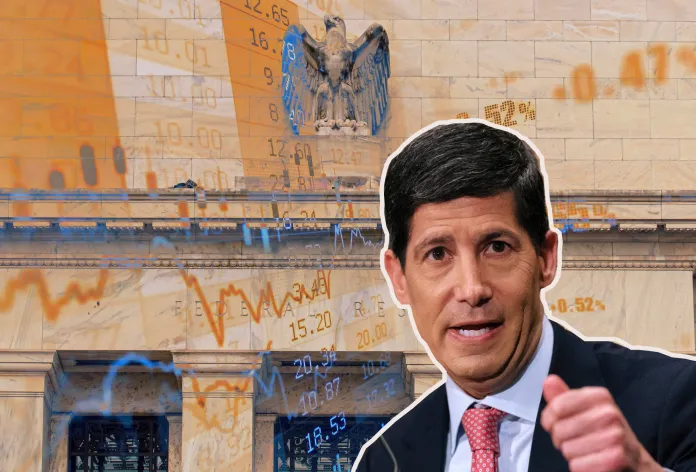
At the Federal Reserve’s last meeting, voting members were divided over whether to raise interest rates. That division will probably persist this week. If so, the committee is likely to defer to its most influential policymakers, Chair Kevin Warsh and New York Federal Reserve Bank President John Williams.
HOW THE BIG BEAUTIFUL BILL BECAME LAW: GRAHAM WINS OVER ‘MURDERER’S ROW’
Warsh is widely regarded as an inflation hawk, but he also believes that AI will produce a sustained increase in productivity growth, allowing the economy to expand more rapidly without igniting a wage-price spiral. Recent productivity data support that view. Meanwhile, John Williams, president and CEO of the Federal Reserve Bank of New York, stated only two weeks ago that there was no need to change interest rates.
Leaving interest rates unchanged would be positive for households, businesses, and the broader economy.
James Rogan is a former diplomat who later worked in law and finance for over 30 years. Today, he writes a daily note on markets, economics, politics, and social issues. He can be reached at Roganjames8202@gmail.com.
Continue reading...
[ H/T Washington Examiner ]