


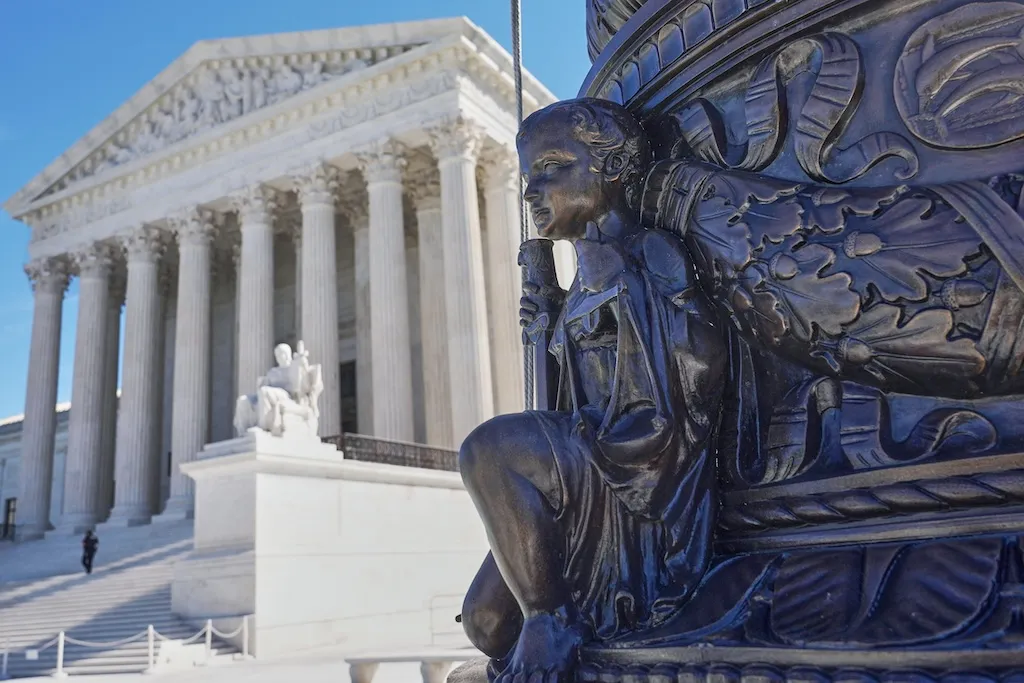
A trio of cases involving property rights and personal freedoms set to be argued this term illustrates the role of the Supreme Court as the last line of defense for people fighting what they see as government overreach.
It is a theme emerging in the cases being heard in the high court’s current term: people challenging federal and local intrusion into their lives. It’s a contrast to the past several terms, when some of the most significant Supreme Court rulings have enforced judicial restraint and recognized expanded presidential power.
The key cases this term involve disputes over property rights, including a federal ban on home distilling of spirits, a state seizure of a plane over a case of beer, and a city trying to enforce permits for prayer groups at home.
“The common denominator between these three cases is that property rights must mean something beyond holding title at the government’s pleasure,” Anastasia Boden, the director of constitutional scholarship and a senior legal analyst at the Pacific Legal Foundation, told the Washington Examiner. “There have to be meaningful limits, and courts have to be willing to step in, otherwise those rights mean nothing.”
“Even though it looks like we’re getting this kind of aggressive pushback, this come-and-take-it attitude, it’s interesting how modest the ask in these cases are, which I think is an illustration of just how far government infringement of property rights has gotten, because here all the plaintiffs really want is a remedy or some limit,” she added.
Court-watchers underline that the cases in question will not focus solely on the federal government. Carrie Severino, the president of the conservative advocacy group Judicial Crisis Network and a former law clerk to Justice Clarence Thomas, said the Supreme Court’s job is to strike down all overreach across governments.
“The Supreme Court is there to enforce the constitutional limits, which are our check against government overreach,” Severino said.
“It’s not as simple as: states are good, federal government is bad, or cities are good, federal government is bad,” she added. “At no level should we have a government overstepping its bounds.”
Nineteenth-century home distilling ban could be struck down as federal overreach
When the federal ban on in-home distilling of spirits was passed, the country was only three years removed from the end of the Civil War. More than 158 years later, the Supreme Court could strike down the ban as an overreach of the federal government’s power in Department of Justice v. McNutt. The challenge to the law was brought by Scott McNutt and other members of the Hobby Distillers Association, an advocacy group pushing for the legalization of in-home distilling. The group was successful at the federal appeals court level in striking down the law, leading the DOJ to appeal that ruling to the Supreme Court.
Severino said the distilling case is about more than making alcohol at home. Instead, it is the latest in a series of disputes in which the Supreme Court has looked at clawing back the federal government’s power to be more in line with constitutional limits.
“Unfortunately, it has often been ignored, or the constitutional limits haven’t been taken as seriously as they should be, as with the separation of powers,” Severino told the Washington Examiner. “This case is an important reconsideration of how far the enumerated powers can be stretched under the necessary and proper clause: How far can we go before it’s just a license to do whatever Congress wants?”
The federal government has defended the law as protecting its authority to tax distilled spirits, but that broad theory could face skepticism at the Supreme Court.
“If that’s true, then … essentially, that would be a logical process to ban essentially anything that people can do in their own home, just put a tax on it, and then say, ‘If you do it within your own home where no one can see you, we’re going to ban it entirely because it’s just too hard to collect a tax on something that people do in their own homes,'” Thomas Berry, director of the libertarian think tank Cato Institute’s Robert A. Levy Center for Constitutional Studies, told the Washington Examiner. “That would be quite the loophole in the Constitution’s design”
Conservatives have pushed for the high court to take up the case over the distilling ban as a matter of curbing federal overreach, with some arguing it could be a way to return decision-making on the matter to local governments, as they claim the Constitution intended.
“We think this is something important for the courts to reexamine because we want the states to be something more than just administrative units of the federal government,” Marc Wheat, general counsel for the conservative think tank Advancing American Freedom, told the Washington Examiner. “We want them to be the laboratories of democracy again, and we want there to be more empowerment for people to use their state government in a way that reflects their population and their cultures.
“People who live in Oregon are very different than people who live in Alabama, and their laws ought to be able to reflect that, rather than having one cookie-cutter approach administered from Washington, D.C.”
Alaska man fights against state taking his plane over case of beer
The Supreme Court will examine whether Alaska infringed the rights of a citizen in the case Jouppi v. Alaska, which will resolve a 14-year legal saga over a punishment handed down for a passenger on Kenneth Jouppi’s plane bringing a six-pack of Budweiser into a village where it is unlawful to have alcohol. Jouppi argued to the high court that the state violated his Eighth Amendment rights by seizing his $95,000 plane as punishment for the infraction, despite it being a first-time offense and over one case of beer.
“It’s actually quite a narrow ask,” Boden told the Washington Examiner. “They’re not even trying to limit government power across the board. They’re just saying, ‘When you fine me, can you just not make it excessive?'”
Jouppi is not fighting the other aspects of his punishment for the rogue six-pack of beer, but rather focusing on whether the seizure of his plane was an unconstitutionally excessive fine. Such civil forfeiture cases are a focus for critics of state power.
“Civil forfeiture is a real problem, not just in Alaska but nationwide, where local governments are using it as an opportunity to enrich themselves,” Severino said. “It illustrates the wisdom of the framers. They knew that governments tend to amass power to themselves across the board; that’s why we have constitutional limits on our government.”
Jouppi, who is now in his 80s, said shortly after the high court agreed to take up his case in July that the case at this point “isn’t just about me or my airplane anymore,” but rather to “ensure that the Bill of Rights actually means something in protecting against government overreach.”
“It’s not like they’re busting a criminal enterprise here,” Wheat said. “The founders were well aware of abuses of tyrannical government, where excessive fines and monetary punishments were used to go after political enemies, and there are constitutional edicts against that.”
Property and religious rights at stake with alleged overreach by city government in Ohio
While most publicized overreaches of power tend to come from federal and state governments, local governments can also intrude on key rights. With Grand v. City of University Heights, property rights and religious rights combine in a dispute in which Daniel Grand was given a cease-and-desist notice from his Ohio city for hosting Sabbath prayer gatherings at his home without a special zoning permit.
Berry said such local zoning enforcement actions are a common form of government overreach that do not get the attention they are due.
“Zoning is definitely one of those sleeper issues that people might not think is a very hot topic, but absolutely governments can influence the way people act in many very serious ways via zoning,” Berry told the Washington Examiner. “You can make it difficult or impossible for people to start a business if you have overly restrictive zoning. Sometimes states enact protectionist zoning.”
The Supreme Court will look at whether the city’s actions unlawfully chilled Grand’s First Amendment religious rights in violation of laws designed to curb infringements of religious freedom through zoning. The Religious Land Use and Institutionalized Persons Act, enacted in 2000, is designed to protect against religious discrimination in zoning laws and will be key to the Grand case.
“Why do we need a religious land use law?” Severino said. “It’s because municipalities have grown accustomed to weaponizing the tools of taxation, permitting, and land use against religious organizations.”
The religious-freedom aspect of the Grand case likely helped get the property-rights case before the justices, Boden said.
“What’s interesting about the Grand case is typically property owners really would have to wait a really long time before challenging those actions,” Boden said. “The only reason the plaintiff in Grand might be able to get a fair shot or to go to court earlier is because his case involves a religious liberty claim.”
Supreme Court picks ‘teaching moments’ with its case selection
The Supreme Court does not have a set formula for taking up certain cases, but among the many reasons the high court decides to hear a case, finding a “teaching moment” is significant, Wheat said.
“I think that they look for cases that are easy to understand how something is terribly wrong, and then they can illustrate what the rule is and how did those rights get asserted and fought for a general beneficence of the American people,” Wheat said, pointing to both the distilling and Grand cases as key examples.
Boden said that while there has been improvement in terms of the justices taking up more property-rights issues, it remains a weak spot for the high court’s docket.
“We’ve seen some headway when it comes to property rights at the Supreme Court,” Boden told the Washington Examiner. “Still, overall property rights are a second-class right. They don’t get as much judicial protection, and courts are much less willing to step in and protect them.”
“So it is exciting when we get to see three property rights in one term because historically property rights, like most economic rights, don’t get that level of protection,” she added, noting that the trio of cases are “modest” with their requests for relief from the Supreme Court, “even though they seem like big swings at the Supreme Court for property rights.”
The Supreme Court typically looks to correct errors of lower courts and set an example, the legal experts said.
“What the court really wants to do more than anything else is provide guidance to lower courts,” Berry said. “So they’re looking for problems that are likely to keep recurring.”
WHY SPECULATION ABOUT JUSTICE ALITO’S FUTURE CONTINUES DESPITE HIS REJECTION OF RETIREMENT
The Supreme Court has scheduled oral arguments in the Jouppi case for Dec. 1, while oral arguments for the Grand case are scheduled for Dec. 9. The high court has yet to schedule oral arguments for the McNutt case, but it is expected to be heard sometime between February and April 2027.
The justices are expected to issue rulings in all the cases they hear this term by the end of June 2027.
Continue reading...
[ H/T Washington Examiner ]