
![‘MAGA pieces of [bleep]’: Watch rock singer launch graphic attack on Republicans, Christians and ICE](https://www.wnd.com/wp-content/uploads/2026/10/hayley-williams-devil-dress-full-jpg.jpg)


The Biggest Threat To Today's Data Centers Is In The Battery Room
Authored by David Ellis via Data Centre Dynamics,
As data centers continue to multiply, facilities are deploying industrial-scale Uninterruptible Power Supply (UPS) units by the hundreds and substation-size front-of-the-meter Battery Energy Storage Systems (BESS) to secure against grid failure, power surges, or other disruptions.
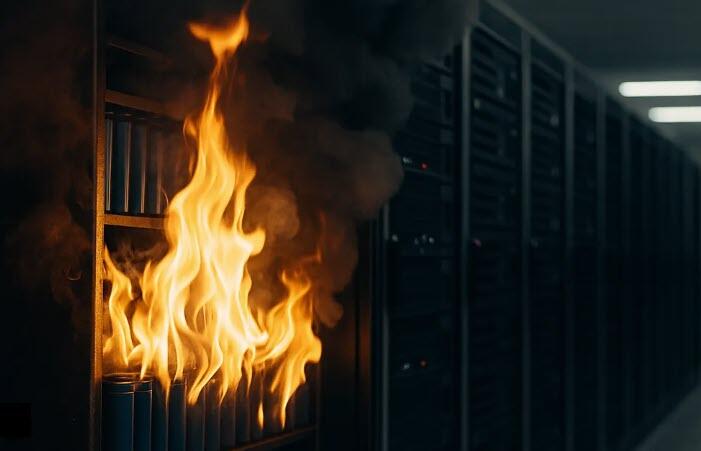
But while the battery units are looking after the servers, who is looking after the batteries?
In the last few years, lithium-ion batteries have become the backup power of choice for data center UPS and BESS systems, and for good reason. They have long lifespans, a small footprint, and superior energy density. While data centers tend to be safe, things can and do go wrong. When they do, it's almost always related to lithium-ion batteries.
The September 2025 data center fire in South Korea that led to a paralyzing nationwide outage in government services started with a single lithium battery explosion. Last year, a battery room at the Chirisa Technology Parks data center in Virginia caught fire twice in two months. Firefighters who responded to a May 2025 fire at an Oregon data center leased by X flagged the battery room as the source of the blaze. As the National Fire Protection Association (NFPA) noted recently, "Nearly every notable fire event in data centers in recent years has involved lithium-ion batteries in some way."
The biggest safety threat to modern data centers' backup battery systems falls on a single culprit: hydrogen. When a lithium-ion cell begins to fail, internal temperatures rise rapidly, forcing a breakdown in the battery's internal chemistry. Hydrogen, the smallest and lightest molecule, is often the most measurable gas during the initial stages of failure. Unlike traditional vented lead-acid batteries, lithium-ion cells do not regularly emit hydrogen gas. When 'off-gassing' does occur, it usually means something has gone very wrong. Overcharging, cell damage, separator defects, internal short circuits, or even the formation of tiny lithium dendrites can trigger a state known as thermal runaway. If early warning detection systems are not installed, this is when things get dangerous fast.
Once thermal runaway is triggered, it's a self-sustaining chain reaction. Rising heat melts the battery's internal separator, causing a short circuit that rapidly generates heat. The extreme heat drives internal thermal decomposition, which releases fuel and oxygen. The release of oxygen feeds sustained combustion that can spike to more than 1,000°F (538°C) in a matter of seconds. Because the cell is sealed, the extreme heat and pressure cause the battery to burst into flames that can ignite neighboring cells and equipment.
While industry data shows a steady decline in BESS failure rates per gigawatt-hour of deployed capacity, the stakes are still high. Because the large-scale shift to lithium-ion battery configurations has only taken place during the last 3-5 years, hyperscalers, regulators, and insurers are beginning to catch up to the reality that lithium-ion deployments do not conform to legacy safety protocols.
Previous safety best practices that focused on ventilation to prevent critical concentrations of hydrogen during regular off-gassing are no longer sufficient for today's battery rooms. Energy-dense lithium-ion cells are often packed in enclosed cabinets. This makes for a small footprint that can trap volatile gas beyond the reach of traditional ventilation units. Given the potential for a sudden flare-up, the safety approach for these configurations has shifted from ventilation to early-stage off-gas detection.
Regulations and standards are evolving accordingly to prioritize early detection and prevent worst-case scenarios. Standards like NFPA 855 were designed specifically for lithium-ion deployments, mandating continuous gas detection alongside standard exhaust systems.
Destructive testing standards, like UL 9540A, generate the fire-propagation data that inform spacing and suppression requirements in model codes and standards like NFPA 855. Additionally, UL 2075, a standard covering gas and vapor detector performance, is now being used in modern BESS and UPS environments to certify specific gas or off-gas detectors used to monitor hydrogen and hazardous gas accumulation in battery rooms.
While the standards and regulations evolve, their practical implementation has not kept pace with the scale of data center deployments. Designing a battery room layout that complies with specific standards and local fire and safety requirements is not exactly intuitive, nor is it top-of-mind for data centers focused on uptime and speed-to-market. Backup battery systems are largely treated as a necessary investment to satisfy stakeholders. In practice, the safety systems underwriting hyperscale battery deployments are not just check-boxes; they're the first line of defense keeping the facility online and off the front-page news.
Anyone who has bought the wrong smoke detector for their home understands that not all safety equipment is created equal. Some battery room gas sensors are overly sensitive and cause false alarms, like the smoke detector that goes off anytime there's a pan on the stove. Some gas sensors quickly lose calibration and require regular maintenance. Other sensors are not designed for integration into today's smart anti-explosion and fire systems and building management systems.
When it comes to safety, too many data centers are left guessing. Industry standards and certification are making it easier for hyperscale operators to identify what they need to optimize safety. But with highly compressed timelines between standard operations and a thermal incident, it's critical to monitor the very first signs of catastrophe. For today's gigawatt-scale data centers, the earliest sign of failure isn't smoke or fire, but hydrogen silently venting in a battery cabinet.
Data centers are rightly focused on delivering massive compute density and next-generation AI chips, but the systems powering those capabilities need rigorous attention as well. Securing a multi-billion-dollar deployment goes beyond acknowledging the thermal risks inherent in modern backup power systems to actively tracking the element responsible for turning a potential risk into an active crisis.
Tyler Durden Mon, 10/12/2026 - 15:00
Continue reading...
[ H/T ZeroHedge ]
Authored by David Ellis via Data Centre Dynamics,
As data centers continue to multiply, facilities are deploying industrial-scale Uninterruptible Power Supply (UPS) units by the hundreds and substation-size front-of-the-meter Battery Energy Storage Systems (BESS) to secure against grid failure, power surges, or other disruptions.
But while the battery units are looking after the servers, who is looking after the batteries?
In the last few years, lithium-ion batteries have become the backup power of choice for data center UPS and BESS systems, and for good reason. They have long lifespans, a small footprint, and superior energy density. While data centers tend to be safe, things can and do go wrong. When they do, it's almost always related to lithium-ion batteries.
The September 2025 data center fire in South Korea that led to a paralyzing nationwide outage in government services started with a single lithium battery explosion. Last year, a battery room at the Chirisa Technology Parks data center in Virginia caught fire twice in two months. Firefighters who responded to a May 2025 fire at an Oregon data center leased by X flagged the battery room as the source of the blaze. As the National Fire Protection Association (NFPA) noted recently, "Nearly every notable fire event in data centers in recent years has involved lithium-ion batteries in some way."
The biggest safety threat to modern data centers' backup battery systems falls on a single culprit: hydrogen. When a lithium-ion cell begins to fail, internal temperatures rise rapidly, forcing a breakdown in the battery's internal chemistry. Hydrogen, the smallest and lightest molecule, is often the most measurable gas during the initial stages of failure. Unlike traditional vented lead-acid batteries, lithium-ion cells do not regularly emit hydrogen gas. When 'off-gassing' does occur, it usually means something has gone very wrong. Overcharging, cell damage, separator defects, internal short circuits, or even the formation of tiny lithium dendrites can trigger a state known as thermal runaway. If early warning detection systems are not installed, this is when things get dangerous fast.
Once thermal runaway is triggered, it's a self-sustaining chain reaction. Rising heat melts the battery's internal separator, causing a short circuit that rapidly generates heat. The extreme heat drives internal thermal decomposition, which releases fuel and oxygen. The release of oxygen feeds sustained combustion that can spike to more than 1,000°F (538°C) in a matter of seconds. Because the cell is sealed, the extreme heat and pressure cause the battery to burst into flames that can ignite neighboring cells and equipment.
While industry data shows a steady decline in BESS failure rates per gigawatt-hour of deployed capacity, the stakes are still high. Because the large-scale shift to lithium-ion battery configurations has only taken place during the last 3-5 years, hyperscalers, regulators, and insurers are beginning to catch up to the reality that lithium-ion deployments do not conform to legacy safety protocols.
Previous safety best practices that focused on ventilation to prevent critical concentrations of hydrogen during regular off-gassing are no longer sufficient for today's battery rooms. Energy-dense lithium-ion cells are often packed in enclosed cabinets. This makes for a small footprint that can trap volatile gas beyond the reach of traditional ventilation units. Given the potential for a sudden flare-up, the safety approach for these configurations has shifted from ventilation to early-stage off-gas detection.
Regulations and standards are evolving accordingly to prioritize early detection and prevent worst-case scenarios. Standards like NFPA 855 were designed specifically for lithium-ion deployments, mandating continuous gas detection alongside standard exhaust systems.
Destructive testing standards, like UL 9540A, generate the fire-propagation data that inform spacing and suppression requirements in model codes and standards like NFPA 855. Additionally, UL 2075, a standard covering gas and vapor detector performance, is now being used in modern BESS and UPS environments to certify specific gas or off-gas detectors used to monitor hydrogen and hazardous gas accumulation in battery rooms.
While the standards and regulations evolve, their practical implementation has not kept pace with the scale of data center deployments. Designing a battery room layout that complies with specific standards and local fire and safety requirements is not exactly intuitive, nor is it top-of-mind for data centers focused on uptime and speed-to-market. Backup battery systems are largely treated as a necessary investment to satisfy stakeholders. In practice, the safety systems underwriting hyperscale battery deployments are not just check-boxes; they're the first line of defense keeping the facility online and off the front-page news.
Anyone who has bought the wrong smoke detector for their home understands that not all safety equipment is created equal. Some battery room gas sensors are overly sensitive and cause false alarms, like the smoke detector that goes off anytime there's a pan on the stove. Some gas sensors quickly lose calibration and require regular maintenance. Other sensors are not designed for integration into today's smart anti-explosion and fire systems and building management systems.
When it comes to safety, too many data centers are left guessing. Industry standards and certification are making it easier for hyperscale operators to identify what they need to optimize safety. But with highly compressed timelines between standard operations and a thermal incident, it's critical to monitor the very first signs of catastrophe. For today's gigawatt-scale data centers, the earliest sign of failure isn't smoke or fire, but hydrogen silently venting in a battery cabinet.
Data centers are rightly focused on delivering massive compute density and next-generation AI chips, but the systems powering those capabilities need rigorous attention as well. Securing a multi-billion-dollar deployment goes beyond acknowledging the thermal risks inherent in modern backup power systems to actively tracking the element responsible for turning a potential risk into an active crisis.
Tyler Durden Mon, 10/12/2026 - 15:00
Continue reading...
[ H/T ZeroHedge ]