







The $1 Million Tanker Was Just The Start: Every Crude Freight Index Hits Record High As Hormuz "Works" Too Well
Just when we thought crude tanker rates couldn't go any higher, they did - again.
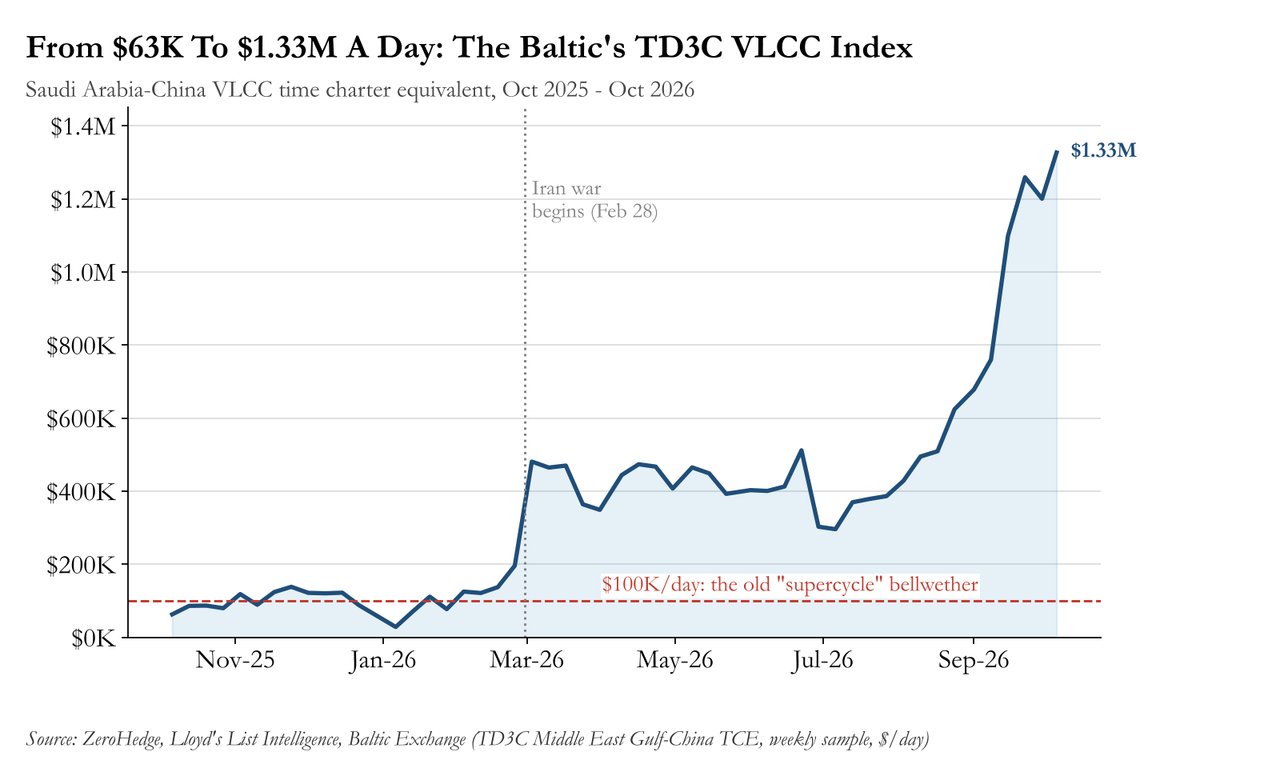
A week ago, a record million dollars a day charter for a supertanker was the punchline. Now it's the floor: the Baltic Exchange's TD3C, the benchmark Saudi Arabia-to-China VLCC route, hit yet another all-time high of $1.33 million per day on Monday, up 10% on the week and 21 times where it was a year ago!
But the real fireworks are elsewhere. As Lloyd's List's Greg Miller writes, the tanker market's "cascade" effect has gone into overdrive, with record VLCC strength spilling into suezmaxes, and suezmax demand in turn dragging up aframaxes:
In other words, the better the Hormuz shuttle "works", the more expensive it gets to ship a barrel anywhere in the world.
Let's take a closer look at the carnage segment by segment, what Goldman, JPM and BofA say is driving it, and why the only thing standing between owners and $1.6 million a day is the refining margin.
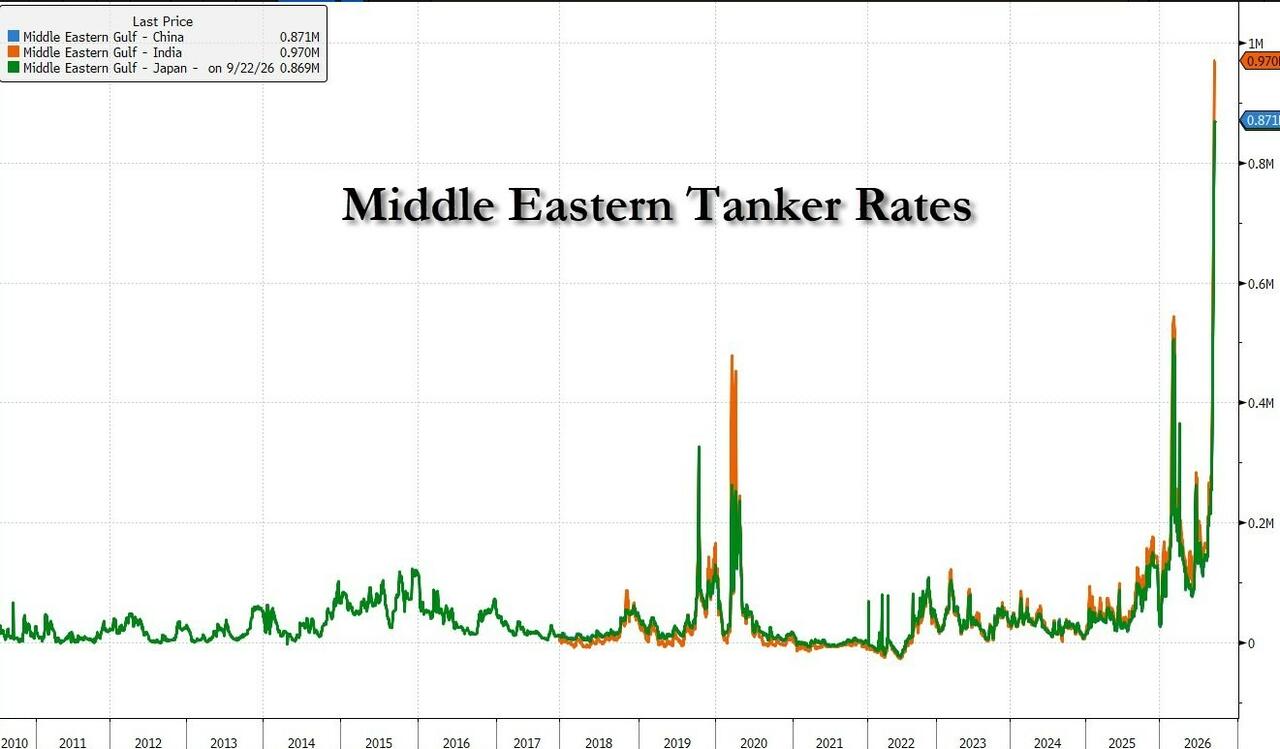
Regular readers know we have been tracking the tanker rate crisis since before it was cool - specifically February 20 - a week before the first Iran shots were fired, when the Baltic's Middle East-China VLCC route had "only" tripled to $151K a day. We were also on the $1 million milestone before it happened: "Mideast Chaos Sends Supertanker Rates Soaring To Near Record $1 Million A Day", a headline we upgraded from $800K within hours. Then on Sept 23, with rates on the Gulf-India route nudging $1 million, we put out this chart:
What changed in the past week?
According to Lloyd's List, Gulf producers decided to push more tankers through Hormuz under US military protection (even as Iran ratchets up attacks: UKMTO confirmed two separate projectile strikes on crude tankers in and around the Strait just over the weekend), which sharply increased near-term cargo supply and pulled more VLCCs to wait for ship-to-ship (STS) transfers in the Gulf of Oman. Clarksons Securities puts the wait for an STS slot at seven to 10 days, and estimates STS volumes have surged from 5-6 million barrels a day a month ago to 12 million b/d.
And since VLCCs loading via STS in the Gulf of Oman earn about 50% more than VLCCs loading in the Atlantic, with a much shorter ballast leg from Asia, owners are doing the rational thing. As Poten & Partners' head of tanker research Erik Broekhuizen put it:
Translation: the Atlantic has run out of supertankers. With few ballast VLCCs around, charterers have been forced to split 2 million-barrel stems into 1 million-barrel suezmax cargoes, and the result is what Fearnley Securities calls a market where "available tonnage is seemingly vacuumed off position lists the second it is marketed." Sparta Commodities summed it up even more concisely: "Atlantic freight is repricing violently on real tightness."
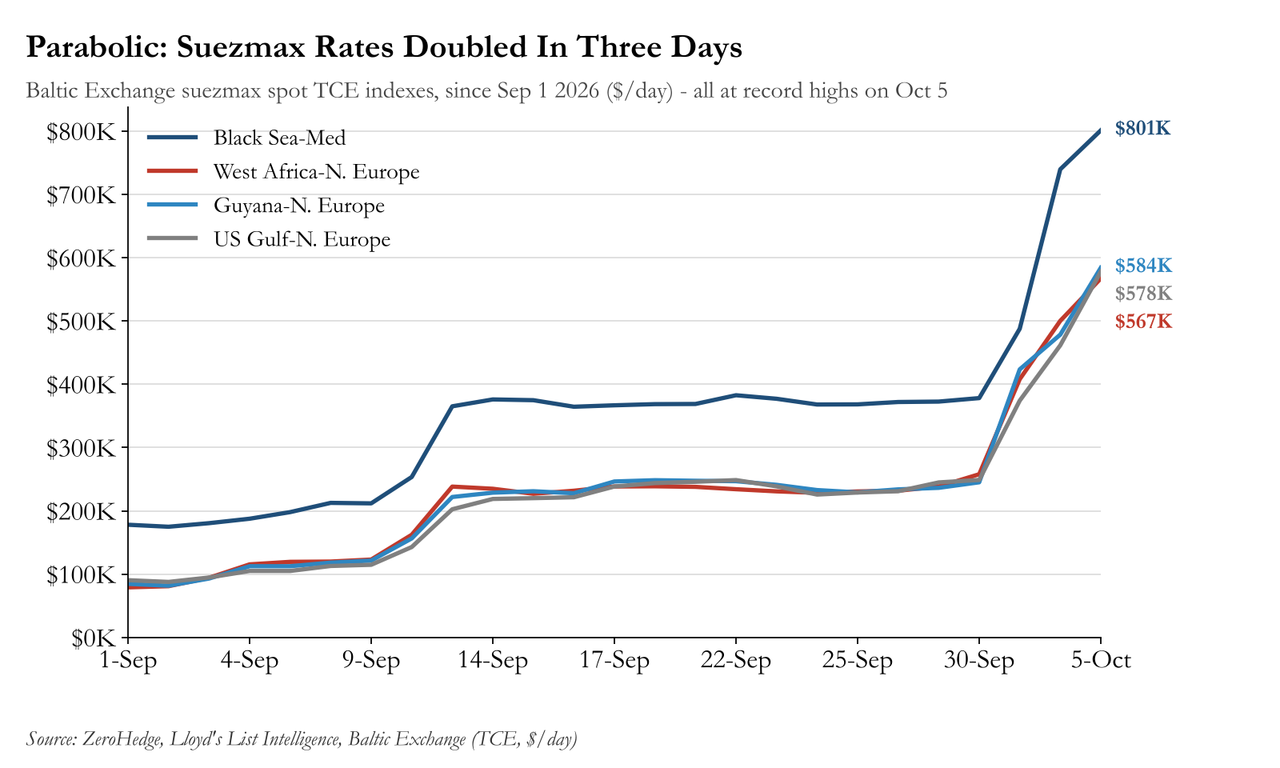
Suezmax owners are the big winners. Atlantic basin suezmax rates more than doubled in three trading days, and they were already at or near record highs before the latest jump. On Monday:
Every single one of the Baltic Exchange's suezmax indexes hit an all-time high on Monday. For context, the US Gulf-Europe route was paying $90K at the start of September.
And now the cascade is running in reverse too: with suezmaxes (half the cargo) earning more than double what VLCCs do in the Atlantic, VLCC owners are simply holding out for more. The Baltic's West Africa-China VLCC index jumped 43% w/w to $697,160/day and US Gulf-China rose 20% to $473,958, both all-time highs. The Oman-China route, the one that actually captures the STS shuttle trade, was steadier at an "astronomical" $860,580/day, just shy of its Sept 17 record.
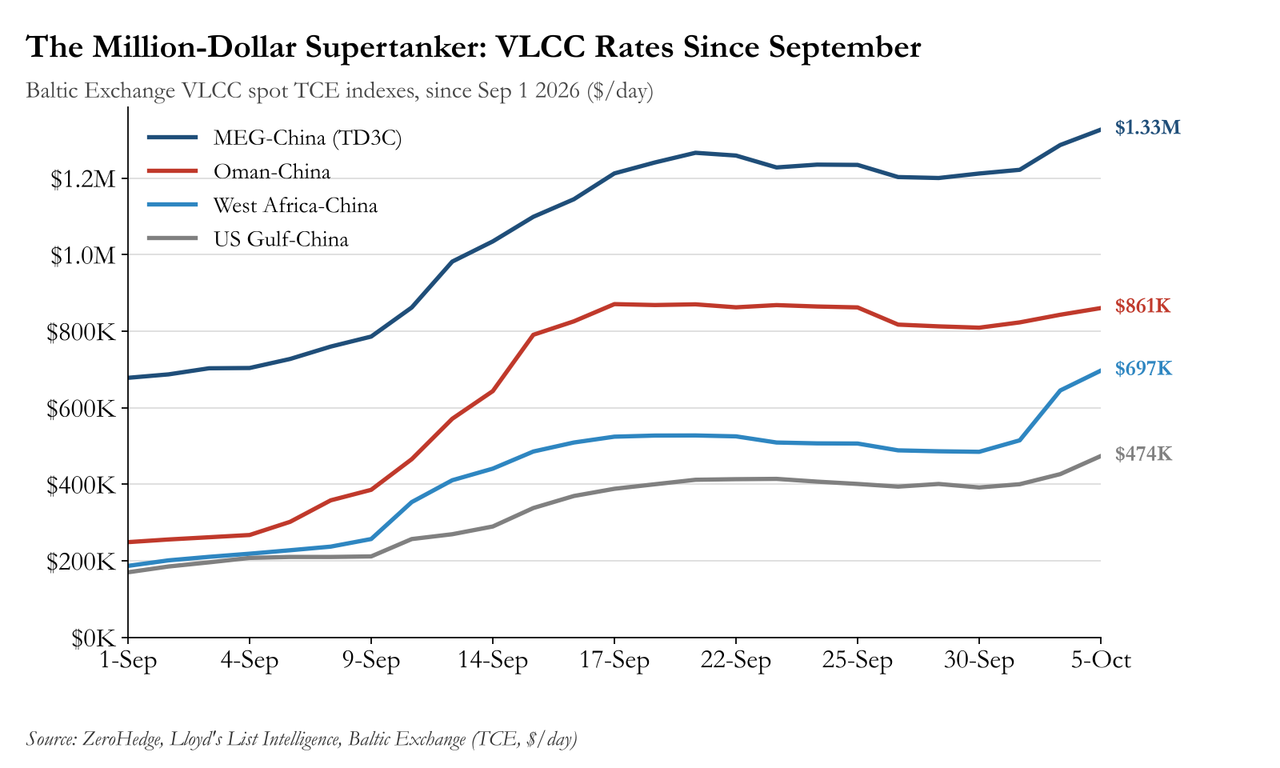
As for TD3C, Lloyd's List notes it is "perhaps the least relevant" index to actual owner earnings since almost no one sails direct from Saudi Arabia to China anymore - most crude is shuttled out to STS positions in a two-step process - but as a proxy for the total freight bill it is hard to beat. Nothing says "orderly market" like the benchmark route nobody uses hitting a record every week.
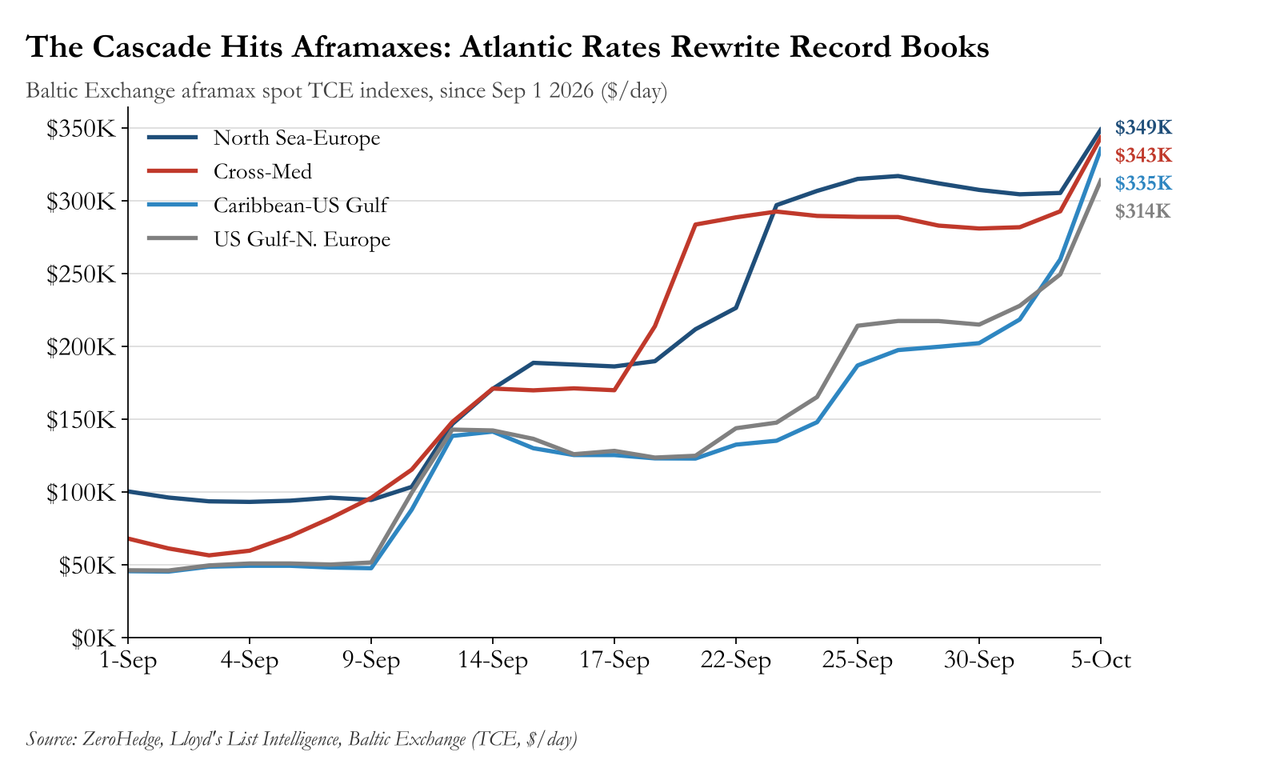
Atlantic aframaxes had their moment in March, when panicked Asian buyers booked unusually long-haul aframax loads out of the US Gulf to replace Mideast crude. Those peaks were never revisited... until now. On Monday the Baltic's US Gulf-Europe aframax index was at $313,794/day (+44% w/w), Cross-Med at $343,227 (+19%), Caribbean-US at $335,288 (+70%) and North Sea-Europe at $348,651 (+10%). In early September most of these were paying $45K-$100K.
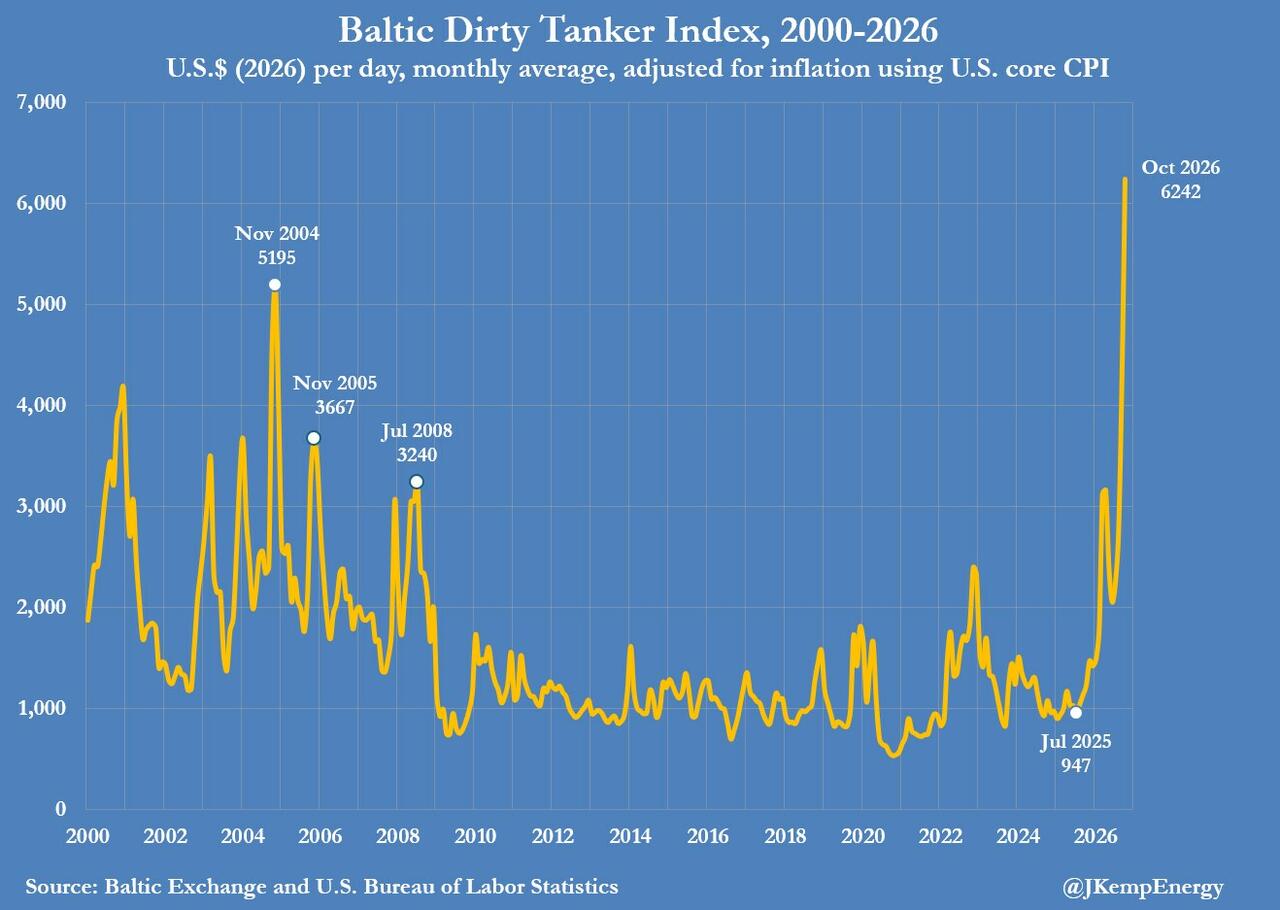
"Increased suezmax activity continues to provide further support for aframax demand," said Clarksons in its Monday brokerage report. Put simply, there is no class of crude tanker left that isn't being squeezed. And for those looking for the long-term perspective, here is John Kemp's inflation-adjusted Baltic Dirty Tanker Index: at 6,242 in October, it is now the highest on record in real terms, blowing past the November 2004 peak of 5,195.
Here is the paradox. Normally, more oil getting out of the Gulf would be bearish for freight. Not this time. As Goldman's commodity team wrote last week in "Adaptation: Persian Gulf Exports Return to 2025 Level" (available to pro subs), which we discussed at the time:
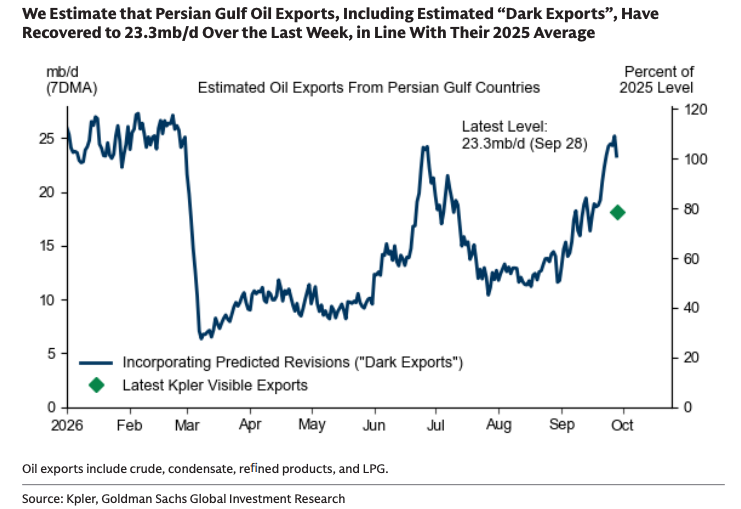
But while the barrels are back, the logistics are not.
A pre-war barrel took one voyage from Ras Tanura to Ningbo; today it takes a dark transit, a shuttle run, a 7-10 day wait off Fujairah or Sohar, a ship-to-ship transfer and then the long haul. Every one of those steps ties up tonnage. It's also why we have been saying since early March that Fujairah and the Hormuz bypass routes would become the center of the oil universe (a call Abu Dhabi is now putting tens of billions behind), and why the US Navy's billion-barrel escort operation has been, from the owners' perspective, the gift that keeps on giving.
JPMorgan's top oil strategist Natasha Kaneva made a similar point in her latest Oil Flash Note (available to pro subs): Hormuz throughput was back to ~13 million b/d, but "SoH transmission is not due to improved safety but improved ability to operate under risk," and freight rates were "~$1.27mm/day, a record." (They are higher now.) Goldman also points out that refined products are more flammable than crude, so the physical risks of a Hormuz crossing are greater for product tankers, which is one reason Gulf product exports are still stuck at ~50% of 2025 levels while crude is at 108%.
Meanwhile, Goldman's Rich Privorotsky summed up the market's take on Monday: "Plenty of threatened escalation and additional tankers hit, but diplomatic pathways remain open and, crucially, oil is getting out of the Gulf." Yes it is - at $1.33 million a day.
For decades, $100,000 a day was the psychological bellwether of a VLCC upcycle. As Lloyd's List puts it, tanker shipping's "Overton window" now has an extra zero. Or as DNB Carnegie shipping analyst Jorgen Lian confessed at last week's Capital Link conference: "Our imagination is obviously not imaginative enough, because we've been lagging the reality by far." Spoken like a true sell-sider.
So where is the ceiling? It's set by the (parabolic) crack spread. If importers pay so much in freight that they can't earn a profit refining the crude, they stop shipping it. And with cracks at historic highs, that ceiling is a lot higher than anyone thought. Clarksons Securities lays out the math:
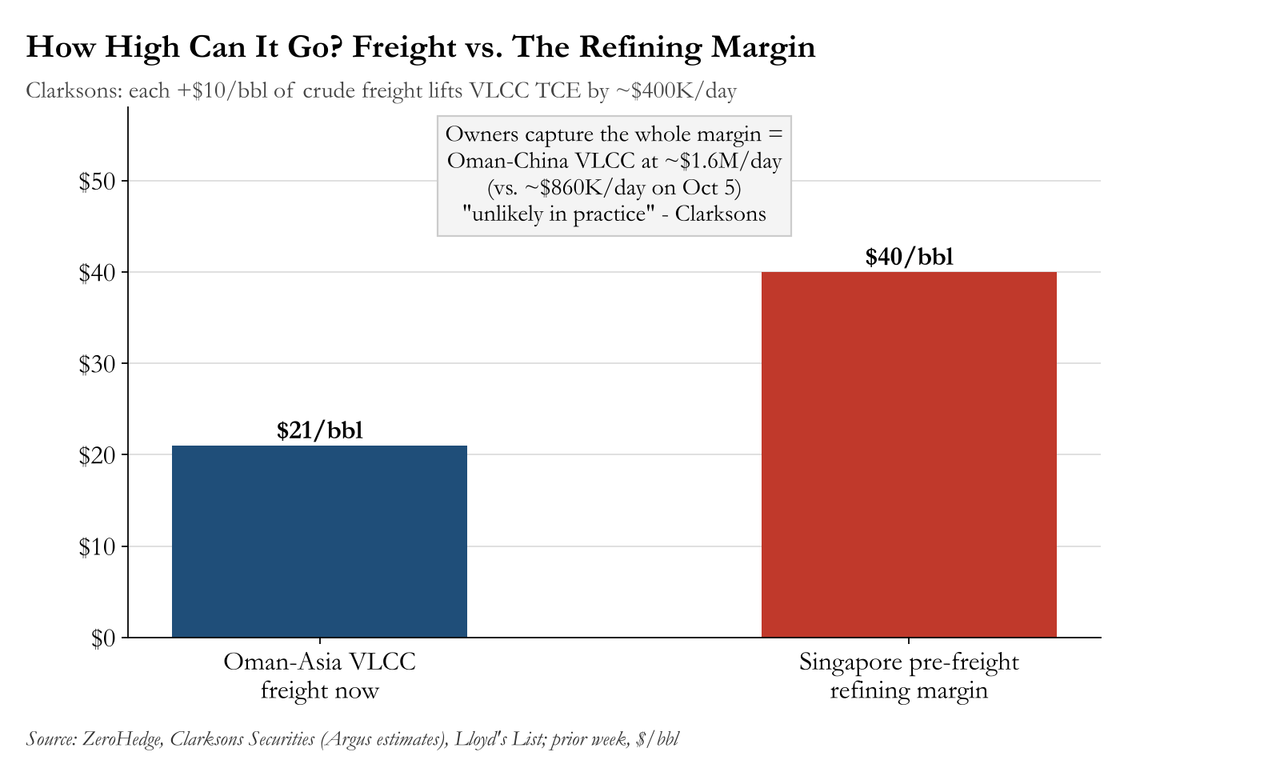
Per Clarksons, every $10/bbl increase in crude freight lifts VLCC TCE by ~$400K/day. Citing Argus, it estimates the Singapore product slate sold for $151/bbl last week, implying a pre-freight refining margin of ~$40/bbl, against Oman-Asia VLCC freight of ~$21/bbl, meaning "there is still considerable margin left for VLCC owners to capture." If owners grabbed the entire margin, which Clarksons admits is "unlikely in practice", Oman-China VLCC rates would be almost double current levels, at $1.6 million a day.
BofA's numbers back that up. The bank's Asian refining margin has been holding at roughly $35-45/bbl since August, more than four times its 5-year average (for more details see BofA's latest "The Oil Gusher" note)....
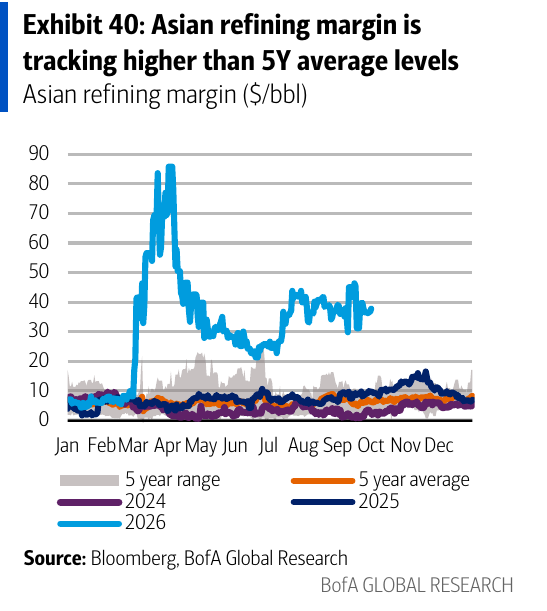
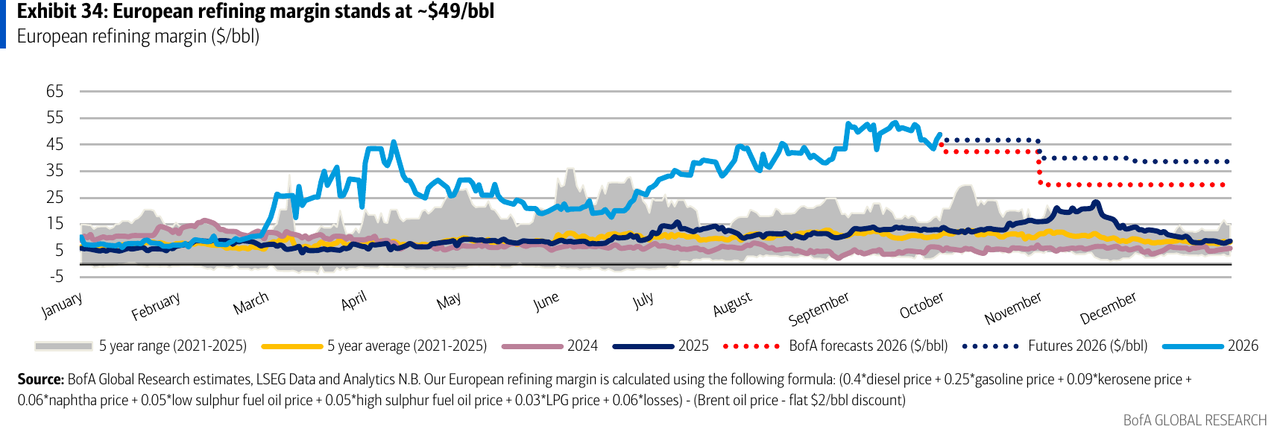
... while its European refining margin is at ~$49/bbl, with diesel cracking ~$90/bbl over Brent. That makes sense to anyone who has followed our coverage of the record diesel crack and Goldman's "nightmare" refining crisis warning; as we put it over the weekend, the US doesn't have an oil problem, it has a refinery problem. Turns out, so does the tanker market, only in a good way (for owners).
Two more factors stretch the ceiling.
Before anyone extrapolates $1.6 million, Clarksons offers a crucial caveat:
And that is where BofA comes in with the counterpoint. Its European refining margin strip is already in "(slight) backwardation", with the 4Q26 strip below the 3Q26 average of more than $42/bbl, and the bank models refining margins dropping to $15/bbl by end-2027. BofA's US refining team (in its "Refining roundup", also available to pro subs) is equally skeptical that the market should be paying up for a permanently higher crack, reiterating its "hesitance to buy into a +$3/bbl LT midcycle crack valuation." If the crack goes, the ceiling on freight goes with it - and we've seen this movie before: in June, tanker rates nearly halved in days on Hormuz normalization hopes, right after earnings had soared to $470,000 a day.
Meanwhile, the war itself isn't getting any calmer: per Bloomberg, the US blockade has now bottled up at least 50 tankers carrying Iranian oil, while Tehran's parliament speaker says the Strait won't fully reopen until the US meets seven conditions. Which, for now, is bullish for freight - right up until the ceasefire headline that sends it the other way.
Lloyd's List puts the commercial logic simply: the spot rate "can be whatever charterers are willing to pay," with the caveat that charterers will, as financial pain increases, belatedly expand period coverage and reduce spot exposure. Or as Clarksons put it, "the rapid increase in Middle East crude flows has put the squeeze on all tanker classes."
Our take: with refining margins at $40+/bbl and Gulf barrels needing two or three ships to get to market instead of one, there is still near-term upside, and the Atlantic cascade has further to run as VLCC owners hold out for suezmax-equivalent economics. But the more important number may not be a TCE at all: freight is now 27% of the delivered cost of a barrel, which makes this an inflation story as much as a shipping one (as Bloomberg's Javier Blas warned in "The Next Inflation Shock: $1 Million-a-Day Oil Tankers" two weeks ago).
And when the owners themselves start ringing the register - Trafigura's tanker arm Volare jumped in its Oslo debut on Monday "as a wave of shipping IPOs builds" - history suggests the people who know ships best are selling them to the people who know them least. Enjoy the $1.33 million a day while it lasts: in shipping (as in everything else) nothing cures record rates like record rates.
Much more in the full Goldman "Adaptation: Persian Gulf Exports Return to 2025 Level" note and BofA's "The Oil Gusher: 3Q26 Playbook Part I" and "Refining roundup" notes, all available to pro subs.
Tyler Durden Tue, 10/06/2026 - 14:40
Continue reading...
[ H/T ZeroHedge ]
Just when we thought crude tanker rates couldn't go any higher, they did - again.
A week ago, a record million dollars a day charter for a supertanker was the punchline. Now it's the floor: the Baltic Exchange's TD3C, the benchmark Saudi Arabia-to-China VLCC route, hit yet another all-time high of $1.33 million per day on Monday, up 10% on the week and 21 times where it was a year ago!
But the real fireworks are elsewhere. As Lloyd's List's Greg Miller writes, the tanker market's "cascade" effect has gone into overdrive, with record VLCC strength spilling into suezmaxes, and suezmax demand in turn dragging up aframaxes:
In other words, the better the Hormuz shuttle "works", the more expensive it gets to ship a barrel anywhere in the world.
Let's take a closer look at the carnage segment by segment, what Goldman, JPM and BofA say is driving it, and why the only thing standing between owners and $1.6 million a day is the refining margin.
"Available Tonnage Is Vacuumed Off Position Lists The Second It Is Marketed"
Regular readers know we have been tracking the tanker rate crisis since before it was cool - specifically February 20 - a week before the first Iran shots were fired, when the Baltic's Middle East-China VLCC route had "only" tripled to $151K a day. We were also on the $1 million milestone before it happened: "Mideast Chaos Sends Supertanker Rates Soaring To Near Record $1 Million A Day", a headline we upgraded from $800K within hours. Then on Sept 23, with rates on the Gulf-India route nudging $1 million, we put out this chart:
What changed in the past week?
According to Lloyd's List, Gulf producers decided to push more tankers through Hormuz under US military protection (even as Iran ratchets up attacks: UKMTO confirmed two separate projectile strikes on crude tankers in and around the Strait just over the weekend), which sharply increased near-term cargo supply and pulled more VLCCs to wait for ship-to-ship (STS) transfers in the Gulf of Oman. Clarksons Securities puts the wait for an STS slot at seven to 10 days, and estimates STS volumes have surged from 5-6 million barrels a day a month ago to 12 million b/d.
And since VLCCs loading via STS in the Gulf of Oman earn about 50% more than VLCCs loading in the Atlantic, with a much shorter ballast leg from Asia, owners are doing the rational thing. As Poten & Partners' head of tanker research Erik Broekhuizen put it:
Translation: the Atlantic has run out of supertankers. With few ballast VLCCs around, charterers have been forced to split 2 million-barrel stems into 1 million-barrel suezmax cargoes, and the result is what Fearnley Securities calls a market where "available tonnage is seemingly vacuumed off position lists the second it is marketed." Sparta Commodities summed it up even more concisely: "Atlantic freight is repricing violently on real tightness."
Parabolic Suezmaxes
Suezmax owners are the big winners. Atlantic basin suezmax rates more than doubled in three trading days, and they were already at or near record highs before the latest jump. On Monday:
- US Gulf-Europe: $577,792/day, up 150% w/w
- Guyana-Europe: $584,012/day, up 150% w/w
- West Africa-Europe: $567,138/day, up 145% w/w
- Black Sea-Med (with a Russia-Ukraine war premium on top): $801,077/day, up 115% w/w
Every single one of the Baltic Exchange's suezmax indexes hit an all-time high on Monday. For context, the US Gulf-Europe route was paying $90K at the start of September.
And now the cascade is running in reverse too: with suezmaxes (half the cargo) earning more than double what VLCCs do in the Atlantic, VLCC owners are simply holding out for more. The Baltic's West Africa-China VLCC index jumped 43% w/w to $697,160/day and US Gulf-China rose 20% to $473,958, both all-time highs. The Oman-China route, the one that actually captures the STS shuttle trade, was steadier at an "astronomical" $860,580/day, just shy of its Sept 17 record.
As for TD3C, Lloyd's List notes it is "perhaps the least relevant" index to actual owner earnings since almost no one sails direct from Saudi Arabia to China anymore - most crude is shuttled out to STS positions in a two-step process - but as a proxy for the total freight bill it is hard to beat. Nothing says "orderly market" like the benchmark route nobody uses hitting a record every week.
The Aframax Record Books Get Rewritten
Atlantic aframaxes had their moment in March, when panicked Asian buyers booked unusually long-haul aframax loads out of the US Gulf to replace Mideast crude. Those peaks were never revisited... until now. On Monday the Baltic's US Gulf-Europe aframax index was at $313,794/day (+44% w/w), Cross-Med at $343,227 (+19%), Caribbean-US at $335,288 (+70%) and North Sea-Europe at $348,651 (+10%). In early September most of these were paying $45K-$100K.
"Increased suezmax activity continues to provide further support for aframax demand," said Clarksons in its Monday brokerage report. Put simply, there is no class of crude tanker left that isn't being squeezed. And for those looking for the long-term perspective, here is John Kemp's inflation-adjusted Baltic Dirty Tanker Index: at 6,242 in October, it is now the highest on record in real terms, blowing past the November 2004 peak of 5,195.
Goldman: Gulf Exports Are Back... Which Is Exactly The Problem
Here is the paradox. Normally, more oil getting out of the Gulf would be bearish for freight. Not this time. As Goldman's commodity team wrote last week in "Adaptation: Persian Gulf Exports Return to 2025 Level" (available to pro subs), which we discussed at the time:
But while the barrels are back, the logistics are not.
A pre-war barrel took one voyage from Ras Tanura to Ningbo; today it takes a dark transit, a shuttle run, a 7-10 day wait off Fujairah or Sohar, a ship-to-ship transfer and then the long haul. Every one of those steps ties up tonnage. It's also why we have been saying since early March that Fujairah and the Hormuz bypass routes would become the center of the oil universe (a call Abu Dhabi is now putting tens of billions behind), and why the US Navy's billion-barrel escort operation has been, from the owners' perspective, the gift that keeps on giving.
JPMorgan's top oil strategist Natasha Kaneva made a similar point in her latest Oil Flash Note (available to pro subs): Hormuz throughput was back to ~13 million b/d, but "SoH transmission is not due to improved safety but improved ability to operate under risk," and freight rates were "~$1.27mm/day, a record." (They are higher now.) Goldman also points out that refined products are more flammable than crude, so the physical risks of a Hormuz crossing are greater for product tankers, which is one reason Gulf product exports are still stuck at ~50% of 2025 levels while crude is at 108%.
Meanwhile, Goldman's Rich Privorotsky summed up the market's take on Monday: "Plenty of threatened escalation and additional tankers hit, but diplomatic pathways remain open and, crucially, oil is getting out of the Gulf." Yes it is - at $1.33 million a day.
How High Can It Go? Ask The Refiners
For decades, $100,000 a day was the psychological bellwether of a VLCC upcycle. As Lloyd's List puts it, tanker shipping's "Overton window" now has an extra zero. Or as DNB Carnegie shipping analyst Jorgen Lian confessed at last week's Capital Link conference: "Our imagination is obviously not imaginative enough, because we've been lagging the reality by far." Spoken like a true sell-sider.
So where is the ceiling? It's set by the (parabolic) crack spread. If importers pay so much in freight that they can't earn a profit refining the crude, they stop shipping it. And with cracks at historic highs, that ceiling is a lot higher than anyone thought. Clarksons Securities lays out the math:
Per Clarksons, every $10/bbl increase in crude freight lifts VLCC TCE by ~$400K/day. Citing Argus, it estimates the Singapore product slate sold for $151/bbl last week, implying a pre-freight refining margin of ~$40/bbl, against Oman-Asia VLCC freight of ~$21/bbl, meaning "there is still considerable margin left for VLCC owners to capture." If owners grabbed the entire margin, which Clarksons admits is "unlikely in practice", Oman-China VLCC rates would be almost double current levels, at $1.6 million a day.
BofA's numbers back that up. The bank's Asian refining margin has been holding at roughly $35-45/bbl since August, more than four times its 5-year average (for more details see BofA's latest "The Oil Gusher" note)....
... while its European refining margin is at ~$49/bbl, with diesel cracking ~$90/bbl over Brent. That makes sense to anyone who has followed our coverage of the record diesel crack and Goldman's "nightmare" refining crisis warning; as we put it over the weekend, the US doesn't have an oil problem, it has a refinery problem. Turns out, so does the tanker market, only in a good way (for owners).
Two more factors stretch the ceiling.
- First, energy security: state-controlled buyers may "temporarily overpay for freight to secure volumes now", particularly if they worry US protection of the shuttle tankers isn't guaranteed indefinitely.
- Second, the share of freight in the delivered cost of crude, which Poten's Broekhuizen estimates has gone from ~3% at the start of the year to 27% now. Unprecedented for crude, though Breakwave Advisors notes Atlantic-to-China freight was more than 40% of landed iron ore cost last week - and capesize rates are nowhere near record highs. In other words, by dry-bulk standards, there is still room to run.
The Catch: Rates Don't Need More Ships To Fall
Before anyone extrapolates $1.6 million, Clarksons offers a crucial caveat:
And that is where BofA comes in with the counterpoint. Its European refining margin strip is already in "(slight) backwardation", with the 4Q26 strip below the 3Q26 average of more than $42/bbl, and the bank models refining margins dropping to $15/bbl by end-2027. BofA's US refining team (in its "Refining roundup", also available to pro subs) is equally skeptical that the market should be paying up for a permanently higher crack, reiterating its "hesitance to buy into a +$3/bbl LT midcycle crack valuation." If the crack goes, the ceiling on freight goes with it - and we've seen this movie before: in June, tanker rates nearly halved in days on Hormuz normalization hopes, right after earnings had soared to $470,000 a day.
Meanwhile, the war itself isn't getting any calmer: per Bloomberg, the US blockade has now bottled up at least 50 tankers carrying Iranian oil, while Tehran's parliament speaker says the Strait won't fully reopen until the US meets seven conditions. Which, for now, is bullish for freight - right up until the ceasefire headline that sends it the other way.
Bottom Line
Lloyd's List puts the commercial logic simply: the spot rate "can be whatever charterers are willing to pay," with the caveat that charterers will, as financial pain increases, belatedly expand period coverage and reduce spot exposure. Or as Clarksons put it, "the rapid increase in Middle East crude flows has put the squeeze on all tanker classes."
Our take: with refining margins at $40+/bbl and Gulf barrels needing two or three ships to get to market instead of one, there is still near-term upside, and the Atlantic cascade has further to run as VLCC owners hold out for suezmax-equivalent economics. But the more important number may not be a TCE at all: freight is now 27% of the delivered cost of a barrel, which makes this an inflation story as much as a shipping one (as Bloomberg's Javier Blas warned in "The Next Inflation Shock: $1 Million-a-Day Oil Tankers" two weeks ago).
And when the owners themselves start ringing the register - Trafigura's tanker arm Volare jumped in its Oslo debut on Monday "as a wave of shipping IPOs builds" - history suggests the people who know ships best are selling them to the people who know them least. Enjoy the $1.33 million a day while it lasts: in shipping (as in everything else) nothing cures record rates like record rates.
Much more in the full Goldman "Adaptation: Persian Gulf Exports Return to 2025 Level" note and BofA's "The Oil Gusher: 3Q26 Playbook Part I" and "Refining roundup" notes, all available to pro subs.
Tyler Durden Tue, 10/06/2026 - 14:40
Continue reading...
[ H/T ZeroHedge ]