

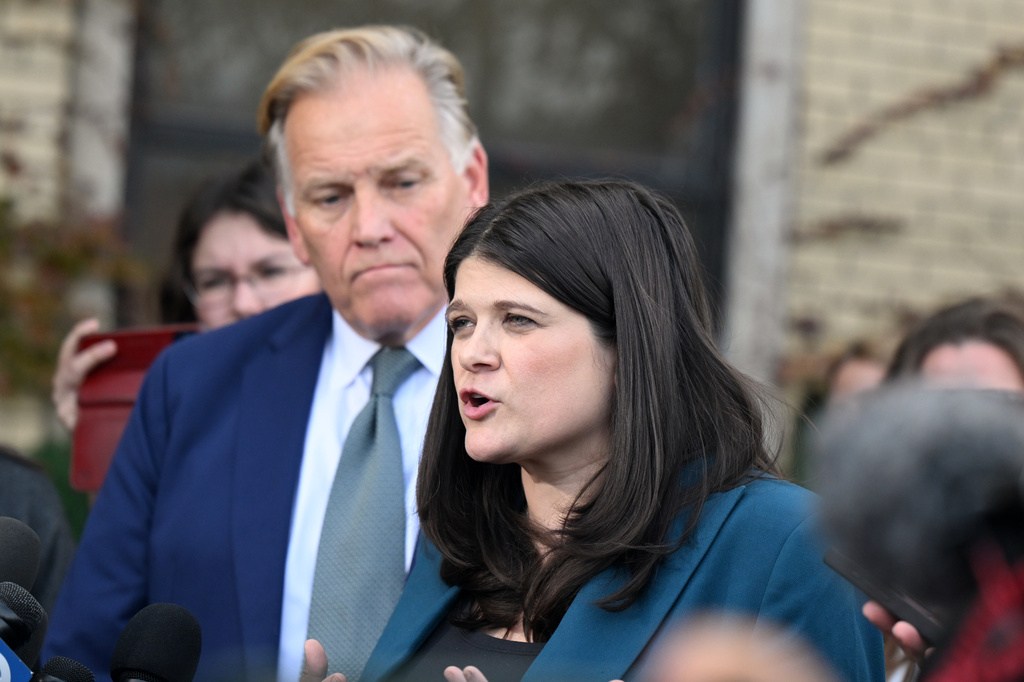
On Sunday morning, two days before Michigan voted, Rep. Haley Stevens (D-MI) walked into Perfecting Church in Detroit and took a seat beside Republican Senate candidate Mike Rogers. She had been scheduled to attend a Detroit church service that same day with Abdul el Sayed, the man who narrowly beat her in the August Democratic primary, as a show of party unity. Instead, she was told she was no longer welcome. Rep. Debbie Dingell (D-MI), who helped organize the event, said she asked Stevens to stay away because the situation had become too distracting. A few hours later, Stevens announced she would back Rogers.
The punishment arrived fast. Sen. Chuck Schumer (D-NY) called it a “despicable betrayal.” Her chief of staff resigned. The chairman of the Michigan Democratic Party said she was no longer a member. On Tuesday night el Sayed won, and he is now headed to the U.S. Senate. By the usual Washington arithmetic, Stevens lost everything, and plenty of commentators will spend the coming years describing her decision as a political blunder.
I see it as one of the most morally correct acts I have watched an American politician perform in a very long time.
Consider how differently the same people reacted two years ago. When Liz Cheney crossed party lines to campaign for Kamala Harris, Democrats were overjoyed. Harris praised the Cheneys for putting country above party, and former President Joe Biden said he had never been so proud. When a Democrat crossed the other way because she could no longer stomach her own party’s nominee, the language of courage disappeared overnight and was replaced with talk of treachery. Apparently conscience is admirable only when it travels in one direction.
So what was it that Stevens could not stomach? In March, a man drove a car packed with explosives into Temple Israel in West Bloomfield, a synagogue whose preschool was the target. The FBI called it an act of terrorism inspired by Hezbollah. El Sayed condemned the attack. Then, at a campus event with the streamer Hasan Piker, el Sayed went on to explain that hurt people hurt people and that events thousands of miles away shape lives here. Asked whether he would extend the same understanding to a Jew who attacked a mosque, el Sayed said the circumstances were different. He apologized only at the end of August, after the primary was safely behind him.
Then, last week, a PAC supporting el Sayed ran an ad blaming aid to Israel for Americans’ struggles with the cost of living. Stevens called it antisemitic and asked him to denounce it. He said he disagreed with the message, accused her of trying to relitigate the primary, and his side closed the campaign by showing her the door.
Stevens was accused of Islamophobia for objecting to any of this, and that charge could not be further from the truth. Objecting when a candidate answers a bombing at a synagogue with talk of grievance against Israel is a judgment about his words, and his words alone.
I have had more private conversations than I can count with politicians who assure me that they stand with the Jewish people and understand that Israel is the only democracy in the Middle East. Then they explain that they cannot say so publicly because a loud and radical minority will make them pay. What erupted on American campuses after Oct. 7, 2023, is now running for office. A generation was taught to demonize Israel and watched antisemitism celebrated openly on the quad, and that generation is now reaching the ballot. I fear el Sayed will help turn the Senate into a smaller version of the United Nations, where condemning Israel becomes a weekly ritual no matter what Israel does.
Haley Stevens is not Jewish, but this week she got a crash course in the Jewish experience. After Oct. 7, one of the most common things our students told me was that people who were their friends on Oct. 6 turned on them almost overnight. Stevens watched colleagues she had campaigned beside do the same thing to her. I suspect she is now asking herself whether they were ever truly her friends, or whether their friendship depended on her toeing the party line.
WHAT ‘NEVER AGAIN’ ACTUALLY REQUIRES
Elie Wiesel, accepting the Nobel Peace Prize in 1986, warned that “silence encourages the tormentor, never the tormented.” Stevens could have stayed quiet, voted for her party’s nominee, and kept her career intact. She chose instead to say out loud what many of her colleagues will only whisper.
That is the real test facing America after this election. Will people of conscience be able to say what they believe is right, or will they be bullied into silence by a toxic minority that grows bolder every day? Our community owes Haley Stevens its gratitude, and it should say so loudly. I would guess she is sleeping soundly these nights, knowing she never put her name behind a career built on hatred of the Jewish state.
Rabbi Steven Burg is the international CEO of Aish, a global Jewish educational movement. He formerly served as eastern director of the Simon Wiesenthal Center, where he oversaw the Museum of Tolerance in New York City. You can find out more about Rabbi Burg at rabbiburg.com
Continue reading...
[ H/T Washington Examiner ]