







Taiwan Plans $930 Million Sea Drone Buildout As China Expands Maritime Pressure
Taiwan is moving quickly to build a large fleet of unmanned vessels as it looks for cheaper, scalable ways to complicate any Chinese attempt to blockade or cross the Taiwan Strait, according to Nikkei Asia.
The emerging strategy combines something Taiwan already does well, building ships and sophisticated electronics, with American expertise in autonomous systems, artificial intelligence and military command networks.
The potential scale is significant. Taiwan’s navy is considering roughly 1,320 small attack drones for the water, with spending estimated at about NT$29.6 billion, or $930 million. The Coast Guard is pursuing unmanned vessels as well, creating what could become a meaningful new domestic market for maritime defense technology.
Taiwan does not need to build the industry from scratch. It already has shipyards capable of designing and producing the physical platforms, along with a deep electronics manufacturing ecosystem. What it needs are many of the technologies that turn an unmanned boat into an effective military system: secure communications, autonomous navigation, sensors, AI, command-and-control software and the ability to coordinate large numbers of vessels simultaneously.
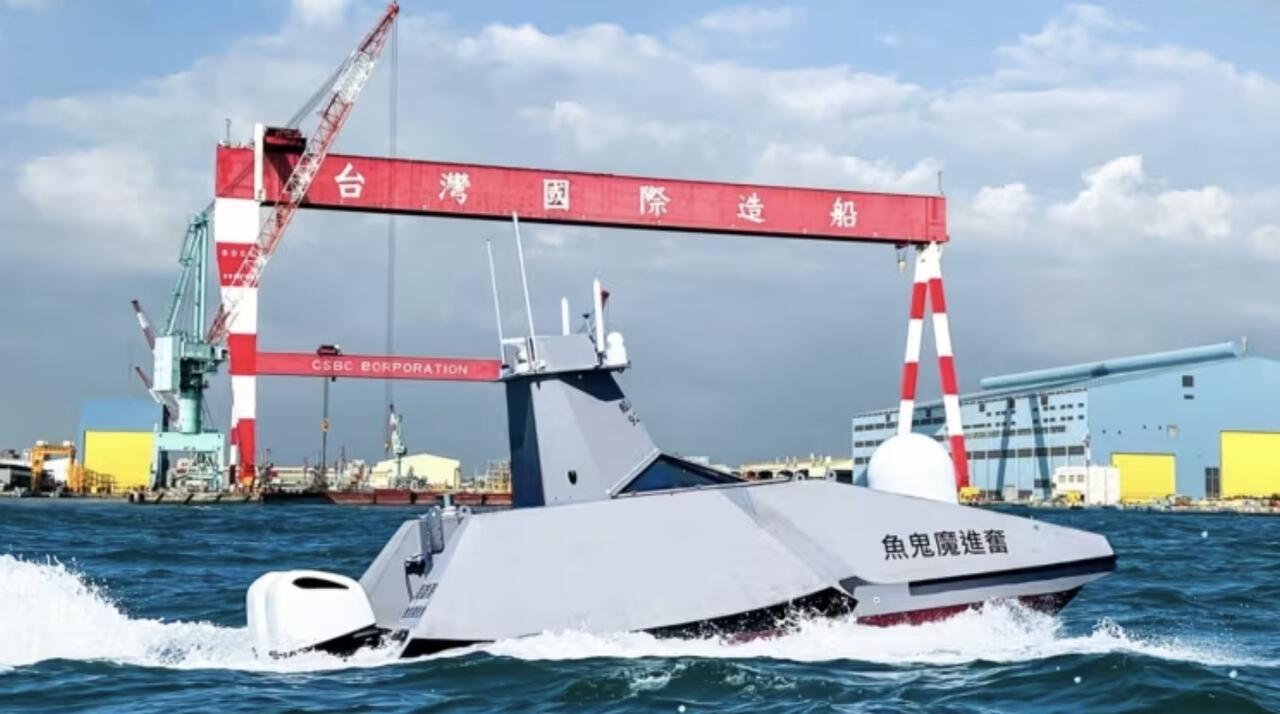
Photos: Nikkei Asia
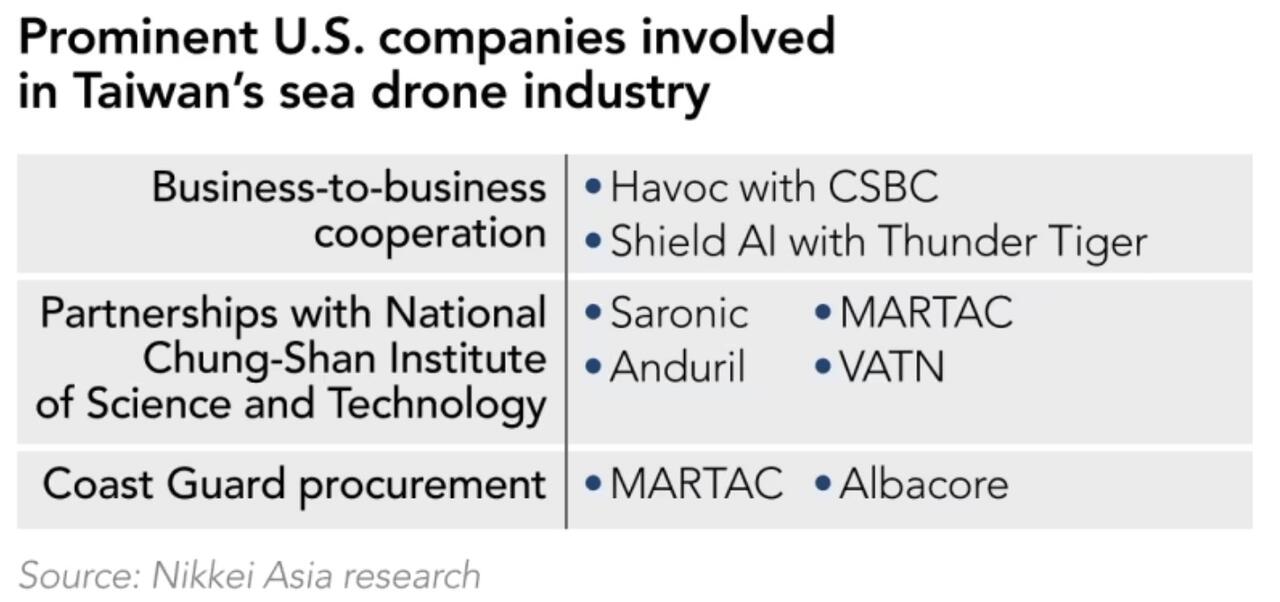
That is where U.S. defense technology companies are increasingly entering the picture. CSBC, Taiwan’s government-backed shipbuilder, recently partnered with Rhode Island-based Havoc to develop autonomous surface vessels using Taiwanese manufacturing and American autonomy technology. Saronic, Anduril, MARTAC, VATN Systems, Albacore, Shield AI and Auterion have also established relationships with Taiwanese organizations, including the government-owned National Chung-Shan Institute of Science and Technology.
Havoc CEO Paul Lwin described the model simply: “American autonomy software, Taiwan-built platforms, Taiwan workforce.”
Nikkei Asia writes that domestic companies are positioning themselves for the spending wave. CSBC has developed its Endeavor Manta unmanned boat and says it has capacity to manufacture about 40 annually. Established shipbuilders Jong Shyn and Lungteh are competing for contracts, while companies better known for drones and semiconductors, including Thunder Tiger and Myson Century, are moving into unmanned maritime systems.
The attraction is partly economic. Instead of attempting to match China ship for ship, Taiwan could deploy large numbers of smaller and cheaper autonomous platforms capable of surveillance, targeting, protecting undersea infrastructure and, in some cases, carrying weapons. The war in Ukraine has provided a real-world demonstration of how unmanned systems can impose substantial costs on a conventionally superior military.
But producing thousands of drone boats is only part of the equation. They must continue communicating, navigating and coordinating in a contested environment where satellites, communications infrastructure and command centers could themselves become targets.
“The key gaps are resilient communications, AI-enabled autonomy and C2, and multi-vessel coordination,” said Cathy Fang of Taiwan’s Research Institute for Democracy, Society and Emerging Technology.
That technological gap helps explain why the growing U.S.-Taiwan partnerships matter. Taiwan can supply the shipyards, electronics manufacturing and eventually the production scale, while American defense technology firms provide much of the software and autonomy layer.
If the navy ultimately proceeds with its proposed 1,320-vessel program, the result could be more than another Taiwanese weapons purchase. It could provide the anchor customer needed to establish an entirely new domestic defense industry built around producing autonomous vessels in large numbers, with Taiwan manufacturing the hardware and U.S. companies supplying much of the technological nervous system.
Tyler Durden Thu, 10/01/2026 - 02:45
Continue reading...
[ H/T ZeroHedge ]
Taiwan is moving quickly to build a large fleet of unmanned vessels as it looks for cheaper, scalable ways to complicate any Chinese attempt to blockade or cross the Taiwan Strait, according to Nikkei Asia.
The emerging strategy combines something Taiwan already does well, building ships and sophisticated electronics, with American expertise in autonomous systems, artificial intelligence and military command networks.
The potential scale is significant. Taiwan’s navy is considering roughly 1,320 small attack drones for the water, with spending estimated at about NT$29.6 billion, or $930 million. The Coast Guard is pursuing unmanned vessels as well, creating what could become a meaningful new domestic market for maritime defense technology.
Taiwan does not need to build the industry from scratch. It already has shipyards capable of designing and producing the physical platforms, along with a deep electronics manufacturing ecosystem. What it needs are many of the technologies that turn an unmanned boat into an effective military system: secure communications, autonomous navigation, sensors, AI, command-and-control software and the ability to coordinate large numbers of vessels simultaneously.
Photos: Nikkei Asia
That is where U.S. defense technology companies are increasingly entering the picture. CSBC, Taiwan’s government-backed shipbuilder, recently partnered with Rhode Island-based Havoc to develop autonomous surface vessels using Taiwanese manufacturing and American autonomy technology. Saronic, Anduril, MARTAC, VATN Systems, Albacore, Shield AI and Auterion have also established relationships with Taiwanese organizations, including the government-owned National Chung-Shan Institute of Science and Technology.
Havoc CEO Paul Lwin described the model simply: “American autonomy software, Taiwan-built platforms, Taiwan workforce.”
Nikkei Asia writes that domestic companies are positioning themselves for the spending wave. CSBC has developed its Endeavor Manta unmanned boat and says it has capacity to manufacture about 40 annually. Established shipbuilders Jong Shyn and Lungteh are competing for contracts, while companies better known for drones and semiconductors, including Thunder Tiger and Myson Century, are moving into unmanned maritime systems.
The attraction is partly economic. Instead of attempting to match China ship for ship, Taiwan could deploy large numbers of smaller and cheaper autonomous platforms capable of surveillance, targeting, protecting undersea infrastructure and, in some cases, carrying weapons. The war in Ukraine has provided a real-world demonstration of how unmanned systems can impose substantial costs on a conventionally superior military.
But producing thousands of drone boats is only part of the equation. They must continue communicating, navigating and coordinating in a contested environment where satellites, communications infrastructure and command centers could themselves become targets.
“The key gaps are resilient communications, AI-enabled autonomy and C2, and multi-vessel coordination,” said Cathy Fang of Taiwan’s Research Institute for Democracy, Society and Emerging Technology.
That technological gap helps explain why the growing U.S.-Taiwan partnerships matter. Taiwan can supply the shipyards, electronics manufacturing and eventually the production scale, while American defense technology firms provide much of the software and autonomy layer.
If the navy ultimately proceeds with its proposed 1,320-vessel program, the result could be more than another Taiwanese weapons purchase. It could provide the anchor customer needed to establish an entirely new domestic defense industry built around producing autonomous vessels in large numbers, with Taiwan manufacturing the hardware and U.S. companies supplying much of the technological nervous system.
Tyler Durden Thu, 10/01/2026 - 02:45
Continue reading...
[ H/T ZeroHedge ]