

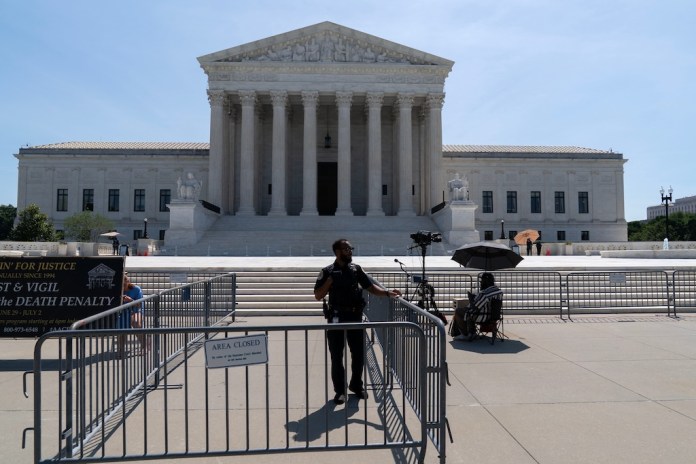
The Supreme Court handed the Trump administration a key election integrity win on the emergency docket Friday, lifting a block on the implementation of a voter verification system that would combine Social Security information with citizenship records.
The high court ruled 6-3, allowing the administration to move forward with modifying the Systematic Alien Verification for Entitlements database to combine citizenship and Social Security records, something they announced last year in a bid to improve the speed and reliability of verifying a person’s citizenship status. The per curiam ruling issued by the six Republican-appointed justices stated that claims by left-wing groups that the modifications to the SAVE database violated privacy laws, among other federal statutes, likely lacked merit.
“Although the plaintiff organizations likely have standing, their claims likely lack merit,” the ruling said, siding with the DOJ’s arguments defending the changes to the SAVE database.
“The plaintiff organizations claim that the federal defendants violated the Social Security Act, Privacy Act, and APA,” the ruling continued. “In 1996, Congress, however, separately and expressly authorized DHS to request and receive information relating to citizenship and immigration status from other agencies, including SSA, in the Illegal Immigration Reform and Immigrant Responsibility Act.”
The majority also found that it is likely the high court could take up the case for oral arguments in the future and that “the Federal Government is likely to suffer irreparable harm absent a stay,” which the justices said are required factors needed to justify lifting the lower court’s block on the changes to the SAVE database.
“Under section 1373(c), the Federal Government has an obligation to respond to requests from state and local election officials seeking to verify the citizenship of voters. The order below prevents the Federal Government from using the program it believes is best suited to the task,” the ruling said.
Justice Ketanji Brown Jackson wrote a dissenting opinion, which was joined by Justices Sonia Sotomayor and Elena Kagan, arguing that the majority’s ruling ignores the “harms that the modified SAVE system has caused, and will likely continue to cause, to lawful voters.”
“In my view, however, the harm caused by burdening or disenfranchising even a few lawful voters outweighs the nonexistent harm that the Government experiences when it is prevented from taking an action that it likely lacks the authority to take,” Jackson wrote in her 12-page dissent. “This imbalance, along with the Government’s improbable merits arguments, should have compelled the Court to deny the stay.”
DOJ ASKS SUPREME COURT TO UNBLOCK VOTER DATABASE LINKING SOCIAL SECURITY AND CITIZENSHIP RECORDS
A federal district judge ruled in favor of the groups suing the administration over the SAVE database changes in June, a ruling that a panel of the federal appeals court later affirmed. The Supreme Court’s ruling allows the SAVE database changes to take effect until either the denial of a petition to hear the case for full arguments before the high court or the eventual ruling by the justices if the case is taken up for arguments by the Supreme Court.
The Supreme Court’s ruling is one of several election-related emergency docket cases the justices have had to decide in recent weeks, ahead of both their upcoming 2026-27 term and the November midterm elections. The high court has also issued an emergency docket ruling on candidate advertisement rates, the United States Postal Service mail ballot rules, and which map Missouri should use for its upcoming congressional elections.
Continue reading...
[ H/T Washington Examiner ]