


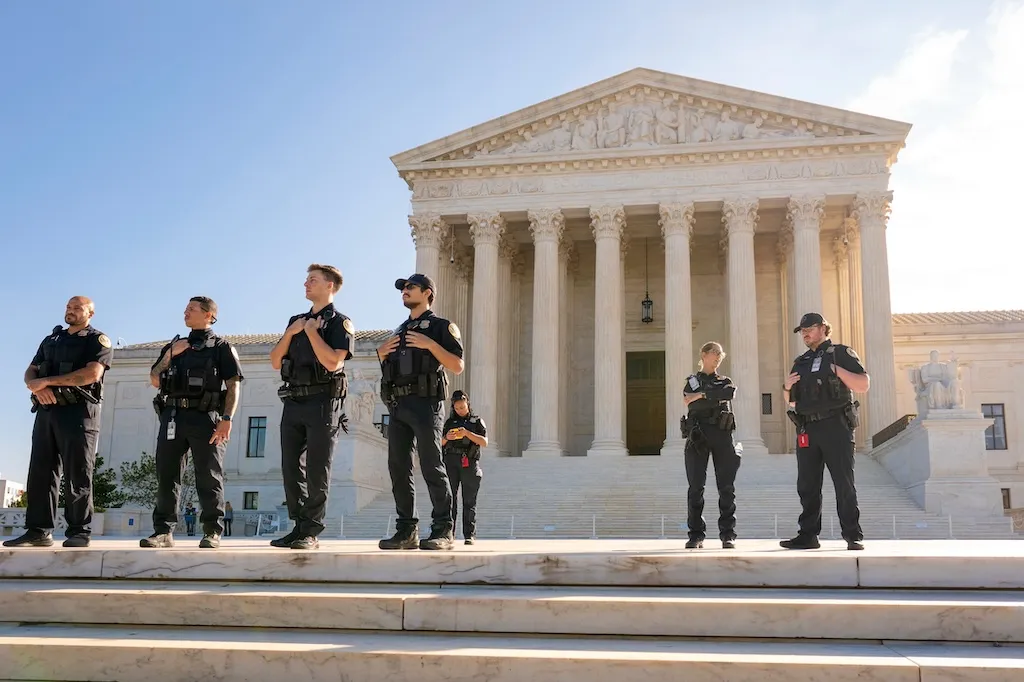
The Supreme Court announced Monday that it will hear a challenge to a federal law barring the distilling of alcohol at home, weighing whether it oversteps the federal government’s powers.
The high court said in an orders list released Monday morning that it will take up Department of Justice v. Scott McNutt for oral arguments later this term, possibly striking down the 160-year-old federal ban on home distilling. The Supreme Court had two pending cases over the distilling ban, opting to take up the appeal brought by the federal government.
The U.S. Court of Appeals for the 5th Circuit struck down the law earlier this year, finding it unconstitutional and leading the Justice Department to appeal the ruling to the high court. Solicitor General D. John Sauer implored the Supreme Court to take up the case, claiming the power for Congress to regulate home alcohol distilling has been long recognized throughout the country’s history.
“Faced with rampant evasion of excise taxes on distilled spirits 160 years ago, Congress enacted a number of provisions regulating ‘the manufacture and storage, [and] the marking, branding, numbering, and stamping with tax stamps, of distilled spirits,’” Sauer said. “Those provisions ‘were adopted with one purpose only, namely, to secure the payment of the tax imposed by law upon distilled spirits.'”
“Among those provisions was a ban on distilling spirits in locations where tax evasion had proved difficult to uncover. The ban “prohibits distilling spirits in locations including ‘any dwelling house,’ or ‘in any shed, yard, or inclosure connected with any dwelling house,'” Sauer added, pointing to the law’s “venerable history and commonsense rationale.”
The Supreme Court will decide whether “the federal prohibition on home distilling exceeds Congress’s enumerated powers.” The people who initially sued over the law claimed the DOJ’s argument in defense of the ban would have no limit on what laws the federal government could enact under the guise of banning taxable activities.
“There is no limit to the government’s claim of power to criminalize local conduct that might theoretically conceal taxable activity,” the respondents told the Supreme Court in a brief. “That amounts to a federal police power in all but name, and its exercise would ‘completely obliterate the Constitution’s distinction between national and local authority.’ The Fifth Circuit’s judgment was correct, as a matter of constitutional text and structure.”
WHY SPECULATION ABOUT SAMUEL ALITO’S FUTURE CONTINUES DESPITE HIS REJECTION OF RETIREMENT
The Supreme Court has yet to decide on a similar petition for review brought by citizens in Ohio backed by a conservative think tank appealing a ruling by the 6th Circuit Court of Appeals earlier this year that upheld the ban on home distilling.
The high court is expected to hear oral arguments in the McNutt case in early 2027, likely sometime between February and April.
Continue reading...
[ H/T Washington Examiner ]