



Guest Post by John Walter
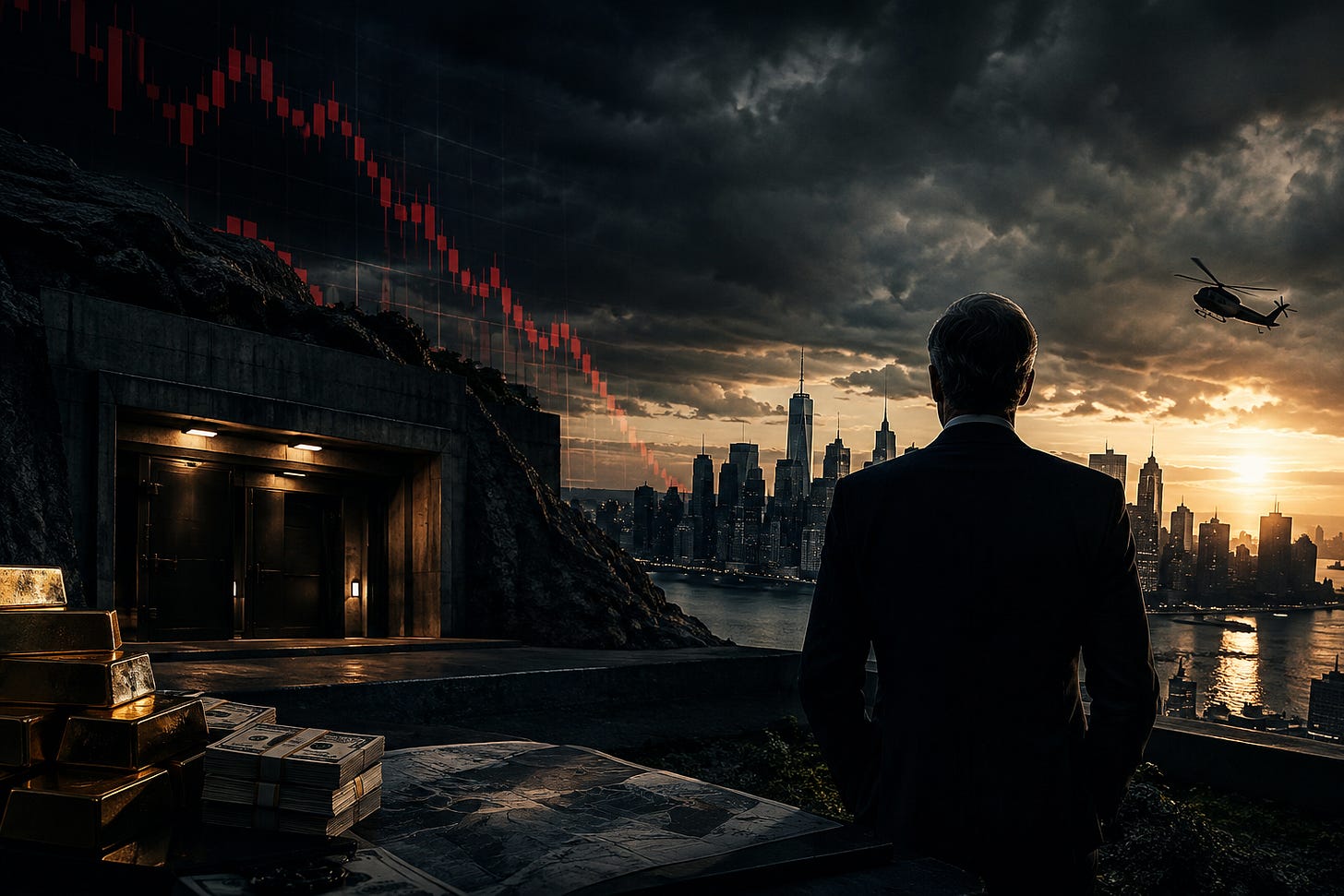
I first noticed the pattern a few years ago. A news item about a tech executive buying agricultural land in New Zealand. Another about a hedge fund manager constructing an underground shelter in Hawaii. Coincidences, I thought. Rich people with expensive hobbies. But then I started seeing the same moves in different places. And the more I followed, the harder the questions became to ignore.
Jonathan Johnson, chairman of the board at Overstock.com, spoke at a precious metals conference in 2015. His company had over $1.5 billion in annual revenue and 1,500 employees. Johnson wasn’t a fringe conspiracy theorist. He was a top executive at a publicly traded corporation. And he said something that should have made front-page news: Overstock held approximately $10 million in gold and silver, mostly in small-denomination coins, stored outside the banking system, enough to pay employee salaries for three months during a financial crisis. They had also stockpiled three months of food for every employee plus one family member each.
Why would an e-commerce company prepare for a “banking holiday”?
The answer, I discovered later, lies in a profound understanding of the fragility of the systems we build.
Where the Money Goes When Money Isn’t Enough
Financial wealth and physical assets are fundamentally different things. The first exists as database entries, as digital promises, as claims on future income streams. The second exists as land, water, calories, metals, shelter. The very wealthy have begun converting massively from the first category into the second.
Mark Zuckerberg acquired 1,400 acres on the island of Kauai, Hawaii. Public documents indicate plans for an approximately 5,000-square-foot underground shelter with blast-resistant doors, independent water infrastructure, and food production systems. The total cost of the property and construction exceeds hundreds of millions of dollars. Sam Altman, CEO of OpenAI, has reportedly told associates about his evacuation plan: private jet to New Zealand in case of major disaster. Peter Thiel, co-founder of Palantir, already holds residency in New Zealand and extensive properties there.
These are not vacation homes. They are redoubts. And their cost does not represent extravagance for those involved, but prudent risk management.
New Zealand has become the preferred destination for this class. Remote islands, diversified agriculture, low population density, stable political institutions. Thiel obtained citizenship through investment — a program closed to most ordinary migrants. Where others see scenic landscapes, these individuals see defensibility, food self-sufficiency, biogeographic isolation.
But why? What do they know that we don’t?
The System the Public Doesn’t See
Wall Street runs on leverage. On debt. On promises. On liquidity created from nothing through mechanisms most people don’t understand and shouldn’t need to understand to live their lives. The problem arises when confidence — the only thing holding the entire structure up — begins to erode.
In February 2026, a Chicago bank failed. The first of this year. Analysts estimate that the U.S. commercial banking system holds approximately $337 billion in unrealized losses, hidden in bond portfolios that declined in value as interest rates rose. The Federal Reserve responded by ending quantitative tightening and implicitly expanding its balance sheet through mechanisms functionally equivalent to new rounds of monetary easing.
Gold has responded accordingly, pushing past $5,600 per ounce. Silver faces a structural deficit projected at 117 million ounces in 2026, its sixth consecutive year of shortfall. Historically, during acute banking crises, gold initially appreciates 10-30%, then 50-200% in subsequent years.
The very wealthy track these figures. They don’t wait for CNBC confirmation. They watch spreads, yield curves, pressure on liquidity. And they act before most understand what’s happening.
Jonathan Johnson, at that conference, explained clearly: “We don’t trust Wall Street. We don’t trust the banks. We foresee another significant financial crisis.” He anticipated what U.S. legislation already permits: a “banking holiday” — presidential order shutting down financial institutions without warning to prevent mass panic and catastrophic withdrawals.
The duration? “Two days, or two weeks, or two months.” Nobody knows until it happens.
When You Have Money But Can’t Touch It
This is where things become harder to interpret for those used to digital banking.
The crucial distinction isn’t between “having money” and “not having money.” It’s between “having money” and “having access to it.” Your bank account is a promise. A database entry. When the payment processing system stops, when ATMs display errors, when bank websites redirect to “maintenance,” the money exists theoretically, but you can’t use it.
In 1933, the Emergency Banking Act established the precedent. The mechanisms remain in place. Dormant, but ready.
The ultra-wealthy understand this distinction. That’s why they store physical cash in homes — especially small bills, ones and fives, because stores won’t be able to make change in crises. That’s why they convert to physical gold and silver, stored outside the banking system. Overstock held coins small enough to pay wages — not kilogram bars, but divisible units for real transactions when cards become useless paper.
But cash is transitional. A bridge between functional banking and barter economies. Permanent stocks take the form of agricultural land, private energy infrastructure, independent water systems, long-term food storage.
Why Bunkers Enter the Story
Vivos Europa One, a subterranean complex carved into solid bedrock in Germany, offers residences capable of withstanding nuclear blasts, electromagnetic pulses, biological and chemical agents. Membership requires not just wealth, but screening — a selection process ensuring “compatibility” between occupants during extended confinement. The facility includes hydroponic agriculture, medical facilities, and communications equipment independent of surface infrastructure.
Similar projects have proliferated across the American Midwest, converting decommissioned missile silos into luxury survival condominiums. Entry cost: millions. Waitlist: long.
These investments aren’t irrational for those making them. They represent ultimate hedging against low-probability, high-impact scenarios. The problem is, when the people building the system start preparing for its collapse, the rest of the population should take note.
Douglas Rushkoff, journalist and digital culture theorist, has reported conversations with billionaires discussing combination-locked food supplies — combinations only they knew — and “disciplinary collars” for security personnel. Rushkoff doesn’t invent these details; he presents them as observations about the psychology of those who believe they can buy absolute safety.
This is where the central paradox emerges.
The Security Problem
A billionaire can buy guards. Can buy land. Can buy technology. But cannot instantly buy a functional society.
Agriculture requires cultivators. Water systems require maintenance. Generators require mechanics. Private security, in extremis, can become unstable — who guarantees guards’ loyalty when the money they were promised becomes worthless paper, and they hold the weapons?
Rushkoff reports these exact questions: what happens if employees stop taking orders? If labor becomes more valuable than capital? If a financial contract cannot replace community trust?
Companies and Employees
Overstock isn’t the only example, but it’s documented. Food stockpiles for 1,500 employees plus families represent not charity, but cold economic calculation. When supply chains fracture, hunger becomes the ultimate motivator. Companies capable of feeding their workforce retain operational capacity while competitors dissolve into chaos.
This is one way to look at operational continuity: economic survival through ensuring the physical survival of essential human resources.
What SHTF Actually Means
The expression comes from English — “**** Hits The Fan” — describing the moment when a problematic situation becomes critical. But collapse isn’t binary. There’s no simple “before” and “after.”
Level 1: Financial crisis. Volatile markets, portfolio losses, anxiety.
Level 2: Banking crisis. Failing institutions, frozen deposits, lost credit access.
Level 3: Logistical interruptions. Trucks not arriving, empty shelves, panic buying.
Level 4: Energy and communications problems. Blackouts, network failures, isolation.
Level 5: Social instability. Protests, violence, eroding authority.
Level 6: Temporary or prolonged loss of institutional functions. The state exists in name but no longer delivers.
These levels aren’t inevitable and don’t automatically succeed one another. But each represents a deeper fracture in the social fabric. And the very wealthy seem to be allocating resources to survive all of them.
What They Might Know That We Don’t
Here we must be careful. Access to privileged information, elite advisors, risk experts, and resources for deep analysis can explain many decisions without implying knowledge of imminent collapse.
Possible explanations for observed behavior:
Not all billionaires prepare this way. Some continue living in vulnerable penthouses, traveling on commercial airlines, keeping wealth in conventional financial instruments. The diversity of behavior suggests there’s no coordinated “plan,” but rather individual assessments that, in certain cases, converge on similar conclusions.
The Part People Ignore: Collapse Isn’t Necessarily One Event
The most likely scenario isn’t a day when “everything ends.” It’s gradual deterioration, erosion of systemic capacity that we perceive only retrospectively.
Services become more expensive and rarer. Infrastructure degrades. Institutions respond more slowly. Debts become unsustainable. Confidence declines. People leave. Communities fragment.
This type of collapse is harder to recognize and harder to film for a movie trailer. But it’s more likely and, in many ways, more dangerous because it prevents collective response. There’s no clear moment to say: “Now is the time to do something.”
What Money Actually Buys
Not just bunkers. But time. Options. Distance. Mobility. Access. Advisors. Lawyers. Doctors. Engineers. Transport. Land. Information. The capacity to leave before others decide they must leave.
When someone has enough money to build their own version of continuity, their choices reveal what risks they consider serious enough to warrant the cost. Not just financial cost, but opportunity cost, energy, attention.
Building a 5,000-square-foot underground shelter with independent water and food production requires years of planning, hundreds of millions of dollars, and a deep conviction that the surface world could become uninhabitable for extended periods.
The Final Paradox
The wealthiest people can buy protection against many risks. But certain risks are collective. If the systems they depend on are destroyed, isolation doesn’t automatically solve the problem.
Water must be maintained. Energy must be produced. Food must be cultivated. Systems must be repaired. People must be convinced to stay. Communities must function.
A bunker, even a luxury one, remains a prison with blast-resistant doors. And guards can become the most dangerous occupants when financial promises evaporate.
The Question That Remains
We don’t know if these preparations are justified by future events or represent the disproportionate anxiety of people with too much time and too much money. We don’t know if the system will find ways to stabilize or if accumulated fragilities will generate systemic crisis. We don’t know if bunkers will ever be used or will become monuments to unjustified fear.
But we know that the people building the system don’t seem to trust it.
And that alone should make us stop what we’re doing and look more carefully.
If those with the most information don’t behave as if the world will remain exactly the same, how much should we care about the reason?
We don’t have the answer. But we have the question. And sometimes, the question is all you can get before events provide the answer on their own terms.
Tweet
Continue reading...
[ H/T The Burning Platform ]
I first noticed the pattern a few years ago. A news item about a tech executive buying agricultural land in New Zealand. Another about a hedge fund manager constructing an underground shelter in Hawaii. Coincidences, I thought. Rich people with expensive hobbies. But then I started seeing the same moves in different places. And the more I followed, the harder the questions became to ignore.
Jonathan Johnson, chairman of the board at Overstock.com, spoke at a precious metals conference in 2015. His company had over $1.5 billion in annual revenue and 1,500 employees. Johnson wasn’t a fringe conspiracy theorist. He was a top executive at a publicly traded corporation. And he said something that should have made front-page news: Overstock held approximately $10 million in gold and silver, mostly in small-denomination coins, stored outside the banking system, enough to pay employee salaries for three months during a financial crisis. They had also stockpiled three months of food for every employee plus one family member each.
Why would an e-commerce company prepare for a “banking holiday”?
The answer, I discovered later, lies in a profound understanding of the fragility of the systems we build.
Where the Money Goes When Money Isn’t Enough
Financial wealth and physical assets are fundamentally different things. The first exists as database entries, as digital promises, as claims on future income streams. The second exists as land, water, calories, metals, shelter. The very wealthy have begun converting massively from the first category into the second.
Mark Zuckerberg acquired 1,400 acres on the island of Kauai, Hawaii. Public documents indicate plans for an approximately 5,000-square-foot underground shelter with blast-resistant doors, independent water infrastructure, and food production systems. The total cost of the property and construction exceeds hundreds of millions of dollars. Sam Altman, CEO of OpenAI, has reportedly told associates about his evacuation plan: private jet to New Zealand in case of major disaster. Peter Thiel, co-founder of Palantir, already holds residency in New Zealand and extensive properties there.
These are not vacation homes. They are redoubts. And their cost does not represent extravagance for those involved, but prudent risk management.
New Zealand has become the preferred destination for this class. Remote islands, diversified agriculture, low population density, stable political institutions. Thiel obtained citizenship through investment — a program closed to most ordinary migrants. Where others see scenic landscapes, these individuals see defensibility, food self-sufficiency, biogeographic isolation.
But why? What do they know that we don’t?
The System the Public Doesn’t See
Wall Street runs on leverage. On debt. On promises. On liquidity created from nothing through mechanisms most people don’t understand and shouldn’t need to understand to live their lives. The problem arises when confidence — the only thing holding the entire structure up — begins to erode.
In February 2026, a Chicago bank failed. The first of this year. Analysts estimate that the U.S. commercial banking system holds approximately $337 billion in unrealized losses, hidden in bond portfolios that declined in value as interest rates rose. The Federal Reserve responded by ending quantitative tightening and implicitly expanding its balance sheet through mechanisms functionally equivalent to new rounds of monetary easing.
Gold has responded accordingly, pushing past $5,600 per ounce. Silver faces a structural deficit projected at 117 million ounces in 2026, its sixth consecutive year of shortfall. Historically, during acute banking crises, gold initially appreciates 10-30%, then 50-200% in subsequent years.
The very wealthy track these figures. They don’t wait for CNBC confirmation. They watch spreads, yield curves, pressure on liquidity. And they act before most understand what’s happening.
Jonathan Johnson, at that conference, explained clearly: “We don’t trust Wall Street. We don’t trust the banks. We foresee another significant financial crisis.” He anticipated what U.S. legislation already permits: a “banking holiday” — presidential order shutting down financial institutions without warning to prevent mass panic and catastrophic withdrawals.
The duration? “Two days, or two weeks, or two months.” Nobody knows until it happens.
When You Have Money But Can’t Touch It
This is where things become harder to interpret for those used to digital banking.
The crucial distinction isn’t between “having money” and “not having money.” It’s between “having money” and “having access to it.” Your bank account is a promise. A database entry. When the payment processing system stops, when ATMs display errors, when bank websites redirect to “maintenance,” the money exists theoretically, but you can’t use it.
In 1933, the Emergency Banking Act established the precedent. The mechanisms remain in place. Dormant, but ready.
The ultra-wealthy understand this distinction. That’s why they store physical cash in homes — especially small bills, ones and fives, because stores won’t be able to make change in crises. That’s why they convert to physical gold and silver, stored outside the banking system. Overstock held coins small enough to pay wages — not kilogram bars, but divisible units for real transactions when cards become useless paper.
But cash is transitional. A bridge between functional banking and barter economies. Permanent stocks take the form of agricultural land, private energy infrastructure, independent water systems, long-term food storage.
Why Bunkers Enter the Story
Vivos Europa One, a subterranean complex carved into solid bedrock in Germany, offers residences capable of withstanding nuclear blasts, electromagnetic pulses, biological and chemical agents. Membership requires not just wealth, but screening — a selection process ensuring “compatibility” between occupants during extended confinement. The facility includes hydroponic agriculture, medical facilities, and communications equipment independent of surface infrastructure.
Similar projects have proliferated across the American Midwest, converting decommissioned missile silos into luxury survival condominiums. Entry cost: millions. Waitlist: long.
These investments aren’t irrational for those making them. They represent ultimate hedging against low-probability, high-impact scenarios. The problem is, when the people building the system start preparing for its collapse, the rest of the population should take note.
Douglas Rushkoff, journalist and digital culture theorist, has reported conversations with billionaires discussing combination-locked food supplies — combinations only they knew — and “disciplinary collars” for security personnel. Rushkoff doesn’t invent these details; he presents them as observations about the psychology of those who believe they can buy absolute safety.
This is where the central paradox emerges.
The Security Problem
A billionaire can buy guards. Can buy land. Can buy technology. But cannot instantly buy a functional society.
Agriculture requires cultivators. Water systems require maintenance. Generators require mechanics. Private security, in extremis, can become unstable — who guarantees guards’ loyalty when the money they were promised becomes worthless paper, and they hold the weapons?
Rushkoff reports these exact questions: what happens if employees stop taking orders? If labor becomes more valuable than capital? If a financial contract cannot replace community trust?
Companies and Employees
Overstock isn’t the only example, but it’s documented. Food stockpiles for 1,500 employees plus families represent not charity, but cold economic calculation. When supply chains fracture, hunger becomes the ultimate motivator. Companies capable of feeding their workforce retain operational capacity while competitors dissolve into chaos.
This is one way to look at operational continuity: economic survival through ensuring the physical survival of essential human resources.
What SHTF Actually Means
The expression comes from English — “**** Hits The Fan” — describing the moment when a problematic situation becomes critical. But collapse isn’t binary. There’s no simple “before” and “after.”
Level 1: Financial crisis. Volatile markets, portfolio losses, anxiety.
Level 2: Banking crisis. Failing institutions, frozen deposits, lost credit access.
Level 3: Logistical interruptions. Trucks not arriving, empty shelves, panic buying.
Level 4: Energy and communications problems. Blackouts, network failures, isolation.
Level 5: Social instability. Protests, violence, eroding authority.
Level 6: Temporary or prolonged loss of institutional functions. The state exists in name but no longer delivers.
These levels aren’t inevitable and don’t automatically succeed one another. But each represents a deeper fracture in the social fabric. And the very wealthy seem to be allocating resources to survive all of them.
What They Might Know That We Don’t
Here we must be careful. Access to privileged information, elite advisors, risk experts, and resources for deep analysis can explain many decisions without implying knowledge of imminent collapse.
Possible explanations for observed behavior:
- Normal hedging against increasing uncertainty
- Personal anxiety disproportionate to actual risk
- Aggressive portfolio diversification
- Social status — “I have my bunker too”
- Opportunism — buying now while it’s cheap
- Professional experience showing how fragile systems are
- Legitimate fear of low-probability, high-impact events
- Personal preferences for autonomy and independence
Not all billionaires prepare this way. Some continue living in vulnerable penthouses, traveling on commercial airlines, keeping wealth in conventional financial instruments. The diversity of behavior suggests there’s no coordinated “plan,” but rather individual assessments that, in certain cases, converge on similar conclusions.
The Part People Ignore: Collapse Isn’t Necessarily One Event
The most likely scenario isn’t a day when “everything ends.” It’s gradual deterioration, erosion of systemic capacity that we perceive only retrospectively.
Services become more expensive and rarer. Infrastructure degrades. Institutions respond more slowly. Debts become unsustainable. Confidence declines. People leave. Communities fragment.
This type of collapse is harder to recognize and harder to film for a movie trailer. But it’s more likely and, in many ways, more dangerous because it prevents collective response. There’s no clear moment to say: “Now is the time to do something.”
What Money Actually Buys
Not just bunkers. But time. Options. Distance. Mobility. Access. Advisors. Lawyers. Doctors. Engineers. Transport. Land. Information. The capacity to leave before others decide they must leave.
When someone has enough money to build their own version of continuity, their choices reveal what risks they consider serious enough to warrant the cost. Not just financial cost, but opportunity cost, energy, attention.
Building a 5,000-square-foot underground shelter with independent water and food production requires years of planning, hundreds of millions of dollars, and a deep conviction that the surface world could become uninhabitable for extended periods.
The Final Paradox
The wealthiest people can buy protection against many risks. But certain risks are collective. If the systems they depend on are destroyed, isolation doesn’t automatically solve the problem.
Water must be maintained. Energy must be produced. Food must be cultivated. Systems must be repaired. People must be convinced to stay. Communities must function.
A bunker, even a luxury one, remains a prison with blast-resistant doors. And guards can become the most dangerous occupants when financial promises evaporate.
The Question That Remains
We don’t know if these preparations are justified by future events or represent the disproportionate anxiety of people with too much time and too much money. We don’t know if the system will find ways to stabilize or if accumulated fragilities will generate systemic crisis. We don’t know if bunkers will ever be used or will become monuments to unjustified fear.
But we know that the people building the system don’t seem to trust it.
And that alone should make us stop what we’re doing and look more carefully.
If those with the most information don’t behave as if the world will remain exactly the same, how much should we care about the reason?
We don’t have the answer. But we have the question. And sometimes, the question is all you can get before events provide the answer on their own terms.
Tweet
Continue reading...
[ H/T The Burning Platform ]