

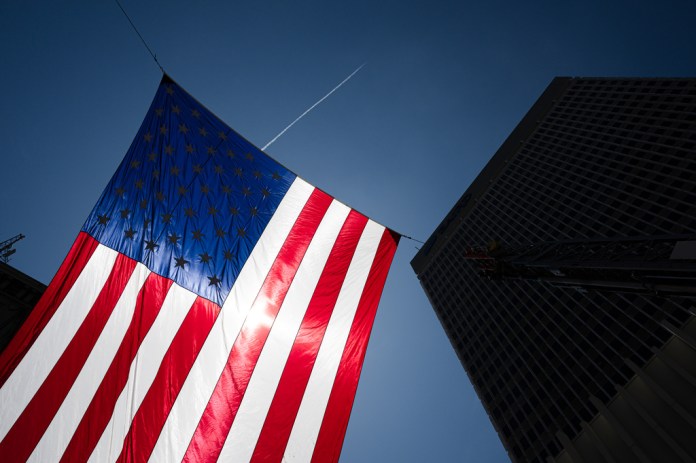
To any observer paying attention, America in 2026 is confronted by a brutal series of ironies, met with a deafening silence when what is required is a robust response.
First, the year of the 250th celebration of America’s founding is also the year of the starkest revelation of the radicals’ goal of dismantling America and its founding. Second, the leading attacks on America are by Americans whose ancestors came to America for a better life, but who now try to change America with ideas that were oppressive in the countries their families fled. Third, those radicals now attacking America’s Constitution and capitalism are not America’s poor and oppressed, but rather are the wealthy and highly educated sons and daughters of America’s own elite universities. Fourth, in the “No Kings” protests, a pseudo-Republican sounding and anti-monarchical movement is backed by slogans and banners emblazoned with the hammer and sickle of the dictators of totalitarianism.
What does all this mean for the American republic in the year of the 250th anniversary? And who is speaking for America as a republic with a freedom like no other? The restoration of the republic is the forgotten key to the American crisis, and a theme that must be sounded boldly in the midterm elections.
I first visited the United States in 1968, following the assassination of Martin Luther King Jr. and Sen. Robert Kennedy, with the anti-Vietnam protests rising to their climax. I met Mario Savio, leader of the Free Speech Movement in Berkeley, and heard the early talk of Rudi Dutschke’s call for “a long march through the institutions.” For nearly 60 years, I have followed the inroads of the long march, and a few days after the savage Hamas massacre on Oct. 7, 2023, I was appalled to witness the clear convergence of the red-green alliance, with radical Marxism joining voices with radical Islamism in openly attacking America, Israel, and the Jewish people.
Over the course of those six decades, presidents have come and gone, the bicentennials of the American Revolution and the U.S. Constitution have blazed and faded, the Watergate scandal has been surmounted, victory in the Cold War was celebrated, and the semi-quincentennial will soon be over, but there has been an ever-diminishing articulation and defense of the American republic. The American covenant was pronounced “broken” in 1976, the year of the bicentennial, yet there has been no serious attempt to repair it. Ronald Reagan stands unique as the only recent president able and ready, like Abraham Lincoln, to address the nation both as a leader and teacher.
To be sure, the eloquence of presidential speechwriters has been heard from time to time; President Joe Biden called for a restoration of “the soul of America,” and President Donald Trump has claimed to “make America great again.” But the former never said what the soul was, and the latter has never said what made America great in the first place. Even now, mainstream leaders routinely counter the radicals in terms of “common sense against craziness” or as “moderates” contrasted with “dangerous extremists and commies.” But with the rarest of exceptions, no one speaks for the republic as such. Instead, despite the warnings from the ancient Greeks, the multiple lessons throughout history, and the explicit wariness of the founders, most Americans today still defend “democracy” and not the republic.
As I read American history and understand the founders, America is the national incarnation of Patrick Henry’s famous cry writ large in history, “Give me liberty or give me death.” Is there any question that liberty and self-governance were the founders’ passion and their goal? As such, the audacity of their great experiment in freedom can be simply stated. First, that the best way to guarantee freedom was through a republic; second, that the best way to ground a republic, to guarantee freedom, was through virtue; and third, that the best way to guard virtue, to ground a republic, to guarantee freedom, was through faith.
From that bold beginning, the founders were united in arguing for a sure and realistic way to answer freedom’s greatest challenge: how to move beyond freedom’s first great task, “winning freedom” (the Revolution in 1776), to its second great task, “ordering freedom” (the U.S. Constitution in 1787), and then to the third, the greatest, and the hardest task of all, “sustaining freedom.” The founders’ solution to this third task may be described as “the golden triangle of freedom”: freedom requires virtue, virtue requires faith (of some sort), and faith (of any sort) requires freedom, (which, in turn, requires virtue, and so on ad infinitum, like the recycling triangle).
This solution, it must be stressed, was neither theocratic nor a form of Christian nationalism. It rested crucially on the genius of the First Amendment. Yet over the course of time, each of the founders’ well-considered convictions has decayed or been discarded — with no alternatives put in their place. America’s drift is now so advanced that the present moment confronts American citizens with an unavoidable choice: restore the republic or decline and slide further toward history’s spacious graveyard for failed republics.
I STILL HAVE GROUND ZERO ASH ON MY SHOES. AMERICA IS FORGETTING WHAT BUILT IT
Who now speaks for the republic? Who still believes in its first principles, or even knows what they are? Who defends them and works to hand them on from generation to generation? The American republic waits for statesmanlike leaders, and for leaders as teachers of the nation, with the understanding, courage, and readiness to champion the republic. The choice confronting America, and the needed renewal of the first principles of the republic, must not be weaponized or politicized. They are a matter of principle, not partisanship. They are essential for both traditional Democrats and traditional Republicans, and they are critical not only for celebrating the past but also for moving forward to the future. America’s future is at stake, and so also is the challenge of countering the menace of global authoritarianism.
The crisis of the republic is why the midterm elections are historic and truly existential: The existence of the republic is at stake now. Issues such as affordability and the war with Iran are important. But sad to say, unless these other issues are addressed within the foundational framework of the republic and its first principles, America’s days as the land of the free are numbered. The writing is clearly on the wall.
Os Guinness is an author and social critic.
Continue reading...
[ H/T Washington Examiner ]