







Mortgage rates just hit the highest level since 2023, further complicating the economic picture as inflation remains high and investors grow increasingly concerned about the federal government’s fiscal footing.
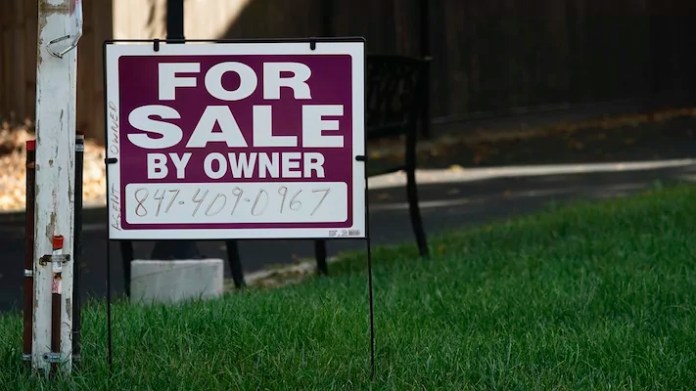
As of Friday, the average rate on a 30-year fixed-rate mortgage has risen to 7.53%, according to Mortgage News Daily, which tracks rates daily. That is up considerably from around the start of the year, when mortgage rates were just above 6%.
OPINION: THE BOND MARKET IS REVOLTING — AND YOUR MORTGAGE IS THE FIRST CASUALTY
Mike Fratantoni, chief economist at the Mortgage Bankers Association, told the Washington Examiner that the spike in mortgage rates is attributable to a confluence of factors, including higher inflation stemming from the ongoing war with Iran, which has driven up oil prices.
That increase in inflation has led the Federal Reserve to raise its interest rate target, he noted, which influences interest rates across the economy.
“And then you have the real challenge, which is on the fiscal side, that U.S. deficits and debt are extraordinarily high, and that is true around the world,” Fratantoni added.
The national debt recently hit $40 trillion, a psychological milestone that has caused a run-up in bond yields. Last month, the yield on the benchmark 10-year Treasury crossed 5%, the highest yield on that security since the summer of 2007, near the start of the financial crisis and the Great Recession.
As of Friday, the yield on the 10-year was clocking in at 5.28%, while the 20-year was up to 5.68%. The longer-run 30-year Treasury yield rose to 5.63%.
Desmond Lachman, a senior fellow at the American Enterprise Institute, pointed out that mortgage rates tend to track the 10-year Treasury, which explains why this past week marked the largest weekly gain for mortgage rates in four years.
“It means that the Treasury secretary needs to raise more money every moment to cover a big budget deficit,” Lachman told the Washington Examiner.
And the higher rates the market is experiencing came after a protracted period of ultra-low mortgage rates following the COVID-19 pandemic — at times below 3% — which juiced housing demand, causing prices to soar and many to lock in great deals on home mortgages.
The higher rates have had a dual effect on the market. On one hand, they might price out some potential buyers who may be waiting until they come down some before they buy. But on the other hand, potential sellers might be holding off on putting their homes on the market because they don’t want to lose those low, pandemic-era mortgages.
“If you look at our applications data, it really has slowed the last couple of weeks,” Fratantoni said.
“When rates were down toward [6%], you saw a ton of purchase activity, and that’s where we were right before the war started in February,” he said. “And when rates get up to [7%] and beyond, like we are now, things really slow down.”
And most experts don’t think there will be much relief for homebuyers in the next year or so, absent some big changes, such as the war in Iran ending or oil prices dramatically falling. Still, they might not move too much higher in the coming weeks.
“The mortgage rates could be very close to top of this cycle,” Lawrence Yun, chief economist at the National Association of Realtors, told the Washington Examiner. “Even though uncertainty remains, the mortgage rates have already risen by 120 basis points while the Fed rate hike to date has been only 25 basis points. The mortgage rates have largely incorporated the upcoming Fed rate hike decisions.”
Fratantoni said his group’s forecast is that mortgage rates might fall a bit, but that indications are they probably won’t drop much below 7% for the full year of 2027.
But Lachman emphasized the debt situation and said there is the potential for mortgage rates to punch even higher than they are right now.
“Because what’s very concerning is that the government’s running these huge budget deficits, which could get bigger, particularly if Trump goes ahead and wants to spend money on defense,” Lachman said.
Yun also emphasized underlying factors that might keep mortgage rates elevated for homebuyers over a longer period of time.
“Over the longer term, persistent federal budget deficits and stronger economic growth, including significant investment in AI and data centers, are likely to keep upward pressure on longer-term interest rates and prevent mortgage rates from falling meaningfully,” he said.
And mortgage rates are just one piece of the housing puzzle. Some argue that the United States is in the throes of a housing crisis, given that young people have been largely priced out of the market.
The bigger issue overshadowing all of this is the need for more housing supply, many experts argue. Most of the effort to increase that and boost housing construction and supply comes from the state and local level, rather than something Congress can do at the national level.
TRUMP ADMINISTRATION FLOATS CAPITAL GAINS TAX CUT ON HOME SALES — WHAT TO KNOW
Still, Congress has made an effort on the supply front. This year, the House and Senate passed the biggest bipartisan housing bill in recent memory — the 21st Century ROAD to Housing Act.
That legislation streamlines environmental reviews to speed up affordable housing development and makes it cheaper and easier to build manufactured homes. In addition to easing federal regulations, the bill also encourages states and cities to reform their land-use rules, which would mark a significant change in the federalist system with respect to city planning.
Continue reading...
[ H/T Washington Examiner ]