

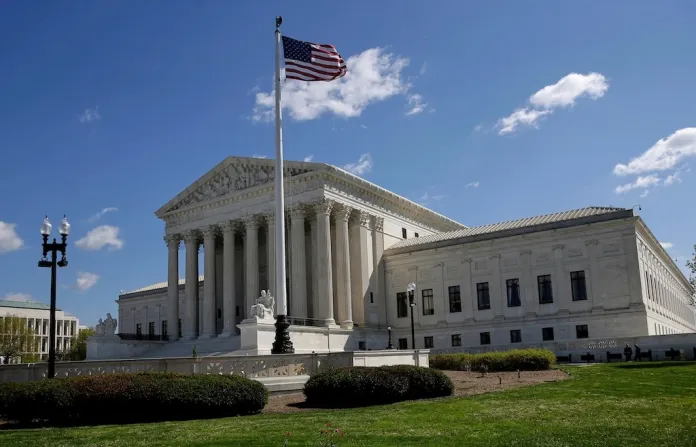
The Supreme Court returns for its new term on Monday, and oral arguments in a major case over the fate of a costly climate change lawsuit brought by Boulder County, Colorado, will kick off a term set to feature several blockbuster legal battles.
Suncor Energy v. County Commissioners of Boulder County will decide whether a lawsuit brought by Boulder County, which seeks to hold oil companies accountable for their alleged role in global climate change, can proceed. The case is expected to have sweeping ramifications for similar lawsuits that climate activists and Democrat-led jurisdictions have attempted to bring against oil companies, either broadly allowing them to continue or shutting them down as barred by federal law.
In addition to the implications of the costly lawsuits, conservatives have noted that the Supreme Court’s eventual decision could affect state sovereignty.
Climate change rulings could have ramifications beyond the environment
The Supreme Court will look at whether federal law preempts Boulder County from bringing forward the lawsuit against Suncor and other oil companies, but also at whether the county is overstepping its jurisdiction by attempting to seek damages for global climate emissions. Boulder County and environmental groups have argued that individualized contributions to global climate change can be identified and quantified, a claim that oil companies and conservatives have rejected.
Christopher Mills, constitutional lawyer and former law clerk to Justice Clarence Thomas, argued that while the Colorado county has “dressed up its complaint as a local dispute over local harms,” in reality, it seeks to govern beyond its borders by trying to set climate policy for the country.
“The Framers established every state as an equal sovereign and ensured that no one state, let alone a single county, could force its policies on the other forty-nine,” Mills said. “They entrusted Congress with issues of national consequence for exactly that reason. If the nation requires a response to global climate change, it should come from our elected representatives in Washington, not county officials in Colorado.”
The Supreme Court could narrowly allow lawsuits to go forward if Boulder County, or a different state or county, can point directly to actions and harm within the jurisdiction’s borders, while affirming that states cannot govern beyond that. A coalition of Republican attorneys general filed a brief to the Supreme Court urging the justices to affirm that states can control matters within their borders but cannot reach beyond to regulate issues like global climate change.
“It’s a pretty simple concept. We don’t think that there’s a role for one state to regulate the activities that are happening in another state,” West Virginia Solicitor General Michael Williams told reporters at the Federalist Society’s Supreme Court preview last week. “So we’re really trying to return the limits that we think our Constitution requires in terms of the sort of extraterritoriality principle that our Constitution has.”
States have increasingly clashed in recent years on several hot-button issues that have reached beyond their borders. The Supreme Court’s ruling in the Suncor case could implicate some of those issues, including abortion restrictions, where states have waged legal wars over the shipment of abortion pills to states where abortion is restricted.
Suncor case at high risk of rare Supreme Court deadlock
When the Supreme Court hears arguments in the Suncor case, Justice Samuel Alito will not be part of the panel that considers the legal battle after he recused himself from deciding the case last week. Alito did not provide an explanation in the letter filed by the Supreme Court clerk to the docket, but he later told Bloomberg he “thought that recusal was the prudent step.”
“Under that rule, I was not required to be recused, and I asked our legal office, as is my custom on any case where there’s an arguable recusal issue, to give me their opinion on whether I was required to recuse, and they said, ‘No,'” Alito told the outlet.
Alito has financial interests through stocks in oil companies, including ConocoPhillips, the parent corporation for Burlington Resources Oil and Gas Company. Last term, he cited the stocks in ConocoPhillips as the reason for his recusal in Chevron USA v. Plaquemines Parish.
With Alito off the bench for Suncor, the Supreme Court could end up with a rare 4-4 deadlock in the closely-watched case. A deadlock means the result would be the same as if the high court had never agreed to take up the case, and the lower court’s ruling would stand. The bench hearing the Suncor case will have a 5-3 conservative majority.
William acknowledged that Alito’s decision to recuse himself “wasn’t welcome news from our perspective,” but he said he is still hopeful that the rest of the high court can offer a ruling that clears up the dispute, noting that “some of these concepts are so fundamental.”
Major case kicks off a busy Supreme Court term
The Suncor case will be the first case the Supreme Court hears for its new term, and with its docket already filled with major cases, the justices look likely to be kicking off another high-profile term.
The Supreme Court’s next major case will come in November, when it hears St. Mary Catholic Parish v. Roy, which concerns Colorado’s decision to exclude Catholic preschools from its universal preschool program. A group of Catholic preschools sued the state over their exclusion as a violation of the First Amendment, after the state said they would be required to accept families who do not share Catholic beliefs. The high court will hear arguments in the closely-watched battle on Nov. 3.
In its December sitting, the Supreme Court will hear oral arguments in several additional major cases. On Dec. 2, the high court will hear arguments in one of the most consequential Second Amendment cases in recent history, regarding the legality of sweeping “assault weapons” bans, which include bans of the popular AR-15 style rifle. On Dec. 7, the Supreme Court will consider a case with major implications for parental rights, regarding a Washington law allowing runaway minors to receive transgender surgeries without parental permission.
Major cases involving President Donald Trump’s immigration agenda will also be heard by the high court this term. The Supreme Court will take up arguments in a major immigration case on Dec. 9, reviewing the legality of the Trump administration’s policy of deporting illegal immigrants to countries other than their own. Sometime in early 2027, the Supreme Court will hear oral arguments in Trump’s policy of keeping illegal immigrants detained indefinitely while their removal proceedings play out in court.
SIX MAJOR CASES THE SUPREME COURT WILL HEAR IN ITS UPCOMING TERM
The justices have announced 28 cases they will hear during the new term, with dozens more expected to be added to the docket in the coming months for oral arguments between January and April 2027. During its most recent term, the Supreme Court heard arguments in 58 cases.
The Supreme Court’s term will continue with oral arguments through the end of April, with decisions in all cases argued for the term expected by the end of June 2027. A ruling in the Suncor case is expected as soon as early 2027.
Continue reading...
[ H/T Washington Examiner ]