





It’s easy to see the still-unfolding case of Lindsay Clancy as unique. It’s horribly unusual for a mother to admit to murdering her own children and novel to use “postpartum psychosis” as a rationale for acquittal. But the national attention bordering on fixation that the case has attracted puts it in an American media tradition: what can be called a “crime of the century” — crimes so dramatic that they captivate the public, owing to both their horror and their novelty. Their attention can be dismissed as press sensationalism, but they serve an important purpose as revealing snapshots of a changing society.
The “crime of the century tradition” can be dated at least to the 1932 “Lindbergh baby” kidnapping: the abduction of the son of the celebrity pilot Charles Lindbergh and his wife, Anne Morrow Lindbergh. The combination of a ransom and its payment, the discovery of the boy’s body, and the ultimate capture and execution of the kidnapper played out over four years, but it was a “crime of the century” because it told a novel story: Even the rich and famous were not insulated from terrible crime. Celebrity, then relatively novel, can be a curse.
Subsequent “crimes of the century” each has its own version of novelty. There were Bonnie Parker and Clyde Barrow, whose magnetic novelty was their unlikely pairing: a small-town Texas waitress drawn to an outlaw, immortalized in photos, including one in which Bonnie has a cigar in her mouth and a pistol in her hand. The story was powered by its involving both a man and a woman, underscoring for the public that women could be violent criminals.
The crimes that captivate us always involve a counter-to-type dimension. The bank robber Charles Arthur “Pretty Boy” Floyd became an enduring legend for supposedly destroying mortgage documents in the course of his crimes, thus providing debt relief during the Depression. He became a Robin Hood figure, celebrated by folksinger Woody Guthrie, who sang of “many a starving farmer; The same old story told; how the outlaw paid their mortgage; And saved their little homes.”
That Floyd escaped from an Ohio prison and was tracked down and killed by the FBI did not deter some 20,000 to 40,000 people from attending his Oklahoma funeral. The novelty of a bank robber helping the needy fueled the legend. But the acclaim revealed, too, the desperation of the Depression in the Dust Bowl.
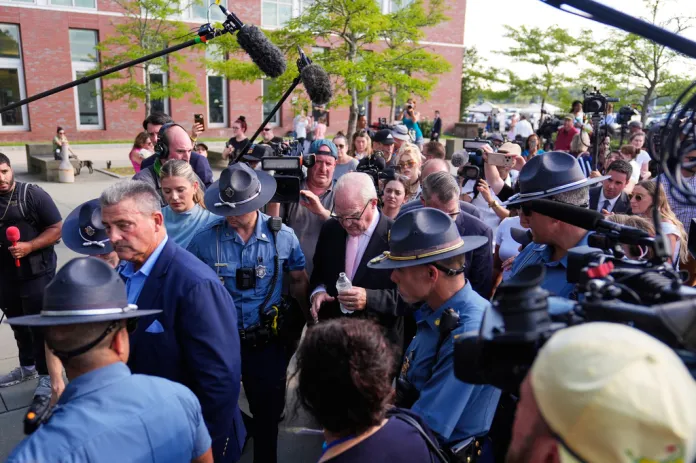
Defense attorney Kevin Reddington, center, leaves court, flanked by media and law enforcement, after the judge declared a mistrial in Lindsay Clancy’s murder trial at Plymouth County Superior Court, Friday, Sept. 4, 2026, in Plymouth, Mass. (AP Photo/Charles Krupa)
" data-large-file="https://www.washingtonexaminer.com/wp-content/uploads/2026/09/AP26247717755461.jpg?w=696" src="https://www.washingtonexaminer.com/wp-content/uploads/2026/09/AP26247717755461.jpg?w=696" alt="Defense attorney Kevin Reddington" class="wp-image-4714697" srcset="https://www.washingtonexaminer.com/wp-content/uploads/2026/09/AP26247717755461.jpg 1024w, https://www.washingtonexaminer.com/wp-content/uploads/2026/09/AP26247717755461.jpg?resize=300,200 300w, https://www.washingtonexaminer.com/wp-content/uploads/2026/09/AP26247717755461.jpg?resize=768,512 768w, https://www.washingtonexaminer.com/wp-content/uploads/2026/09/AP26247717755461.jpg?resize=150,100 150w, https://www.washingtonexaminer.com/wp-content/uploads/2026/09/AP26247717755461.jpg?resize=696,464 696w" sizes="(max-width: 1024px) 100vw, 1024px">
Defense attorney Kevin Reddington, center, leaves court, flanked by media and law enforcement, after the judge declared a mistrial in Lindsay Clancy’s murder trial at Plymouth County Superior Court, Friday, Sept. 4, 2026, in Plymouth, Mass. (AP Photo/Charles Krupa)
Later crimes of the century, including Clancy’s, have continued the counter-to-type tradition. Capturing an evolving zeitgeist, Dr. Sam Sheppherd, a Cleveland osteopath, was accused of murdering his pregnant wife, Marilyn, in 1954. The publicity attendant to a doctor doing harm was so intense that his conviction was ultimately overturned for the novel reason of prejudicial pretrial publicity. His acquittal spotlighted another novel figure in American society: the celebrity lawyer, in his case, F. Lee Bailey.
Novelty, too, fueled the “crime of the century”-level attention to New York’s “Son of Sam” serial killer, whose 1975-77 murders of women were followed by taunting letters to the city’s police and sparked what remains one of the most intense manhunts in city history. That David Berkowitz was clever enough to elude the New York Police Department added to the fear and horror his crimes engendered. His potential capacity to write a memoir, though, led to the important “Son of Sam law,” precluding criminals from profiting from their crimes.
Tragically, the character of these crimes that captivate the public has, in some ways, become worse; it takes greater and greater horror to shock. It’s a version of Daniel Patrick Moynihan’s observation about “defining deviancy down”; what was once perverse becomes unsurprising, and greater and greater horror and novelty are required to shock.
The murders of Rob and Michele Reiner make clear the non-protection of celebrity and the limits of the therapy meant to help their son. The murders of health care executive Brian Thompson in midtown Manhattan and Turning Point USA leader Charlie Kirk reveal the evolving targets for politically-inspired assassins.
And now a mother who admits to murdering her own children: a story both new and ancient (Medea).
TRUMP AND XI SIZE EACH OTHER UP
One can only wonder whether the attention “crimes of the century” attract serves to motivate more, as with our skein of mass shootings.
The press is not innocent of what was once called sensationalism. The novelty of “man bites dog” is hard to resist. Our “crimes of the century” are all that and more. There is little chance that they will fail to fascinate or that we will be able to turn away. But nor should we. They serve both as morality plays and reports on our social ills, both timeless and evolving.
Howard Husock is a fellow at the American Enterprise Institute and author of “The Projects: A New History of Public Housing.”
Continue reading...
[ H/T Washington Examiner ]