


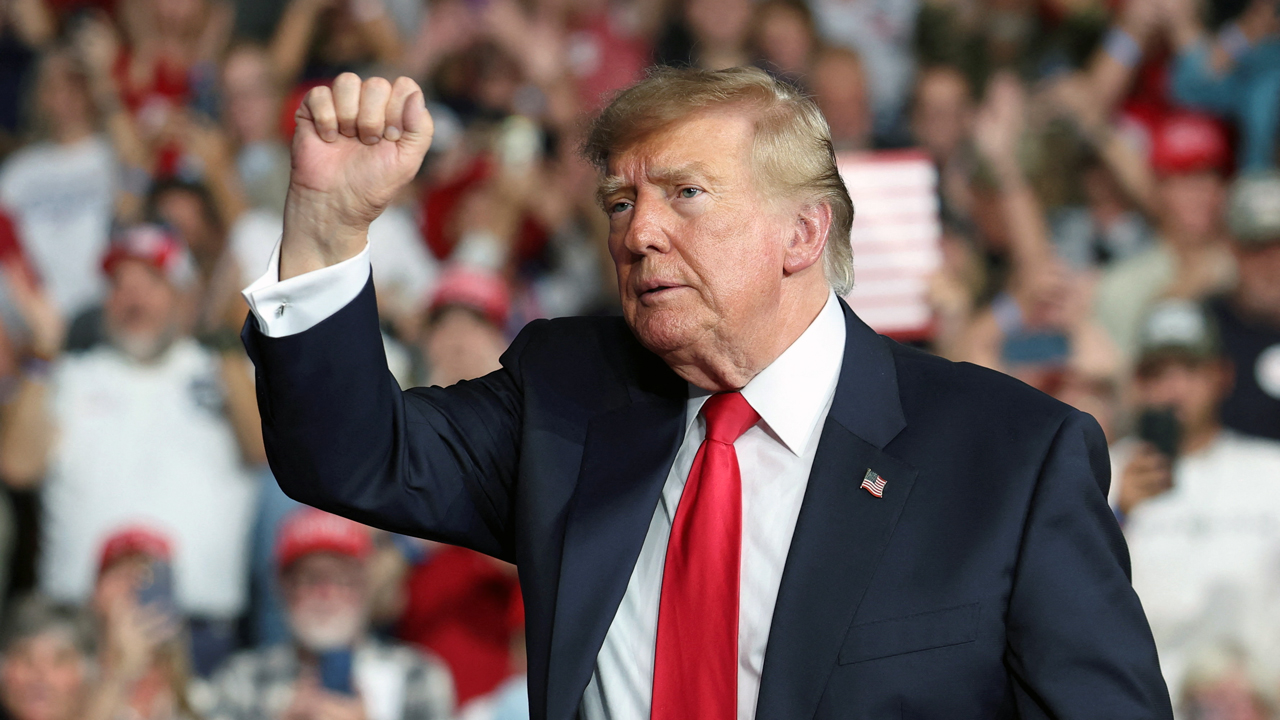


President Trump just explained, in the plainest possible terms, how he would respond if Democrats won control of Congress and created legislative gridlock: he would use the presidential veto as leverage until they came to the negotiating table.
Voters have not yet decided control of Congress, so this is a contingency rather than a policy already in motion. The full interview transcript preserved by Roll Call Factba.se shows exactly how President Trump framed it: he said losing control would be bad for the country, argued that Republicans winning would let the administration keep its agenda moving, and then described vetoes as the pressure point he would use if Democrats instead created gridlock; in that divided-government scenario, he said Democrats would eventually call to ask how legislation could get through, opening the door to a deal rather than leaving Washington permanently frozen.
Here is President Trump laying out that veto-and-negotiate strategy himself:
That is a negotiating posture, not an announcement that a veto has already been issued or a guarantee that every future bill would be rejected. It is also not absolute power.
As Constitution Annotated explains, a President who vetoes a bill returns it to Congress with his objections, giving lawmakers the choice to revise the measure, abandon it, or attempt an override. Congress can defeat the veto only with a two-thirds vote in each chamber, while a bill the President holds for ten days, excluding Sundays, ordinarily becomes law without his signature unless congressional adjournment prevents its return.
Those rules make a veto enormously powerful without making it unlimited. Democrats controlling Congress could pass legislation, but without the extraordinary margins needed for an override they would still need President Trump’s signature, turning his backstop into real pressure for a workable deal.
That is why the midterm campaign matters so much. The President plainly prefers Republican victories and continued governing power over a divided Washington in which every major measure becomes a showdown.
His veto plan is the fallback if voters produce that second scenario, not his preferred outcome.
A current campaign clip shows the personal effort he is making to prevent that gridlock:
A reporter covering President Trump admitted she's EXHAUSTED going to just ONE rally a week, while Trump is doing them EVERY day, sometimes TWICE a day
TRUMP: "It's a strain on your voice. It's not normal. In fact, I heard a couple of the outlets say nobody else has ever done… pic.twitter.com/MTwT3Fmjn4
— Nick Sortor (@nicksortor) October 24, 2026
The video highlights a striking campaign contrast: a reporter was described as exhausted from attending one rally a week, while President Trump was doing events every day and sometimes twice a day. He acknowledged the strain on his voice, underscoring the effort he is making to help Republicans win so the veto backstop never has to become the central method of governing.
There was also a separate but related question about another possible backstop. Asked about pardoning junior administration officials against possible future congressional investigations, President Trump said he had not considered such pardons while also saying he believed he possessed the authority to issue them.
Here is the President’s response to that distinct pardon question:
The legal boundaries matter. The pardon power covers federal offenses; it does not reach state crimes, civil wrongs, or impeachment.
Constitution Annotated explains that the Supreme Court has recognized presidential power to pardon criminal contempt of federal court, but not civil contempt, and it identifies whether that authority reaches contempt of Congress as an open legal question. Even a broad federal pardon would not erase state liability, civil disputes, impeachment, congressional hearings, or political scrutiny; clemency can remove or reduce federal criminal exposure within constitutional limits, but it cannot simply switch off the legislative branch’s oversight role.
These are two constitutional tools serving two different purposes. A veto can block legislation and force negotiation unless Congress finds two-thirds support in both chambers, while a pardon can address federal offenses but cannot erase every other legal or political consequence.
President Trump presented the first as his clear gridlock strategy and the second only as an authority he believes he has—not a plan he has decided to use.
That leaves voters with a sharp choice. Republican congressional victories would give President Trump the unified governing strength he says he wants, while Democratic control would create the possibility of gridlock, veto fights, and forced negotiation.
The President has now told the country exactly what his backstop would be. The election will determine whether Washington gets unified governing power or a government where every serious advance may require Democrats to come and make a deal.
The post President Trump Reveals His Midterm Backstop: ‘I Veto Everything’ Until Democrats Deal appeared first on 100PercentFedUp.com.
Continue reading...
[H/T 100PercentFedUp]


