

With less than a month to go before the midterm elections, Democrats are doing so well that many political observers are beginning to wonder if there is something wrong with the polls.
It’s not just that President Donald Trump is unpopular, with a job approval rating below 40% nationally, though that is exactly what the RealClearPolitics polling average shows. He receives even lower marks on three of the top issues in the midterm campaign: Iran, the economy, and inflation, where he’s below 30% approval.
Nor is it just that voters prefer Democrats controlling Congress over Republicans by 7.9 points, according to the same website’s average of polls, with some recent surveys giving Democrats a lead as high as 12 points. The final RealClearPolitics average ahead of the 2018 midterm elections during Trump’s first term was a 7.3-point Democratic edge. Democrats gained more than 40 House seats that year to take the majority and ended up winning the congressional popular vote by 8.4 points.
Democratic candidate for Congress Christina Bohannan, at far right, speaks to a county-level organization of Democrats in Columbus Junction, Iowa, Aug. 16, 2026. (Joseph Cress/AP)
" data-large-file="https://www.washingtonexaminer.com/wp-content/uploads/2026/10/Feat.BlueWave1.101426.jpg?w=696" height="658" width="1024" src="https://www.washingtonexaminer.com/wp-content/uploads/2026/10/Feat.BlueWave1.101426.jpg?w=696" alt="Democratic candidate for Congress Christina Bohannan, at far right, speaks to a county-level organization of Democrats in Columbus Junction, Iowa, Aug. 16, 2026. (Joseph Cress/AP)" class="wp-image-4762431" style="width:757px;height:auto" srcset="https://www.washingtonexaminer.com/wp-content/uploads/2026/10/Feat.BlueWave1.101426.jpg 1400w, https://www.washingtonexaminer.com/...6/10/Feat.BlueWave1.101426.jpg?resize=300,193 300w, https://www.washingtonexaminer.com/...6/10/Feat.BlueWave1.101426.jpg?resize=768,494 768w, https://www.washingtonexaminer.com/.../10/Feat.BlueWave1.101426.jpg?resize=1024,658 1024w, https://www.washingtonexaminer.com/...26/10/Feat.BlueWave1.101426.jpg?resize=150,96 150w, https://www.washingtonexaminer.com/...6/10/Feat.BlueWave1.101426.jpg?resize=696,447 696w, https://www.washingtonexaminer.com/.../10/Feat.BlueWave1.101426.jpg?resize=1068,687 1068w" sizes="(max-width: 1024px) 100vw, 1024px">
Democratic candidate for Congress Christina Bohannan, at far right, speaks to a county-level organization of Democrats in Columbus Junction, Iowa, Aug. 16, 2026. (Joseph Cress/AP)
But this blue wave is threatening to wipe out Republicans in some of the reddest states in the country. Democrats are ahead in the RealClearPolitics average for every major competitive Senate race in the country except for Kansas, where Sen. Roger Marshall (R-KS) clings to the barest 0.2-point advantage. This includes Democratic leads in Texas, Ohio, Iowa, and Alaska, all states Trump won by double digits just two years ago.
North Carolina, which hasn’t voted Democratic at the presidential level since 2008, is considered by many in both parties to be all but gone as campaign cash is redirected elsewhere. Georgia, once viewed as the Republicans’ best Senate pickup opportunity this year, looks similarly out of reach.
Those were both 2024 battleground states that Trump won narrowly. But then there is South Carolina, which Trump carried by nearly 18 points, where the Republican-friendly pollster Trafalgar found Sen. Darline Graham (R-SC) with just a 1-point lead late last month. There has been rumbling about a couple of shock polls in Nebraska showing a surprisingly competitive race for Sen. Pete Ricketts (R-NE), which seems validated by Trump’s decision to campaign there.
Trump won statewide in Nebraska by more than 20 points, though 2024 Democratic nominee Kamala Harris managed to net a single electoral vote by carrying the state’s Omaha-centric 2nd Congressional District by less than 5 points.
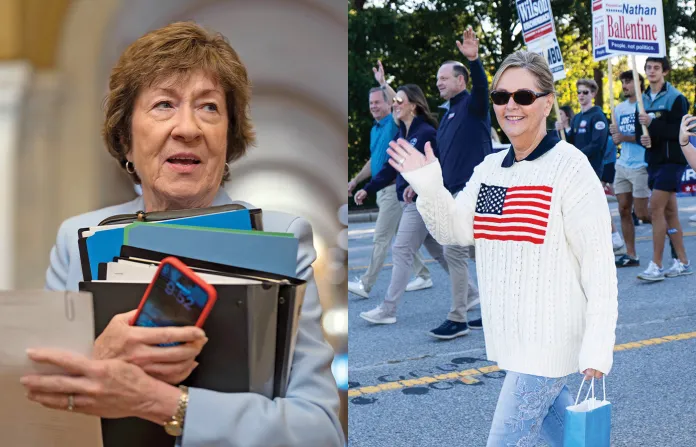
Left: Sen. Susan Collins (R-ME) arrives at the Capitol Building in Washington, D.C., for a hearing of the Senate Intelligence Committee, June 17, 2026; Right: Sen. Darline Graham (R-SC) campaigns in Irmo, South Carolina, Sept. 26, 2026. (J. Scott Applewhite/AP; Bill Clark/ CQ-Roll Call/Getty Images)
" data-large-file="https://www.washingtonexaminer.com/wp-content/uploads/2026/10/Feat.BlueWave2.101426.jpg?w=696" height="658" width="1024" src="https://www.washingtonexaminer.com/wp-content/uploads/2026/10/Feat.BlueWave2.101426.jpg?w=696" alt="Left: Sen. Susan Collins (R-ME) arrives at the Capitol Building in Washington, D.C., for a hearing of the Senate Intelligence Committee, June 17, 2026; Right: Sen. Darline Graham (R-SC) campaigns in Irmo, South Carolina, Sept. 26, 2026. (J. Scott Applewhite/AP; Bill Clark/ CQ-Roll Call/Getty Images)" class="wp-image-4762432" style="width:789px;height:auto" srcset="https://www.washingtonexaminer.com/wp-content/uploads/2026/10/Feat.BlueWave2.101426.jpg 1400w, https://www.washingtonexaminer.com/...6/10/Feat.BlueWave2.101426.jpg?resize=300,193 300w, https://www.washingtonexaminer.com/...6/10/Feat.BlueWave2.101426.jpg?resize=768,494 768w, https://www.washingtonexaminer.com/.../10/Feat.BlueWave2.101426.jpg?resize=1024,658 1024w, https://www.washingtonexaminer.com/...26/10/Feat.BlueWave2.101426.jpg?resize=150,96 150w, https://www.washingtonexaminer.com/...6/10/Feat.BlueWave2.101426.jpg?resize=696,447 696w, https://www.washingtonexaminer.com/.../10/Feat.BlueWave2.101426.jpg?resize=1068,687 1068w" sizes="(max-width: 1024px) 100vw, 1024px">
Left: Sen. Susan Collins (R-ME) arrives at the Capitol Building in Washington, D.C., for a hearing of the Senate Intelligence Committee, June 17, 2026; Right: Sen. Darline Graham (R-SC) campaigns in Irmo, South Carolina, Sept. 26, 2026. (J. Scott Applewhite/AP; Bill Clark/ CQ-Roll Call/Getty Images)
What’s the matter with Kansas — and all of these other red states? Some political analysts think pollsters are undercounting the rural vote and setting themselves up for another big miss on Election Day.
“Rural Iowa Rs ignored our survey,” election forecaster Chaz Nuttycombe wrote on X. “We think this could be a Canary in the Cornfields for Iowa polling this year.” This prompted veteran GOP pollster Frank Luntz to observe, “If Republican voters aren’t answering polls, the polls could end up making the same mistake they did in 2016.”
“We’re having problems just getting Republican voters to respond to polls,” a national Republican pollster complained to Axios late last month. “At what point do we think these guys aren’t showing up at the actual polls on Election Day?”
The polling error could correct itself in that way, with low response rates meaning low turnout — the headline on the story in which the last pollster was quoted? “GOP election outlook goes from bad to craptastic.” GOP pollster Brent Buchanan calls Trump voters who expect Democrats to win Congress “Republican Fatalists” and estimates they are 9% of the electorate.
But several pollsters the Washington Examiner spoke to said the nonresponses were more likely to produce a polling error, as some of the voters who are avoiding pollsters aren’t too demoralized to cast their ballots.
This concern isn’t just being raised by desperate Republicans, who are looking for any way out of the blue bloodbath that appears to be on the way in November — though there is, as the youths of today say, plenty of GOP cope going around. Democrats and nonpartisan analysts are preparing for this possibility, too.
“Most smart people I’ve spoken to (in both parties) think there is likely some pro-Dem bias in current polling,” Democratic strategist Adam Carlson wrote on X. “The expected size and universality of the bias varies person to person.”
Naturally, there is a lot of coping, expectations management, and worst-case scenario thinking going around. “Some of that is likely a defense mechanism from past polling misses overestimating Dems (though typically that happens when Trump is on the ballot), especially in states like Maine, where there have been large misses in the last decade,” Carlson continued. “Some of that is legitimate concern about partisan differential non-response/having a tough time reaching a representative sample of rural Republicans (i.e., not MAGA enough). … There is no way of knowing if this is a correct assumption before we have final results.”
Others have raised concerns about the “likely voter” screens used by major pollsters as the 2026 campaign enters the homestretch. “Some pollsters have a rather narrow definition of what a likely voter is, and some have a more nuanced definition,” election analyst Danny Cowan wrote. “It was with the former interpretation of a likely voter that exposed a flaw, one that inadvertently was showing Democrats to have a bigger lead than advertised.”
Before your eyes glaze over, consider the upshot of these differences. “The difference between Democrats winning by 8% or 15% is substantial. The former implies a 2018-sized blue wave where Democrats are competitive in the Senate, and the latter implies that Democrats win north of 270 House seats and 55 Senate seats,” Cowan concluded. “Democrats are very motivated to say they are voting, while Republicans are not. However, if you simply exclude those less-enthusiastic Republicans from polls, you may end up getting a sample that’s too Democratic.”
There is also the simple fact that Democrats are polling worse in blue states such as Maine, Michigan, and Minnesota than in red states such as Texas that Trump has won in each of the last three presidential elections. New Hampshire isn’t quite blue, but it has become more inclined to vote for Democrats for federal office. The Granite State Senate contest, however, is close.
This strange dynamic on its face makes political operatives working on the various Senate races across the country nervous.
Candidate quality is a logical explanation for this discrepancy. Sen. Susan Collins (R-ME) is a strong candidate who has survived past election cycles friendly to Democrats, while her opponent, Troy Jackson, is weaker, though not quite as troubled as Graham Platner, the Democratic primary winner he replaced. Underfunded Texas Attorney General Ken Paxton, running to replace Sen. John Cornyn (R-TX) after beating him in a primary, is not as formidable, while Democrats landed their preferred nominee in James Talarico.
Local conditions also still matter despite both parties’ efforts to nationalize the midterm elections — Republicans even took the nearly unprecedented step of holding a midterm convention at which Trump and Vice President JD Vance spoke alongside GOP candidates in some of the toughest races. The Minnesota Senate race is competitive in part because Somali daycare fraud was a big enough scandal to get Gov. Tim Walz (D-MN), Harris’s 2024 running mate, to drop his reelection bid.
Finally, three of these four Senate races feature socialists. Trump won Michigan and Maine’s 2nd Congressional District, good for one electoral vote, in 2024. He came within 4.24 points in Minnesota, the only state to vote against President Ronald Reagan in 1984. Maybe socialism is a bridge too far, or nearly so. The fourth has a former Republican senator and iconic New Hampshire family name, John Sununu, running.
If the polls are overestimating Democrats, even by a few points, this could make a huge difference in the race for control of the Senate. This is most likely in the least Democratic states with competitive senatorial elections. “In the last few election cycles, we’ve seen a pattern of Democrats looking competitive in red state Senate contests during the summer only to fade by election day,” Republican pollster Patrick Ruffini wrote earlier this year.
More than a decade ago, this kind of talk might have been confined to conservative bloggers, who were largely political hobbyists, and professional Republican partisans with their heads buried in the sand. In 2012, a plausible assumption — perhaps then-President Barack Obama would not be able to replicate his 2008 turnout and support levels from millennial and minority voters as he sought a second term, making the race closer than it appeared in many surveys — turned into an obsession with unskewing the polls.
In what eventually became known as “crosstabs truthing,” these motivated politicos sifted through the poll results and declared that the public pollsters, usually hired by universities or legacy media outlets, were systematically oversampling Democrats to the detriment of Republican nominee Mitt Romney.
Romney rather conspicuously did not win the presidential election that year. The pollsters were vindicated. But they were increasingly having trouble getting people to respond and ensuring they had representative samples, which became a major problem in the Rust Belt during the race for the White House four years later. This caused most of the polling industry to miss Trump’s upset victory over Democrat Hillary Clinton.
Nor was this a fluke. Trump outperformed his poll numbers to varying degrees in all three of his elections, including the one he lost in 2020. This was especially true in the battleground states. There was the famous 2024 Des Moines Register poll, considered the “gold standard” in Iowa polling, that showed Trump trailing Harris by 3 points in the Hawkeye State right before the election. He won by 13.2 points. Ann Selzer, the legendary pollster, announced her retirement from electoral polling shortly afterward.
In 2020, Collins trailed in virtually every poll conducted in Maine. Then she won by nearly 9 points. She was running with Trump on the ballot, losing statewide, though he prevailed in the 2nd Congressional District.
A few polls that year showed competitive Senate races in red states featuring legendary incumbent Sens. Mitch McConnell (R-KY) and Lindsey Graham (R-SC). McConnell, who is retiring after this year, won by nearly 20 points. Graham, who died in office earlier this year, won by 11.
Two years earlier, Republican Mike Braun trailed then-Sen. Joe Donnelly (D-IN) by 1.3 points in the final RealClearPolitics average, while Republican Josh Hawley led then-Sen. Claire McCaskill (D-MO) by less than a point. Both Republicans won by around 6 points. 2018 was a good year both for Democrats and overall polling accuracy. But that year, red states defied the blue wave and actually enlarged the Republican Senate majority even as Democrats captured the House. And there were still polling misses.
Some go a step further and say pollsters are intentionally producing results designed to demoralize Republicans and depress their turnout. Trump routinely dismisses polls he dislikes as “fake” and sued, without much success, over the 2024 Des Moines Register poll, alleging deliberate fraud.
This sentiment is bipartisan, however. “Campaigns try to get polls that are favorable to them and put them out … get polls of questionable accuracy, but if they look good for you, get them to have media folks pick them up and report them to try to create like a bandwagon effect, which is a technique as old as politics itself,” retiring Sen. Gary Peters (D-MI) told reporters after his preferred candidate lost the Michigan Senate primary but outperformed her poll numbers. “We saw polls that were questionable right from the start for me.” More on this later.
In fact, pollsters generally rely on a reputation for accuracy. Private pollsters, though their numbers are often selectively leaked to the public for political purposes, are counted on by campaigns to help them decide where to spend time and money. National Democrats would have surely liked to have invested some of the dollars that went to a noncompetitive South Carolina Senate race in 2020 elsewhere.
But there have been a few results this year that have aroused suspicions. The polling averages showed Michigan progressive Abdul el Sayed leading in the Democratic primary by more than 10 points. He ended up winning by 1 point. While response rate bias was likely a factor, with younger voters being overrepresented and other groups, such as older black voters, underrepresented, many of the polls that produced this big lead were actually conducted for groups aligned with el Sayed. He had previously accused the American Israel Public Affairs Committee of buying favorable poll results for his opponent.
Socialist Francesca Hong was expected to easily win the Wisconsin Democratic gubernatorial nomination based on the polling. Instead, she lost by a slim margin. The polls came close to Hong’s vote share but wildly underestimated Milwaukee County Executive David Crowley, the eventual nominee. Response rate bias was likely a factor here, too, but it should be noted that the field opposed to Hong was shaken up late in the race — perhaps too late for pollsters to capture what was really going on in public opinion. Hong had just endured a disastrous news cycle over woke social media posts and disliking Thanksgiving.
But an actual fake poll was released in the Los Angeles mayoral race and was touted by incumbent Mayor Karen Bass. “All previously published polling releases have been withdrawn and should not be cited or treated as genuine polling data,” the company that produced the fake poll said in a press release. “Median Strategies was created as a short-term social experiment examining how purported polling information could enter and spread through the political information ecosystem without independent verification.”
Another pollster used questionable methods to produce better results for Florida Republican gubernatorial candidate James Fishback, whose campaign had paid for the poll. Fishback ran a distant third in the primary, winning just 10.4% of the vote as Rep. Byron Donalds (R-FL) won the nomination.
These bad actors are far from the norm, but they do generate headlines and undermine confidence in the polls at a time when many already doubt them. Elections prognosticator Nate Silver estimates that polling bias occurred in one direction or the other in 6 of 10 elections dating back to 2008.
One thing to take away from Silver’s analysis is that the polls actually overestimated Republican support in some key races last year. Polling showed the New Jersey gubernatorial election was going to be close. Instead, Democrat Mikie Sherrill won in a landslide. Virginia Democrats outran their polling numbers by a smaller amount.
Some pollsters thought there was going to be a red wave in 2022. Instead, Republicans just barely retook the House and actually lost a seat in the Senate. A similar outcome for Democrats this year may be the GOP’s best-case scenario this year.
The polls could always prove right. The numbers showing overwhelming public disapproval of the cost of living and what Trump has done to handle the issue are well outside the realm of normal polling errors. The Trump tariffs hit red-state farmers and certain battleground states particularly hard. The Iran war has produced a spike in gasoline and diesel prices that generally bodes ill for the party in power, which has, in any event, lost House seats in all but two midterm elections dating back to 1938.
Republicans certainly aren’t acting as if they see different, more favorable data than what the public polls are showing. Trump and Vance are campaigning in red states. Republicans are spending a considerable amount of money shoring up what would normally be favorable states and districts. Republicans narrowly lost independents in 2022, which is why the red wave was more of a ripple. Polls showing the GOP getting trounced among these voters aren’t implausible.
“The party in power owns the pump, and Republicans are paying for it this year,” Buchanan, the GOP pollster, wrote in a memo. “Telling voters the economic stats are doing well will not change the weekly reminder of how painful it is to fill the tank. Republicans need a believable answer for voters on costs, especially for many of their own voters who are expecting the party to lose. It’s those voters who need to see how casting a ballot could change what they are struggling with at home.”
2026 MIDTERM ELECTIONS LIVE UPDATES: LATEST NEWS, RESULTS, AND ANALYSIS
Republicans had hoped to use favorable House and Senate maps to counteract a bad national environment in the midterm elections. They have used mid-decade redistricting and money from Trump’s vast campaign war chest to bolster their structural edge. So far, the polls say it isn’t working, and these trends tend to accelerate rather than reverse themselves in the closing weeks of a campaign.
Counting on the polls to be wrong is never a good place for a candidate or political party to be. But it is probably the least bad a bet has been since the famous “Dewey Defeats Truman” headline. We’ll see whether we get a blue wave or a blue mirage when the only poll that matters happens on Nov. 3.
W. James Antle III (@jimantle) is executive editor of the Washington Examiner magazine.
Continue reading...
[ H/T Washington Examiner ]