




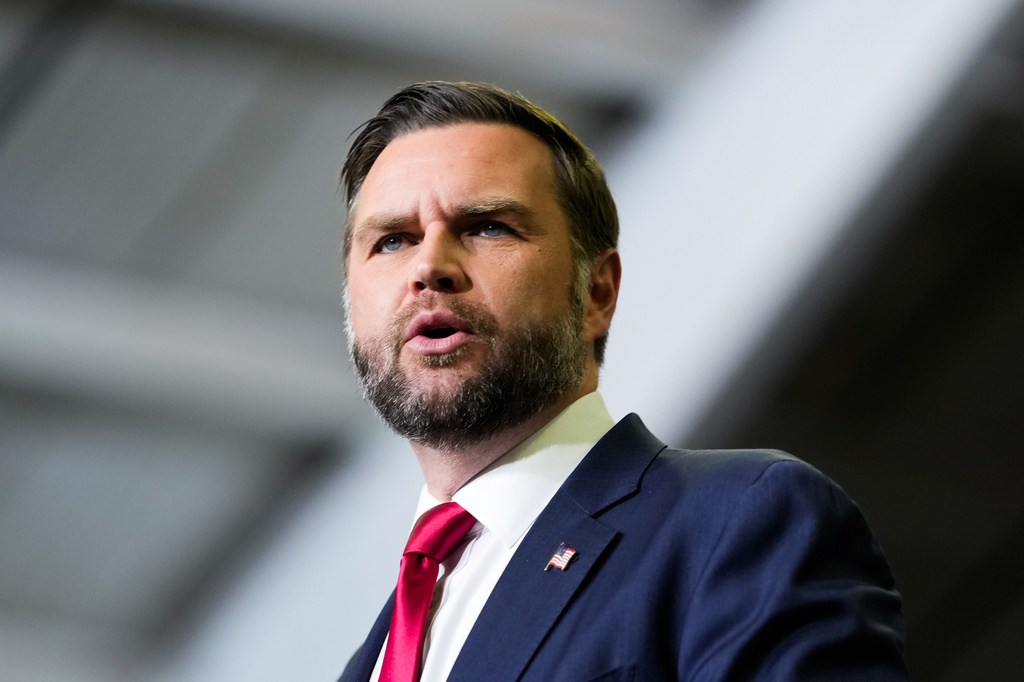
Vice President JD Vance has once again scapegoated the U.S.–Israel alliance and the war with Iran for Republican midterm setbacks, recycling the selective framing he first test-ran on Joe Rogan’s podcast. Under the rhetorical banner of an “Americans first” doctrine that regularly decries alleged Israeli influence operations, he now demotes Jerusalem to an electoral liability. What drove voters to the ballot box, however, was persistent consumer inflation and punitive fuel prices aggravated by the mismanaged drawdown of the Strategic Petroleum Reserve — not the durability of the bilateral alliance; but that’s not the reality Vance wants to address.
Scrutinized in full, Vance’s public record reveals a glaring and indefensible double standard. While he reflexively singles out Israel for condemnation, he maintains a telling silence on Qatar (whose Prime Minister ignored Vance as if he were a nobody) — the long-standing financial and logistical sanctuary for the Hamas leadership. This blind spot is entirely predictable given Vance’s fierce personal friendship and political alliance with Tucker Carlson, whose media maneuvers share the exact same pattern. Documented reports reveal that the Qatari Embassy in Washington poured $180,000 monthly into public relations firms like Lumen8 Advisors to broker elite media access, notably orchestrating Carlson’s softball sit-down with Doha’s prime minister. Network denials of direct compensation cannot erase this institutional manipulation — nor can they obscure how Vance’s loyalty to Carlson effectively shields the whitewashing of a terrorism sponsor. By refusing to denounce Doha’s role in sustaining Hamas or Tehran’s systemic campaign of proxy terrorism, Vance betrays the selective, coordinated nature of his circle’s “isolationism.” Perversely, this ideological blind spot leads him to legitimize Iran’s ballistic missile and nuclear programs, even as Tehran crowds burn his image in effigy and the regime openly champions outcomes calibrated to “Make America Hungry Again.”
Beyond this domestic scapegoating, the administration’s core strategic failure is leaving the military campaign against Tehran unfinished. Supplying roughly 70% to 73% of Iran’s natural gas while providing vital feedstock for domestic power and petrochemical production, the South Pars complex would have collapsed national electricity generation and industrial output had its processing platforms faced sustained strikes. Concurrently, severing Kharg Island — which historically handles approximately 90% of Iranian crude exports, mainly to China — alongside the storage terminals on Qeshm Island would have stripped the regime of its primary hard-currency artery. Had Israeli precision air strikes then bottled surviving IRGC command elements inside a tight Tehran perimeter while Washington extended targeted assistance to restive ethnic minority regions, the Iranian populace would have surged into the streets the instant the regime’s economic floor disintegrated.
Financially, the ongoing maritime blockade already deprives Tehran of an estimated $400 million to $500 million daily from halted oil loadings, pushing the open-market rial past 2.6 million per dollar and driving annual inflation near 90%. Layering targeted infrastructure destruction atop this existing financial chokehold would have triggered an internal fracture without demanding an expansive ground occupation. With Israeli and U.S. special operations forces securing Kharg and Qeshm while concentrated airpower sealed the Tehran pocket, this convergence of energy collapse, currency implosion, and structural decapitation would have delivered modern history’s first regime change executed primarily from the air.
Neutralizing Tehran’s continuity assets would have finalized that collapse. Parliamentary Speaker Mohammad Bagher Ghalibaf — who established himself as a wartime hub linking IRGC networks, municipal patronage, and legislative power — embodies the connective tissue that enables the clerical system to absorb elite losses. Severing Rawa Majid’s European crime-terror syndicate, which channels clandestine capital and dual-use hardware through Spain and continental hubs, would have eliminated an indispensable foreign logistics and revenue pipeline. Eliminating surviving IRGC Aerospace and Quds Force supply commanders alongside those figures would have foreclosed any rapid reconstitution of command authority.
To those who doubt, history proves this operational model’s viability. During Operation Countenance in August 1941, Anglo-Soviet forces neutralized Iran by capturing the Abadan oil works and critical railway junctions with minimal ground forces; within three weeks, Reza Shah abdicated, the Trans-Iranian rail corridor fell under Allied control, and the regime’s independent capacity evaporated. Strategic mastery over energy arteries, rather than widespread troop deployments, dictated the political outcome. That probed lesson applies today to South Pars, Kharg, and Qeshm, the modern Abadan.
Thus, Vance’s latest polemic functions merely as a political alibi. By displacing electoral defeat onto the partnership with the Jewish state, he dodges accountability for the decision to pull punches just as the Islamic Republic faced systemic collapse. Strip away the populist varnish, and Vance’s foreign-policy instincts track closely with Barack Obama’s doctrine of selective disengagement. He operates, in effect, as a “White Obama” with holy water on his hands — taking the former president’s Frankenstein project of American retrenchment, appending a layer of pre-Second Vatican Council narrative, and rebranding the result as nationalist conservatism. In this rebranding, extreme-right isolationism and extreme-left internationalism seamlessly converge in their mutual rejection of American primacy; one side simply invokes God while the other remains atheist, agnostic, or whatever they are these days.
The same opportunism governs his public persona. The man born James Donald Bowman, then James David Hamel, then James David Vance has long treated identity as a revisable document. This habit extends to his marriage: the vice president has publicly expressed hope that his Hindu wife, Usha, will convert to Christianity because he “believe
YES, JD VANCE: LOSING THE MIDTERMS WAS ‘WORTH IT’ TO PREVENT A NUCLEAR IRAN
The midterm statement fits the pattern exactly. Having once referred to Trump as “cultural heroin” and “America’s Hitler” before pivoting to full-throated support, Vance has executed a second about-face. With MAGA’s inheritance within reach and the Iran campaign incomplete, he has chosen to blame the war — and the U.S.–Israel relationship, of course — for Republican losses. The maneuver distances him from the potential decision to strike again, discourages further action, and insulates his 2028 prospects should the outcome fall short of a decisive victory.
Indeed, Jerusalem, already confronting the eventual sunset of roughly $4 billion in annual U.S. security assistance, must accelerate domestic manufacturing across munitions, sensors, and aerospace platforms. Unapologetic self-reliance, not grievance, remains Israel’s only durable defense when Washington treats a bedrock alliance as an expendable variable. Midterm voters delivered an indictment of lingering inflation and irresolute execution; they did not deliver a mandate against the U.S.–Israel alliance (even if James David Vance says the opposite).
Jose Lev Alvarez is an American–Israeli scholar specializing in international security policy. A multilingual veteran of the IDF special forces and the U.S. Army, he holds three master’s degrees and is completing a Ph.D. in Intelligence and Global Security in the Washington, D.C., area.
Continue reading...
[ H/T Washington Examiner ]