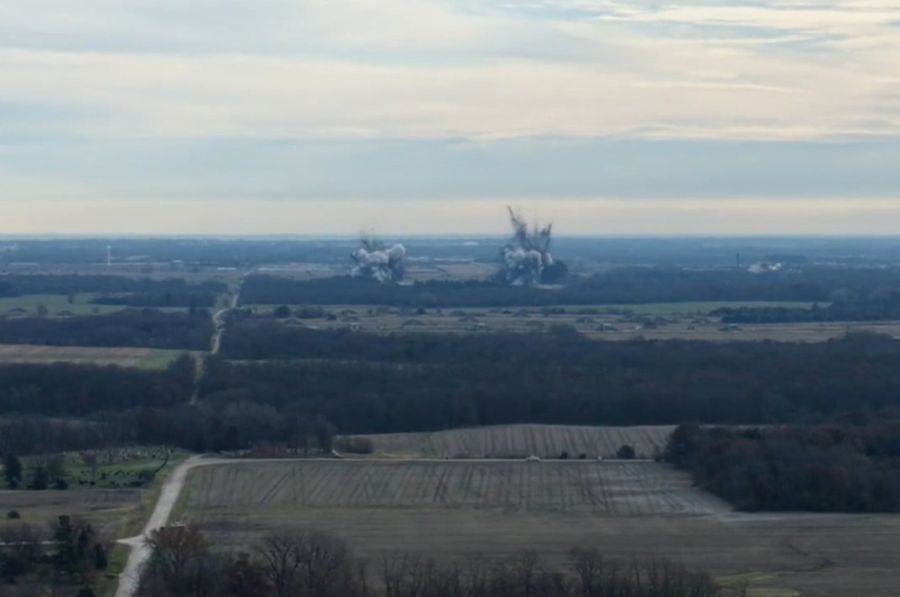

Federal and state officials stated that the controlled detonation of degraded lead azide at the Iowa Army Ammunition Plant in Middletown, Iowa, on Wednesday was successful.
The U.S. Army conducted the operation around 9 a.m. Central Time, detonating approximately 9,500 pounds of the material contained in 68 barrels. Lead azide is a primary explosive used in munitions initiators, though the destroyed stock dates back to the Obama Administration after the army shifted away from the material.
The blast produced a visible plume of smoke that rose several hundred feet and dissipated relatively quickly, with wind conditions directing movement southwest. Initial assessments indicated the event was contained, with no elevated lead readings reported on monitoring equipment in the immediate aftermath.
“I’ve received, you know, initial feedback that is very positive… they believe that the mitigation exceeded expectations, so they are very happy,” Environmental Protection Agency (EPA) Administrator Lee Zeldin told reporters. He added that the Department of Defense described the outcome as “a huge success,” and noted a follow-up message stating “nothing above 0.0 on EPA sensor array yet.”
Acting Army Secretary Adam Telle stated on X that the detonation was a “HUGE success” and that “the threat of an uncontrolled spontaneous detonation has been eliminated.” He further reported that monitoring of EPA lead particle tracking showed “no readings so far above 0.0.”
The material comprised the nation’s remaining bulk stockpile of lead azide. It had been stored at the Iowa Army Ammunition Plant for more than 20 years, with the country’s entire stockpile consolidated there around 2009.
BREAKING: EPA Chief Lee Zeldin announces the Army-controlled lead azide detonation in Iowa EXCEEDED containment expectations
Amazing news
"I've received initial feedback that is VERY positive from DOW. They believe that the mitigation EXCEEDED expectations."… pic.twitter.com/d4VmkTSZl0
— Eric Daugherty (@EricLDaugh) November 25, 2026
The barrels sat in earth-covered, concrete-lined magazines submerged in an ethanol-and-water bath intended to maintain stability. Concerns about the aging stockpile had been noted in earlier assessments, including a 2004 reference to deteriorating material at the site.
A routine inspection in March 2026 found that the stabilizing liquid had evaporated, allowing the lead azide to recrystallize. This increased its sensitivity to friction, shock, and cold temperatures, raising the risk of spontaneous detonation. Alternatives such as chemical neutralization or transport were evaluated but determined to carry higher risks given the material’s condition.
Ahead of Wednesday’s demolition, the Trump Administration activated a multi-agency response to facilitate mitigation and any necessary rapid response measures required.
Mitigation measures included surrounding the storage magazines with approximately 300 two-story sand barriers and 19,000 cubic yards of lime-fill foundation, saturating soil with water, deploying water misters and gel or foam barriers to suppress dust, and timing the detonation for favorable wind conditions that directed any plume away from denser population centers. The EPA positioned hundreds of personnel and collected more than 1,200 pre-event samples of soil, dust, water, and air, with continued monitoring planned during and after the operation.
Officials indicated that post-event sampling and analysis would continue to assess any longer-term effects on air, soil, water, agriculture, and public health.
The Trending Politics News app is your home for breaking updates. Download it FREE today!
Continue reading...
[ H/T Trending Politics ]