





National Institutes of Health Director Dr. Jay Bhattacharya said the agency would increase direct research funding and make new investments in early-career scientists to revitalize trust in public health and scientific expertise.
Bhattacharya, addressing academics and public health scholars in Washington on Wednesday, said the agency will fund 1,300 early-career scientists across the United States this year and hire roughly 100 new scientists to work directly at the NIH on various projects.
“We have this unified funding strategy whose underlying ethos is democracy, to democratize science, to allow early scientists to have a chance that they didn’t otherwise have,” Bhattacharya said.
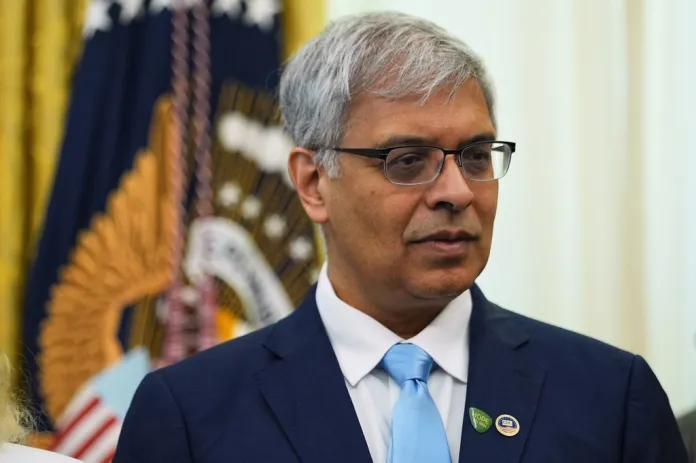
NIH Director Dr. Jay Bhattacharya at the RealClear Foundation’s Future of Public Health conference 9/9/2026, Gabrielle M. Etzel.
" data-large-file="https://www.washingtonexaminer.com/wp-content/uploads/2026/09/6632.jpg?w=696" height="1024" width="771" src="https://www.washingtonexaminer.com/wp-content/uploads/2026/09/6632.jpg?w=696" alt="National Institutes of Health Director Dr. Jay Bhattacharya at the RealClearFoundation's Future of Public Health conference." class="wp-image-4718833" style="aspect-ratio:0.7532425805360615;width:424px;height:auto" srcset="https://www.washingtonexaminer.com/wp-content/uploads/2026/09/6632.jpg 3072w, https://www.washingtonexaminer.com/wp-content/uploads/2026/09/6632.jpg?resize=226,300 226w, https://www.washingtonexaminer.com/wp-content/uploads/2026/09/6632.jpg?resize=768,1020 768w, https://www.washingtonexaminer.com/wp-content/uploads/2026/09/6632.jpg?resize=771,1024 771w, https://www.washingtonexaminer.com/wp-content/uploads/2026/09/6632.jpg?resize=1157,1536 1157w, https://www.washingtonexaminer.com/wp-content/uploads/2026/09/6632.jpg?resize=1542,2048 1542w, https://www.washingtonexaminer.com/wp-content/uploads/2026/09/6632.jpg?resize=150,199 150w, https://www.washingtonexaminer.com/wp-content/uploads/2026/09/6632.jpg?resize=300,398 300w, https://www.washingtonexaminer.com/wp-content/uploads/2026/09/6632.jpg?resize=696,924 696w, https://www.washingtonexaminer.com/wp-content/uploads/2026/09/6632.jpg?resize=1068,1418 1068w, https://www.washingtonexaminer.com/wp-content/uploads/2026/09/6632.jpg?resize=1920,2550 1920w" sizes="auto, (max-width: 771px) 100vw, 771px">
National Institutes of Health Director Dr. Jay Bhattacharya at the RealClearFoundation’s Future of Public Health conference on Sept. 9, 2026, in Washington. (Gabrielle M. Etzel/Washington Examiner)
President Donald Trump’s pick to lead the NIH has said restoring trust in the premier research agency in the aftermath of the COVID-19 pandemic is one of his top priorities.
For Bhattacharya, that includes investing federal research dollars in institutions that do not usually get funding, as well as addressing the so-called replication crisis, which involves scientists not being able to repeat experiments and achieve the same results.
Bhattacharya described the replication crisis as a culture problem within the scientific community, in which younger researchers are discouraged from questioning the orthodoxy set by senior scientists.
The NIH director stressed that a younger scientist asking for information necessary to replicate the studies of a more experienced researcher ought to be taken as a compliment instead of an attack.
“Let’s encourage replications so that the culture of science changes in a healthier way,” Bhattacharya said. “I think that’s the challenge that we as scientists now face.”
Bhattacharya outlined his vision for the future of science at the Future of Public Health conference hosted by journalism nonprofit organization RealClearFoundation, which announced the launch of a new scientific publication, the Journal of the Academy of Public Health.
The Journal of the Academy of Public Health is an open-access journal, meaning the research it publishes is not behind a paywall.
Bhattacharya also said the NIH would set up its own open-access journal focused solely on replication and asked academics in the room to apply for NIH grants if they were interested in conducting such research.
Taxpayer-funded research through NIH grants ought to be very easily accessible to the public, Bhattacharya said, adding that paywalls are the best way to “undermine trust in science and public health.”
“Scientific journals are there to foster discussion and access to scientific ideas, and yet you have these gatekeepers,” Bhattacharya said.
Bhattacharya said the debate over truth in science, including discrepancies in replicating science, should be held in public view. He also said scientists should “invite people in” despite the messiness of the process in fine-tuning scientific answers.
“Expertise still matters. Peer review still matters. Scientific rigor still matters,” Bhattacharya said. “I don’t mean in any of the things I’m saying to get away from any of that, but I’m saying we should do that in the open.”
FACT CHECK: TRUMP CLAIMS NO AUTISM CASES AMONG UNVACCINATED AMISH CHILDREN
Bhattacharya said restoring trust in public health expertise through transparency is necessary heading into the next public health emergency.
“I think the coming decades will present public health challenges we can’t possibly fully anticipate,” Bhattacharya said. “It’s vitally important to get this right, coming out of the pandemic.”
Continue reading...
[ H/T Washington Examiner ]