
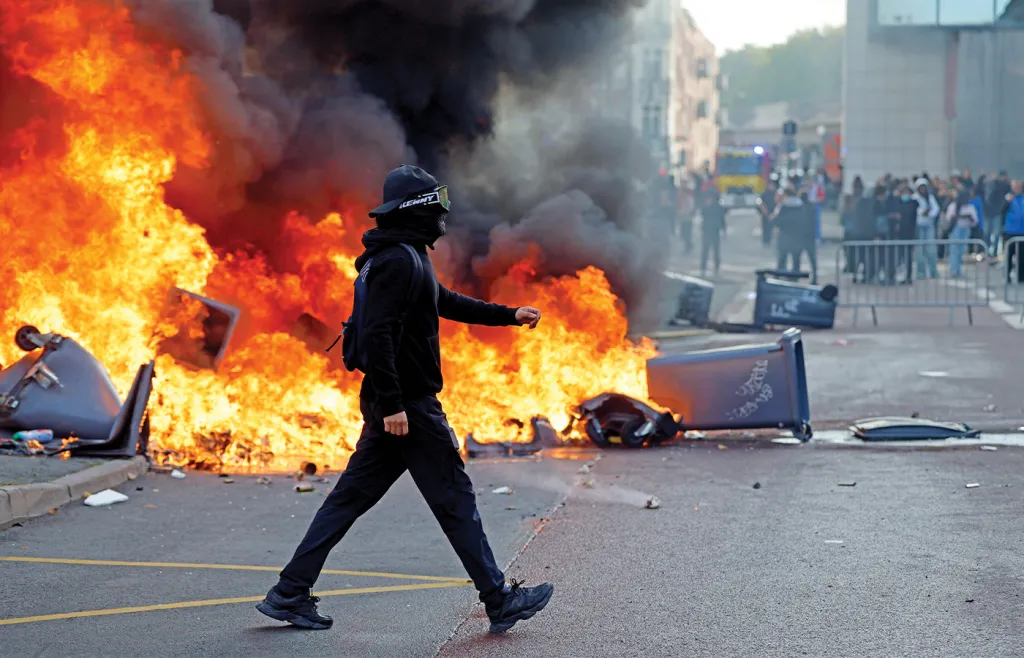




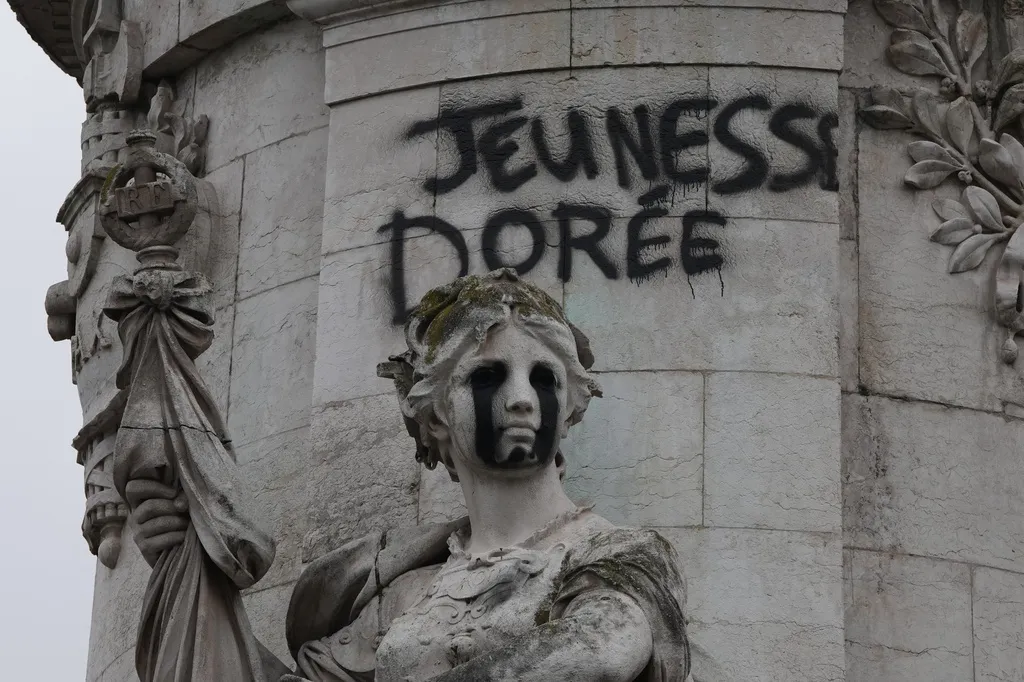
Police attempting to block and contain demonstrators amid clouds of tear gas in Paris over the past month have generated daily newspaper headlines and up-to-the-minute commentary on social media. Yet this is also old news. Paris without a wannabe anarchist torching a Peugeot parked on the boulevard near a Left Bank cafe would be like Paris without existentialism.
From the City of Lights at the center, protests fan out to other towns and provinces in France. In 1981, 1983, 1990, 1991, and 1993, riots between police and most frequently ethnic minorities featured a variety of revolutionary scenes in Bordeaux, Rennes, Nantes, Marseille, and Lyon. This begins when somebody, usually an Arab teenager, gets killed or seriously injured by police during some kind of one-on-one confrontation, setting in motion an angry response in the banlieues (French suburbs). These are disadvantaged neighborhoods with large immigrant populations, mainly from North Africa.
For example, a 1981 summer riot in Lyon at times had a circus atmosphere. Rather than the full-on San-culottes reign of terror circa 1793-94, the exuberant young firebrands entertained themselves with what they called “rodeo”— driving stolen cars around in tight circles before burning them. The summer riot widened into a larger social movement two years later, in 1983, when more than 100,000 people turned out in Paris for a series of demonstrations tagged “March for Equality and Against Racism.”
More recently, the centrist political tendency of President Emmanuel Macron, whose second five-year term will end next year, is beginning to unravel on both the Left and the Right. This was most evident during the “Yellow Vest” movement, which started shortly before the Christmas holidays in 2018 and fizzled out during the summer of 2020. It achieved some success by forcing the French government to cancel a proposed fuel tax. It attracted worldwide media attention with its made-for-the-screen visual of crowds decked out in yellow vests. French law requires all drivers to have the brightly colored vest packed away in one’s car or truck. They are to be worn outside the vehicle in case of an emergency. The symbolic emergency spectacle did ring a working-class solidarity bell. The Left always champions the proletariat, but just as in the United States, workers in Europe are finding politics on the conservative side more to their taste. Thus this yellow line ran right and left.
I grant the symbolic power of the yellow vest, but for smashing the Capitalist Totality I’m more impressed by the name of a protest movement in 2025 which kicked off on TikTok: “Block Everything.”
Way to go! Leave nothing untouched. Nothing is worth preserving. Weirdly, it came nowhere near living up to its name. Block Everything was far more reformist, objecting to a proposed cut in the national budget that included a freeze on pensions and a health care cost cut of 5 billion euros.
The Bloquons Tout did block roads and roundabouts leading to bus depots and caught some tear gas from the cops outside Paris’s Gare du Nord train station, but that’s about all.
All of the above eruptions pale in comparison to the uprising of university students in the spring of 1968. From the French Napoleonic conservative point of view, this was the greatest catastrophe since the German army smashed through the Maginot Line in 1940. Instead of defeat from without, it felt more like defeat from within. “Existentialist to excrementalist,” as one reactionary intellectual put it.
Yet it was not a defeat for the French establishment. Although the three-month-long spectacle looked like it might topple President Charles de Gaulle’s government, that was an illusion one of the shrewdest agitators saw through from the get-go. Daniel Cohn-Bendit, nicknamed “Danny the Red” for both his revolutionary enthusiasm and his magnificent red hair, was 100% behind the “uncontrollable effervescence” on display at the barricades. But he was not surprised when de Gaulle and the establishment in power regained and retained control of the situation.
“All the political parties thankfully took to the hustlings and restored politics to its exalted function in the rarefied atmosphere of ideologies, declarations of intent, programs, and promises,” he fumed. At that point toward the end of May 68, the “petty bourgeois, racist, nationalist, reactionary, Fascist” elements among the power elite “gradually shook off the dust and marched sprucely down the Champs-Élysées shouting support for the old general.”
Now 81, Cohn-Bendit has shaken off some dust himself since his Danny the Red days. He has discovered the Château Lafite Rothschild Pauillac served in the halls of power tastier than the fumes from Molotov cocktails hurled across the barricades. He is now a friend and informal advisor to Macron. During the Yellow Vest uprising, Cohn-Bendit said, “If the movement becomes more violent all that will happen is more capitalism, not less.” He added we need to stop and think when “we see Macron’s car being banged on and spat on, when we see written on the Arc de Triomphe ‘**** your old women, not us!'” In such an atmosphere, the protesters are moving toward “authoritarian danger,” he concluded.
The current wave of demonstrations kicked off last month with students at the front. This time around, high school students. Unlike the famous demand from university students in 1968 — “be realistic, ask for the impossible”— revolution does not seem to be on the menu for their younger counterparts. Rather than non-negotiable demands, the list of grievances from the high school students boils down to bargaining-table reforms. And a minimum ask: a decent education system.
Students voiced their concerns over what they say are overcrowded classes, long wait times, budget cuts to education, staff shortages, and dilapidated school buildings. Over the past 10 years, only 15% of all school buildings have been renovated or expanded, and most buildings are over 60 years old, according to the French Ministry of Education. One-third of all schools are classified as overcrowded. In public schools, 70% of classrooms have more than 30 students. Most telling, since 2000 there has been a marked decline in academic achievement in grade school and high school. (Hi there, USA.)
Over the past week, the protest has gone way beyond school cafeteria food. Bigger bread-and-butter issues have come to the fore: rising living costs combined with deteriorating public services. The high schoolers have been embraced by overflowing crowds from people of all walks of life, including some masked douchebags decked out in black hoodies smashing windows and metallic store shutters in Parisian shopping districts. On Saturday, Agence France-Presse noted the looting sprees cleared “the shelves of cigarettes, sunglasses, clothes, jewelry and food.” AFP journalists witnessed “looters emerging from a supermarket carrying bags stuffed with cakes, fruit juice and alcohol.”
For the most part, the looters faced no resistance from the authorities, although police did use tear gas and water cannons against demonstrators in the streets of the capital and other cities. The interior ministry said about half a million people joined the demonstrations nationwide, with about 1,200 arrested and 150 police officers and some protesters injured.
RO KHANNA THINKS TORCHING JEWISH BUSINESSES IS AN ‘INSPIRING’ YOUTH MOVEMENT
The cost of property damage in France to date has been 40 million euros, or about 46 million dollars. By comparison, the 2020 social justice extravaganza on behalf of George Floyd ran anywhere from $1 billion to $2 billion in property damage, depending on which source you Google. Also, 164 buildings were damaged or destroyed by fire, according to the AFT and FBI. Minneapolis and Saint Paul bore most of the burden.
Despite the determination and wildness of those in the streets, what Cohn-Bendit said during the Yellow Vest days might well hold true. More violence means more capitalism, not less.
Bob Armstrong’s memoir, NO EXIT FROM VIETNAM, has just been published by Pen & Sword Books. He is a contributing writer to Thursday Review, an online magazine.
Continue reading...
[ H/T Washington Examiner ]