


The Department of Justice charged three men, whom they say have ties to Iran’s Islamic Revolutionary Guard Corps, with planning roughly 18 terrorist attacks in Europe, including the thwarted plan to target a U.K. Air Force Base housing U.S. personnel and aircraft in September, and attempting to carry out similar attacks in the United States.
A new indictment from the DOJ on Tuesday showed the lengths the three men went to in order to orchestrate attacks across Europe, often focused on civilian targets, many of which had ties to the Jewish community, in response to the U.S. and Israel’s war against Iran.
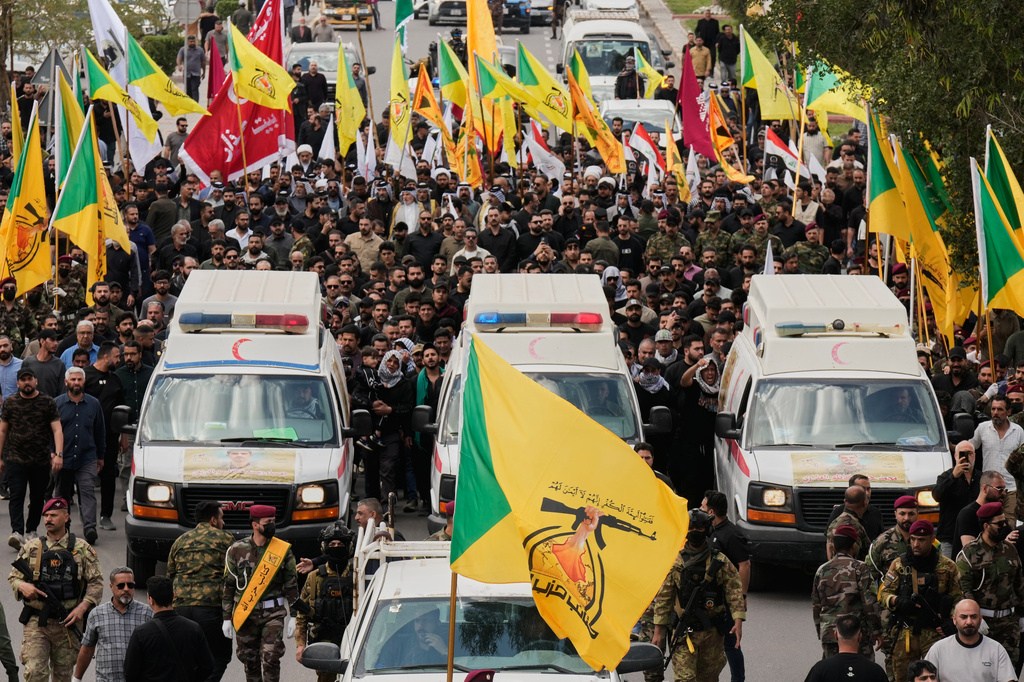
One of the men, Mohammad Baqer Saad Dawood al Saadi, a dual Iranian-Iraqi national, is a commander in Kata’ib Hezbollah, an influential Iranian-backed militia based in Iraq, and he had close ties with IRGC leaders, like Qassem Soleimani, whom the U.S. killed in a 2020 airstrike.
Al Saadi and two associates — Mohsen Mohajeri, who is an Iranian national and IRGC operative, and Mohammed Ali Al Hassani, an Iraqi national — coordinated and tracked approximately 18 attacks across Europe designed to instill fear in the local communities. They didn’t take credit for the attacks directly. Instead, they created a new terrorist organization called “Harakat Ashab al-Yamin al-Islamiya” (HAYI), which means “the Islamic Movement of the Companions of the Right,” to obfuscate responsibility.
“Put bluntly, [HAYI] is kind of a fake organization,” Crispin Smith, an attorney whose research focuses on operational issues related to irregular warfare, told the Washington Examiner. “It’s a media brand, and we’ve seen proxies; we’ve seen the IRGC do this for years. They’ll create a media front that they can sort of propagandize the deed without taking legal or military responsibility.”
Seven of the attacks occurred in the United Kingdom, and they ranged from arson attacks on Jewish community rescue services, synagogues, an attack on a Jewish charity organization, an attempted drone attack on the Israeli embassy, and a stabbing attack that left two Jewish men seriously injured.
On the day of the first of these European attacks, al Saadi sent an image with the HAYI logo at the top with a message in Arabic calling for “warriors of Islam” to engage in “jihad,” or a violent holy war.
The indictment also includes a photo of Mohajeri and al Hassani together in Iraq with a computer screen in front of them depicting a map of London. Mohajeri told al Hassani they “need to get focused on London,” and HAYI then claimed responsibility for six attacks that occurred around London about a week later.
In one of the attacks in London, al Hassani took a video call with an individual committing an arson attack. Days later, the trio was together, along with others, watching a FaceTime video of the perpetrator carrying out the attack on the Jewish charity organization. Al Saadi recorded the attack, while Mohajeri recorded al Hassani and al Saadi directing the attack.
HAYI has also claimed responsibility for other attacks in Belgium, the Netherlands, France, Germany, Macedonia, and Greece.
The attacks coincided with rising antisemitism across the West amid the war, and the extended fighting in the Middle East dating back to Hamas’s Oct. 7, 2023 attack in Israel that instigated a multi-pronged conflict that has continued since then.
Al Saadi, for his part, sought to arrange similar attacks on U.S. soil, specifically targeting three Jewish institutions, including a Manhattan-based synagogue. He exchanged messages with a U.S.-based individual about the plan, and they discussed using a third individual to carry out the attack, but unbeknownst to him, that third person was an undercover law enforcement officer. Al Saadi paid the undercover officer an initial installment of $3,000 in anticipation of the first attack.
Police officers open the cordon for Chief Rabbi Ephraim Mirvis after two people were stabbed in Golders Green neighborhood, that has a large Jewish community, in London, Wednesday, April 29, 2026.(AP Photo/Kin Cheung)
" data-image-caption="
Police officers open the cordon for Chief Rabbi Ephraim Mirvis after two people were stabbed in Golders Green neighborhood, that has a large Jewish community, in London, Wednesday, April 29, 2026.(AP Photo/Kin Cheung)
" data-large-file="https://www.washingtonexaminer.com/wp-content/uploads/2026/11/UK-stabbing.jpg?w=700" src="https://www.washingtonexaminer.com/wp-content/uploads/2026/11/UK-stabbing.jpg" alt="Police officers escort Chief Rabbi Ephraim Mirvis." class="wp-image-4803035" srcset="https://www.washingtonexaminer.com/wp-content/uploads/2026/11/UK-stabbing.jpg 700w, https://www.washingtonexaminer.com/wp-content/uploads/2026/11/UK-stabbing.jpg?resize=300,200 300w" sizes="(max-width: 700px) 100vw, 700px">
Police officers open the cordon for Chief Rabbi Ephraim Mirvis after two people were stabbed in Golders Green neighborhood, that has a large Jewish community, in London, Wednesday, April 29, 2026. (AP Photo)
In many cases, the three men were able to pay local criminals to carry out the attacks and were not in the country at the time of the attacks.
“Hostile nation states are using Telegram and other apps to hoodwink people, petty criminals, for example, into committing petty crime, and not necessarily explaining why,” Adam Hadley, the founder of Tech Against Terrorism, told the Washington Examiner. “As it stands, what HAYI did could be repeated. They’ve created the precedent, and we should be really concerned about how easy they managed this because actually it was quite an amateur operation.”
Hadley’s team at Tech Against Terrorism were able to use open-source intelligence to trace the attacks back to Kata’ib Hezbollah and the IRGC. One of the keys they realized is that Telegram accounts closely linked to both were often the first to publish details of such attacks.
“When we first started to see the attacks, our first assumption was that this was Iranian because of the timing of the Iran war,” Hadley said, but “it appeared that the attacks were claimed by this mysterious group that no one ever heard of. So, our team started looking for all of this content, trying to track it down, trying to find where it comes from because usually the distribution network is a very important indicator of where that content’s come from and lo and behold, what we found is that Iranian-supported Telegram groups appeared to be the ones that had the content first.”
Things took a turn when al Saadi was arrested abroad around May 1, and he was later transferred to U.S. custody. His arrest stopped the attacks that HAYI took credit for for months. Ultimately, he began passing along covert messages to his loved ones in Iraq, whom he was able to speak to over the phone, with the intent for them to relay the information back to al Hassani and Mohajeri.
He spoke with his mother and sister about Mohajeri by using the alias of his son, whom Mohajeri had already said al Saadi could transfer money to in furtherance of their plots. He said he owed money to Mohajeri and he urged his family to pay him.
Things changed in August when al Hassani began taking preparatory steps for an attack on the U.K.’s Royal Air Force Base Fairford, which hosted both U.S. personnel and aircraft. He paid someone to surveil the perimeter and surrounding area of the base, and about a week later, he tasked and paid several others to procure vans and barrels of fuel, while he also researched the purchasing of chemical accelerants and metal objects that could be used to cause shrapnel in the blast.
An Airforce sentry on duty around the perimeter of RAF Fairford as US Airforce crews work on B1 Lancer bombers parked on the apron at RAF Fairford, England, Tuesday, March 10, 2026. (AP Photo/Alastair Grant)
" data-large-file="https://www.washingtonexaminer.com/wp-content/uploads/2026/03/AP26069596556789.jpg?w=1024" src="https://www.washingtonexaminer.com/wp-content/uploads/2026/03/AP26069596556789.jpg?w=1024" alt="An Airforce sentry on duty." class="wp-image-4499331" srcset="https://www.washingtonexaminer.com/wp-content/uploads/2026/03/AP26069596556789.jpg 1024w, https://www.washingtonexaminer.com/wp-content/uploads/2026/03/AP26069596556789.jpg?resize=300,200 300w, https://www.washingtonexaminer.com/wp-content/uploads/2026/03/AP26069596556789.jpg?resize=768,512 768w" sizes="(max-width: 1024px) 100vw, 1024px">
U.S. Air Force crews work on B1 Lancer bombers parked on the apron at RAF Fairford, England, Tuesday, March 10, 2026. (AP Photo)
On Sept. 26, al Hassani tasked people to drive the three vans to the air base, but at least two of them were not able to proceed on their intended route to the base due to a security checkpoint. In the early hours of the next day, U.K. authorities arrested the occupants of the van. Al Hassani and Mohajeri were in Iran at the time.
Amid the news of the thwarted attack on the base, the U.S. military pulled its bombers off the base.
“As alleged, these defendants helped orchestrate a campaign of terror on behalf of terrorist organizations affiliated with Iran that targeted Jewish communities in Europe and the United States, and the British military base, RAF Fairford, housing American service members,” said U.S. Attorney Jamie McDonald. “Even after one of their co-conspirators was arrested and placed in federal custody, the defendants allegedly continued coordinating terrorist activity through coded communications and a network of associates overseas. The threat presented by Iran and Iran-backed terrorist groups to America and our allies is not hypothetical—it is very real. Our Office will not stop working to address and disrupt this threat, and to prosecute those responsible.”
U.K. Prime Minister Andy Burnham revealed last month in the House of Commons that the Fairford incident was “almost certainly” a scheme designed by Iran, while Sir Ken McCallum, director general of MI5, said days later, “2026 has also seen the Iranians, like the Russians, attempting to expand their hybrid campaign. Over the last twelve months, our Iran-linked operations have led to more than fifty arrests in the UK.”
Brian Carter, an expert with the American Enterprise Institute, said these plots come “in the context of a war where they found that the missile and drone attacks were not effective in the sense that the effects or attacks did not cause the United States and the Israelis to end the war, and so the Iranians were searching for another way to increase pressure on Israel and the United States.”
Kata’ib Hezbollah, the group al Saadi is a commander for, also directly attacked U.S. troops during the Iran War. A U.S. Central Command spokesperson told the Washington Examiner in March that Kata’ib Hezbollah had fired rockets and drones at U.S. troops in and near Iraq and that U.S. personnel “have taken action in response.”
Iran’s broader efforts to carry out smaller and destabilizing attacks in the west, not dissimilar to Russia’s covert attacks in Europe, could continue even as President Donald Trump may seek to end the conflict.
“If I was Iran, or if I was Russia, I would press my advantage and do more hybrid attacks to show that I can do this to soften my targets, to sow division. I wouldn’t let up,” Sharon Adarlo, a conflict analyst with Militant Wire, told the Washington Examiner. “And if I was America or Europe, I would really stop looking at these hybrid attacks as hybrid attacks, and I would actually start seeing them as, particularly Russia, basically acts of war.”
Threats to Trump and his Cabinet
Treasury Secretary Scott Bessent confirmed on Friday that he recently moved from his home to a military base on the advice of the Secret Service due to threats from the Iranians. Bessent also criticized the Wall Street Journal for publishing a photograph of his home in January 2025, alleging that the image contained geolocation information that could expose his whereabouts.
“I’m not going to be a coward because they have initiated death threats against me,” Bessent said, “F the Iranian leadership.”
He’s one of a handful of Cabinet officials who have moved into military housing, but not all of them have done so in response to Iranian threats specifically.
Iran’s efforts to target Trump and those close to him date back to his first term in the aftermath of the Soleimani strike. Many of the officials in the administration at the time of Soleimani strike continued having Secret Service protection into the start of Trump’s second administration about five years after the strike.
In July 2024, a Pakistani man with ties to Iran named Asif Raza Merchant was arrested and charged with trying to arrange a murder-for-hire plot.
DEMOCRATS SALIVATE OVER PENTAGON OVERSIGHT WITH NEW MAJORITIES
The Justice Department unsealed charges in August 2022 accusing Shahram Poursafi, an Iranian national and Islamic Revolutionary Guard Corps member, of attempting to arrange the murder of then-Trump national security adviser John Bolton. Poursafi was accused of agreeing to pay an informant $300,000 to kill him, and the Iranian noted he had an additional “job” for the individual, which he’d pay $1 million for the source to accomplish.
The FBI has Poursafi on its most wanted terrorist list, and there is a reward of up to $20 million for information leading to his arrest or conviction.
Continue reading...
[ H/T Washington Examiner ]